




404
+1-313-307-4176

Composite Adhesives Market Analysis | 2025-2032

Composite Adhesives Market Size, Share, Trends, Dynamics, Forecast, & Growth Analysis: 2025-2032
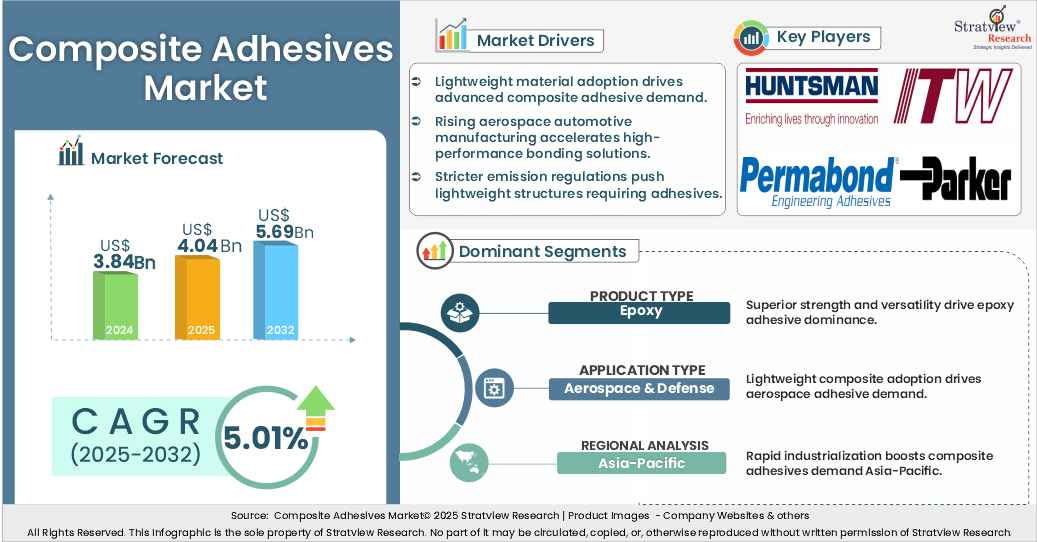
"Composite adhesives market size was USD 3.84 billion in 2024.”
Want to get a free sample? Register Here
Have a look at the sales opportunities presented by the composite adhesives market in terms of growth and market forecast.
|
Composite Adhesives Market Data & Statistics |
||
|
Market Statistics |
Value (in USD Billion) |
Market Growth (%) |
|
Annual Market Size in 2023 |
USD 3.64 billion |
- |
|
Annual Market Size in 2024 |
USD 3.84 billion |
YoY Growth in 2024: 5.50% |
|
Annual Market Size in 2025 |
USD 4.04 billion |
YoY Growth in 2025: 5.18% |
|
Annual Market Size in 2032 |
USD 5.69 billion |
CAGR 2025-2032: 5.01% |
|
Cumulative Sales Opportunity during 2025-2032 |
USD 38.63 billion |
|
|
Top 10 Countries’ Market Share in 2024 |
USD 3 billion + |
> 80% |
|
Top 10 Company’s Market Share in 2024 |
USD 1.90 billion to USD 2.70 billion |
50% - 70% |
What are composite adhesives?
Composite adhesives are high-performance bonding agents used to join composite materials, such as carbon fiber, fiberglass, or thermoplastics. These adhesives offer excellent strength, durability, and resistance to environmental factors. Commonly used in aerospace, automotive, and construction industries, they ensure structural integrity while reducing weight and enhancing design flexibility.
Rising Adoption of Lightweight Composites in Electric Vehicles and Aerospace
The increasing adoption of lightweight composite materials in electric vehicles and aerospace is driving composite adhesives market growth as manufacturers replace mechanical fasteners with structural bonding solutions that reduce weight while providing high strength, fatigue resistance, and corrosion protection. Adhesives also enable efficient joining of composite structures and dissimilar materials, supporting lightweight vehicle and aircraft designs.
According to the International Energy Agency (IEA), global electric car sales exceeded 17 million units in 2024, accounting for more than 20% of new car sales worldwide. The rapid electrification of transportation is increasing demand for lightweight composite components and advanced bonding technologies that help EV manufacturers reduce vehicle weight and improve energy efficiency.
Expansion of Wind Energy Installations Worldwide
The expansion of onshore and offshore wind energy is accelerating composite adhesives market demand as manufacturers increasingly use structural adhesives to assemble large composite wind turbine blades. Adhesive bonding provides high fatigue resistance, durability, and reliable performance under continuous mechanical loading and harsh environmental conditions.
According to the Global Wind Energy Council (GWEC), approximately 117 GW of new wind power capacity was installed globally in 2024. The continued expansion of wind installations is increasing production of large composite turbine blades, creating higher demand for structural adhesives used in blade manufacturing and assembly.
Difficult Recycling of Bonded Composite Structures
The difficulty of recycling bonded composite structures continues to challenge composite adhesives market growth because thermoset adhesive systems can permanently bond composite components and make material separation more complex. Removing adhesives without damaging the underlying composite can increase processing costs and limit material recovery, particularly in automotive, aerospace, and wind energy applications.
According to the European Environment Agency (EEA), the EU's material footprint reached approximately 14.1 tonnes per capita in 2023, highlighting the continued intensity of resource use and the need to improve material circularity. The growing focus on resource efficiency and material recovery is increasing pressure on composite manufacturers to develop more recyclable structures and adhesive systems that facilitate end-of-life processing
Stringent Environmental and VOC Regulations
Increasing environmental regulations governing volatile organic compounds (VOCs), hazardous chemicals, and worker exposure are challenging composite adhesives market expansion by requiring manufacturers to reduce emissions and adopt safer adhesive formulations. Compliance with evolving environmental standards can increase formulation, testing, and manufacturing costs while accelerating the transition toward low-emission adhesive technologies.
According to the U.S. Environmental Protection Agency (EPA), VOC emissions and hazardous air pollutants are regulated under the Clean Air Act, requiring industrial manufacturers to implement controls that limit harmful emissions. Increasing regulatory requirements are encouraging adhesive manufacturers to develop low-VOC and environmentally compliant formulations while maintaining the mechanical performance required for composite bonding.
Volatility in Raw Material Supply and Prices
Volatility in petrochemical feedstock prices continues to challenge the composite adhesives market as manufacturers depend on epoxy resins, polyurethane intermediates, specialty curing agents, and other chemical inputs. Supply disruptions and fluctuations in energy and feedstock prices can increase production costs, create procurement uncertainty, and pressure margins across the adhesive value chain.
According to the International Energy Agency (IEA), energy markets experienced significant volatility during 2024, influenced by geopolitical tensions and supply uncertainties. Changes in energy and petrochemical feedstock costs can increase the manufacturing expenses of resin-based adhesive systems, making cost management a persistent challenge for composite adhesive producers.
Development of Recyclable and Bio-Based Adhesive Technologies
The growing emphasis on circular manufacturing and lower environmental impact is creating opportunities in the composite adhesives market forecast for recyclable, debondable, low-VOC, and bio-based adhesive technologies. Manufacturers are developing new adhesive chemistries that maintain structural performance while enabling easier material separation and recovery, particularly for automotive, aerospace, and wind energy composite structures.
According to the European Commission, circular economy measures have the potential to reduce the European Union's greenhouse gas emissions by up to 39%. The growing focus on resource efficiency and emissions reduction is expected to accelerate investment in recyclable and bio-based bonding technologies, creating opportunities for next-generation composite adhesive formulations.
Rising Demand for Advanced Air Mobility and Next-Generation Aircraft
The development of electric aircraft, drones, and advanced air mobility (AAM) platforms is emerging as a significant composite adhesives market trend as these aircraft require lightweight structures that combine high strength, durability, and manufacturing efficiency. Adhesive bonding enables the integration of composite components while reducing the weight and complexity associated with conventional mechanical fastening.
According to the Federal Aviation Administration (FAA), the United States is working toward enabling advanced air mobility operations at scale by 2028, supported by ongoing development of powered-lift aircraft and associated regulatory frameworks. The emergence of new electric and hybrid-electric aircraft platforms is expected to create additional demand for structural composite adhesives used in lightweight airframe manufacturing.
|
Segmentations |
List of Sub-Segments |
Segments with High-Growth Opportunity |
|
Product Analysis |
Acrylic, Epoxy, Polyurethane, and Cyanoacrylate |
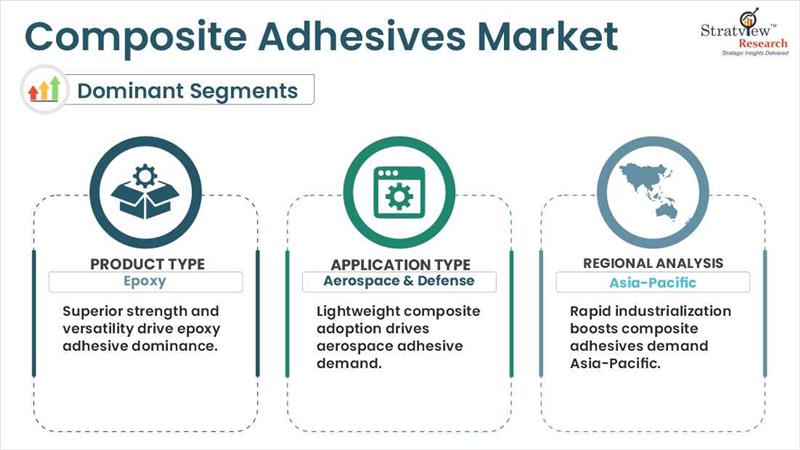
Epoxy segment accounted for the largest market share and is further expected to be the fastest-growing segment of the composite adhesives market during the forecast period. |
|
Application Analysis |
Automotive & Transportation, Aerospace & Defense, Electrical & Electronics, and Construction & Infrastructure |
Aerospace & Defense segment accounted for the largest market share and is further expected to be the fastest-growing segment of the composite adhesives market during the forecast period. |
|
Regional Analysis |
North America, Europe, Asia-Pacific, and The Rest of the World |
Asia-Pacific is expected to be the dominant and fastest-growing region over the forecasted period. |
“Epoxy segment accounted for the largest market share and is further expected to be the fastest-growing segment of the composite adhesives market during the forecast period.”
"The Aerospace & Defense segment accounted for the largest market share and is further expected to be the fastest-growing segment of the composite adhesives market during the forecast period.”
Want to get more details about the segmentations? Register Here
“Asia-Pacific is expected to be the dominant and the fastest-growing region over the forecasted period.”
Most of the major players compete in some of the factors, including price, service offerings, regional presence, etc. The following are the key players in the composite adhesives market:
Note: The above list does not necessarily include all the top players in the market.
Are you a leading player in this market? We would love to include your name. Please write to us at [email protected]
This report provides market intelligence most comprehensively. The report structure has been kept so that it offers maximum business value. It provides critical insights into market dynamics and will enable strategic decision-making for existing market players as well as those willing to enter the market.
The following are the key features of the report:
|
Market Study Period |
2019-2032 |
|
Base Year |
2024 |
|
Forecast Period |
2025-2032 |
|
Trend Period |
2019-2023 |
|
Number of Tables & Figures |
>100 |
|
Number of Segments Analysed |
3 (Product Type, Application Type, and Region) |
|
Number of Regions Analysed |
4 (North America, Europe, Asia-Pacific, Rest of the World) |
|
Countries Analysed |
15 (The USA, Canada, Mexico, Germany, France, Italy, The UK, China, Japan, India, Brazil, Saudi Arabia, Rest of Europe, Rest of APAC, and Rest of the World) |
|
Free Customization Offered |
10% |
|
After Sales Support |
Unlimited |
|
Report Presentation |
Complimentary |
|
Market Dataset |
Complimentary |
|
Further Deep Dive & Consulting Services |
10% Discount |
This report studies the market, covering a period of 15 years of trend and forecast. The report provides detailed insights into the market dynamics to enable informed business decision-making and growth strategy formulation based on the opportunities present in the market.
The composite adhesives market is segmented into the following categories.
By Product Type
By Application Type
By Region
With this detailed report, Stratview Research offers one of the following free customization options to our respected clients:
Company Profiling
Competitive Benchmarking
Custom Research: Stratview Research offers custom research services across industries. In case of any custom research requirement related to market assessment, competitive benchmarking, sourcing and procurement, target screening, and others, please send your inquiry to [email protected].
The report is delivered digitally through our online portal. Buyers receive login credentials from our team to access the report and may update their credentials at any time after the initial login.
Delivery timelines depend on the status of the report:
For the most accurate delivery timeline, please contact us to confirm the current status of the report.
Yes. You may request a complimentary preview of the report through a video conference with our team.
Yes. The scope of the report can be fully customized to align with your specific research objectives and information requirements.
Please contact us at [email protected], and our team will be happy to discuss your requirements and propose a tailored solution.
Yes. Selected sections of the report can be purchased separately based on your requirements. Please contact us at [email protected] to discuss your needs.
Yes, AI can help gather publicly available information, but its outputs are only as reliable as the data it accesses. Stratview Research reports are built using validated data, extensive primary interviews with industry stakeholders, and the expertise of our experienced research team.
Additionally, many critical insights, including market dynamics, competitive intelligence, and industry-specific trends, are not publicly available and therefore cannot be captured through AI alone.
The composite adhesives market refers to the industry focused on adhesives used to bond composite materials, such as carbon fiber and glass-reinforced plastics. These adhesives offer high strength, durability, and resistance to heat and chemicals, making them essential in aerospace, automotive, wind energy, and construction applications for lightweight and high-performance bonding solutions.
The forecasted value for the market is US$ 5.69 billion in 2032.
The composite adhesives market size was USD 3.84 billion in 2024 and is expected to grow from USD 4.04 billion in 2025 to USD 5.69 billion in 2032, witnessing an impressive market growth (CAGR) of 5.01% during the forecast period (2025-2032).
The key drivers of the market include the growing construction sector and rising infrastructure development and rising demand from the aerospace and automotive industries.
The top players in the composite adhesives market include: • Huntsman International LLC. • Illinois Tool Works Inc. • Permabond LLC • Parker Hannifin Corp • Sika AG
Asia-Pacific is expected to be the dominant and the fastest-growing region over the forecasted period, due to rapid industrialization, expanding automotive and aerospace sectors, and significant infrastructure development.


WE ACCEPT