




404
+1-313-307-4176

Carbon Fiber Market Analysis | 2025-2030

Carbon Fiber Market Size, Share, Trends, Dynamics, Forecast, & Growth Analysis: 2025-2030
Carbon Fiber Market is segmented by End-Use Industry Type (Aerospace [Commercial, Regional Jets, General Aviation, Helicopters, Defense, and Space], Industrial [Marine, Wind Energy, Transportation/Automotive, Civil/Construction, Electrical & Electronics, and Others], and Sporting Goods [Golf; Rackets; Skis, Snowboards, and Other winter Sports; Fishing Pole; and Others]), by Precursor Type (PAN-based Carbon Fiber and Pitch-based Carbon Fiber), by Tow Size Type (Small Tow (≤24k) and Large Tow (>24k)), by Modulus Type (Standard Modulus, Intermediate Modulus, and High Modulus), and by Region (North America [The USA, Canada, and Mexico], Europe [Germany, France, The UK, Russia, Italy, and Rest of Europe], Asia-Pacific [China, Japan, India, South Korea, and Rest of Asia-Pacific], and Rest of the World [Brazil, Argentina, and Others]).
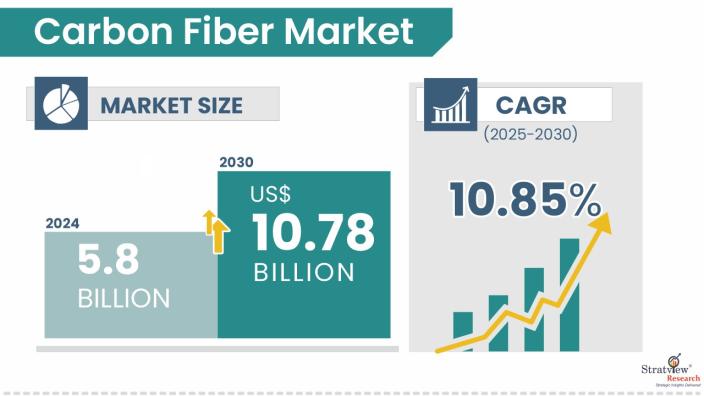
The carbon fiber market was estimated at USD 5.8 billion in 2024 and is likely to grow at a CAGR of 10.85% during 2025-2030 to reach USD 10.78 billion in 2030.
Want to know more about the market scope? Register Here
Carbon fibers are crystalline filaments of carbon atoms that are thin and strong. These fibers have a diameter of 5 to 10 micrometres and can be used as a strengthening material, particularly in resins and ceramics. Carbon fibers are mostly made of polyacrylonitrile (PAN), but they can also be made of rayon or petroleum pitch.
These fibers offer various advantages, such as high stiffness, excellent strength-to-weight ratio, outstanding tensile strength, exceptional chemical resistance, remarkable temperature tolerance, and low thermal expansion.
Rising Demand for Lightweight Materials in Electric Vehicles and Aerospace
The growing use of lightweight materials in electric vehicles and aerospace is driving carbon fiber market growth as manufacturers seek to reduce component weight, improve energy efficiency, and increase vehicle range. Carbon fiber composites offer high strength-to-weight ratios and are increasingly used in structural components where weight reduction directly improves transportation performance.
According to the U.S. Department of Energy (DOE), advanced carbon fiber composites can reduce component weight by 50–75% compared with conventional materials. This substantial lightweighting potential is encouraging automakers and aerospace manufacturers to integrate carbon fiber composites into next-generation vehicles and aircraft, supporting long-term carbon fiber demand.
Expanding Renewable Energy Installations, Particularly Wind Turbines
The expansion of renewable energy capacity is increasing carbon fiber market demand as wind turbine manufacturers use carbon fiber composites in increasingly large blades to provide high stiffness, fatigue resistance, and lower structural weight. Carbon fiber enables longer blades that can capture more wind energy while managing structural loads, supporting the development of larger and more efficient turbines.
According to the International Energy Agency (IEA), global renewable power capacity additions reached approximately 510 GW in 2023, nearly 50% higher than in 2022 and the fastest growth rate in more than two decades. Continued expansion of wind power capacity is increasing demand for lightweight, high-performance composite materials used in large turbine blades.
High Production Costs and Energy-Intensive Manufacturing
High production costs continue to constrain carbon fiber market growth because conventional carbon fiber manufacturing involves energy-intensive stabilization and carbonization processes and relies on relatively expensive precursor materials. These cost pressures make carbon fiber less competitive with aluminum and other conventional materials in high-volume applications, particularly automotive and industrial markets.
Recycling and End-of-Life Management Limitations
The complexity of recovering carbon fibers from polymer-based composite structures continues to challenge carbon fiber market expansion as conventional recycling processes can be costly and may reduce fiber performance. Increasing use of carbon fiber composites in automotive, aerospace, and wind energy applications is consequently creating greater pressure to develop economically viable end-of-life recovery systems.
Development of Recycled Carbon Fiber and Circular Manufacturing
The growing emphasis on resource efficiency and circular manufacturing is creating opportunities in the carbon fiber market forecast for recycled carbon fiber technologies that can reduce material waste, energy consumption, and production costs. Improvements in pyrolysis, solvolysis, and other recovery processes could expand the use of recycled carbon fiber across automotive, sporting goods, industrial, and other applications where performance requirements are less stringent than aerospace.
According to the European Commission, the EU’s circular material use rate reached 11.8% in 2023, meaning that nearly 12% of materials used in the EU came from recycled sources. The increasing use of secondary raw materials and policies supporting circular production are creating opportunities for recycled carbon fiber by encouraging manufacturers to develop technologies that recover and reintegrate fibers into new composite applications.
Emerging Low-Cost Carbon Fiber Production Technologies
The development of lower-cost carbon fiber manufacturing technologies is creating a significant carbon fiber market trend by targeting the industry's primary cost barrier. Research into alternative precursors, automated production, energy-efficient processing, and scalable manufacturing could make carbon fiber economically viable for higher-volume applications such as automotive, infrastructure, hydrogen storage, and industrial equipment.
According to the U.S. Department of Energy (DOE), Oak Ridge National Laboratory's Carbon Fiber Technology Facility (CFTF) has a production capacity of approximately 25 tons of carbon fiber per year and is designed to accelerate the scale-up of lower-cost carbon fiber manufacturing technologies. The facility's focus on alternative precursor materials and scalable processing is supporting efforts to reduce production costs and expand carbon fiber adoption into higher-volume applications such as automotive, infrastructure, and industrial equipment.
Want to have a closer look at this market report? Click Here
|
Segmentations |
List of Sub-Segments |
Dominant and Fastest-Growing Segments |
|
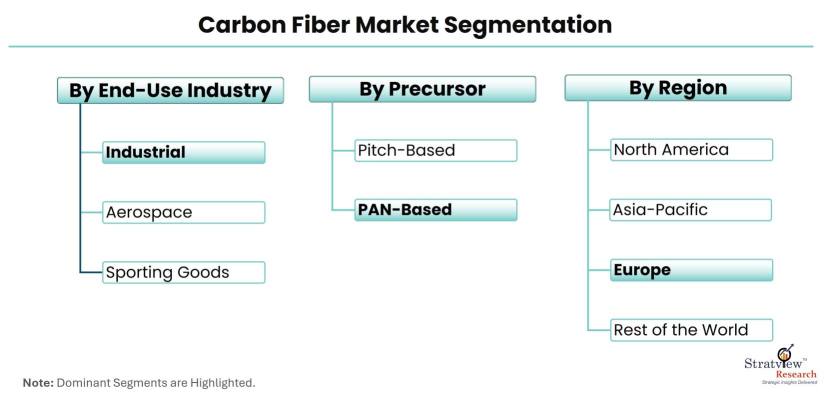
End-Use Industry-Type Analysis |
Aerospace, Industrial, and Sporting Goods |
The industrial end-use industry segment is estimated to hold the major share of the market during the forecast period. |
|
Precursor Type Analysis |
PAN-based Carbon Fiber and Pitch-based Carbon Fiber |
PAN-based carbon fiber is likely to be the largest segment of the market during the forecast period. |
|
Regional Analysis |
North America, Europe, Asia-Pacific, and Rest of the World |
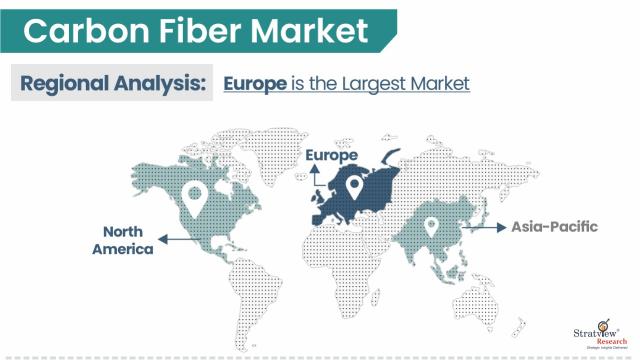
Europe is estimated to be the largest growing region in the market during the forecast period. |
“The industrial end-use industry segment is estimated to hold the major share of the market during the forecast period.”
The market is segmented as aerospace, industrial, and sporting goods. The industrial end-use industry segment is estimated to hold the major share of the market during the forecast period.
The growing demand for high-performance lightweight materials in the automotive industry, as well as the increasing demand for carbon composites in wind turbines, can be attributed to the segment's growth. In addition, sporting goods are expected to witness significant growth in the market in the coming years.
“PAN-based carbon fiber is likely to be the largest as well as the fastest-growing segment of the market during the forecast period”.
The market is segmented as PAN-based carbon fiber and pitch-based carbon fiber. PAN-based carbon fiber is likely to be the largest as well as the fastest-growing segment of the market during the forecast period. It has a wide range of applications in transportation, wind energy, and aerospace/defense, which is expected to fuel the segment’s growth in the coming years.
“Europe is estimated to be the largest as well as the fastest-growing region in the market during the forecast period.”
The market is broken down geographically into areas like North America, Europe, Asia-Pacific, and the Rest of the World (RoW). During the period from 2025 to 2030, Europe is anticipated to emerge as both the largest and the most rapidly expanding region in the market. Growing product demand from the aerospace, automotive, and wind energy industries is likely to drive regional market growth over the forecast period.
Know the high-growth countries in this report. Register Here
The following are the key players in the carbon fiber market (arranged alphabetically):
Note: The above list does not necessarily include all the top players in the market.
Are you the leading player in this market? We would love to include your name. Write to us at [email protected]
Recent mergers & acquisitions and other developments in the carbon fiber market reflect evolving market trends, and impact the market. Below given are a few recent developments in the market –
In January 2026, Envision Outdoor Living expanded its Cool Tread Technology into the Ridge Premium capped-composite decking collection, introducing three new colors. Envision reported surfaces up to 25% cooler, with up to 33% better traction and 61% lower moisture absorption than average leading competitors, extending heat-management technology into a more accessible composite-decking price tier.
In January 2026, Trex launched Refuge ignition-resistant decking, introducing a PVC-based product designed for fire-prone and Wildland-Urban Interface markets. Third-party testing demonstrated compliance with ASTM E84 Class A flame-spread requirements and ASTM E2768 ignition-resistance standards, highlighting fire performance as an increasingly important feature in alternative decking.
In August 2025, Trex expanded its partnership with International Wood Products, with IWP agreeing to exclusively stock Trex decking and railing across all six of its Western U.S. distribution centers, including its new Salt Lake City facility. The expansion strengthened Trex's distribution coverage across Utah and the wider Intermountain West.
In July 2025, PrimeSource Brands acquired Fortress Railing from Fortress Building Products, strengthening its position in the North American decking and outdoor-living channel. The transaction, which closed on July 1, included Fortress Railing's product portfolio, manufacturing expertise, and intellectual property. Financial terms were not disclosed.
In March 2025, UFP Industries announced a US$77 million investment in a new Deckorators manufacturing facility in Lackawanna, New York, following its acquisition of a 30-acre site. The approximately 240,000-square-foot facility was designed to initially double Surestone composite-decking production capacity and forms part of UFP's broader US$250 million five-year Deckorators expansion plan.
In February 2025, Deckorators entered a distribution partnership with Wausau Supply Company, expanding availability of its decking and railing portfolio across Washington, Idaho, Colorado, Utah, Ohio, Michigan, and Indiana. The agreement broadens access to Deckorators' Surestone-based Voyage decking and complementary railing systems through Wausau's established two-step distribution network.
This report provides market intelligence in the most comprehensive way. The report structure has been kept such that it offers maximum business value. It provides critical insights into market dynamics and will enable strategic decision-making for existing market players as well as those willing to enter the market. The following are the key features of the report:
This report studies the market, covering a period of 12 years of trend and forecast. The report provides detailed insights into the market dynamics to enable informed business decision-making and growth strategy formulation based on the opportunities present in the market.
The carbon fiber market is segmented into the following categories:
By End-Use Industry Type
By Precursor Type
By Tow Size Type
By Modulus Type
By Region
Click Here, to learn the market segmentation details.
This strategic assessment report, from Stratview Research, provides a comprehensive analysis that reflects today’s carbon fiber market realities and future market possibilities for the forecast period of 2025 to 2030. After a continuous interest in our carbon fiber market report from the industry stakeholders, we have tried to further accentuate our research scope to the carbon fiber market to provide the most crystal-clear picture of the market. The report segments and analyses the market in the most detailed manner to provide a panoramic view of the market. The vital data/information provided in the report can play a crucial role for the market participants as well as investors in the identification of the low-hanging fruits available in the market as well as to formulate the growth strategies to expedite their growth process.
This report offers high-quality insights and is the outcome of a detailed research methodology comprising extensive secondary research, rigorous primary interviews with industry stakeholders, and validation and triangulation with Stratview Research’s internal database and statistical tools. More than 1000 authenticated secondary sources, such as company annual reports, fact books, press releases, journals, investor presentations, white papers, patents, and articles, have been leveraged to gather the data. We conducted more than 15 detailed primary interviews with the market players across the value chain in all four regions and industry experts to obtain both qualitative and quantitative insights.
With this detailed report, Stratview Research offers one of the following free customization options to our respectable clients:
Company Profiling
Competitive Benchmarking
Custom Research:
Stratview Research offers custom research services across sectors. In case of any custom research requirement related to market assessment, competitive benchmarking, sourcing and procurement, target screening, and others, please send your inquiry to [email protected].
The report is delivered digitally through our online portal. Buyers receive login credentials from our team to access the report and may update their credentials at any time after the initial login.
Delivery timelines depend on the status of the report:
For the most accurate delivery timeline, please contact us to confirm the current status of the report.
Yes. You may request a complimentary preview of the report through a video conference with our team.
Yes. The scope of the report can be fully customized to align with your specific research objectives and information requirements.
Please contact us at [email protected], and our team will be happy to discuss your requirements and propose a tailored solution.
Yes. Selected sections of the report can be purchased separately based on your requirements. Please contact us at [email protected] to discuss your needs.
Yes, AI can help gather publicly available information, but its outputs are only as reliable as the data it accesses. Stratview Research reports are built using validated data, extensive primary interviews with industry stakeholders, and the expertise of our experienced research team.
Additionally, many critical insights, including market dynamics, competitive intelligence, and industry-specific trends, are not publicly available and therefore cannot be captured through AI alone.
Carbon fibers are crystalline filaments of carbon atoms that are thin and strong. These fibers have a diameter of 5 to 10 micrometers and can be used as a strengthening material, particularly in resins and ceramics. Carbon fibers are mostly made of polyacrylonitrile (PAN), but they can also be made of rayon or petroleum pitch.
The carbon fiber market was estimated at USD 5.8 billion in 2024.
The forecasted value of the carbon fiber market is expected to be USD 10.78 billion in 2030.
The carbon fiber market is likely to grow at a CAGR of 10.85% during 2025-2030.
Toray Industries Inc., Hexcel Corporation, Mitsubishi Rayon Corporation Limited, Cytec Solvay Group, SGL Carbon Group, Teijin Limited, Formosa Plastics Corporation, DowAksa, Hyosung Corporation, and Nippon Graphite Fiber Corporation are some of the key players in the market.
Europe is estimated to remain dominant and the fastest-growing region in the market in the foreseeable future. Growing product demand from the aerospace, automotive, and wind energy industries is expected to drive the regional market growth during the forecasted period.
Industrial is estimated to be the dominant segment of the market during the forecast period. The growth of the segment can be attributed to the rising demand for high-performance lightweight materials in the automotive industry and the increasing demand for carbon composites in wind turbines. In addition, sporting goods are expected to witness significant growth in the market in the coming years.
Key factors driving the growth of the market are demand from the aerospace & defense and automotive industries, renewable energy expansion, and electric vehicle adoption.


WE ACCEPT