



404
+1-313-307-4176

Battery Energy Storage System Market Analysis | 2026-2034

Battery Energy Storage System Market Size, Share, Trends, Dynamics, Forecast, & Growth Analysis: 2026-2034
"Battery energy storage system market size was USD 14.7 billion in 2025."
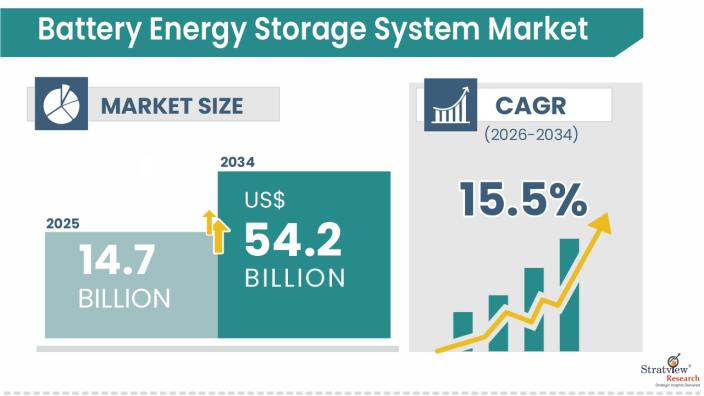
The annual demand for battery energy storage systems was USD 14.7 billion in 2025 and is expected to reach USD 17.1 billion in 2026, reflecting a year-over-year (YoY) growth of 16.4% compared with 2025.
During the forecast period (2026-2034), the battery energy storage system market is expected to grow at a CAGR of 15.5%. The annual demand will reach USD 54.2 billion in 2034.
During 2026-2034, the battery energy storage system industry is expected to generate a cumulative sales opportunity of USD 295.9 billion.
Want to get a free sample? Register Here
Market Statistics:
Have a look at the sales opportunities presented by the battery energy storage system market in terms of growth and market forecast.
|
Battery Energy Storage System Market Data & Statistics |
||
|
Market Statistics |
Value (in USD Billion) |
Market Growth (%) |
|
Annual Market Size in 2024 |
USD 12.6 billion |
- |
|
Annual Market Size in 2025 |
USD 14.7 billion |
YoY Growth in 2025: 16.6% |
|
Annual Market Size in 2026 |
USD 17.1 billion |
YoY Growth in 2026: 16.4% |
|
Annual Market Size in 2034 |
USD 54.2 billion |
CAGR 2026-2034: 15.5% |
|
Cumulative Sales Opportunity during 2026-2034 |
USD 295.9 billion |
- |
|
Top 10 Countries’ Market Share in 2025 |
USD 11.7 billion+ |
> 80% |
|
Top 10 Companies’ Market Share in 2025 |
USD 7.3 billion - USD 10.3 billion |
50% - 70% |
A Battery Energy Storage System (BESS) is an advanced technology that captures excess electricity, primarily from renewable sources like solar and wind, storing it in batteries (often lithium-ion) to discharge later, improving grid stability and reliability. These systems act as a buffer to balance supply and demand, with a lifespan generally ranging from 5 to 15 years.
Rapid Renewable Energy Deployment Increases Need for Grid Storage
The rapid expansion of solar and wind generation is accelerating battery energy storage systems market growth as utilities deploy BESS to balance variable renewable output, shift electricity to peak-demand periods, and improve grid flexibility. As renewable penetration increases, battery storage is becoming an essential resource for maintaining grid reliability.
According to the International Energy Agency (IEA), global battery storage deployment reached 108 GW in 2025, approximately 40% higher than in 2024. The record addition reflects increasing deployment of BESS to integrate renewable generation and strengthen electricity system flexibility.
Grid Modernization and Energy Security Investments Support BESS Deployment
Increasing investments in grid modernization and energy security are driving market demand for battery energy storage systems as utilities seek flexible resources for frequency regulation, peak-demand management, congestion relief, and backup power. BESS can respond rapidly to changes in electricity supply and demand, strengthening grid resilience while supporting the integration of new renewable and distributed energy resources.
According to the U.S. Energy Information Administration (EIA), the United States added 10.4 GW of utility-scale battery storage in 2024, bringing cumulative capacity to more than 26 GW. The expansion demonstrates growing reliance on BESS to provide grid flexibility and reliability services.
Declining Battery Costs Improve BESS Project Economics
Falling battery costs are improving the economic viability of battery energy storage systems, making storage projects more attractive for utilities, commercial facilities, and industrial users. Lower upfront costs improve project returns and support wider deployment for renewable integration, peak shaving, backup power, and ancillary grid services.
International Energy Agency (IEA) reported that the cost of lithium-ion battery packs declined by approximately 90% between 2010 and 2024. Continued cost reductions are improving the competitiveness of BESS and supporting broader adoption across electricity markets.
Critical Mineral Supply Risks Increase BESS Procurement Uncertainty
Battery energy storage systems rely on critical minerals such as lithium, graphite, nickel, and cobalt, exposing BESS manufacturers to supply concentration, price volatility, and geopolitical risks. Disruptions in mining or refining can increase battery costs and create procurement uncertainty, potentially affecting the economics and timelines of large-scale storage projects.
According to the IEA, China accounts for approximately 75% of lithium-ion battery cell production capacity and 80% of battery cell manufacturing capacity globally, highlighting the geographic concentration of the battery supply chain and the resulting risks for BESS manufacturers and project developers.
Grid Connection and Permitting Delays Restrict Project Deployment
Although BESS projects can be deployed faster than many conventional power infrastructure projects, lengthy interconnection approvals, transmission constraints, and permitting requirements can delay their commercial operation. Such delays increase development costs and prevent storage systems from being deployed quickly enough to address growing renewable integration and grid flexibility requirements.
More than 2,500 GW of renewable, storage, and large-load projects are currently waiting for grid connections worldwide. These interconnection constraints can delay BESS projects and limit the ability of storage systems to provide timely grid support.
Safety and End-of-Life Management Increase Lifecycle Complexity
The growing deployment of lithium-ion BESS is increasing concerns related to thermal runaway, fire safety, transportation, recycling, and end-of-life management. These requirements compel project developers to invest in monitoring, fire protection, safe handling, and recycling infrastructure, increasing the lifecycle complexity and cost of BESS installations.
According to the International Energy Agency (IEA), the energy sector deployed more than 2,000 GWh of battery storage capacity by 2024, significantly expanding the installed battery base that will eventually require safe retirement, recycling, and material recovery solutions.
Utility-Scale Storage Expansion Creates Significant Growth Opportunities
The increasing deployment of utility-scale BESS is creating substantial opportunities as power systems require flexible capacity to integrate renewable generation, manage peak demand, and provide grid-balancing services. Longer-duration storage systems can further expand the role of batteries by shifting renewable electricity across multiple hours and reducing curtailment.
According to the IEA, global energy storage capacity needs to increase sixfold to around 1,500 GW by 2030, with batteries expected to account for approximately 1,200 GW of this capacity. The forecast indicates significant long-term demand for utility-scale BESS.
Behind-the-Meter Storage Expands Distributed BESS Applications
The increasing adoption of rooftop solar, rising electricity costs, and growing demand for energy resilience are creating opportunities for behind-the-meter BESS across residential, commercial, and industrial applications. These systems enable users to store electricity during periods of low demand or solar generation and discharge it during peak periods, improving energy cost management and reducing dependence on the grid.
According to the IEA, behind-the-meter systems accounted for approximately 20% of global battery storage additions in 2025, demonstrating the growing contribution of distributed storage to overall BESS deployment.
According to the U.S. Energy Information Administration (EIA), U.S. utility-scale solar and wind generators curtailed approximately 17.5 TWh of electricity in 2024, highlighting the growing need for flexible storage capacity to capture excess renewable generation.
Data Center Expansion Creates New Demand for Battery Storage
The rapid expansion of AI, cloud computing, and hyperscale data centers is creating opportunities for BESS as operators require reliable backup power, power-quality management, and greater energy resilience. Battery systems can support critical loads during grid disruptions while also helping facilities manage peak electricity demand and integrate renewable power.
According to the IEA, global data center electricity consumption is projected to more than double to around 945 TWh by 2030. The rapid increase in data center power requirements is creating additional opportunities for battery-based backup and energy storage systems
|
Segmentations |
List of Sub-segments |
Dominant/Fastest Growing Segment |
|
Application Analysis |
Telecommunication, Data Center, Medical, Industrial, Marine, Others |
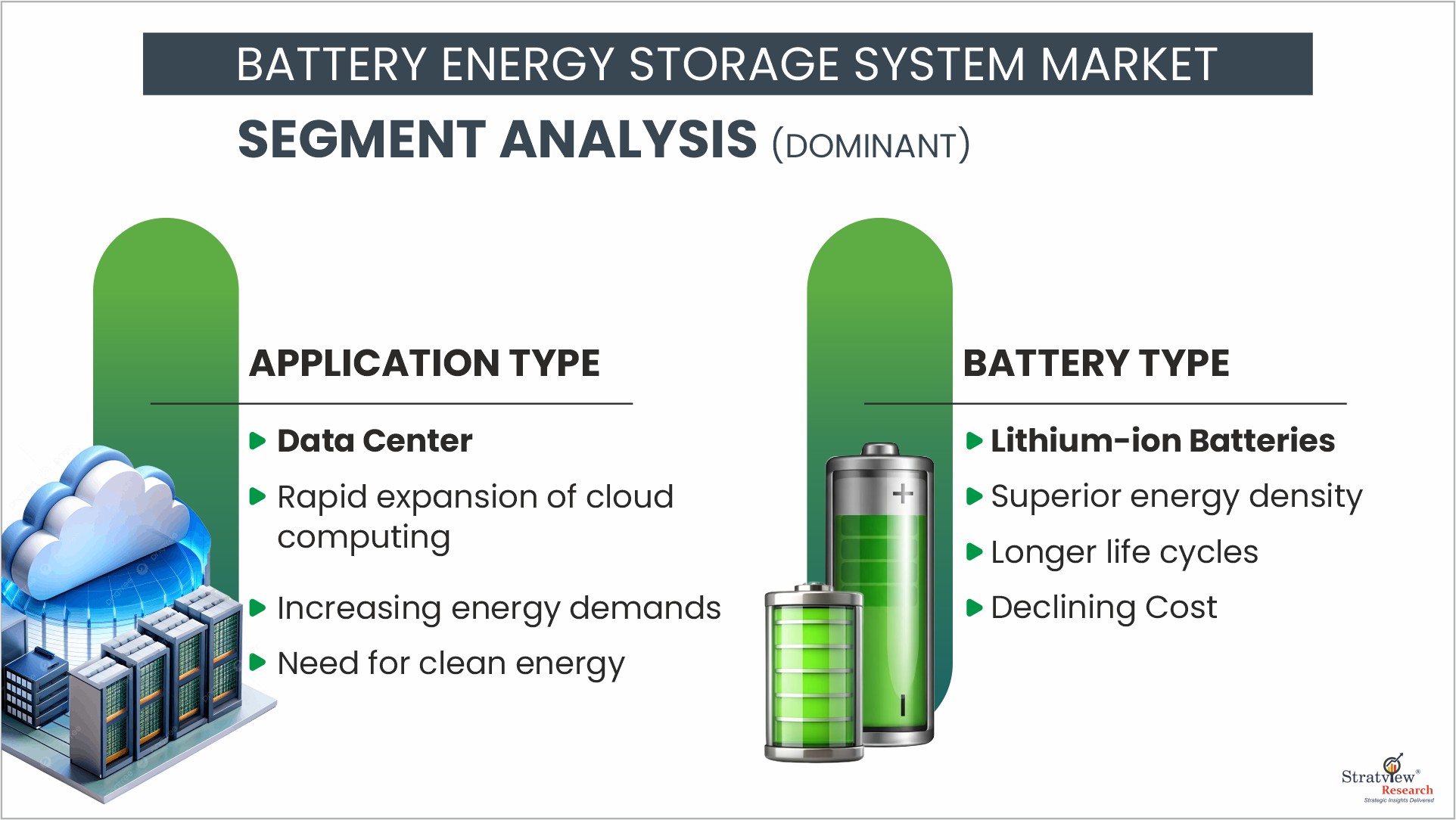
Data center applications are expected to have the highest growth in the battery energy storage system market due to the rapid expansion of cloud computing, increasing energy demands, and the need for clean energy |
|
Battery Analysis |
Flywheel batteries, Lead-acid batteries, Lithium-ion batteries, Others |
Lithium-ion batteries are expected to grow the most due to their superior energy density, longer cycle life, and decreasing costs. |
|
Regional Analysis |
North America, Europe, Asia-Pacific, and the Rest of the World. |
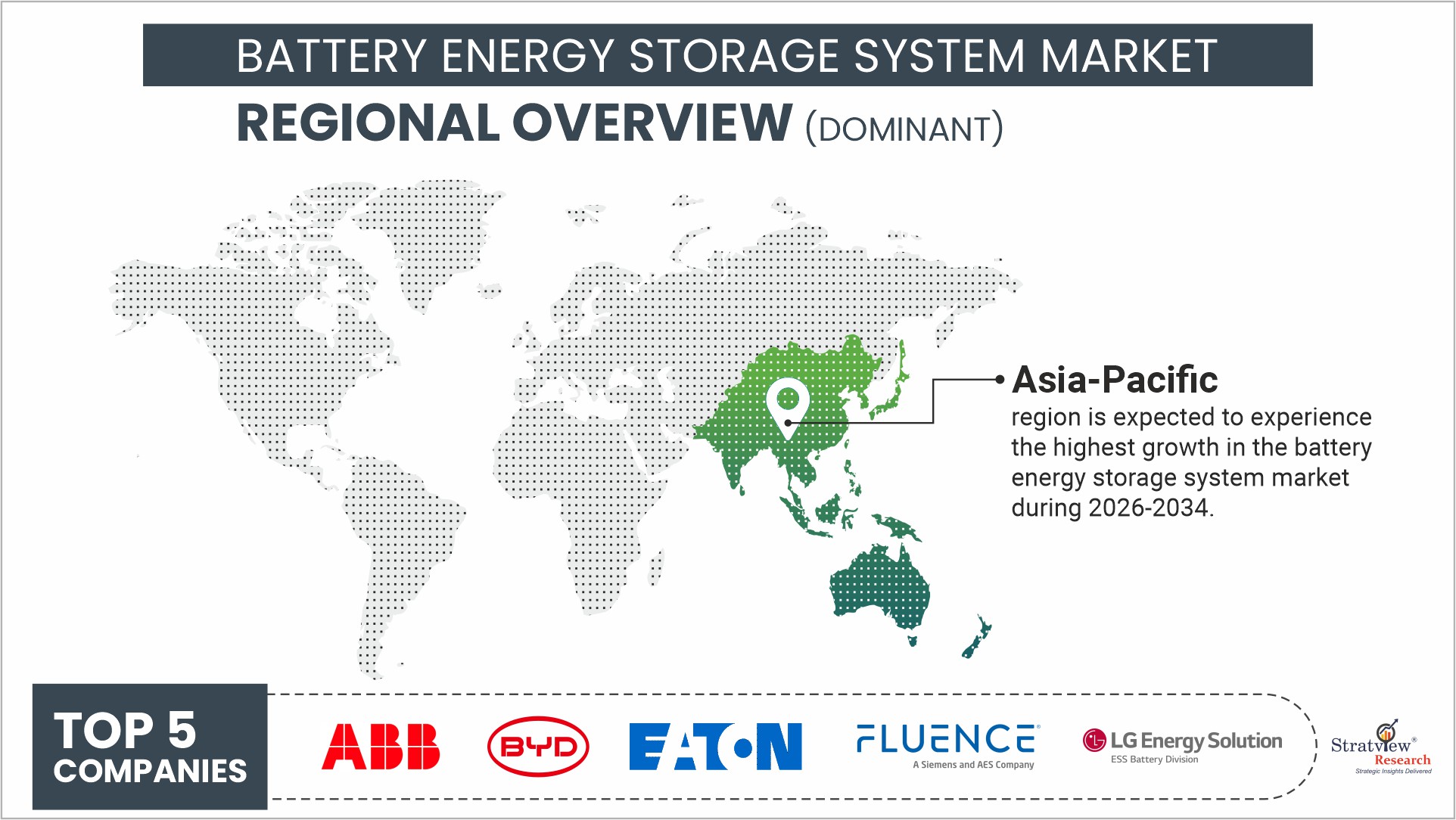
Asia-Pacific region is expected to experience the highest growth in the battery energy storage system market due to rapid industrialization. |
“Data Centers Witness Accelerated Adoption Amid Rising Digital Infrastructure Demand.”
Want to get a free sample? Register Here
“Lithium-Ion Batteries Dominate Due to Superior Performance and Cost Efficiency.”
“Asia-Pacific Emerges as the Core Growth Engine Backed by Industrial Expansion and Energy Transition.”
Want to get a free sample? Register Here
Most of the major players compete in some of the factors, including price, service offerings, regional presence, etc. The following are the key players in the battery energy storage system market: (Based on Dominance)
Note: The above list does not necessarily include all the top players in the market.
Are you a leading player in this market? We would love to include your name. Please write to us at [email protected]
This report provides market intelligence most comprehensively. The report structure has been kept to maximize business value. It provides critical insights into market dynamics and will enable strategic decision-making for existing market players as well as those willing to enter the market.
The following are the key features of the report:
|
Market Study Period |
2019-2034 |
|
Base Year |
2025 |
|
Forecast Period |
2026-2034 |
|
Trend Period |
2019-2024 |
|
Number of Tables & Figures |
>100 |
|
Number of Segments Analysed |
3 (Application Type, Battery Type, and Region) |
|
Number of Regions Analysed |
4 (North America, Europe, Asia-Pacific, Rest of the World) |
|
Countries Analysed |
15 (The USA, Canada, Mexico, Germany, France, Italy, The UK, China, Japan, India, Brazil, Saudi Arabia, Rest of Europe, Rest of APAC, and Rest of the World) |
|
Free Customization Offered |
10% |
|
After Sales Support |
Unlimited |
|
Report Presentation |
Complimentary |
|
Market Dataset |
Complimentary |
|
Further Deep Dive & Consulting Services |
10% Discount |
The report provides detailed insights into market dynamics to enable informed business decision-making and the formulation of growth strategies based on market opportunities.
The battery energy storage system market is segmented into the following categories:
By Application Type
By Battery Type
By Region
This strategic assessment report, from Stratview Research, provides a comprehensive analysis that reflects today’s battery energy storage system market realities and future market possibilities for the forecast period of 2026 to 2034. After a continuous interest in our battery energy storage system market report from the industry stakeholders, we have tried to further accentuate our research scope to the battery energy storage system market to provide the most crystal-clear picture of the market. The report segments and analyses the market in the most detailed manner to provide a panoramic view of the market. The vital data/information provided in the report can play a crucial role for the market participants as well as investors in the identification of the low-hanging fruits available in the market as well as to formulate the growth strategies to expedite their growth process.
This report offers high-quality insights and is the outcome of a detailed research methodology comprising extensive secondary research, rigorous primary interviews with industry stakeholders, and validation and triangulation with Stratview Research’s internal database and statistical tools. More than 1000 authenticated secondary sources, such as company annual reports, fact books, press releases, journals, investor presentations, white papers, patents, and articles, have been leveraged to gather the data. We conducted more than 15 detailed primary interviews with the market players across the value chain in all four regions and industry experts to obtain both qualitative and quantitative insights.
With this detailed report, Stratview Research offers one of the following free customization options to our respected clients:
Company Profiling
Competitive Benchmarking
Custom Research: Stratview Research offers custom research services across industries. In case of any custom research requirement related to market assessment, competitive benchmarking, sourcing and procurement, target screening, and others, please send your inquiry to [email protected].
The report is delivered digitally through our online portal. Buyers receive login credentials from our team to access the report and may update their credentials at any time after the initial login.
Delivery timelines depend on the status of the report:
For the most accurate delivery timeline, please contact us to confirm the current status of the report.
Yes. You may request a complimentary preview of the report through a video conference with our team.
Yes. The scope of the report can be fully customized to align with your specific research objectives and information requirements.
Please contact us at [email protected], and our team will be happy to discuss your requirements and propose a tailored solution.
Yes. Selected sections of the report can be purchased separately based on your requirements. Please contact us at [email protected] to discuss your needs.
Yes, AI can help gather publicly available information, but its outputs are only as reliable as the data it accesses. Stratview Research reports are built using validated data, extensive primary interviews with industry stakeholders, and the expertise of our experienced research team.
Additionally, many critical insights, including market dynamics, competitive intelligence, and industry-specific trends, are not publicly available and therefore cannot be captured through AI alone.
The battery energy storage systems market was valued at USD 14.7 billion in 2025 and is projected to reach USD 54.2 billion by 2034, growing at a CAGR of 15.5% during 2026–2034.
Market growth is primarily driven by the rapid expansion of renewable energy capacity, increasing demand for grid stability, and rising adoption of energy storage across utility-scale, commercial, and industrial applications.
BESS helps manage the intermittency of renewable sources such as solar and wind by storing excess energy and supplying it when generation is low, thereby improving grid reliability and overall energy efficiency.
Lithium-ion batteries dominate the market due to their high energy density, longer cycle life, and declining costs, making them suitable for both grid-scale and distributed energy storage applications.
Data center applications are expected to witness the fastest growth, driven by increasing electricity demand, the need for uninterrupted power supply, and the expansion of cloud computing and digital infrastructure.
Asia-Pacific is expected to be the fastest-growing region due to rapid industrialization, increasing electricity demand, and significant investments in renewable energy and grid infrastructure.
Key challenges include safety concerns related to lithium-ion batteries, supply chain constraints for critical raw materials, and regulatory uncertainties in energy storage integration across different regions.
Key opportunities include the development of hybrid energy systems, increasing adoption in commercial and industrial sectors for energy cost optimization, and supportive government policies promoting energy storage deployment.


WE ACCEPT