




404
+1-313-307-4176

Aircraft Nacelle and Thrust Reverser Market Analysis | 2026-2032

Aircraft Nacelle and Thrust Reverser Market Size, Share, Trends, Dynamics, Forecast, & Growth Analysis: 2026-2032
Aircraft Nacelle and Thrust Reverser Market is segmented by End-User Type (Original Equipment Manufacturer (OEM) and Maintenance Repair Overhaul (MRO)), by Material Type (Composites, Titanium Alloys, Nickel Chromium, Stainless Steel, and Aluminum Alloys), by Component Type (Thrust Reverser and Aircraft Nacelle), by Engine Type (Turbofan, Turboprop, and Gas Turbine), and by Region (North America, Europe, Asia-Pacific, and Rest of the World).
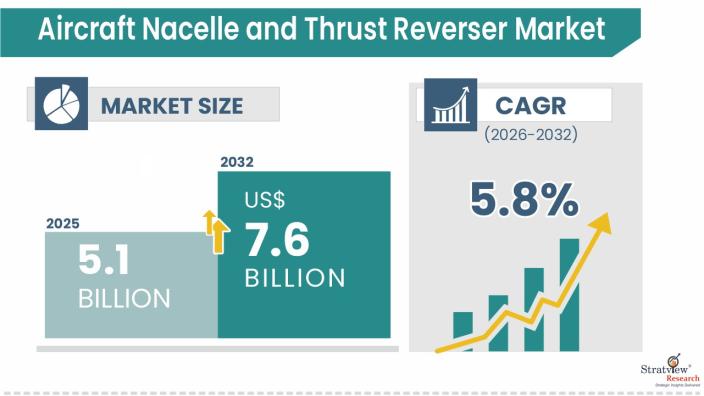
The aircraft nacelle and thrust reverser market was estimated at USD 5.1 billion in 2025 and is likely to grow at a CAGR of 5.8% during 2025-2032 to reach USD 7.6 billion in 2032.
Want to know more about the market scope? Register Here
Aircraft nacelles and thrust reversers are aerodynamic structures that are highly important for the aircraft. The nacelle is mainly a department that is separate from the fuselage. It houses the engines or any other equipment or even, at times, the aircraft. While thrust reverse offers deceleration for landings of short distances and controls the wear in the tires and brakes.
Aircraft nacelles and thrust reversers can be made up of composites, titanium alloys, nickel-chromium, stainless steel, and aluminum alloys.
|
Segmentations |
List of Sub-Segments |
Segments with High Growth Opportunity |
|
End-User Type Analysis |
Original Equipment Manufacturer (OEM), Maintenance Repair Overhaul (MRO) |
The OEM segment is estimated to register a higher growth in the coming five years. |
|
Material Type Analysis |
Composites, Titanium Alloys, Nickle Chromium, Stainless Steel, and Aluminum Alloys |
The aluminum alloys segment is anticipated to retain its dominance during the forecast period. |
|
Component Type Analysis |
Thrust Reverser, Aircraft Nacelle |
The thrust reverser segment is expected to depict a higher growth in the coming five years. |
|
Engine Type Analysis |
Turbofan, Turboprop, and Gas Turbine |
The turbofan segment is estimated to portray the highest growth during the forecast period. |
|
Regional Analysis |
North America, Europe, Asia-Pacific, and Rest of the World |
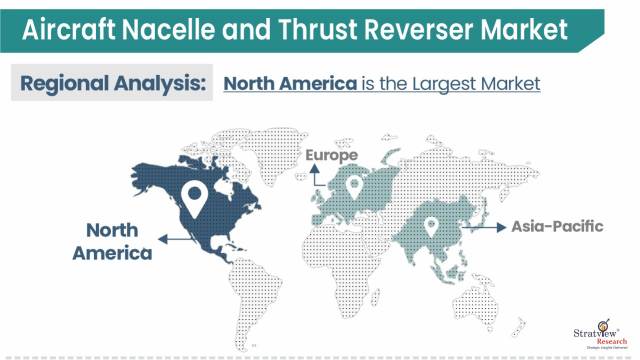
North America is estimated to remain dominant in the aircraft nacelle and thrust reverser market during the forecast period. |
The market is segmented as original equipment manufacturer (OEM) and maintenance repair overhaul (MRO). The OEM segment is estimated to register a higher growth in the coming five years. In the aviation industry, aircraft are engineered and delivered to airline companies with aircraft nacelle and thrust reverser technology mounted in aircraft. Original Equipment Manufacturers (OEMs) are accountable for the installation of aircraft nacelle and thrust reverser mechanisms. This is an appropriate substitute for airline companies, as after the delivery of aircraft, aftermarket alteration becomes onerous for aircraft manufacturers.
The market is segmented as composites, titanium alloys, nickle chromium, stainless steel, and aluminum alloys. The aluminum alloys segment is anticipated to retain its dominance during the forecast period. Metals, such as aluminum, steel, and titanium and its alloys, are chosen for the production of aircraft nacelles owing to their strength and high temperature tolerance. As an instance, in Airbus A380, composites are employed on the foremost boundaries and in the fuselage frame for structural clips and engine nacelles, but aluminum remains the foremost material in terms of total share of materials in an aircraft due to its ductility and corrosion resistance. Hence, owing to the rising demand for new aircraft deliveries across the globe, the aluminum alloys segment is estimated to lead the market during the forecast period.
The market is segmented as thrust reverser and aircraft nacelle. The thrust reverser segment is expected to depict a higher growth in the coming five years. Thrust reversers are the most intricate and weightiest part of any aircraft nacelle and influence significantly the cost of the overall aircraft nacelle. Thus, owing to the growing demand for new aircraft deliveries globally, the thrust reverser segment is anticipated to remain dominant during the forecast period.
The market is segmented as turbofan, turboprop, and gas turbine. The turbofan segment is estimated to portray the highest growth during the forecast period. In the aviation industry, almost all the aircraft used in the commercial and regional travel, function on the principle of turbofan-based aircraft propulsion owing to which the upsurge in the demand for commercial and regional airliners is contributing to the escalating demand for turbofan-based engine nacelles.
North America is estimated to remain dominant in the aircraft nacelle and thrust reverser market during the forecast period owing to the high demand for new aircraft and substitution of aging fleets. The Asia-Pacific region is also anticipated to be the fastest-growing region as there is an increase in the modernization agendas in the Asia-Pacific aviation industry, which is estimated to contribute to the high acceptance of advanced aircraft nacelles. These factors are expected to further drive the demand for aircraft nacelles and thrust reversers in the Asia-Pacific region. China and India are the growth engines of the region. Europe is also expected to offer substantial growth opportunities during the forecast period.
Know the high-growth countries in this report. Register Here
Some of the major players in the aircraft nacelle and thrust reverser market are:
Note: The above list does not necessarily include all the top players in the market.
Are you the leading player in this market? We would love to include your name. Write to us at [email protected]
This strategic assessment report, from Stratview Research, provides a comprehensive analysis that reflects today’s aircraft nacelle and thrust reverser market realities and future market possibilities for the forecast period of 2026 to 2032. After a continuous interest in our aircraft nacelle and thrust reverser market report from the industry stakeholders, we have tried to further accentuate our research scope to the aircraft nacelle and thrust reverser market to provide the most crystal-clear picture of the market. The report segments and analyses the market in the most detailed manner to provide a panoramic view of the market. The vital data/information provided in the report can play a crucial role for the market participants as well as investors in the identification of the low-hanging fruits available in the market as well as in the formulation of the growth strategies to expedite their growth process.
This report offers high-quality insights and is the outcome of a detailed research methodology comprising extensive secondary research, rigorous primary interviews with industry stakeholders, and validation and triangulation with Stratview Research’s internal database and statistical tools. More than 1000 authenticated secondary sources, such as company annual reports, fact books, press releases, journals, investor presentations, white papers, patents, and articles, have been leveraged to gather the data. We conducted more than 15 detailed primary interviews with the market players across the value chain in all four regions and industry experts to obtain both qualitative and quantitative insights.
This report provides market intelligence in the most comprehensive way. The report structure has been kept such that it offers maximum business value. It provides critical insights into market dynamics and will enable strategic decision-making for existing market players as well as those willing to enter the market. The following are the key features of the report:
This report studies the market, covering a period of 12 years of trends and forecasts. The report provides detailed insights into the market dynamics to enable informed business decision-making and growth strategy formulation based on the opportunities present in the market.
The aircraft nacelle and thrust reverser market is segmented into the following categories:
By End-User Type
By Material Type
By Component Type
By Engine Type
By Region
With this detailed report, Stratview Research offers one of the following free customization options to our respectable clients:
Company Profiling
Market Segmentation
Competitive Benchmarking
Custom Research: Stratview Research offers custom research services across sectors. In case of any custom research requirement related to market assessment, competitive benchmarking, sourcing and procurement, target screening, and others, please send your inquiry to [email protected].
The report is delivered digitally through our online portal. Buyers receive login credentials from our team to access the report and may update their credentials at any time after the initial login.
Delivery timelines depend on the status of the report:
For the most accurate delivery timeline, please contact us to confirm the current status of the report.
Yes. You may request a complimentary preview of the report through a video conference with our team.
Yes. The scope of the report can be fully customized to align with your specific research objectives and information requirements.
Please contact us at [email protected], and our team will be happy to discuss your requirements and propose a tailored solution.
Yes. Selected sections of the report can be purchased separately based on your requirements. Please contact us at [email protected] to discuss your needs.
Yes, AI can help gather publicly available information, but its outputs are only as reliable as the data it accesses. Stratview Research reports are built using validated data, extensive primary interviews with industry stakeholders, and the expertise of our experienced research team.
Additionally, many critical insights, including market dynamics, competitive intelligence, and industry-specific trends, are not publicly available and therefore cannot be captured through AI alone.
Aircraft nacelles and thrust reversers are aerodynamic structures that are highly important for the aircraft. The nacelle is mainly a department that is separate from the fuselage. It houses the engines or any other equipment or even, at times, the aircraft. While thrust reverse offers deceleration for landings of short distances and controls the tear in the tires and brakes. Aircraft nacelles and thrust reversers can be made up of composites, titanium alloys, nickel-chromium, stainless steel, and aluminum alloys.
The aircraft nacelle and thrust reverser market was estimated at USD 5.1 billion in 2025.
The forecasted value of the aircraft nacelle and thrust reverser market is expected to be USD 7.6 billion in 2032.
The aircraft nacelle and thrust reverser market is likely to grow at a CAGR of 5.8% during 2025-2032.
Bombardier Inc., GKN Plc, Leonardo S.P.A., Nordam, Safran S.A., Spirit Aerosystems Inc., Triumph Group, United Technologies Corporation, Woodward, Inc are among the key players in the market.
The OEM segment is expected to register a higher growth in the market during the next five years.
The aluminum alloys segment is expected to remain dominant in the market during the next five years.
North America is expected to remain dominant in the market during the forecast period.


WE ACCEPT