




404
+1-313-307-4176

Indian Aerospace Composites Market Report

Indian Aerospace Composites Market Size, Share, Trend, Forecast, Competitive Landscape & Growth Opportunities: 2026-2035 ... See more
"The Indian aerospace composites market is expected to reach USD 124.3 million in 2026, growing 21.0% over 2025, and is projected to reach USD 514.5 million by 2035, registering a CAGR of 17.1% during 2026–2035. The market is primarily driven by the expansion of India’s commercial aircraft fleet and MRO activity, rising indigenous aircraft production and defense modernization, and increasing integration of Indian aerospace suppliers into global OEM programs.”
The Indian aerospace composites market was valued at USD 102.7 million in 2025 and is expected to reach USD 124.3 million in 2026, representing a year-on-year growth of 21.0%.
During the forecast period (2026–2035), the market is projected to grow at a CAGR of 17.1%, reaching USD 514.5 million by 2035.
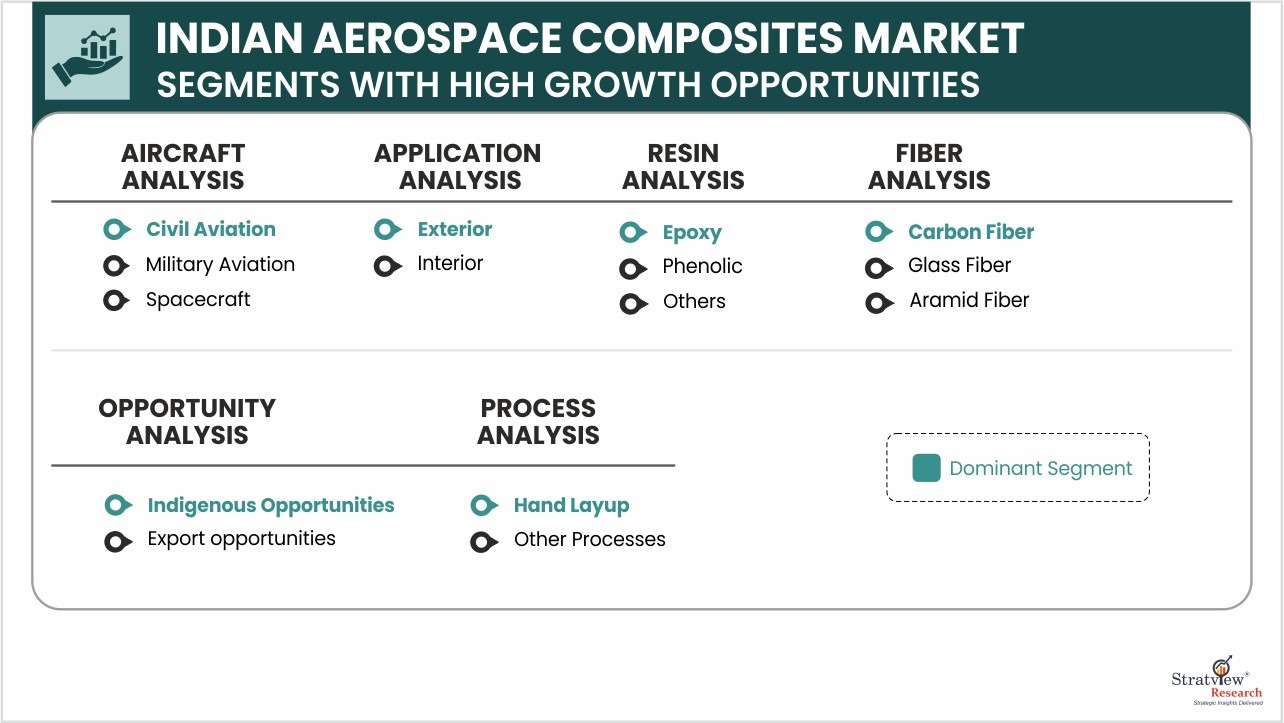
Carbon fiber composites are expected to remain the largest fiber type segment over the forecast period, supported by its high strength-to-weight ratio and their growing adoption in indigenous fighter, helicopter, and airframe programs.
Civil aviation is projected to maintain its position as the leading aircraft segment during the forecast period.
Epoxy composites are expected to remain the biggest demand generator among resin types throughout the forecast period.
Aerospace Exterior Composites are projected to remain the dominant application area for composites in the market during the forecast period.
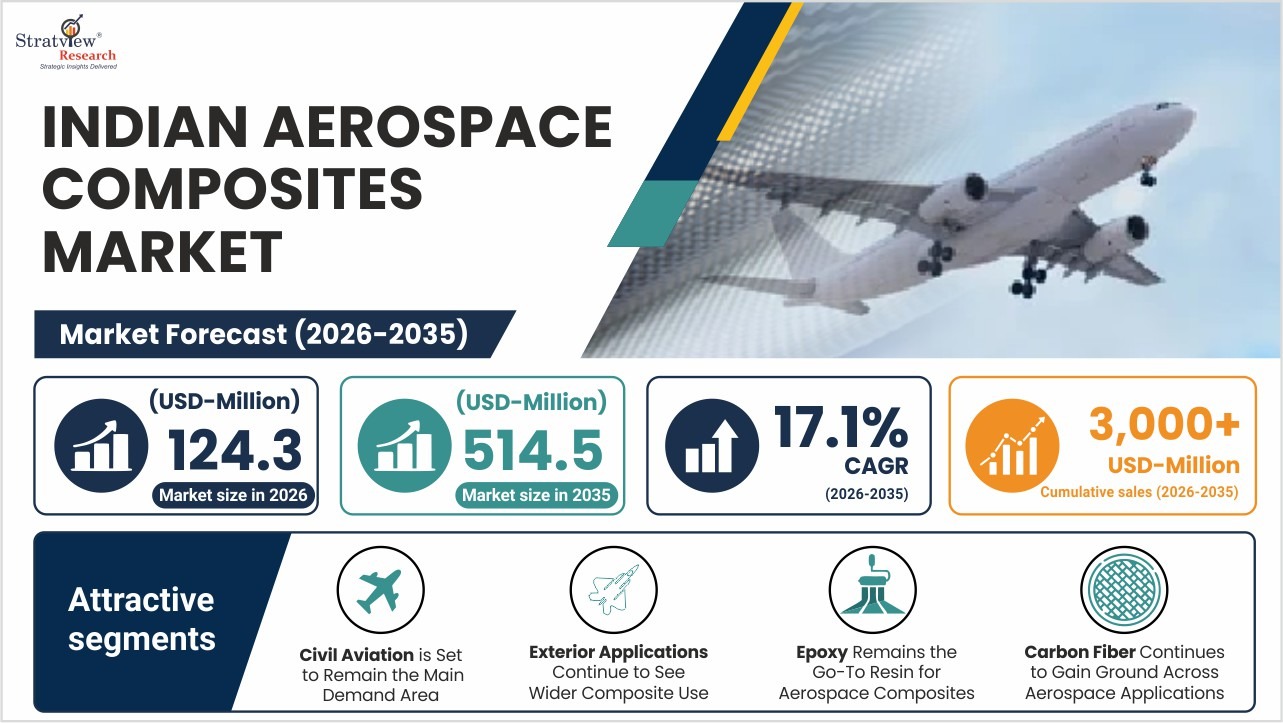
"As per the Senior Analyst at Stratview Research, the Indian aerospace composites market is expected to create a cumulative sales opportunity of USD 3028.0 million during 2026–2035. During the upcoming years, Epoxy Composites, Civil Aviation, & Carbon Fiber Composites are some of the high-opportunity segments to bank upon."
Sharpen your strategies to explore this USD 3,000 million+ opportunity. Get a free sample of our report here.
Have a look at the sales opportunities presented by the Indian aerospace composites market in terms of growth and market forecast.
|
Market Statistics |
Value (in USD Million) |
Market Growth (%) |
|---|---|---|
|
Market Size in 2025 |
USD 102.7 million |
- |
|
Market Size in 2026 |
USD 124.3 million |
YoY Growth in 2026: 21.0% |
|
Market Size in 2035 |
USD 514.5 million |
CAGR 2026-2035: 17.1% |
|
Cumulative Sales Opportunity during 2026-2035 |
USD 3028.0 million |
- |
|
Top 10 Companies' Market Share in 2025 |
USD 56 million – USD 72 million |
55% - 70% |
Want to explore the market opportunities? Get a free sample here.
The Indian aerospace composites market is undergoing significant transformation as indigenous fighter, helicopter, and airframe programs scale up production, defense modernization accelerates, and global OEMs deepen sourcing from India. Rising adoption of carbon fiber and glass fiber composites in structural, interior, and secondary applications, expanding domestic manufacturing capacity under the Make in India initiative, and growing participation of private players in composite aerostructure production are reshaping how component manufacturers serve both indigenous defense programs and global commercial aircraft supply chains.
Want to explore the market growth factors? Get a free sample here
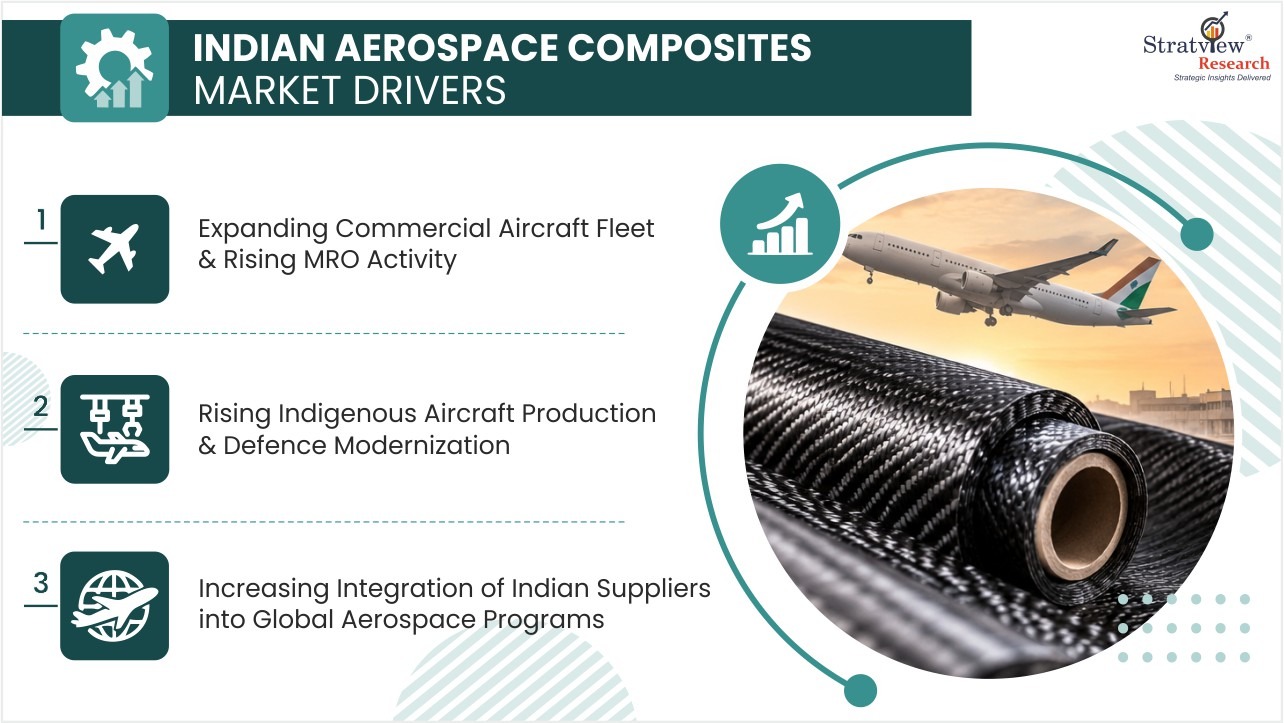
Expanding Commercial Aircraft Fleet and Rising MRO Activity
India’s expanding commercial aircraft fleet is strengthening the underlying demand for aerospace composites, while a growing maintenance, repair, and overhaul (MRO) base is adding an aftermarket demand channel. Airbus expects India’s commercial fleet to reach around 2,250 aircraft by 2035, nearly three times the 2025 fleet, driven by rising passenger traffic and airline fleet expansion. A larger installed fleet increases the recurring requirement for aircraft maintenance, structural repairs, component replacement, and refurbishment, including work involving composite-intensive structures and components. Airbus also projects India’s airframe, engine, and component MRO market to reach US$9.5 billion by 2035. As new aircraft enter service and the installed fleet ages, demand therefore develops through both new-aircraft production and the maintenance of composite components already in service. This combination of original-equipment and aftermarket consumption is expanding the overall demand base for aerospace composites in India.
Rising Indigenous Aircraft Production and Defense Modernization
India’s defense modernization and increasing indigenous aircraft production are creating a sustained domestic demand base for aerospace composites. Higher military aircraft procurement, combined with the localization of aircraft manufacturing, is increasing the volume of aerospace production taking place within the country. The Airbus-Tata C295 programme provides a clear example: India has ordered 56 aircraft, with 40 being manufactured and assembled in Vadodara. The programme includes more than 85% structural and final assembly in India for those 40 aircraft, along with the manufacture of around 13,000 detail parts and participation from 37 India-based suppliers. As programmes such as C295 and other indigenous or locally manufactured defense platforms move into serial production, they generate recurring requirements for lightweight structural materials and composite components rather than one-time development demand. The continued shift of defense procurement toward domestic aircraft manufacturing is therefore a key growth driver for the Indian aerospace composites market.
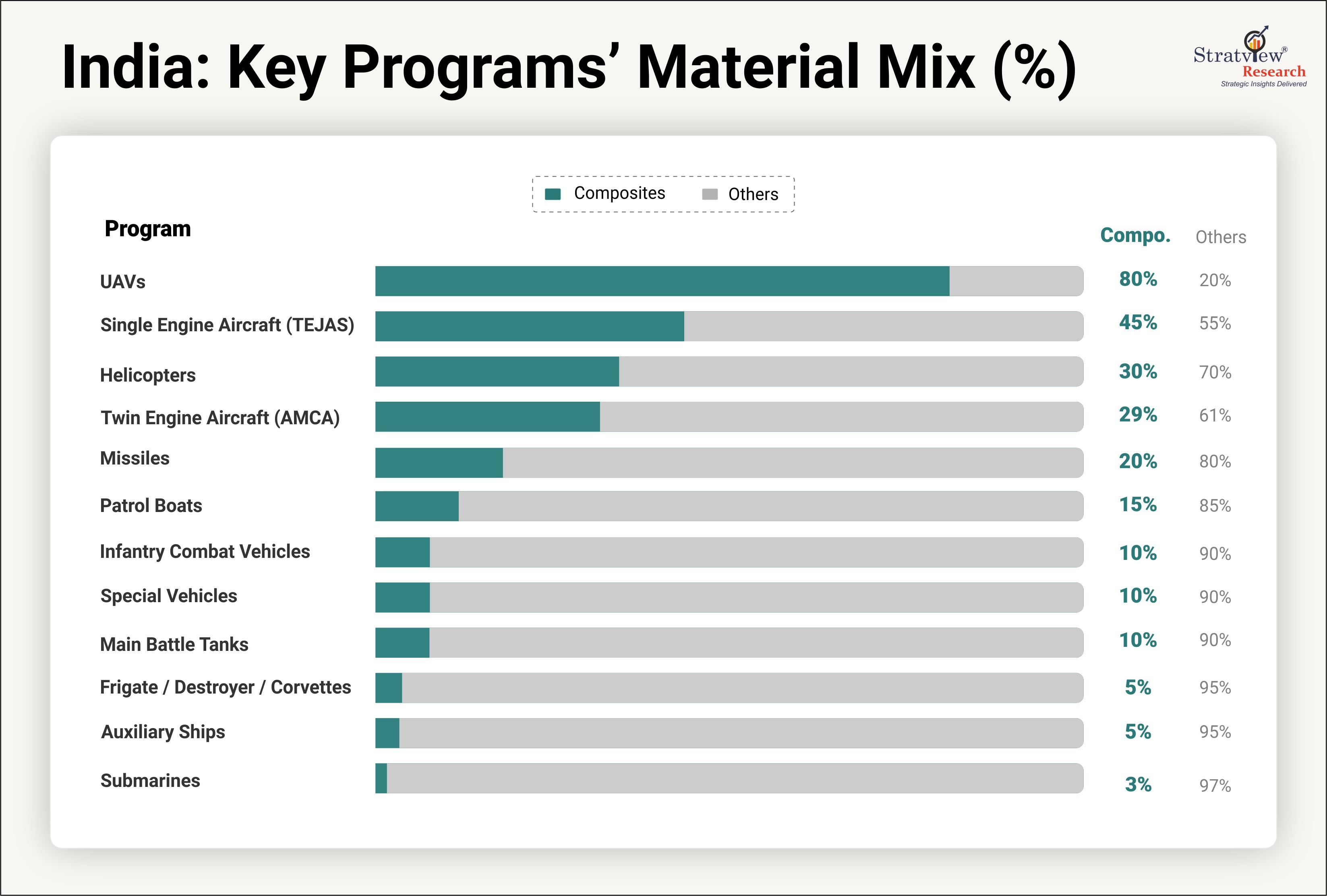
For detailed analysis on composite adoption across defense programs, view the full report here.
Increasing Integration of Indian Suppliers into Global Aerospace Programs
The increasing integration of Indian aerospace suppliers into global original equipment manufacturer (OEM) programmes is expanding the production base for aerospace composites in India. International aerospace companies are increasingly sourcing aircraft components, structures, engineering services, and assemblies from Indian suppliers, creating demand that extends beyond the domestic aircraft market. Airbus reported in March 2026 that its annual sourcing from India had increased to more than US$1.5 billion, with over 100 Indian companies supplying components for global programmes, including flap track beams, aircraft doors, and helicopter fuselages. This deeper supplier integration allows Indian manufacturers to participate in recurring global aerospace production programmes and progressively move into higher-value components and assemblies. As the volume and complexity of aerospace manufacturing undertaken in India increase, so does the requirement for locally processed composite materials and composite components. The expansion of India’s role within global aerospace supply chains therefore provides a separate demand engine for the Indian aerospace composites market, alongside domestic civil aviation and defense production.
“As per our analyst, the Indian aerospace composites market is seeing stronger domestic demand, supported by commercial fleet growth, defense aircraft production, and India’s growing role in global aerospace supply chains. The wider use of composite structures in civil and military aircraft is supporting demand for composite materials and components, while growing MRO activity is creating additional aftermarket demand.”
Align with the mega trends shaping the industry. Get a free sample here.
Dependence on Imported Aerospace-Grade Composite Materials
India’s aerospace composites market continues to face an upstream supply constraint due to the limited domestic availability of qualified aerospace-grade composite materials. Hindustan Aeronautics Limited (HAL) stated that composite raw materials, particularly prepregs used in platforms such as the Light Combat Aircraft (LCA), Advanced Light Helicopter (ALH), Light Combat Helicopter (LCH), and Light Utility Helicopter (LUH), were being imported, while there was no equivalent proven Indian supplier qualified for several aircraft-grade carbon, aramid, and glass prepregs. This dependence can expose aerospace manufacturers to longer procurement cycles and external supply-chain conditions, while also making the localization of composite-intensive aircraft production more dependent on the development and qualification of domestic material suppliers. Although India is pursuing indigenous production of critical composite materials, the qualification requirements associated with aerospace applications mean that replacing imported materials is a gradual process rather than a simple capacity addition.
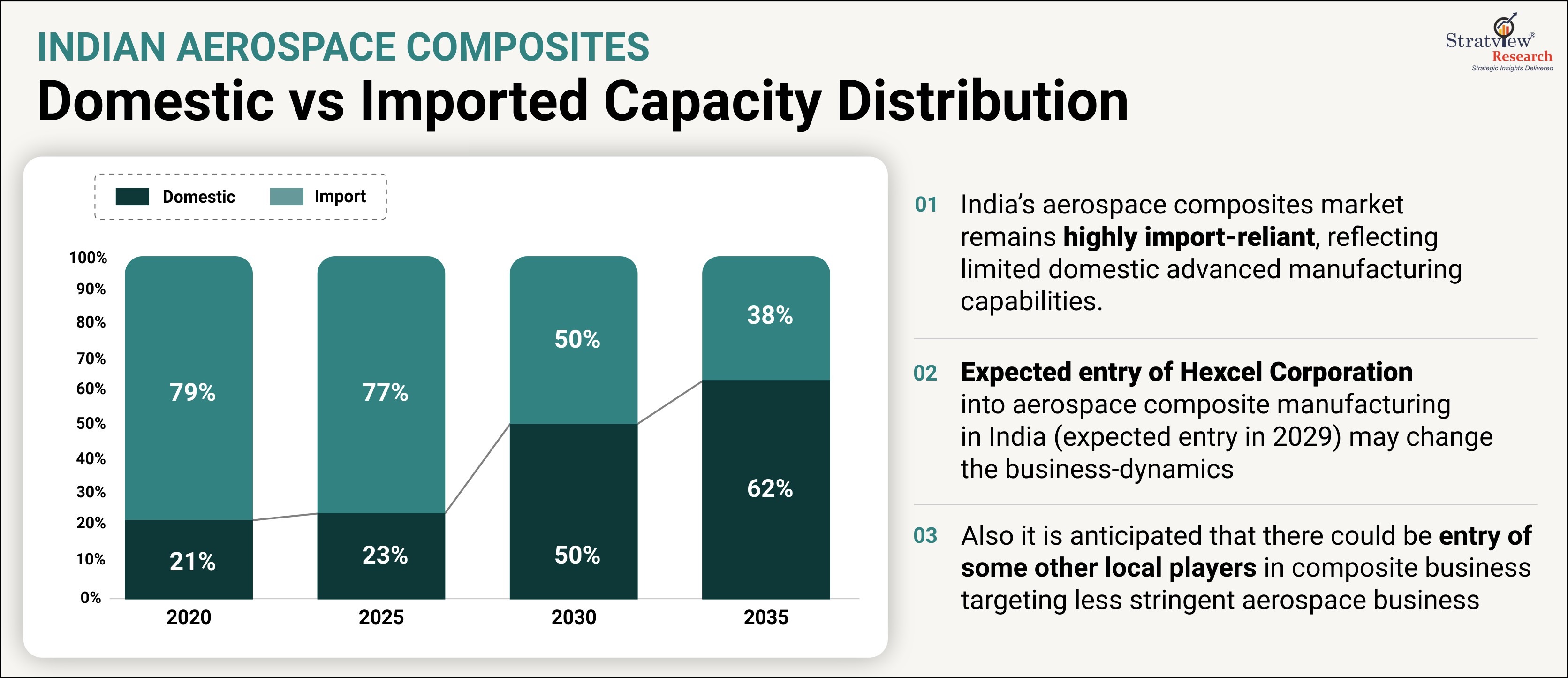
Explore detailed insights and data on Indian aerospace composites here.
Lengthy Certification and Qualification Processes for Aerospace Components
Stringent certification and qualification requirements can slow the entry and scale-up of Indian suppliers in the aerospace composites market. Aerospace components must satisfy demanding quality, performance, traceability, and airworthiness requirements before they can be incorporated into aircraft programmes. A recent Department of Scientific and Industrial Research (DSIR) assessment identifies lengthy international airworthiness approvals for parts manufactured in India as a specific industry issue, noting that approvals not being completed domestically can increase costs for original equipment manufacturers (OEMs) and discourage outsourcing to Indian suppliers. The same assessment also highlights difficulties faced by smaller suppliers in keeping pace with rising quality requirements and global standards. For composite manufacturers, these requirements can extend the time and investment needed to qualify new materials, processes, and components for aerospace applications. As a result, certification and qualification can become a practical barrier to faster supplier onboarding and capacity expansion, particularly for smaller Indian companies seeking to enter higher-value aerospace programmes.
Get insights on high-growth segments. Get a free sample here.
“Civil aviation and military aviation are expected to remain the key aircraft-type segments in the market during the forecast period.”
Based on aircraft type, the Indian aerospace composites market is segmented into civil aviation, military aviation, and spacecraft. Civil aviation and military aviation are expected to remain the key demand segments during the forecast period. Civil aviation demand is supported by the expansion of India’s commercial aircraft fleet and the increasing use of composite-intensive aircraft, while military aviation benefits from defense modernization and the growing production of indigenous and locally manufactured aircraft platforms. The spacecraft segment represents a more specialized application base, with demand linked to India’s space programmes and the use of composites in spacecraft and launch-system structures. The combination of commercial fleet expansion, defense aircraft production, and continued aerospace manufacturing localization is expected to sustain demand for composites across the three aircraft types.
“Exterior applications are expected to remain the dominant application type in the market during the forecast period.”
Based on application type, the market is segmented into exterior and interior applications. Exterior applications are expected to account for the larger share of the market during the forecast period, primarily because composites are extensively used in aircraft structural and semi-structural components. Fuselage sections, wings, empennage structures, fairings, and other exterior components benefit from the high strength-to-weight ratio, stiffness, fatigue performance, and corrosion resistance offered by composite materials. The increasing use of composite-intensive aircraft is supporting this application base, while interior applications remain important for cabin interior components requiring lightweight construction and stringent fire, smoke, and toxicity performance.
“Epoxy is expected to remain the dominant resin type in the market during the forecast period.”
Based on resin type, the market is segmented into epoxy, phenolic, and other resin systems. Epoxy is expected to retain its leading position during the forecast period owing to its established use in structural aerospace composites and its combination of mechanical strength, adhesion, durability, and processing flexibility. Epoxy systems are compatible with carbon, glass, and aramid reinforcements and are used across a broad range of aircraft structural applications. Phenolic resin systems occupy a more specialized position, particularly in aircraft interiors where fire, smoke, and toxicity (FST) performance is a critical material requirement. The established processing base for epoxy composites and their broad applicability across aerospace structures further support their leading position in the market.
“Carbon fiber is expected to remain the dominant and fastest-growing fiber type in the market during the forecast period.”
Based on fiber type, the Indian aerospace composites market is segmented into carbon fiber, glass fiber, and aramid fiber composites. Carbon fiber is expected to remain the dominant and fastest-growing fiber type during the forecast period, supported by its high strength-to-weight ratio, stiffness, fatigue performance, and suitability for weight-sensitive aircraft structures. Carbon fiber reinforced polymer (CFRP) is extensively used in primary and secondary aircraft structures where structural efficiency and weight reduction are critical. Glass fiber continues to serve applications where cost and adequate mechanical performance are important, while aramid fiber is used selectively in applications requiring low weight and impact resistance. The increasing use of composite-intensive aircraft and the localization of aerospace manufacturing in India are expected to further support demand for carbon fiber composites.
Speak to us for a deep dive into a segment/program-specific opportunity. Contact us here.
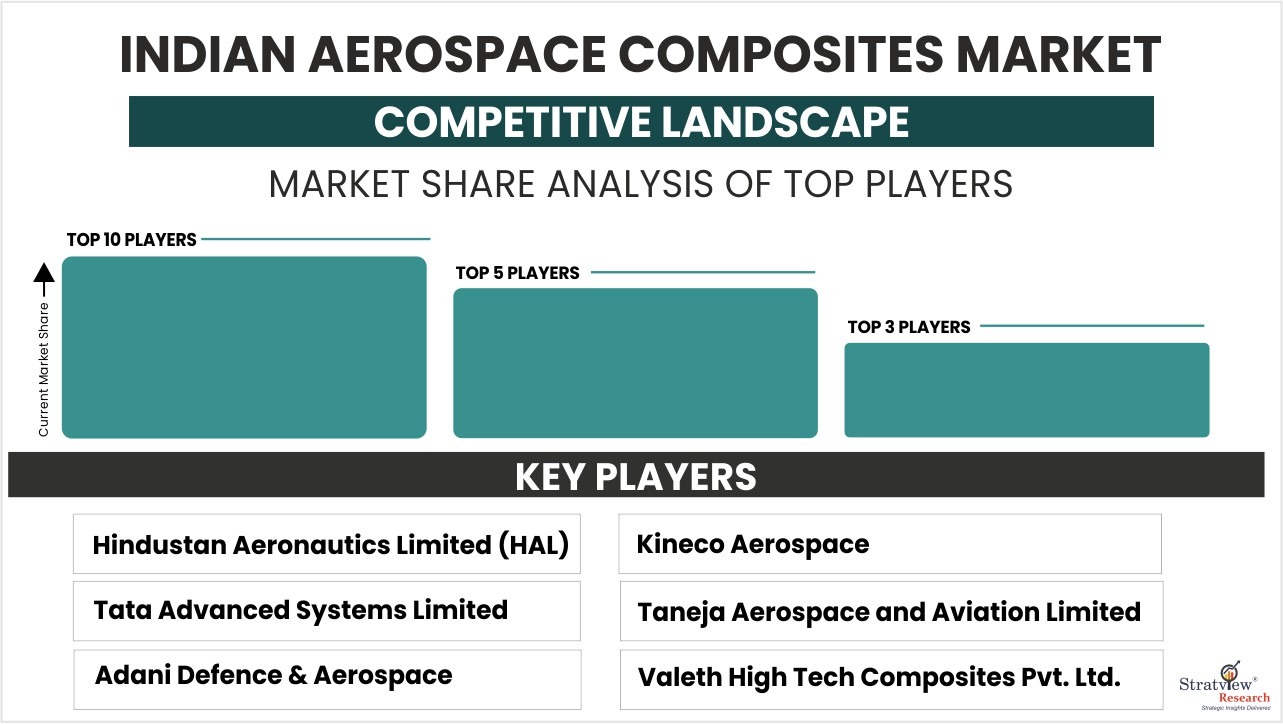
The Indian aerospace composites market features a mix of a state-owned aerospace major, established private conglomerates, and specialized independent composite manufacturers. Key players compete primarily on manufacturing capability, certification credentials, program qualification history, and long-term supply agreements with global and domestic OEMs.
Have the competitive edge with our intelligence. Get a free sample here.
The following are the key players in the Indian aerospace composites market:
Hindustan Aeronautics Limited (HAL)
Tata Advanced Systems Limited
Adani Defence & Aerospace
Kineco Aerospace
Taneja Aerospace and Aviation Limited
Valeth High Tech Composites Pvt. Ltd.
Note: The above list is not an exhaustive list of the key players in the market. If your company is active in this market and would like to be considered for inclusion in future editions of this study, please contact us at [email protected].
Recent mergers & acquisitions and other developments in the Indian aerospace composites market reflect increasing investments in composite manufacturing, deeper integration with global aerospace programs, and the expansion of domestic aerospace production. Below are a few recent developments in the market –
July 2026 | Kineco Aerospace & FACC | Composite Production Expansion
November 2025 | Tata Advanced Systems | Composite Manufacturing Expansion
June 2025 | Kineco Aerospace & FACC | Aerospace Composite Supply Agreement
June 2025 | Tata Advanced Systems & Dassault Aviation | Rafale Aerostructure Manufacturing
The Indian aerospace composites market encompasses carbon fiber, glass fiber, and aramid fiber-reinforced composite materials used in the manufacture of structural, semi-structural, and interior components for military aircraft, civil aircraft, helicopters, and spacecraft platforms manufactured or operating in India. These composites, combined with epoxy, phenolic, and other resin systems, are used across airframe structures, wings, fuselage panels, interior components, and secondary structures, supporting weight reduction, fuel efficiency, and structural performance across indigenous and export-oriented aerospace programs.
This report provides the most comprehensive market intelligence. The report structure has been kept so that it offers maximum business value. It provides critical insights into market dynamics and will enable strategic decision-making for existing market players and those looking to enter the market.
The following are the key features of the report:
Market structure: Overview, industry life cycle analysis, supply chain analysis.
Market environment analysis: Growth drivers and constraints, Porter's five forces analysis, SWOT analysis.
Market trend and forecast analysis.
Market segment trend and forecast.
Competitive landscape and dynamics: Market share, manufacturing capability, new facility launches, etc.
Attractive market segments and associated growth opportunities.
Emerging trends.
Strategic growth opportunities for the existing and new players.
Key success factors.
|
Market Study Period |
2020-2035 |
|---|---|
|
Base Year |
2025 |
|
Forecast Period |
2026-2035 |
|
Trend Period |
2020-2025 |
|
Number of Tables & Figures |
100+ |
|
Number of Segments Analysed |
6 (Opportunity Type, Resin Type, Aircraft Type, Application Type, Fiber Type, and Process Type) |
|
Free Customization Offered |
10% |
|
After Sales Support |
Unlimited |
|
Report Presentation |
Complimentary |
|
Market Dataset |
Complimentary |
|
Further Deep Dive & Consulting Services |
10% Discount |
Want a report tailor-made to your objectives? Speak with our analyst.
The report provides detailed insights into market dynamics to enable informed business decision-making and the formulation of growth strategies based on market opportunities.
The Indian aerospace composites market is segmented into the following categories:
Indian Aerospace Composites Market, By Opportunity Type
Indigenous Opportunities
Export opportunities
Indian Aerospace Composites Market, By Fiber Type
Carbon Fiber Composites
Glass Fiber Composites
Aramid Fiber Composites
Indian Aerospace Composites Market, By Resin Type
Epoxy Composites
Phenolic Composites
Other Composites
Indian Aerospace Composites Market, By Aircraft Type
Military Aviation
Civil Aviation
Spacecraft
Indian Aerospace Composites Market, By Application Type:
Aerospace Exterior Composites
Aerospace Interior Composites
Indian Aerospace Composites Market, By Process Type:
Hand Layup
Other Processes
Looking for a deep dive? Speak with our analyst.
This strategic assessment report from Stratview Research provides a comprehensive analysis that reflects today's Indian aerospace composites market realities and future market possibilities for the forecast period.
The report segments and analyses the market in the most detailed manner to provide a panoramic view of the market. The vital data/information provided in the report can play a crucial role for market participants and investors in identifying the low-hanging fruits available in the market and formulating growth strategies to expedite their growth process.
This report offers high-quality insights and is the outcome of a detailed research methodology comprising extensive secondary research, rigorous primary interviews with industry stakeholders, and validation and triangulation with Stratview Research's internal database and statistical tools.
More than 1,000 authenticated secondary sources, such as company annual reports, fact books, press releases, journals, investor presentations, white papers, patents, and articles, have been leveraged to gather the data.
We conducted more than 10 detailed primary interviews with market players across the value chain in India and industry experts to obtain both qualitative and quantitative insights.
Customization Options
With this detailed report, Stratview Research offers one of the following free customization options to our valued clients:
Company Profiling
Detailed profiling of additional market players (up to three players).
SWOT analysis of key players (up to three players).
Competitive Benchmarking
Benchmarking of key players on the following parameters: manufacturing capability, geographical reach, program qualifications, and strategic alliances.
Custom Research: Stratview Research offers custom research services across industries. In case of any custom research requirement related to market assessment, competitive benchmarking, sourcing and procurement, target screening, and others, please send your inquiry to [email protected].
The report is delivered digitally through our online portal. Buyers receive login credentials from our team to access the report and may update their credentials at any time after the initial login.
Delivery timelines depend on the status of the report:
For the most accurate delivery timeline, please contact us to confirm the current status of the report.
Yes. You may request a complimentary preview of the report through a video conference with our team.
Yes. The scope of the report can be fully customized to align with your specific research objectives and information requirements.
Please contact us at [email protected], and our team will be happy to discuss your requirements and propose a tailored solution.
Yes. Selected sections of the report can be purchased separately based on your requirements. Please contact us at [email protected] to discuss your needs.
Yes, AI can help gather publicly available information, but its outputs are only as reliable as the data it accesses. Stratview Research reports are built using validated data, extensive primary interviews with industry stakeholders, and the expertise of our experienced research team.
Additionally, many critical insights, including market dynamics, competitive intelligence, and industry-specific trends, are not publicly available and therefore cannot be captured through AI alone.
Indian aerospace composites market size was USD 102.7 million in 2025. The market is expected to grow from USD 124.3 million in 2026 to USD 514.5 million in 2035, witnessing a robust market growth (CAGR) of 17.1% during the forecast period (2026-2035).
Hindustan Aeronautics Limited (HAL), Tata Advanced Systems Limited, Adani Defence & Aerospace, Kineco Aerospace, Dynamatic Technologies Limited, Taneja Aerospace and Aviation Limited, Valeth High Tech Composites Pvt. Ltd., and Alpha Design Technologies Pvt. Ltd. are key players in the Indian aerospace composites market.
Carbon fiber composites is anticipated to remain the pioneer in the Indian aerospace composites market during the forecast period, driven by its dominant use in fighter aircraft wings, helicopter structures, and growing commercial aerostructure sourcing.


WE ACCEPT