




404
+1-313-307-4176

Continuous Fiber Composites Market Analysis | 2026-2032

Continuous Fiber Composites Market Size, Share, Trends, Dynamics, Forecast, & Growth Analysis: 2026-2032
Continuous Fiber Composites Market is segmented by Form Type (Woven Fabrics, Non-Crimp Fabrics, Unidirectional Tape, and Others), by Resin Type (Thermoset Composites and Thermoplastic Composites), by Reinforcement Type (Glass Fiber Composites, Carbon Fiber Composites, and Other Composites), by End-Use Industry Type (Aerospace & Defense, Automotive, Wind Energy, Sporting Goods, Electronics, and Others), and by Region (North America, Europe, Asia-Pacific, and Rest of the World).
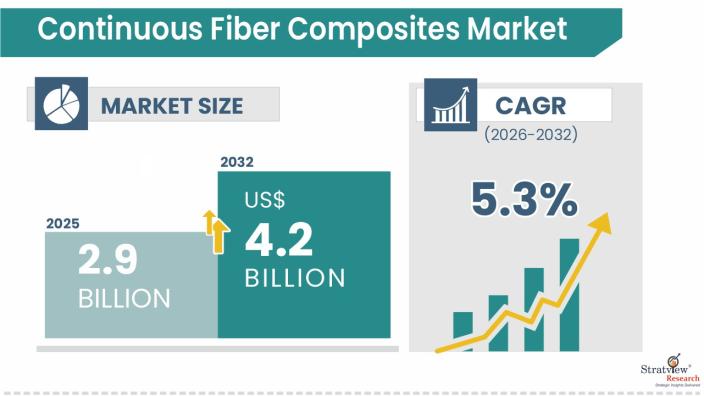
The continuous fiber composites market was estimated at USD 2.9 billion in 2025 and is likely to grow at a CAGR of 5.3% during 2026-2032 to reach USD 4.2 billion in 2032.
Want to know more about the market scope? Register Here
Composites have earned their way into various end-use industries, propelled by a long list of their advantages, including high strength-to-weight ratio, excellent corrosion and creep resistance, low maintenance cost, and being lightweight. The materials have a disruptive journey of more than eight decades and are efficaciously gaining penetration in both high-performance and cost-sensitive end-use industries. The penetration of composites is not likely to cease here and will penetrate more in the coming years.
Composite is one of the most versatile materials with the combination of different fibers, resins, and core materials. The availability of different manufacturing processes further raises the complexity of these materials. Also, there are different forms of fibers, including continuous, chopped, and milled, whose selection is based on different requirements of applications, including part strength, part cost, part geometry, and part complexity. Continuous fiber is one of the most common fiber forms used in various end-use industries, including electronics, wind energy, automotive, and sporting goods.
The growth of the continuous fiber composites market is driven by a host of factors, including organic growth of composite-rich end-use industries, including automotive and aerospace & defense; introduction of stringent government regulations regarding fuel efficiency enhancements and carbon emission reductions; and superior performance of continuous fiber composites over traditional metals, including aluminum and steel. Both glass and carbon fibers are increasingly used in various applications, owing to their distinct advantages.
|
Segmentations |
List of Sub-Segments |
Segments with High Growth Opportunity |
|
Form Type Analysis |
Wireless and Wired Telemetry |
Woven fabric is projected to remain the most dominant form type in the market during the forecast period, driven by a high usage in various end-use industries including wind energy, automotive, and electronics. |
|
Reinforcement Type Analysis |
Airborne, Ground, Marine, Space, UAVs, and Weapons |
Glass fiber composite is projected to remain the most dominant segment of the market during the forecast period, driven by a wide array of advantages including low cost, good mechanical performance, and excellent corrosion and abrasion resistance. |
|
End-Use Industry Type Analysis |
Residential, Non-Residential |
Wind energy is likely to maintain its dominance in the total continuous fiber composites market during the forecast period. |
|
Regional Analysis |
North America, Europe, Asia-Pacific, and Rest of the World |
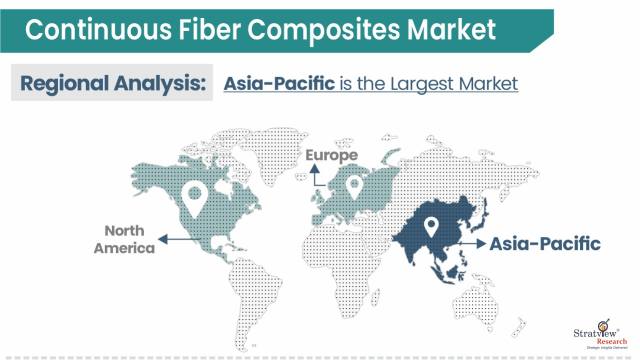
Asia-Pacific is likely to remain the largest market during the forecast period. |
The continuous fiber composites market is segmented into the form type as Woven Fabrics, Non-Crimp Fabrics, Unidirectional Tape, and Others. Woven fabric is projected to remain the most dominant form type in the market during the forecast period, driven by high usage in various end-use industries, including wind energy, automotive, and electronics. Non-crimp fabric occupied a considerable share of the market, driven by increased usage in wind energy. The fabric allows an easy flow of resin and provides good mechanical strength in multiple directions.
The unidirectional (UD) tape is likely to be the fastest-growing market over the next five years. UD tape offers the advantages of high impact strength, high mechanical strength in one direction, and excellent chemical and corrosion resistance. The fiber is gaining traction in the aerospace & defense and automotive industries.
Based on the reinforcement type, the continuous fiber composites market is segmented into Glass Fiber Composites, Carbon Fiber Composites, and Other Composites. Other composites mainly include aramid fiber composites. Glass fiber composite is projected to remain the most dominant segment of the market during the forecast period, driven by a wide array of advantages, including low cost, good mechanical performance, and excellent corrosion and abrasion resistance. The fiber mainly competes with metals including steel and aluminum and is considered an ideal material in highly cost-sensitive markets, such as wind energy, automotive, marine, and building & construction.
On the other side, carbon fiber composite is likely to witness the highest growth during the same period. Carbon fiber is catching the world's attention, driven by a host of factors, including the demand for lightweight materials in order to fulfill the stringent government regulations of different countries regarding fuel efficiency. Ongoing efforts for reducing the cost of carbon fiber further elevate its potential in many cost-sensitive industries. Carbon fiber offers a series of advantages in which the most important is an extreme lightweight coupled with excellent aesthetics.
Based on the end-use industry type, the continuous fiber composites market is segmented into Aerospace & Defense, Automotive, Wind Energy, Electronics, Sporting Goods, and Others. Wind energy is likely to maintain its dominance in the total continuous fiber composites market during the forecast period. Wind blades, spinners, and nacelles are the major composite applications in wind energy and are largely fabricated with glass fiber composites using continuous fiber composites. Increasing wind turbine installation across the globe is the prime driver for the demand for composites in this industry. China, India, the UK, Germany, and the USA are likely to remain the growth engines of the market for the segment over the next five years.
Aerospace & Defense and automotive are likely to be the fastest-growing markets during the forecast period, driven by an increasing penetration of composites in structural to semi-structural applications. Stringent regulations regarding the fuel efficiency enhancements are the major factors driving the demand for composites in these segments. All the major OEMs are introducing composite-rich vehicles and aircraft in order to meet the industry requirements. For instance, Boeing developed the B787 aircraft program, a next-generation aircraft, with 50% composite content of the total structural weight of the aircraft. Similarly, Airbus developed the A350XWB aircraft, another next-generation aircraft, with more than 50% composite content of the total aircraft’s structural weight.
Automotive is also following the footsteps of the A&D industry. Major automakers are working closely with composite industry stakeholders with regard to increasing the composite content in their upcoming vehicle models. For instance, BMW developed the BMW i3 vehicle using a carbon composite passenger cell. It is the world’s first mass-produced model in the auto industry with high carbon-composite content.
Based on the regions, Asia-Pacific is likely to remain the largest market during the forecast period, driven by China, India, and Japan. High installations of wind turbines, high automobile production, high electronic parts manufacturing, upcoming indigenous commercial and regional aircraft (COMAC C919 and Mitsubishi MRJ), and the opening of assembly plants of Boeing and Airbus in China are some of the major factors driving the demand for continuous fiber composites in the region.
Europe is likely to witness the highest growth during the same period, driven by the aerospace & defense and automotive industries. Europe is the manufacturing capital of premium and electric vehicles, where advanced composites are efficaciously gaining traction. All the major premium and electric automakers are increasingly increasing the composite content in order to address the EU norms regarding the carbon emission reduction targets. Furthermore, they would like to excel at the aerodynamics and aesthetics of their upcoming models. Increasing production rates of the A350XWB and A320 family, including neo versions, are further likely to boost the demand for continuous fiber composites of the region in the coming years.
Know the high-growth countries in this report. Register Here
The global continuous fiber composites market is highly competitive with the presence of a large number of global as well as regional players, in which some of the players are vertically integrated from fiber manufacturing to intermediate product manufacturing to composite parts manufacturing. Some of the major global players are Owens Corning Corporation, Saertex GmbH & Co. KG, Sekisui Jushi Corporation, Chomarat Group, Hexcel Corporation, Toray Industries, and SABIC Corporation.
Almost all the major players own distinct capabilities and are serving specific product segments. For instance, Owens Corning Corporation leads the woven textiles market, whereas Saertex GmbH spreads the non-crimp textiles market. It is important to note that this reduces the overall competition, as they do not have the presence in all the form types.
Most of the major players are focusing on the development of innovative products addressing existing as well as upcoming market requirements. At the same time, they have been forming strategic alliances, including mergers & acquisitions, joint ventures, and collaborations, to remain competitive and to quickly gain market share.
This strategic assessment report, from Stratview Research, provides a comprehensive analysis that reflects today’s continuous fiber composites market realities and future market possibilities for the forecast period of 2026 to 2032. After a continuous interest in our continuous fiber composites market report from the industry stakeholders, we have tried to further accentuate our research scope to the continuous fiber composites market to provide the most crystal-clear picture of the market. The report segments and analyses the market in the most detailed manner to provide a panoramic view of the market. The vital data/information provided in the report can play a crucial role for the market participants as well as investors in the identification of the low-hanging fruits available in the market as well as in the formulation of the growth strategies to expedite their growth process.
This report offers high-quality insights and is the outcome of a detailed research methodology comprising extensive secondary research, rigorous primary interviews with industry stakeholders, and validation and triangulation with Stratview Research’s internal database and statistical tools. More than 1000 authenticated secondary sources, such as company annual reports, fact books, press releases, journals, investor presentations, white papers, patents, and articles, have been leveraged to gather the data. We conducted more than 15 detailed primary interviews with the market players across the value chain in all four regions and industry experts to obtain both qualitative and quantitative insights.
This report provides market intelligence in the most comprehensive way. The report structure has been kept such that it offers maximum business value. It provides critical insights into market dynamics and will enable strategic decision-making for existing market players as well as those willing to enter the market. The following are the key features of the report:
This report studies the market, covering a period of 12 years of trends and forecasts. The report provides detailed insights into the market dynamics to enable informed business decision-making and growth strategy formulation based on the opportunities present in the market.
The continuous fiber composites market is segmented in the following ways:
By Form Type:
By Resin Type
By Reinforcement Type
By End-Use Industry Type
By Region
With this detailed report, Stratview Research offers one of the following free customization options to our respectable clients:
Company Profiling
Competitive Benchmarking
Custom Research: Stratview Research offers custom research services across sectors. In case of any custom research requirement related to market assessment, competitive benchmarking, sourcing and procurement, target screening, and others, please send your inquiry to [email protected].
The report is delivered digitally through our online portal. Buyers receive login credentials from our team to access the report and may update their credentials at any time after the initial login.
Delivery timelines depend on the status of the report:
For the most accurate delivery timeline, please contact us to confirm the current status of the report.
Yes. You may request a complimentary preview of the report through a video conference with our team.
Yes. The scope of the report can be fully customized to align with your specific research objectives and information requirements.
Please contact us at [email protected], and our team will be happy to discuss your requirements and propose a tailored solution.
Yes. Selected sections of the report can be purchased separately based on your requirements. Please contact us at [email protected] to discuss your needs.
Yes, AI can help gather publicly available information, but its outputs are only as reliable as the data it accesses. Stratview Research reports are built using validated data, extensive primary interviews with industry stakeholders, and the expertise of our experienced research team.
Additionally, many critical insights, including market dynamics, competitive intelligence, and industry-specific trends, are not publicly available and therefore cannot be captured through AI alone.
The continuous fiber composites market is likely to grow at a CAGR of 5.3% during 2026-2032.
The continuous fiber composites market was estimated at USD 2.9 billion in 2025.
The forecasted value of the continuous fiber composites market is expected to be USD 4.2 billion in 2032.
Owens Corning Corporation, Saertex GmbH & Co. KG, Sekisui Jushi Corporation, Chomarat Group, Hexcel Corporation, Toray Industries, and SABIC Corporation are among the key players in the market.
Asia-Pacific is expected to remain the largest market for continuous fiber composites during the next five years, driven by China, India, and Japan.
Wind energy is likely to remain the dominant end-use industry in the market in the coming years.
The growth of the continuous fiber composites market is driven by a host of factors, including organic growth of composite-rich end-use industries, including automotive and aerospace & defense; introduction of stringent government regulations regarding fuel efficiency enhancements and carbon emission reductions; and superior performance of continuous fiber composites over traditional metals, including aluminum and steel. Both glass and carbon fibers are increasingly used in various applications, owing to their distinct advantages.


WE ACCEPT