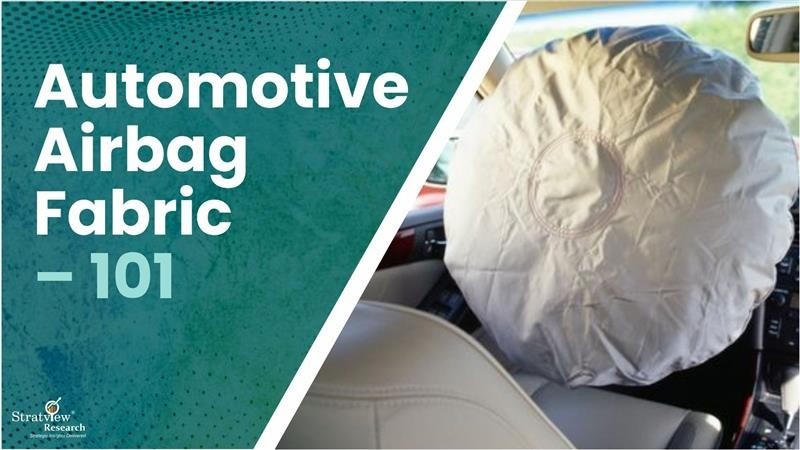
What Is Automotive Airbag Fabric?
Automotive airbag fabric is a high-performance technical textile engineered for use in vehicle airbag systems. It forms the structural enclosure of the airbag and is designed to deploy within milliseconds during a collision to protect vehicle occupants.
The fabric must withstand high mechanical loads, elevated temperatures generated during gas inflation, and long-term folded storage throughout the vehicle’s service life. At the same time, it must remain lightweight, compact, and dimensionally stable. These demanding requirements make airbag fabric a critical component in the overall performance of automotive restraint systems.
How Automotive Airbag Fabric Works: The Deployment Process
Airbag deployment follows a precisely controlled sequence that occurs within fractions of a second. While sensors and inflators initiate the process, the airbag fabric governs inflation behavior, energy absorption, and controlled deflation.
Crash Detection and System Activation- Crash sensors detect rapid deceleration and transmit signals to the airbag control unit (ACU). If the impact severity exceeds a predefined threshold, the system initiates deployment.
Inflator Ignition - An electrical signal activates the inflator, where a solid propellant generates a large volume of inert gas. The gas is filtered and cooled before entering the airbag to protect the fabric and ensure controlled inflation, typically at speeds approaching 200 mph.
Rapid Fabric Expansion - Within approximately 20–30 milliseconds, the folded airbag fabric expands and deploys through the module cover. During this stage, the fabric must tolerate high thermal and mechanical stress while maintaining structural integrity.
Occupant Cushioning - Once fully deployed, the airbag fabric absorbs and distributes impact forces across a larger surface area, reducing peak loads on the occupant and lowering injury risk.
Controlled Deflation - After impact, gas exits through calibrated vents in the fabric. This controlled deflation prevents rebound forces and allows occupant movement following the collision.
Completion of the Event - From crash detection to controlled deflation, the entire deployment sequence is completed well within one second, underscoring the importance of airbag fabric performance in occupant protection.
Material Composition and Structural Design of Automotive Airbag Fabrics
Automotive airbag fabrics are engineered using specific fiber materials, weave constructions, and surface treatments to meet safety, durability, and regulatory requirements.
Base Fiber Materials
-
Nylon 6,6 (Polyamide 66) - The dominant material used in airbag fabrics, Nylon 6,6 offers high tensile strength, thermal stability, abrasion resistance, and fatigue performance under repeated folding and rapid deployment conditions.
-
Polyester - Used selectively in certain applications where cost considerations or specific performance characteristics are required.
Among available options, Nylon 6,6 remains the preferred material due to its proven performance under extreme deployment conditions.
Coated vs. Uncoated Airbag Fabrics: Key Performance & Design Trade-offs
Automotive airbag fabrics are classified as coated or uncoated, depending on application-specific performance requirements.

Source - Stratview Research
Coated fabrics are preferred in applications requiring enhanced gas retention and thermal resistance, while uncoated fabrics are increasingly adopted for lightweighting and sustainability considerations.
Applications Across Vehicle Safety Systems
Airbag fabrics are used across multiple vehicle safety modules, including:
-
Driver and passenger frontal airbags
-
Side airbags for thorax protection
-
Curtain airbags for head protection
-
Knee airbags
-
Center airbags between front seats
As vehicle safety architectures become more complex, the number of airbags per vehicle continues to increase, supporting sustained demand for airbag fabrics.
Why Automotive Airbag Fabric Is Critical to Vehicle Safety
Automotive airbag fabrics are selected due to their ability to deliver:
-
High strength-to-weight performance
-
Thermal and mechanical stability during deployment
-
Consistent inflation and deflation behavior
-
Long-term durability under folded storage conditions
-
Compatibility with automated, high-volume manufacturing processes
These characteristics make airbag fabrics an essential component of modern automotive safety systems.
Future Outlook of Automotive Airbag Fabrics and Material Innovation
Automotive airbag fabric is not a passive textile, it is a precisely engineered safety material that directly determines deployment reliability and occupant protection. Its ability to withstand extreme heat, pressure, and mechanical stress within milliseconds makes it fundamental to the effectiveness of modern restraint systems.
As vehicles integrate more airbags and safety regulations tighten, airbag fabric performance is now dictated by material capability rather than system design. This reality underpins a global automotive airbag fabric market valued at USD 2.6 billion in 2024, which is on track to reach USD 3.5 billion by 2031, as advances in fiber chemistry, fabric architecture, and coating technologies directly determine how effectively future vehicles manage crash energy and protect occupants.
Subscribe to our newsletter
Related Blogs:
Automotive Nonwoven – 101 – How They’re Made, Used, and Why They Matter
.jpg)
Aircraft Interior Sandwich Panels – 101
.jfif)
Aircraft Floor Panel 101 - Designed for Safety, Not Visibility
Didn’t find what you were looking for?
Tell us about your requirements
(Our team usually responds within a few hours)