

Micro Electric Vehicle Market Analysis | 2025-2032

Micro Electric Vehicle Market Analysis | 2025-2032

Micro Electric Vehicle Market Analysis | 2025-2032
Report code - SR3298
Analyst: Jagriti Lal Delivery - 2 Weeks
Micro Electric Vehicle Market Size, Share, Trends, Dynamics, Forecast, & Growth Analysis: 2025-2032
See less...

Attractive Opportunities

Global Demand Analysis & Sales Opportunities in Micro Electric Vehicle Market

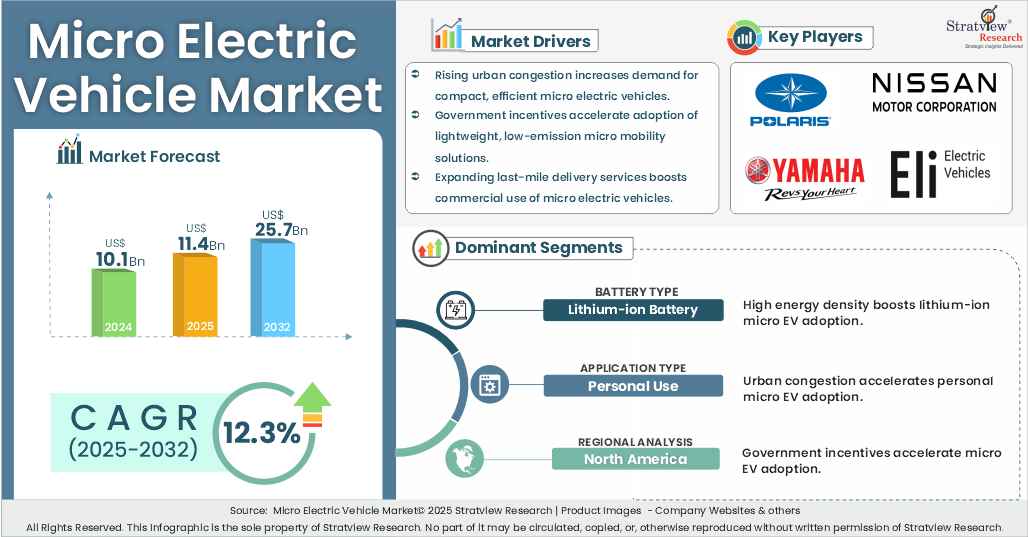
  • The annual demand for micro electric vehicle was USD 10.1 billion in 2024 and is expected to reach USD 11.4 billion in 2025, up 12.7% than the value in 2024.
  • During the next 8 years (forecast period of 2025-2032), the micro electric vehicle market is expected to grow at a CAGR of 12.3%. The annual demand will reach USD 25.7 billion in 2032, which is more than 2 times the demand in 2025.
  • During 2025-2032, the micro electric vehicle industry is expected to generate a cumulative sales opportunity of USD 142.0 billion, which is more than 3 times the opportunities during 2019-2024.

Micro-Electric-Vehicle-Market-Attractive-Opportunities

Want to get a free sample? Register Here

High-Growth Market Segments:

  • North America is expected to be the dominant and fastest-growing region over the forecasted period.
  • By type, Golf Cart segment is expected to be the fastest-growing segment of the micro EV market during the forecast period.
  • By battery type, Lithium-ion Battery segment accounted for the largest market share in 2024 and is further expected to be the fastest-growing segment during the forecast period.
  • By application type, Personal Use segment is expected to be the fastest-growing segment of the micro electric vehicle market during the forecast period.

Market Statistics

Have a look at the sales opportunities presented by the micro electric vehicle market in terms of growth and market forecast.

Micro Electric Vehicle Market Data & Statistics

Market Statistics

Value (in USD Billion)

Market Growth (%)

Annual Market Size in 2023

USD 8.9 billion

-

Annual Market Size in 2024

USD 10.1 billion

YoY Growth in 2024: 12.9%

Annual Market Size in 2025

USD 11.4 billion

YoY Growth in 2025: 12.7%

Annual Market Size in 2032

USD 25.7 billion

CAGR 2025-2032: 12.3%

Cumulative Sales Opportunity during 2025-2032

USD 142.0 billion

  •  

Top 10 Countries’ Market Share in 2024

USD 8.0 billion +

> 80%

Top 10 Company’s Market Share in 2024

USD 5.0 billion to USD 7.0 billion

 50% - 70%

Market Dynamics

Introduction:

What is a micro electric vehicle?

A micro electric vehicle (micro EV) is a short-distance battery-powered vehicle for urban commuting. Smaller than a conventional electric vehicle, micro EVs are energy-efficient, have lower emissions, and offer convenient parking in denser urban environments. Micro EVs are ideally suited for last-mile mobility, urban driving, and closed-environment applications such as campuses and industrial parks.

Market Drivers:

Rising Urban Congestion and Demand for Compact Mobility

Increasing urbanization, traffic congestion, and limited parking are driving market growth for micro electric vehicles as consumers seek compact and economical transportation for short-distance travel. Their small footprint, lower operating costs, and zero tailpipe emissions make them suitable for dense cities, campuses, and short urban trips, where conventional passenger vehicles can be inefficient.

  • According to the International Energy Agency (IEA), global electric car sales exceeded 20 million units in 2025, representing around 25% of new car sales worldwide. The rapid expansion of electric mobility is encouraging manufacturers to diversify their portfolios toward smaller and more affordable vehicle formats, creating favorable conditions for micro electric vehicles in urban markets.

Government Support for Electric Mobility

Government purchase incentives, zero-emission vehicle targets, and domestic EV manufacturing programs are improving the affordability and availability of electric vehicles. These policies are also encouraging automakers to expand electric offerings across different vehicle sizes and price points, strengthening market demand for micro electric vehicles as governments seek cost-effective solutions for urban decarbonization.

  • The Government of India introduced several initiatives in 2024 to accelerate electric mobility and strengthen the domestic EV ecosystem. The PM E-DRIVE Scheme, notified in September 2024 with an outlay of ₹10,900 crore, provides demand incentives for electric two- and three-wheelers while supporting charging infrastructure and EV testing facilities. The scheme is expected to support 24.79 lakh e-2Ws and 3.16 lakh e-3Ws, improving affordability and encouraging adoption of compact electric mobility solutions.

Expansion of Urban Charging Infrastructure

The expansion of public charging networks is improving the practicality of micro EVs for daily commuting and commercial applications. Since these vehicles generally require smaller battery packs and shorter driving ranges than conventional passenger EVs, strategically located charging infrastructure can support frequent urban trips while reducing range-related concerns. This infrastructure expansion is strengthening market growth by making electric mobility more accessible to urban users.

  • According to the IEA, nearly 1.8 million public charging points were added globally in 2025, bringing the total number of public chargers to more than 7 million. The growing charging network is improving accessibility for electric vehicle users and creating a stronger infrastructure base for micro EV deployment.

  • According to Government of India, India’s expanding charging infrastructure is improving the practicality of electric mobility and supporting the adoption of compact electric vehicles for urban commuting. As of July 2024, the country had 16,344 public EV charging stations and 27,471 public charging points, including 10,756 fast-charging points, according to the Government of India.

  • In 2024, China added more than 4.22 million EV charging poles, bringing the national total to 12.82 million, up 49.1% year over year. Public charging poles reached approximately 3.58 million, according to the Chinese government.The rapid expansion of charging infrastructure is improving the practicality of micro electric vehicles for daily urban mobility. 

Market Challenges:

Uneven Charging Accessibility in Urban Areas

Despite rapid charging infrastructure expansion, access remains uneven across cities and residential locations. Consumers living in apartments or areas without dedicated parking may have limited access to home charging and depend on public infrastructure, which can reduce the convenience of micro EV ownership and constrain market demand in underserved locations.

Battery Costs and Critical Mineral Supply Risks

Battery costs remain a challenge for micro EV manufacturers because the segment competes strongly on affordability. Volatility in lithium, graphite, nickel, and other battery materials can increase manufacturing costs and limit manufacturers' ability to maintain competitive vehicle prices. These supply-chain pressures can therefore restrict market growth, particularly in price-sensitive developing economies.

  • According to the IEA, demand for lithium, nickel, graphite, and other critical minerals is continuing to rise alongside clean-energy technologies. Concentrated mining and processing capacity leaves battery supply chains exposed to disruptions, increasing cost and procurement risks for electric vehicle manufacturers.

Safety and Performance Limitations

Micro EVs can face consumer concerns regarding crash protection, driving range, acceleration, and highway performance compared with conventional passenger vehicles. Their compact and lightweight designs are advantageous for urban transportation but can restrict their use outside city environments. Manufacturers must therefore improve safety and performance without significantly increasing vehicle weight or purchase costs, creating a challenge for market development.

  • According to the European Commission, new vehicle safety requirements under the EU's General Safety Regulation include technologies such as intelligent speed assistance, reversing detection, and event data recording. These requirements increase the technology and compliance burden for manufacturers developing compact electric vehicles.

Market Opportunities

Expansion of Last-Mile Delivery and Commercial Fleets

The growth of e-commerce, urban deliveries, and service-based fleets is creating new market opportunities for purpose-built micro EVs. Their compact dimensions enable easier maneuverability and parking in congested areas, while lower energy consumption and operating costs can improve fleet economics for repetitive short-distance routes.

  • According to the IEA, global electric light-commercial vehicle sales increased by approximately 40% in 2024. Rising electrification among commercial fleets is expanding demand for compact electric platforms and creating opportunities for micro EVs in urban delivery and service applications.

Development of Battery-Swapping and Fast-Charging Solutions

Battery-swapping and fast-charging technologies can reduce vehicle downtime and improve utilization, particularly for commercial and shared-mobility fleets. Battery swapping is especially relevant to small electric vehicles because standardized, compact battery packs can be exchanged quickly without requiring long charging periods. This market trend could support higher utilization rates and create new business models around micro EVs.

  • According to the IEA, China had more than 3,000 battery-swapping stations by the end of 2024, demonstrating the increasing deployment of alternative charging models. The expansion of battery-swapping infrastructure provides opportunities for micro EV manufacturers to develop vehicles compatible with standardized and rapidly exchangeable battery systems.

Integration With Shared and Connected Urban Mobility

The integration of shared mobility, intelligent transportation systems, digital payments, and connected fleet management is creating opportunities for micro EVs within smart-city transportation networks. Their compact size makes them suitable for first- and last-mile journeys, car-sharing, and short-distance trips around transit hubs. As cities seek to reduce congestion and emissions, connected micro EVs can complement public transportation while improving access to zero-emission urban mobility.

  • According to the European Environment Agency, European cities are increasingly adopting shared mobility and zero-emission transport measures as part of sustainable urban mobility strategies. The expansion of low-emission zones and shared transportation services is creating opportunities for compact electric vehicles to serve short-distance urban travel and first- and last-mile connectivity. 

Segments' Analysis

Segmentations

List of Sub-Segments

Segments with High-Growth Opportunity

Type Analysis

Quadricycle and Golf Carts

Golf Cart segment is expected to be the fastest-growing segment of the micro EV market during the forecast period.

Battery Analysis

Lithium-ion Battery and Lead-acid Battery

Lithium-ion Battery segment accounted for the largest market share in 2024 and is further expected to be the fastest-growing segment during the forecast period.

Application Analysis

Commercial Use, Public Utilities, and Personal Use

Personal Use segment is expected to be the fastest-growing segment of the micro electric vehicle market during the forecast period.

Regional Analysis

North America, Europe, Asia-Pacific, and The Rest of the World

North America is expected to be the dominant and fastest-growing region over the forecasted period.

By Battery Type 

“Lithium-ion Battery segment accounted for the largest market share in 2024 and is further expected to be the fastest-growing segment during the forecast period.”

  • The micro electric vehicle market is segmented by battery type into lithium-ion battery and lead-acid battery.
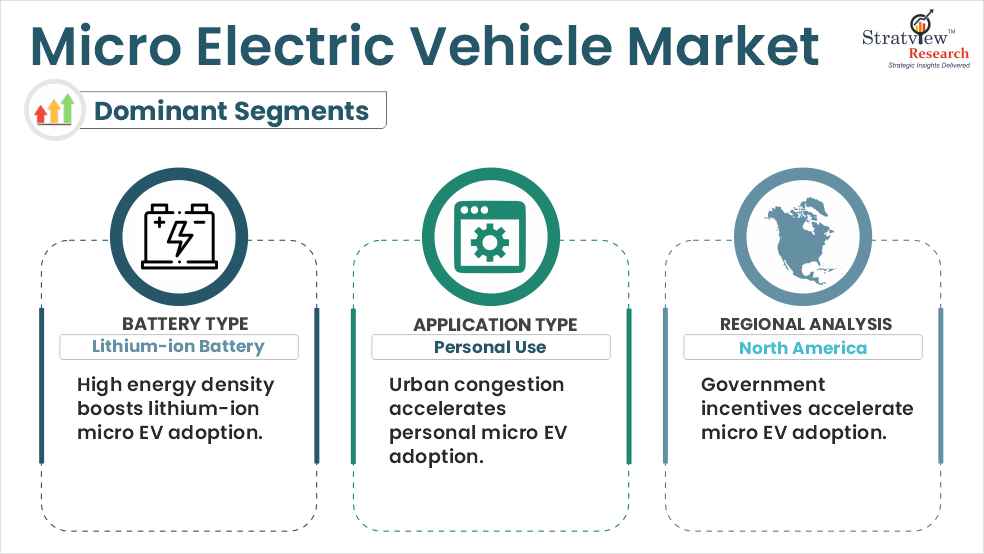
  • Lithium-ion Battery segment accounted for the largest market share in 2024 and is further expected to be the fastest-growing segment during the forecast period, due to their longer lifespan, superior energy density, and faster charging capabilities compared to traditional battery types.
  • Moreover, declining battery costs and advancements in lithium-ion technology are boosting micro EV performance and range, enhancing their suitability for urban commuting and commercial use while supporting eco-friendly transportation goals.

By Application Type 

“Personal Use segment is expected to be the fastest-growing segment of the micro electric vehicle market during the forecast period.”
  • The micro electric vehicle market is segmented by application type into commercial use, public utilities, and personal use.
  • Personal Use segment is expected to be the fastest-growing segment of the micro electric vehicle market during the forecast period, due to rising demand for affordable, eco-friendly, and compact transportation solutions, particularly in urban areas.
  • Increasing traffic congestion, limited parking space, and growing environmental awareness are prompting individuals to adopt micro EVs for daily commuting. Moreover, improved vehicle design, longer battery range, and lower operating costs enhance their appeal.
  • Additionally, government incentives and changing consumer preferences toward sustainable personal mobility further contribute to the rapid growth of this segment.

Micro-Electric-Vehicle-Market-Segment-Analysis-By-Application-Type

Want to get more details about the segmentations? Register Here

Regional Insights

“North America is expected to be the dominant and fastest-growing region over the forecasted period.

  • In terms of region, the micro electric vehicle market is segmented into the North American region, the European region, the Asia-Pacific region, and the rest of the world.
  • North America is expected to be the dominant and fastest-growing region over the forecasted period, due to increasing urbanization, rising environmental awareness, and strong governmental support for sustainable transportation.

  • Initiatives such as tax incentives, infrastructure investments, and emission reduction targets are encouraging the adoption of micro EVs.
  • Additionally, the region's well-established technological landscape, growing demand for last-mile mobility solutions, and rising fuel costs are driving consumer interest.

Competitive Landscape

Most of the major players compete in some of the factors, including price, service offerings, regional presence, etc. The following are the key players in the micro electric vehicles market:

  • Citroen
  • Club Car
  • Micro Mobility System AG (Microlino)
  • Nissan Motor
  • Polaris
  • Toyota Motor Corporation
  • Yamaha Motor
  • Eli Electric Vehicles
  • GEM (Waev Inc.)
  • ICON Electric Vehicles

Note: The above list does not necessarily include all the top players in the market.

Are you a leading player in this market? We would love to include your name. Please write to us at [email protected]

Recent Developments/Mergers & Acquisitions:

  • In May 2024, Eli Electric Vehicles entered the U.S. market with the debut of the Eli ZERO, a micro electric vehicle aimed at easing urban congestion and enhancing everyday commuting. This compact, zero-emission EV combines space efficiency with advanced automotive technology and high-end features usually reserved for larger vehicles, offering a modern and sustainable urban mobility solution. 
  • In April 2024, Geely launched the updated Panda Mini EV in China, tailored for city driving. Featuring a bold, motorsport-inspired body kit, the new design boosts both aerodynamics and aesthetic appeal. With this release, Geely targets the rising consumer preference for sleek, space-efficient electric vehicles that align with the lifestyle and needs of urban residents.

Report Features

This report provides market intelligence most comprehensively. The report structure has been kept so that it offers maximum business value. It provides critical insights into market dynamics and will enable strategic decision-making for existing market players as well as those willing to enter the market.

The following are the key features of the report:

  • Market structure: Overview, industry life cycle analysis, supply chain analysis.
  • Market environment analysis: Growth drivers and constraints, Porter’s five forces analysis, SWOT analysis.
  • Market trend and forecast analysis.
  • Market segment trend and forecast.
  • Competitive landscape and dynamics: Market share, Service portfolio, New Product Launches, etc.
  • COVID-19 impact and its recovery curve.
  • Attractive market segments and associated growth opportunities.
  • Emerging trends.
  • Strategic growth opportunities for the existing and new players.
  • Key success factors.

Market Study Period

2019-2032

Base Year

2024

Forecast Period

2025-2032

Trend Period

2019-2023

Number of Tables & Figures

>100

Number of Segments Analysed

4 (Type, Battery Type, Application Type, and Region)

Number of Regions Analysed

4 (North America, Europe, Asia-Pacific, Rest of the World)

Countries Analysed

15 (The USA, Canada, Mexico, Germany, France, Italy, The UK, China, Japan, India, Brazil, Saudi Arabia, Rest of Europe, Rest of APAC, and Rest of the World)

Free Customization Offered

10%

After Sales Support

Unlimited

Report Presentation

Complimentary

Market Dataset

Complimentary

Further Deep Dive & Consulting Services

10% Discount

Market Segmentation 

This report studies the market, covering a period of 15 years of trend and forecast. The report provides detailed insights into the market dynamics to enable informed business decision-making and growth strategy formulation based on the opportunities present in the market.

The micro electric vehicle market is segmented into the following categories.

By Type

  • Quadricycle
  • Golf Carts

By Battery Type

  • Lithium-ion Battery
  • Lead-acid Battery

By Application Type

  • Commercial Use
  • Public Utilities
  • Personal Use

By Region

  • North America (Country Analysis: The USA, Canada, and Mexico)
  • Europe (Country Analysis: Germany, France, Italy, The UK, and Rest of Europe)
  • Asia-Pacific (Country Analysis: Japan, China, India, and Rest of Asia-Pacific)
  • Rest of the World (Country Analysis: Brazil, Saudi Arabia, and Others)

Research Methodology

  • This strategic assessment report from Stratview Research provides a comprehensive analysis that reflects today’s micro electric vehicle market realities and future market possibilities for the forecast period.
  • The report segments and analyzes the market in the most detailed manner to provide a panoramic view of the market.
  • The vital data/information provided in the report can play a crucial role for market participants and investors in identifying the low-hanging fruits available in the market and formulating growth strategies to expedite their growth process.
  • This report offers high-quality insights and is the outcome of a detailed research methodology comprising extensive secondary research, rigorous primary interviews with industry stakeholders, and validation and triangulation with Stratview Research’s internal database and statistical tools.
  • More than 1,000 authenticated secondary sources, such as company annual reports, fact books, press releases, journals, investor presentations, white papers, patents, and articles, have been leveraged to gather the data.
  • We conducted more than 15 detailed primary interviews with market players across the value chain in all four regions and industry experts to obtain both qualitative and quantitative insights.

Report Customization Options

With this detailed report, Stratview Research offers one of the following free customization options to our respected clients:

Company Profiling

  • Detailed profiling of additional market players (up to three players)
  • SWOT analysis of key players (up to three players)

Competitive Benchmarking

  • Benchmarking of key players on the following parameters: Service portfolio, geographical reach, regional presence, and strategic alliances

Custom Research: Stratview Research offers custom research services across industries. In case of any custom research requirement related to market assessment, competitive benchmarking, sourcing and procurement, target screening, and others, please send your inquiry to [email protected]

Frequently Asked Questions (FAQs)

The report is delivered digitally through our online portal. Buyers receive login credentials from our team to access the report and may update their credentials at any time after the initial login.

Delivery timelines depend on the status of the report:

  • Published reports are typically delivered within 24 hours.
  • If the dataset is ready but the report is still being prepared, the dataset is usually delivered within 24 hours, while the completed report is delivered within 2 weeks.
  • For ongoing studies, both the dataset and the final report are generally delivered within 4–5 weeks .

For the most accurate delivery timeline, please contact us to confirm the current status of the report.

Yes. You may request a complimentary preview of the report through a video conference with our team.

Yes. The scope of the report can be fully customized to align with your specific research objectives and information requirements.
Please contact us at [email protected], and our team will be happy to discuss your requirements and propose a tailored solution.

Yes. Selected sections of the report can be purchased separately based on your requirements. Please contact us at [email protected] to discuss your needs.

Yes, AI can help gather publicly available information, but its outputs are only as reliable as the data it accesses. Stratview Research reports are built using validated data, extensive primary interviews with industry stakeholders, and the expertise of our experienced research team.

Additionally, many critical insights, including market dynamics, competitive intelligence, and industry-specific trends, are not publicly available and therefore cannot be captured through AI alone.

The micro electric vehicle (micro EV) market refers to the industry segment focused on the production, distribution, and adoption of small, battery-powered electric vehicles designed primarily for short-distance travel and urban mobility. These vehicles typically feature compact designs, low speeds, and zero emissions, making them ideal for congested city environments, last-mile connectivity, and specialized uses such as campus or industrial transport. The market encompasses various vehicle types, including microcars, quadricycles, and neighbourhood electric vehicles (NEVs).

The forecasted value for the market is US$ 25.7 billion in 2032.

Micro electric vehicle market size was USD 10.1 billion in 2024 and is expected to grow from USD 11.4 billion in 2025 to USD 25.7 billion in 2032, witnessing an impressive market growth (CAGR) of 12.3% during the forecast period (2025-2032).

The key drivers of the micro electric vehicle market include urbanization and traffic congestion, environmental regulations and advancements in battery technology.

The top players in the micro electric vehicle market include • Citroen • Club Car • Micro Mobility System AG (Microlino) • Nissan Motor • Polaris

North America is expected to be the dominant and fastest-growing region over the forecasted period, due to increasing urbanization, rising environmental awareness, and strong governmental support for sustainable transportation.