




404
+1-313-307-4176

Electric Vehicle Aftermarket Market Analysis | 2025-2032

Electric Vehicle Aftermarket Market Size, Share, Trends, Dynamics, Forecast, & Growth Analysis: 2025-2032
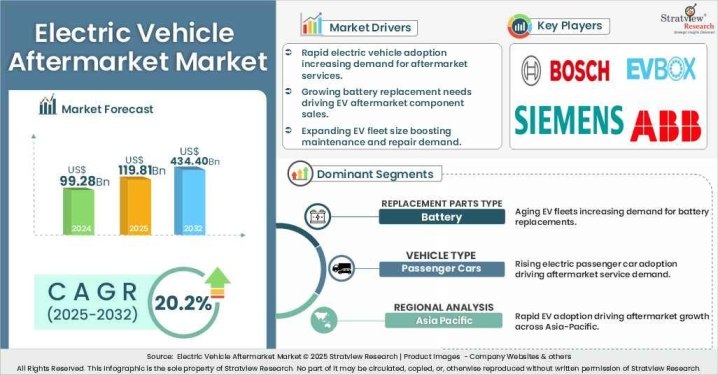
"Electric vehicle aftermarket market size was USD 99.28 billion in 2024.”
Wish to get a free sample report? Click Here
Have a look at the sales opportunities presented by the electric vehicle aftermarket market in terms of growth and market forecast.
|
Electric Vehicle Aftermarket Market Data & Statistics |
||
|
Market Statistics |
Value (in USD Billion) |
Market Growth (%) |
|
Annual Market Size in 2023 |
USD 82.25 billion |
- |
|
Annual Market Size in 2024 |
USD 99.28 billion |
YoY Growth in 2024: 20.9% |
|
Annual Market Size in 2025 |
USD 119.81 billion |
YoY Growth in 2025: 20.6% |
|
Annual Market Size in 2032 |
USD 434.40 billion |
CAGR 2025-2032: 20.2% |
|
Cumulative Sales Opportunity during 2025-2032 |
USD 1998.11 billion |
|
|
Top 10 Countries’ Market Share in 2024 |
USD 80 billion + |
> 80% |
|
Top 10 Company’s Market Share in 2024 |
USD 50 billion to USD 70 billion |
50% - 70% |
The electric vehicle (EV) aftermarket refers to the secondary market of products and services related to EVs after their initial sale. This includes replacement parts, accessories, battery upgrades, maintenance, repair services, and software enhancements. As EV adoption grows, the aftermarket plays a vital role in ensuring vehicle longevity, performance optimization, and supporting evolving consumer needs and preferences.
The electric vehicle aftermarket is experiencing significant growth due to the expanding global EV fleet and the increasing need for maintenance, repair, diagnostics, software updates, and battery-related services.
Applications of aftermarket services are expanding rapidly across passenger vehicles, commercial fleets, and shared mobility platforms, driven by strong market demand for cost-effective repairs, predictive maintenance, and battery lifecycle management. A key market trend shaping the industry is the growing adoption of connected vehicle technologies and digital service platforms, which is accelerating the development of advanced EV aftermarket solutions globally.
Growing Global EV Parc Expanding the Serviceable Aftermarket:
The rapid expansion of the global electric vehicle fleet is significantly increasing the size of the serviceable aftermarket. As more EVs enter circulation and transition beyond warranty periods, demand is rising for replacement parts, diagnostics, software updates, and maintenance services. This expanding installed base is gradually strengthening the independent EV servicing ecosystem and increasing aftermarket monetization opportunities across global markets.
According to the International Energy Agency (IEA), global electric car sales are projected to exceed 20 million units in 2025, accounting for more than 25% of total car sales worldwide. The rapid growth in EV adoption is expanding the overall vehicle parc, directly increasing long-term demand for aftermarket services including repairs, component replacement, and diagnostic solutions.
Digitalization and OTA-Enabled Service Ecosystems
The increasing integration of connectivity, telematics, and software-defined vehicle architectures is transforming the electric vehicle aftermarket. Connected EVs increasingly depend on over-the-air (OTA) updates, remote diagnostics, predictive maintenance, and real-time vehicle monitoring, enabling aftermarket service providers to expand beyond traditional repair activities and offer software-based and subscription-driven services.
The U.S. Department of Energy (DOE) reports ongoing industry efforts to reduce EV charging times to less than 15 minutes through advancements in battery technologies and charging infrastructure. As EVs become increasingly software-controlled and connected, demand for remote monitoring, predictive maintenance, battery management, and advanced diagnostic services is expected to grow across the aftermarket ecosystem.
High Cost of Battery Repair and Replacement
Despite ongoing declines in battery prices, battery packs remain the most expensive component in electric vehicles, making repairs and replacements costly for vehicle owners. High battery-related expenses can discourage post-warranty repairs, reduce vehicle retention rates, and limit the participation of independent aftermarket service providers that may lack the resources to offer cost-competitive battery solutions.
The DOE's Battery500 Consortium and related battery initiatives target battery pack costs of less than USD 75/kWh by 2030, highlighting that further cost reductions are still required before battery replacement becomes economically accessible for a broader segment of EV owners. Until then, high battery repair and replacement costs are expected to constrain market demand for certain aftermarket services.
Limited Availability of Skilled Technicians
Servicing high-voltage systems requires specialized tools, safety certifications, and technical expertise. Many traditional repair shops lack adequately trained personnel, slowing aftermarket expansion. The growing global EV fleet necessitates workforce development initiatives to support maintenance requirements as adoption accelerates. IEA emphasizes the need for ecosystem readiness alongside vehicle deployment.
OEM Control Over Proprietary Systems
Automakers increasingly retain control over diagnostic software, battery management systems, and proprietary repair procedures, limiting access for independent service providers. The increasing integration of software-defined vehicle architectures requires advanced diagnostic capabilities beyond conventional repair practices.
The growing adoption of battery refurbishment, remanufacturing, and second-life applications is creating new revenue opportunities across the EV aftermarket. As more EV batteries reach the end of their automotive life, demand for battery lifecycle management services is expected to support EV aftermarket market growth.
According to the International Energy Agency (IEA), global EV battery demand exceeded 1 TWh in 2024, reflecting continued growth in battery deployment and expanding the future pool of batteries available for refurbishment and second-life applications.
In 2025, Redwood Materials deployed a 12 MW/63 MWh energy storage system using retired EV batteries, demonstrating the increasing commercial viability of battery repurposing and second-life battery services.
Emergence of Specialized EV Service Networks
The growing complexity of electric vehicles is creating opportunities for specialized EV-focused service networks that offer battery diagnostics, software updates, predictive maintenance, and subscription-based service packages. As the global EV fleet expands, independent service providers are increasingly positioned to address growing maintenance requirements beyond traditional OEM networks, supporting the electric vehicle aftermarket market forecast.
According to the International Energy Agency (IEA), global electric vehicle sales increased by 35% year-over-year in the first quarter of 2025, with more than 4 million EVs sold during the period. The growing vehicle parc is expected to increase future demand for specialized maintenance and repair services.
Growth in Predictive Maintenance and Telematics Solution
Advancements in telematics, remote monitoring, and AI-driven diagnostics are transforming maintenance practices across the EV aftermarket. These technologies enable proactive servicing, reduce vehicle downtime, and improve operational efficiency, supporting the electric vehicle aftermarket market forecast.
In 2025, the U.S. Department of Energy's National Renewable Energy Laboratory (NREL) highlighted mobility datasets covering more than 760,000 drivers, demonstrating the increasing use of large-scale vehicle data analytics to improve charging infrastructure planning, vehicle performance monitoring, and predictive maintenance capabilities across EV ecosystems.
|
Segmentations |
List of Sub-Segments |
Segments with High-Growth Opportunity |
|
Replacement Parts Analysis |
Tire, Battery, Brake Parts, Filters, Body Parts, Lighting & Electronic Components, and Wheels |
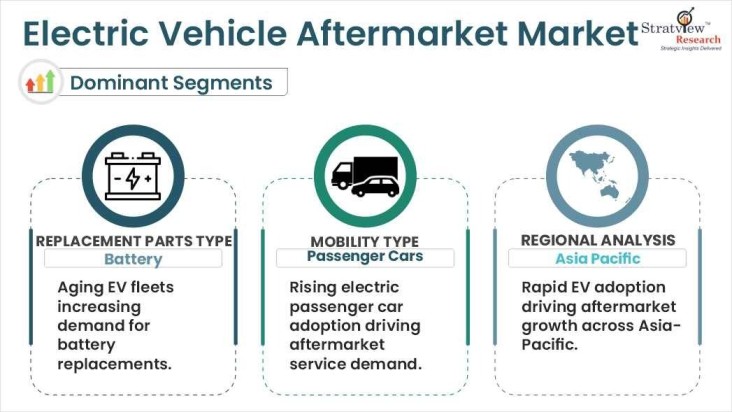
Battery segment is expected to have the largest share of the electric vehicle aftermarket during the forecast period. |
|
Propulsion Analysis |
Battery Electric Vehicles, Hybrid Electric Vehicles, Fuel Cell Electric Vehicles, and Plug-In Hybrid Electric Vehicles |
Battery Electric Vehicles segment is projected to be the fastest-growing segment of the electric vehicle aftermarket during the forecast period. |
|
Vehicle Analysis |
Passenger Cars and Commercial Vehicles |
Passenger Cars segment is expected to have the largest share of the electric vehicle aftermarket during the forecast period. |
|
Distribution Channel Analysis |
Retailers and Wholesaler/Distributors |
Retailers segment is expected to have the largest share of the electric vehicle aftermarket during the forecast period. |
|
Regional Analysis |
North America, Europe, Asia-Pacific, and The Rest of the World |
Asia Pacific is expected to be the dominant and fastest-growing region over the forecasted period. |
“Battery segment is expected to have the largest share of the electric vehicle aftermarket during the forecast period.”
“Passenger Cars segment is expected to have the largest share of the electric vehicle aftermarket during the forecast period.”
Want to get more details about the segmentations? Register Here
“Asia-Pacific is expected to be the dominant and the fastest-growing region over the forecasted period.”
Most of the major players compete in some of the factors, including price, service offerings, regional presence, etc. The following are the key players in the electric vehicle aftermarket market:
Note: The above list does not necessarily include all the top players in the market.
Are you a leading player in this market? We would love to include your name. Please write to us at [email protected]
In October 2025, WEG agreed to acquire a 54% stake in Brazilian EV charging platform Tupi Mob for approximately BRL 38 million (US$7 million). The acquisition expands WEG's EV charging and digital service capabilities. At the time of the transaction, Tupi Mob's platform connected more than 370,000 users and had supported over 1.3 million charging sessions.
In January 2025, American Axle & Manufacturing (AAM) agreed to acquire Dowlais Group, the parent company of GKN Automotive, for approximately US$1.44 billion in cash and shares. The acquisition strengthens AAM's portfolio of electric drive systems, side shafts, propshafts, and other components that will increasingly support the EV aftermarket and remanufacturing sector.
In July 2026, MAHLE introduced its Battery Workshop Support system and a new digital workshop portal ahead of Automechanika Frankfurt 2026. The solution communicates directly with installed or removed high-voltage battery packs through the CAN interface, providing diagnostic results within minutes to support battery repair-versus-replacement decisions.
In October 2025, Valeo began production of a remanufactured high-voltage inverter for the Renault ZOE, manufactured with THE REMAKERS at the Flins Refactory. The program expands affordable replacement options for EV power electronics while demonstrating the commercial viability of OEM-standard high-voltage remanufacturing.
This report provides market intelligence most comprehensively. The report structure has been kept so that it offers maximum business value. It provides critical insights into market dynamics and will enable strategic decision-making for existing market players as well as those willing to enter the market.
The following are the key features of the report:
|
Market Study Period |
2019-2032 |
|
Base Year |
2024 |
|
Forecast Period |
2025-2032 |
|
Trend Period |
2019-2023 |
|
Number of Tables & Figures |
>100 |
|
Number of Segments Analysed |
5 (Replacement Parts Type, Propulsion Type, Vehicle Type, Distribution Channel Type, and Region) |
|
Number of Regions Analysed |
4 (North America, Europe, Asia-Pacific, Rest of the World) |
|
Countries Analysed |
15 (The USA, Canada, Mexico, Germany, France, Italy, The UK, China, Japan, India, Brazil, Saudi Arabia, Rest of Europe, Rest of APAC, and Rest of the World) |
|
Free Customization Offered |
10% |
|
After Sales Support |
Unlimited |
|
Report Presentation |
Complimentary |
|
Market Dataset |
Complimentary |
|
Further Deep Dive & Consulting Services |
10% Discount |
This report studies the market, covering a period of 15 years of trend and forecast. The report provides detailed insights into the market dynamics to enable informed business decision-making and growth strategy formulation based on the opportunities present in the market.
The electric vehicle aftermarket market is segmented into the following categories.
By Replacement Parts Type
By Propulsion Type
By Vehicle Type
By Distribution Channel Type
By Region
With this detailed report, Stratview Research offers one of the following free customization options to our respected clients:
Company Profiling
Competitive Benchmarking
Custom Research: Stratview Research offers custom research services across industries. In case of any custom research requirement related to market assessment, competitive benchmarking, sourcing and procurement, target screening, and others, please send your inquiry to [email protected]
The report is delivered digitally through our online portal. Buyers receive login credentials from our team to access the report and may update their credentials at any time after the initial login.
Delivery timelines depend on the status of the report:
For the most accurate delivery timeline, please contact us to confirm the current status of the report.
Yes. You may request a complimentary preview of the report through a video conference with our team.
Yes. The scope of the report can be fully customized to align with your specific research objectives and information requirements.
Please contact us at [email protected], and our team will be happy to discuss your requirements and propose a tailored solution.
Yes. Selected sections of the report can be purchased separately based on your requirements. Please contact us at [email protected] to discuss your needs.
Yes, AI can help gather publicly available information, but its outputs are only as reliable as the data it accesses. Stratview Research reports are built using validated data, extensive primary interviews with industry stakeholders, and the expertise of our experienced research team.
Additionally, many critical insights, including market dynamics, competitive intelligence, and industry-specific trends, are not publicly available and therefore cannot be captured through AI alone.
The electric vehicle (EV) aftermarket refers to the market for parts, services, and accessories used to maintain, repair, upgrade, or customize electric vehicles after their initial sale. This includes battery replacements, software updates, charging accessories, tires, and specialized maintenance services. The EV aftermarket supports vehicle longevity, performance, and personalization, and plays a crucial role as global EV adoption continues to grow.
The forecasted value for the market is US$ 434.40 billion in 2032.
Electric vehicle aftermarket market size was USD 99.28 billion in 2024 and is expected to grow from USD 119.81 billion in 2025 to USD 434.40 billion in 2032, witnessing an impressive market growth (CAGR) of 20.2% during the forecast period (2025-2032).
The key drivers of the electric vehicle aftermarket market include rapid adoption of EVs, customization and accessory demand, and supportive government policies.
The top players in the electric vehicle aftermarket market include • 3M • ABB Ltd. • EVBox Group • ChargePoint Inc. • Siemens AG • Bosch Automotive Sevrice Solution Inc.
Asia-Pacific is expected to be the dominant and fastest-growing region over the forecasted period, driven by increasing EV adoption, supportive government policies, a well-established EV manufacturing base, and significant investments in charging infrastructure.


WE ACCEPT