




404
+1-313-307-4176

DERMS Market Analysis | 2025-2032

DERMS Market Size, Share, Trends, Dynamics, Forecast, & Growth Analysis: 2025-2032
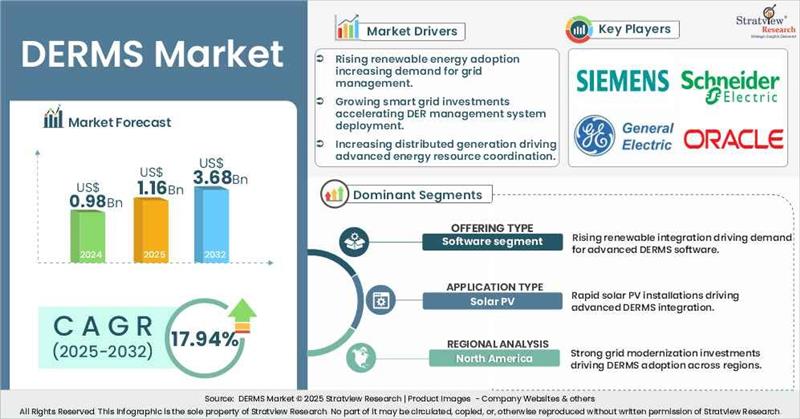
"DERMS market size was USD 0.98 billion in 2024.”
Want to get a free sample? Register Here
Have a look at the sales opportunities presented by the DERMS market in terms of growth and market forecast.
DERMS Market Data & Statistics
|
Market Statistics |
Value (in USD Billion) |
Market Growth (%) |
|
Annual Market Size in 2023 |
USD 0.83 billion |
|
|
Annual Market Size in 2024 |
USD 0.98 billion |
YoY Growth in 2024: 18.3% |
|
Annual Market Size in 2025 |
USD 1.16 billion |
YoY Growth in 2025: 18.4% |
|
Annual Market Size in 2032 |
USD 3.68 billion |
CAGR 2025-2032: 17.94% |
|
Cumulative Sales Opportunity during 2025-2032 |
USD 17.81 billion |
|
|
Top 10 Countries’ Market Share in 2024 |
USD 0.78 billion + |
> 80% |
|
Top 10 Company’s Market Share in 2024 |
USD 0.49 billion to USD 0.69 billion |
50% - 70% |
Introduction
What is DERMS?
DERMS stands for Distributed Energy Resource Management Systems, an advanced software for managing distributed energy resources (DERs). These resources include solar panels, wind turbines, battery storage systems, and electric vehicles. The Development of new applications like integration with solar PV, wind power, and other renewable energy resources is necessitating the demand for efficient DERMS solutions. The global DERMS market is growing with the rising focus on grid modernization and energy decentralization, along with the increasing adoption of renewable energy supported by government policies and increasing awareness of renewable energy storage systems.
Rapid Growth of Distributed Energy Resources
The rapid deployment of distributed energy resources (DERs), including rooftop solar PV, battery energy storage systems, electric vehicles, and demand response assets, is driving DERMS market growth as utilities require advanced platforms to monitor, forecast, and optimize decentralized energy resources. DERMS provides real-time visibility, intelligent control, and grid balancing capabilities that enable reliable integration of distributed generation while maintaining power quality and grid stability.
According to the International Energy Agency (IEA), global renewable electricity capacity additions reached nearly 700 GW in 2024, the highest annual increase on record. The rapid growth of renewable energy resources is increasing the complexity of distribution networks, driving utilities to adopt DERMS platforms that enable real-time coordination and optimization of distributed energy assets.
Grid Modernization and Smart Grid Investments
Growing investments in grid modernization and smart grid infrastructure are accelerating DERMS market demand as utilities transition toward digitally connected, resilient, and decentralized electricity networks. DERMS plays a critical role in modern grid operations by integrating distributed energy resources with advanced metering, intelligent sensors, and distribution management systems to improve operational efficiency and renewable energy integration.
According to the U.S. Department of Energy (DOE), more than USD 3.5 billion has been allocated through the Grid Resilience and Innovation Partnerships (GRIP) Program to support grid modernization projects across the United States. These investments are accelerating the deployment of advanced grid management technologies, creating significant demand for DERMS solutions capable of managing increasingly complex distribution networks.
Growing Need for Grid Flexibility and Demand Response
The increasing need for grid flexibility and demand response is supporting DERMS market growth as higher renewable energy penetration introduces greater variability in electricity generation. DERMS enables utilities to coordinate distributed generation, battery storage, and demand response resources in real time, improving grid reliability while reducing peak demand and deferring costly infrastructure upgrades.
According to the International Energy Agency (IEA), demand-side flexibility could provide up to 15% of global electricity system flexibility needs by 2030. The growing reliance on flexible energy resources is expected to accelerate DERMS adoption as utilities seek intelligent platforms to optimize distributed assets and balance electricity supply and demand.
Integration with Legacy Utility Infrastructure
Integrating DERMS with legacy utility infrastructure continues to restrain DERMS market growth as many existing SCADA, EMS, and distribution management systems were not designed to accommodate large-scale distributed energy resources. Achieving seamless interoperability across diverse hardware, communication protocols, and software platforms increases implementation complexity, project timelines, and deployment costs.
Cybersecurity and Data Security Concerns
Growing cybersecurity and data security risks present a significant challenge for the DERMS market as utilities increasingly connect thousands of distributed energy assets through digital communication networks. Protecting critical grid infrastructure, operational data, and customer information requires continuous investment in cybersecurity technologies while ensuring compliance with evolving regulatory requirements.
High Deployment and Operational Costs
High deployment and operational costs continue to challenge DERMS market expansion as utilities must invest in software platforms, communication infrastructure, system integration, cybersecurity, and workforce training. These capital and operational expenditures can slow DERMS adoption, particularly among smaller utilities operating under constrained budgets.
Expansion of Virtual Power Plants and Microgrids
The expansion of virtual power plants (VPPs) and microgrids is expected to strengthen the DERMS market forecast as utilities increasingly aggregate distributed energy resources to improve grid resilience, optimize electricity supply, and reduce infrastructure investments. DERMS enables real-time coordination of distributed assets, allowing them to operate as flexible, dispatchable energy resources.
According to the U.S. Department of Energy (DOE), virtual power plants could provide between 80 GW and 160 GW of flexible capacity in the United States by 2030. The growing deployment of VPPs is expected to create significant opportunities for DERMS platforms that enable intelligent aggregation, monitoring, and control of distributed energy resources.
Growth of Electric Vehicle Charging and Vehicle-to-Grid Applications
The rapid expansion of electric vehicle charging infrastructure is emerging as a key DERMS market trend as utilities increasingly require intelligent energy management solutions to coordinate charging loads and support vehicle-to-grid (V2G) integration. DERMS enables real-time optimization of EV charging while utilizing vehicle batteries as flexible distributed energy resources.
According to the International Energy Agency (IEA), global electric vehicle sales exceeded 17 million units in 2024, accounting for more than 20% of worldwide vehicle sales. The continued growth of transportation electrification is expected to increase demand for DERMS platforms capable of managing EV charging networks and integrating mobile energy storage resources into grid operations.
AI-Driven Grid Optimization and Advanced Analytics
The growing adoption of artificial intelligence and advanced analytics is expected to improve the DERMS market outlook by enabling utilities to optimize distributed energy resources with greater accuracy and operational efficiency. AI-powered DERMS platforms enhance renewable generation forecasting, predict equipment failures, automate grid operations, and improve real-time decision-making across increasingly decentralized electricity networks.
According to the International Energy Agency (IEA), digital technologies and artificial intelligence can reduce grid operational costs by up to 20% while improving system reliability and efficiency. The increasing integration of AI into utility operations is expected to accelerate the adoption of intelligent DERMS platforms capable of managing complex distributed energy ecosystems.
|
Segmentations |
List of Sub-Segments |
Segments with High-Growth Opportunity |
|
Offering Type Analysis |
Software, Services |
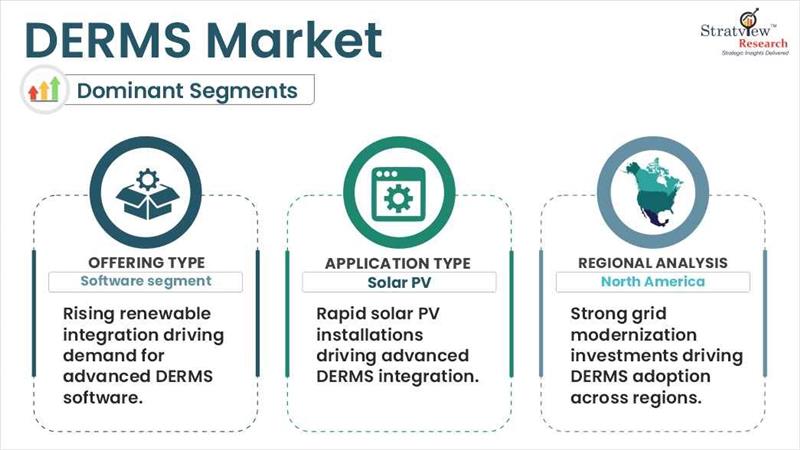
Software segment is expected to be the fastest-growing segment during the forecast period. |
|
Application Type Analysis |
Solar PV Systems, Wind Energy Systems, Energy Storage Systems, Chip Systems, EV Charging Solutions |
Solar PV segment is expected to grow with the highest CAGR during the forecast period. |
|
End-Use Type Analysis |
Residential, Commercial, Industrial |
Industrial segment is expected to dominate the market during the forecast period. |
|
Regional Analysis |
North America, Europe, Asia-Pacific, and The Rest of the World |
North America is expected to be the dominant and fastest-growing region over the forecasted period. |
“Software segment is expected to be the fastest-growing segment during the forecast period."
“Solar PV segment is expected to grow with the highest CAGR during the forecast period.”
Want to get more details about the segmentations? Register Here
“North America is expected to be the dominant and fastest-growing region over the forecasted period.”
Most of the major players compete in some of the factors, including price, service offerings, regional presence, etc. The following are the key players in the DERMS market:
Note: The above list does not necessarily include all the top players in the market.
Are you a leading player in this market? We would love to include your name. Please write to us at [email protected]
This report provides market intelligence most comprehensively. The report structure has been kept so that it offers maximum business value. It provides critical insights into market dynamics and will enable strategic decision-making for existing market players as well as those willing to enter the market.
The following are the key features of the report:
|
Market Study Period |
2019-2032 |
|
Base Year |
2024 |
|
Forecast Period |
2025-2032 |
|
Trend Period |
2019-2023 |
|
Number of Tables & Figures |
>100 |
|
Number of Segments Analysed |
4 (Offering Type, Application Type, End-use Type, and Region) |
|
Number of Regions Analysed |
4 (North America, Europe, Asia-Pacific, Rest of the World) |
|
Countries Analysed |
15 (The USA, Canada, Mexico, Germany, France, Italy, The UK, China, Japan, India, Brazil, Saudi Arabia, Rest of Europe, Rest of APAC, and Rest of the World) |
|
Free Customization Offered |
10% |
|
After Sales Support |
Unlimited |
|
Report Presentation |
Complimentary |
|
Market Dataset |
Complimentary |
|
Further Deep Dive & Consulting Services |
10% Discount |
This report studies the market, covering a period of 15 years of trend and forecast. The report provides detailed insights into the market dynamics to enable informed business decision-making and growth strategy formulation based on the opportunities present in the market.
The DERMS market is segmented into the following categories:
By Offering Type
By Application Type
By End-Use Type
By Region
With this detailed report, Stratview Research offers one of the following free customization options to our respectable clients:
Company Profiling
Competitive Benchmarking
Custom Research: Stratview Research offers custom research services across industries. In case of any custom research requirement related to market assessment, competitive benchmarking, sourcing and procurement, target screening, and others, please send your inquiry to [email protected]
The report is delivered digitally through our online portal. Buyers receive login credentials from our team to access the report and may update their credentials at any time after the initial login.
Delivery timelines depend on the status of the report:
For the most accurate delivery timeline, please contact us to confirm the current status of the report.
Yes. You may request a complimentary preview of the report through a video conference with our team.
Yes. The scope of the report can be fully customized to align with your specific research objectives and information requirements.
Please contact us at [email protected], and our team will be happy to discuss your requirements and propose a tailored solution.
Yes. Selected sections of the report can be purchased separately based on your requirements. Please contact us at [email protected] to discuss your needs.
Yes, AI can help gather publicly available information, but its outputs are only as reliable as the data it accesses. Stratview Research reports are built using validated data, extensive primary interviews with industry stakeholders, and the expertise of our experienced research team.
Additionally, many critical insights, including market dynamics, competitive intelligence, and industry-specific trends, are not publicly available and therefore cannot be captured through AI alone.
The DERMS Market refers to the global industry centered around the development, deployment, and operation of software platforms and tools that enable the effective integration, control, and optimization of Distributed Energy Resources (DERs) into the electric grid.
The forecasted value for the market is US$ 3.68 billion in 2032.
DERMS market size was USD 0.98 billion in 2024 and is expected to grow from USD 1.16 billion in 2025 to USD 3.68 billion in 2032, witnessing an impressive market growth (CAGR) of 17.94% during the forecast period (2025-2032).
The key drivers of the DERMS market include rising demand for EVs, consumer electronics, and industrial growth.
The top players in the market include Siemens, ABB, Hitachi Ltd., and General Electric Company.
North America is expected to be the dominant and the fastest-growing region of the market over the forecasted period due to advanced energy infrastructure and significant grid modernization investments.


WE ACCEPT