




404
+1-313-307-4176

Zero Liquid Discharge Systems Market Analysis | 2025-2032

Zero Liquid Discharge Systems Market Size, Share, Trends, Dynamics, Forecast, & Growth Analysis: 2025-2032
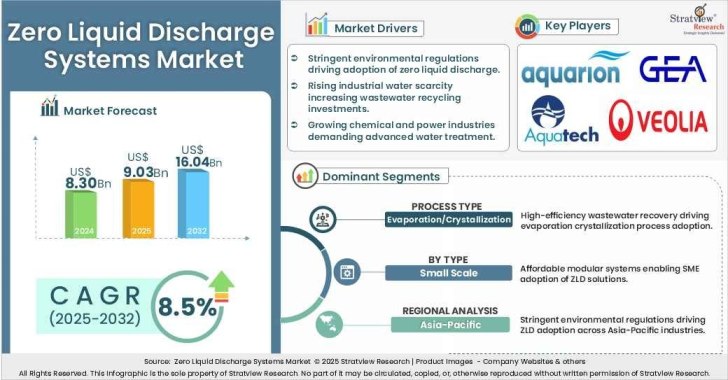
"Zero liquid discharge systems market size was USD 8.30 billion in 2024.”
Wish to get a free sample report? Click Here
Have a look at the sales opportunities presented by the zero liquid discharge systems market in terms of growth and market forecast.
|
Zero Liquid Discharge Systems Market Data & Statistics |
||
|
Market Statistics |
Value (in USD Billion) |
Market Growth (%) |
|
Annual Market Size in 2023 |
USD 7.68 billion |
- |
|
Annual Market Size in 2024 |
USD 8.30 billion |
YoY Growth in 2024: 8.1% |
|
Annual Market Size in 2025 |
USD 9.03 billion |
YoY Growth in 2025: 8.8% |
|
Annual Market Size in 2032 |
USD 16.04 billion |
CAGR 2025-2032: 8.5% |
|
Cumulative Sales Opportunity during 2025-2032 |
USD 98.26 billion |
- |
|
Top 10 Countries’ Market Share in 2024 |
USD 6.6 + |
> 80% |
|
Top 10 Company’s Market Share in 2024 |
USD 4.1 billion to USD 5.8 billion |
50% - 70% |
What is a zero liquid discharge system?
Zero Liquid Discharge (ZLD) systems are advanced wastewater treatment solutions designed to eliminate all liquid waste from industrial processes. They recover and recycle water while converting contaminants into solid waste. This helps industries meet strict environmental regulations, reduce water consumption, and promote sustainable operations, especially in water-scarce regions.
Rising Water Scarcity & Reuse Demands
Minimizing Water Loss in High-Energy ZLD Operations
Rapid Industrial Growth in Emerging Economies
|
Segmentations |
List of Sub-Segments |
Segments with High-Growth Opportunity |
|
Process Analysis |
Pretreatment, Filtration, and Evaporation/Crystallization |
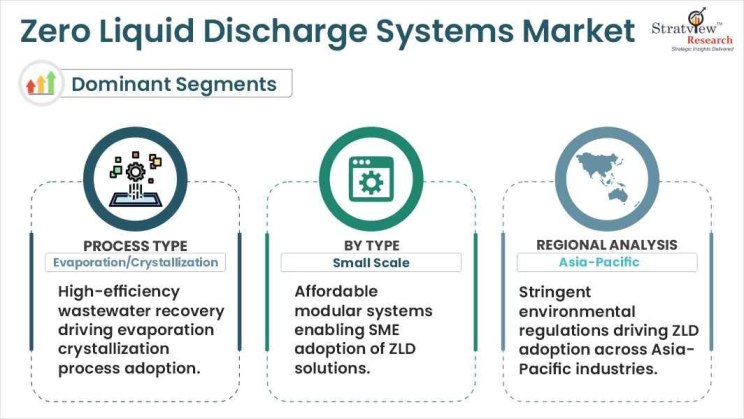
Evaporation/Crystallization segment is anticipated to have the largest share of this market in the coming years. |
|
Capacity Analysis |
Small Scale, Medium Scale, and Large Scale |
Small Scale segment is expected to be the fastest-growing segment during the forecast period. |
|
System Analysis |
Conventional and Hybrid |
Hybrid segment is projected to be the fastest-growing segment during the forecast period. |
|
End-Use Industry |
Energy & Power, Chemicals & Petrochemicals, Food & Beverages, Textiles, Pharmaceuticals, Semiconductors & Electronics, and Others |
Energy & Power segment is projected to be the fastest-growing segment during the forecast period. |
|
Regional Analysis |
North America, Europe, Asia-Pacific, and The Rest of the World |
Asia-Pacific is expected to be the dominant and fastest-growing region over the forecasted period. |
“Evaporation/Crystallization segment is anticipated to have the largest share of this market in the coming years.”
“Small Scale segment is expected to be the fastest-growing segment during the forecast period.”
Want to get more details about the segmentations? Register Here
“Asia-Pacific is expected to be the dominant and the fastest-growing region over the forecasted period.”
Most of the major players compete in some of the factors, including price, service offerings, regional presence, etc. The following are the key players in the zero liquid discharge systems market:
Note: The above list does not necessarily include all the top players in the market.
Are you a leading player in this market? We would love to include your name. Please write to us at [email protected]
This report provides market intelligence most comprehensively. The report structure has been kept so that it offers maximum business value. It provides critical insights into market dynamics and will enable strategic decision-making for existing market players as well as those willing to enter the market.
The following are the key features of the report:
|
Market Study Period |
2019-2032 |
|
Base Year |
2024 |
|
Forecast Period |
2025-2032 |
|
Trend Period |
2019-2023 |
|
Number of Tables & Figures |
>100 |
|
Number of Segments Analysed |
5 (Process Type, System Type, Capacity Type, End-Use Type, and Region) |
|
Number of Regions Analysed |
4 (North America, Europe, Asia-Pacific, Rest of the World) |
|
Countries Analysed |
15 (The USA, Canada, Mexico, Germany, France, Italy, The UK, China, Japan, India, Brazil, Saudi Arabia, Rest of Europe, Rest of APAC, and Rest of the World) |
|
Free Customization Offered |
10% |
|
After Sales Support |
Unlimited |
|
Report Presentation |
Complimentary |
|
Market Dataset |
Complimentary |
|
Further Deep Dive & Consulting Services |
10% Discount |
This report studies the market, covering a period of 15 years of trend and forecast. The report provides detailed insights into the market dynamics to enable informed business decision-making and growth strategy formulation based on the opportunities present in the market.
The zero liquid discharge systems market is segmented into the following categories.
By Process Type
By Capacity Type
By System Type
By Application Type
By End-Use Industry Type
By Region
With this detailed report, Stratview Research offers one of the following free customization options to our respectable clients:
Company Profiling
Competitive Benchmarking
Custom Research: Stratview Research offers custom research services across sectors. In case of any custom research requirement related to market assessment, competitive benchmarking, sourcing and procurement, target screening, and others, please send your inquiry to [email protected].
The report is delivered digitally through our online portal. Buyers receive login credentials from our team to access the report and may update their credentials at any time after the initial login.
Delivery timelines depend on the status of the report:
For the most accurate delivery timeline, please contact us to confirm the current status of the report.
Yes. You may request a complimentary preview of the report through a video conference with our team.
Yes. The scope of the report can be fully customized to align with your specific research objectives and information requirements.
Please contact us at [email protected], and our team will be happy to discuss your requirements and propose a tailored solution.
Yes. Selected sections of the report can be purchased separately based on your requirements. Please contact us at [email protected] to discuss your needs.
Yes, AI can help gather publicly available information, but its outputs are only as reliable as the data it accesses. Stratview Research reports are built using validated data, extensive primary interviews with industry stakeholders, and the expertise of our experienced research team.
Additionally, many critical insights, including market dynamics, competitive intelligence, and industry-specific trends, are not publicly available and therefore cannot be captured through AI alone.
The forecasted value for the market is US$16.04 billion in 2032.
Aquatech International, Veolia, GEA Group AG, Alfa Laval AB, Praj Industries are the leading players in the market.
Asia-Pacific is estimated to remain dominant in the market in the foreseeable future due to rapid industrialization, escalating water scarcity concerns, and stringent environmental regulations fostering the adoption of sustainable water management solutions.
The energy & power sector's vast scale and resource-intensive nature make ZLD systems particularly relevant, as they allow for the sustainable management of water resources, reduce the environmental impact of power generation, and align with the global shift towards more responsible industrial practices. As a result, the dominance of ZLD systems in the energy & power sector reflects a proactive commitment to both regulatory compliance and sustainable resource management.


WE ACCEPT