




404
+1-313-307-4176

Trenchless Pipe Relining Market Growth Analysis | 2026-2032

Trenchless Pipe Relining Market Size, Share, Trend, Forecast, Competitive Landscape & Growth Opportunities: 2026-2032
The annual demand for trenchless pipe relining was USD 6.5 billion in 2025 and is expected to reach USD 6.7 billion in 2026, up 3.1% the value in 2025.
During the forecast period (2026-2032), the market is expected to grow at a CAGR of 3.6%. The annual demand will reach USD 8.3 billion in 2032.
North America generated the greatest demand across regions in the trenchless relining market.
In terms of application types, wastewater pipes are the most dominant segment in the market.
By diameter type, <18-inch pipes are expected to maintain the lead in the market.
Based on methods, CIPP is expected to remain the dominant method throughout the forecast period.
“The trenchless pipe relining market will generate a cumulative sales opportunity worth USD 52.6 billion during 2026-2032. During the next six years, Wastewater Pipes, <18-inch Pipes, CIPP, & North America are some of the high-opportunity segments to bank upon.”
Sharpen Your Strategies to Explore this USD 50+ billion Opportunity. Get a Free Sample of Our Report: “Here”.
Have a look at the sales opportunities presented by the trenchless pipe relining market in terms of growth and market forecast.
|
Market Statistics |
Value (in USD Billion) |
Market Growth (%) |
|
Market Size in 2025 |
USD 6.5 billion |
- |
|
Market Size in 2026 |
USD 6.7 billion |
YoY Growth in 2026: 3.1% |
|
Market Size in 2032 |
USD 8.3 billion |
CAGR 2026-2032: 3.6% |
|
Cumulative Sales Opportunity during 2026-2032 |
USD 52.6 billion |
- |
|
Top 10 Countries’ Market Share in 2025 |
USD 5.5 billion+ |
>85% |
|
Top 10 Companies’ Market Share in 2025 |
USD 1.9 billion+ |
>30% |
Want to Explore the Market Opportunities? Get Free Sample “Here”.
The trenchless pipe relining market has emerged as a vital segment of the broader pipeline rehabilitation industry, offering an efficient and minimally disruptive solution for restoring aging underground infrastructure. As water, wastewater, stormwater, and industrial pipeline networks continue to age, utilities and municipalities are increasingly turning to relining technologies to extend asset life without the cost and inconvenience associated with traditional excavation-based replacement methods.
Trenchless pipe relining involves creating a new pipe within an existing damaged pipeline by installing a liner or applying a specialized coating to the pipe's interior. Technologies such as cured-in-place pipe (CIPP), sliplining, close-fit lining, and spray-applied pipe linings have become widely adopted due to their ability to rehabilitate pipelines with little or no digging. This approach significantly reduces project timelines, restoration costs, and disruptions to surrounding communities while maintaining the structural integrity and performance of the pipeline system.
One of the key advantages of trenchless relining is its ability to minimize the impact on daily life. Unlike traditional dig-and-replace methods, relining projects typically require limited excavation, helping to reduce traffic congestion, preserve roads, landscaping, and existing infrastructure, and lower environmental disturbance. These benefits make trenchless relining particularly attractive in densely populated urban areas where minimizing disruption is a critical consideration.
Growing investments in water and wastewater infrastructure renewal, increasing awareness of sustainable asset management practices, and the need to address aging pipeline networks are driving the adoption of trenchless relining technologies worldwide. As advancements in liner materials, curing methods, and installation techniques continue to improve performance and reliability, trenchless pipe relining is expected to play an increasingly important role in modern infrastructure rehabilitation strategies.
Aging Global Pipeline Infrastructure
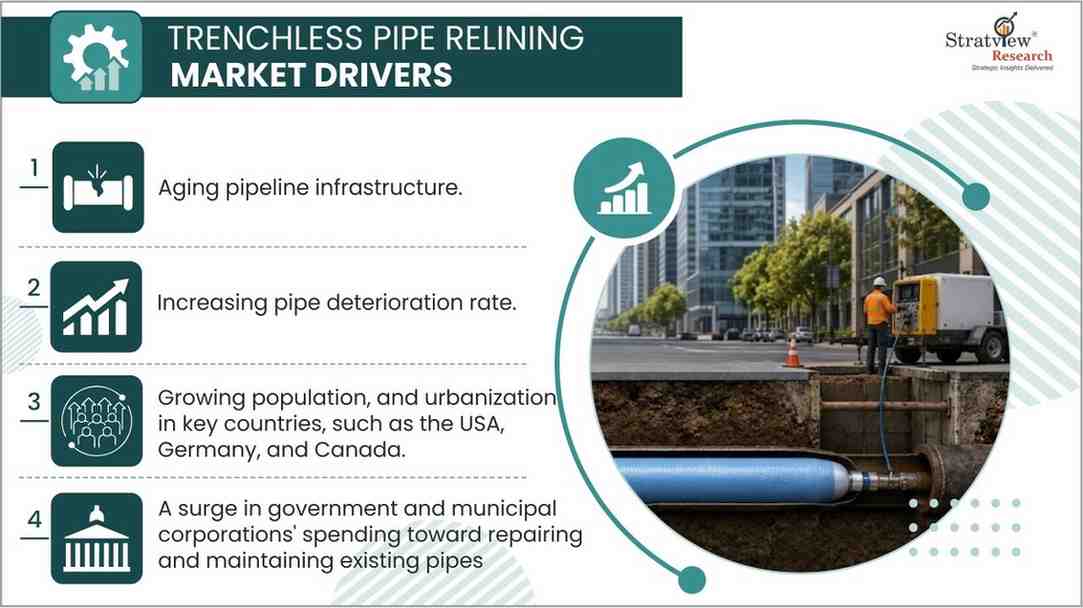
The aging global pipeline infrastructure is a major factor driving demand for trenchless pipe relining solutions, as a substantial portion of water, wastewater, and other networks worldwide are approaching or exceeding their intended service life. Over time, water supply and wastewater pipelines become increasingly vulnerable. This vulnerability leads to issues such as leaks and breaks. In urban environments, excavating connected water and sewer lines can cause significant disruption and inconvenience. Trenchless pipe rehabilitation technology effectively repairs and reconstructs these aging pipes without the need for traditional digging. This rehabilitation method addresses common pipeline issues like leaks, cracks, and corrosion. It also facilitates the installation of new pipes using built-in techniques. As infrastructure continues to age, the demand for trenchless pipe rehabilitation is expected to rise.
Increasing Government Investments and Regulations
Public authorities are increasing investments in water and wastewater networks to address aging infrastructure and enhance long-term service reliability. These investments create significant opportunities for trenchless pipe relining technologies, which offer a cost-effective and less disruptive approach to pipeline renewal compared to conventional replacement methods.
“The trenchless pipe relining industry is evolving fast. While conducting the market analysis and speaking with the leading players, it is quite clear that the next decade will be defined by trends like the adoption of advanced trenchless technologies & focus on sustainable infrastructure solutions.”
Align with the Mega Trends Shaping the Industry. Get Free Sample “Here”.
High Initial Setup and Equipment Costs
One of the most significant barriers to the expansion of the trenchless pipe relining industry is the high initial setup and equipment costs required for technology deployment and project execution. Technologies such as CIPP and SIPP often involve advanced curing equipment, robotic inspection systems, liner installation machinery, and quality control processes, which can increase the upfront cost of project execution. The relatively high upfront investment can delay project approvals and limit adoption, particularly in cost-sensitive markets and smaller-scale rehabilitation projects.
Technical Limitations in Complex Conditions
A key challenge for the trenchless pipe relining market is the technical limitation of rehabilitation technologies when operating under complex pipeline, environmental, and network conditions. Factors such as severe pipe deterioration, irregular geometries, underground congestion, extensive service connections, difficult ground conditions, and unknown asset conditions can reduce the feasibility of trenchless solutions or require highly specialized engineering approaches.
“Wastewater pipes are likely to generate high demand for the trenchless pipe relining market, whereas water main pipe applications are likely to grow at the fastest rate during the forecast period.”
The trenchless pipe relining market is segmented into water main pipes, wastewater pipes, and other applications, with wastewater pipes expected to remain the dominant segment, while water main pipes are projected to register the fastest growth over the forecast period. The extensive and aging wastewater infrastructure is subject to frequent wear and tear, driving the need for cost-effective rehabilitation solutions. At the same time, increasing environmental regulations and the need for safe wastewater management are further supporting demand. In parallel, growing investments in water infrastructure and efforts to minimize potable water loss are accelerating the adoption of relining technologies in water main applications.
“CIPP is the most widely employed method for relining trenchless pipes and is likely to maintain its superiority over other methods in the forecasted period.”
Based on method, the market is categorized into CIPP, sliplining, SIPP, and other techniques, with CIPP (Cured-In-Place Pipe) expected to maintain its position as the most widely used method throughout the forecast period. Its strong market position is driven by advantages such as faster and simpler installation, longer service life, and superior performance compared to alternative methods. Notably, CIPP installation can be up to five times faster than conventional trench-based pipe replacement, making it a highly preferred solution for reducing costs and minimizing disruption.
“<18-inch pipes are the most preferred ones in residential areas and municipal sewer networks constituting the biggest portion of the market, and it is expected to maintain its dominance over the coming years.”
The market is segmented by pipe diameter into <18-inch, 18–36-inch, and >36-inch categories, with <18-inch pipes accounting for the largest share and expected to maintain their dominance in the coming years. These smaller-diameter pipes are widely used in residential areas and municipal sewer networks, particularly in densely populated regions where trenchless methods significantly reduce excavation-related disruptions. Additionally, their cost-effectiveness and less frequent maintenance requirements make them the preferred choice for municipal authorities managing extensive urban infrastructure.
“North America enjoys the lion’s share and is expected to remain the largest market for trenchless pipe relining during the forecast period.”
Regionally, North America holds the largest share of the trenchless pipe relining market and is expected to retain its leadership position, driven primarily by the United States, which serves as both the regional and global growth engine due to its early adoption of advanced trenchless technologies. Meanwhile, Asia-Pacific is projected to witness the fastest growth, supported by key countries such as Japan, China, and Australia. Rapidly aging infrastructure, along with increasing government investments aimed at reducing water loss and improving water quality, is significantly boosting demand for trenchless pipe relining solutions across the region.
“Analysis suggests that the Top 10 countries generate more than 85% of the annual sales for the trenchless pipe relining market. A few countries are the demand powerhouses and will drive the regional markets in big ways, offering attractive business opportunities.”
Speak to Us for Deep Diving into a Country/Region Specific Opportunity. Contact Us “Here”.
The market is highly populated with several local, regional, and global players. It is also highly fragmented, with different players serving different trenchless methods. However, most of the major players in the market serve more than one trenchless method.
The following are the key players in the trenchless pipe relining market.
Azuria Water Solutions (formerly Aegion Corporation)
PURIS Corporation
Per Aarsleff A/S
SAK Construction, LLC
Reline UV Group
Michels Corporation
SAERTEX Multicom® GmbH
IMPREG Group
Ashimori Industry Co., Ltd.
Spinello Companies
Note: The above list is not an exhaustive list of the key players in the market. If your company is active in this market and would like to be considered for inclusion in future editions of this study, please contact us at [email protected].
Have the Competitive Edge with Our Intelligence. Get Free Sample “Here”.
Recent mergers & acquisitions and other developments in the trenchless pipe relining market reflect evolving market trends and impact the market. Below are a few M&As in the market –
In April 2026, United Felts acquired BKP Berolina Polyester GmbH & Co. KG, a leading manufacturer of UV-cured composite liners used in trenchless pipe relining applications. The acquisition expanded United Felts’ global manufacturing footprint and strengthened its position in the rapidly growing UV-CIPP liner market.
In April 2026, The Vortex Companies acquired Mainlining America LLC, a provider of watermain rehabilitation and replacement services. The acquisition enhanced Vortex’s capabilities in potable water infrastructure renewal and expanded its trenchless rehabilitation service platform across North America.
In February 2026, Per Aarsleff Holding A/S acquired a 49.5% stake in LiquiForce Services (Ontario) Inc., a PURIS company, establishing a strategic partnership to expand trenchless pipe relining and lateral rehabilitation activities in the Canadian market. The collaboration combines LiquiForce’s regional expertise with Aarsleff’s advanced rehabilitation technologies.
In May 2025, The Vortex Companies acquired Foraction Inc., a Canadian specialist in trenchless watermain rehabilitation. The acquisition strengthened Vortex’s presence in Canada and enhanced its capabilities in pressure pipe renewal and water infrastructure relining solutions.
In January 2024, Azuria Water Solutions acquired Twin D Inc., a provider of wastewater infrastructure inspection, maintenance, and rehabilitation services. The acquisition expanded Azuria’s trenchless pipe relining capabilities and strengthened its presence across the southeastern United States.
In October 2023, Azuria Water Solutions acquired C.K. Masonry Company, Inc., enhancing its wastewater infrastructure rehabilitation and manhole restoration capabilities while expanding its service coverage in the Mid-Atlantic region.
In June 2023, Azuria Water Solutions acquired AM-Liner East, Inc., a provider of cured-in-place pipe (CIPP) installation and trenchless rehabilitation services. The acquisition strengthened Azuria’s position in the municipal wastewater relining market and expanded its operational footprint across the eastern United States.
The market encompasses a wide range of relining technologies, including Cured-in-Place Pipe (CIPP), sliplining, Sprayed-in-Place Pipe (SIPP), and other trenchless relining methods. Unlike pipe bursting (which is included under the broad scope of trenchless rehabilitation), these technologies do not create a new pipe by bursting the old pipe; instead, it only forms protective lining within the existing pipeline, which allows deteriorated assets to be rehabilitated while preserving the surrounding roads, buildings, and landscapes.
This report provides market intelligence most comprehensively. The report structure has been kept so that it offers maximum business value. It provides critical insights into market dynamics and will enable strategic decision-making for existing market players as well as those willing to enter the market.
The following are the key features of the report:
Market structure: Overview, industry life cycle analysis, supply chain analysis.
Market environment analysis: Growth drivers and constraints, Porter’s five forces analysis, SWOT analysis.
Market trend and forecast analysis.
Market segment trend and forecast.
Competitive landscape and dynamics: Market share, Service portfolio, New Product Launches, etc.
Attractive market segments and associated growth opportunities.
Emerging trends.
Strategic growth opportunities for the existing and new players.
Key success factors.
|
Market Study Period |
2020-2032 |
|
Base Year |
2025 |
|
Forecast Period |
2026-2032 |
|
Trend Period |
2020-2025 |
|
Number of Tables & Figures |
>100 |
|
Number of Segments Analyzed |
4 (Application Type, Method Type, Pipe Diameter Type, and Region) |
|
Number of Regions Analyzed |
4 (North America, Europe, Asia-Pacific, Rest of the World) |
|
Countries Analyzed |
11 (The USA, Canada, Mexico, Germany, France, The UK, Spain, China, Japan, Australia, Singapore) |
|
Free Customization Offered |
10% |
|
After Sales Support |
Unlimited |
|
Report Presentation |
Complimentary |
|
Market Dataset |
Complimentary |
|
Further Deep Dive & Consulting Services |
10% Discount |
Want a Report Tailor-Made to Your Objectives? Speak with Our Analyst
The report provides detailed insights into the market dynamics to enable informed business decision-making and growth strategy formulation based on the opportunities present in the market.
The trenchless pipe relining market is segmented into the following categories:
Trenchless Pipe Relining Market, By Application Type
Water Main Pipes
Wastewater Pipes
Others
Trenchless Pipe Relining Market, By Method Type
CIPP
Sliplining
SIPP
Others
Trenchless Pipe Relining Market, By Pipe Diameter Type
<18-inch Pipes
18-36-inch Pipes
>36-inch Pipes
Trenchless Pipe Relining Market, By Region
North America (Country Analysis: The USA, Canada, and Mexico)
Europe (Country Analysis: Germany, France, The UK, Spain, and the Rest of Europe)
Asia-Pacific (Country Analysis: China, Japan, Australia, Singapore, and Rest of Asia-Pacific)
Rest of the World (Sub-Region Analysis: Latin America, Middle East, and Others)
Looking for a Deep Dive? Speak with Our Analyst
This strategic assessment report from Stratview Research provides a comprehensive analysis that reflects today’s trenchless pipe relining market realities and future market possibilities for the forecast period.
The report segments and analyzes the market in the most detailed manner to provide a panoramic view of the market. The vital data/information provided in the report can play a crucial role for market participants and investors in identifying the low-hanging fruits available in the market and formulating growth strategies to expedite their growth process.
This report offers high-quality insights and is the outcome of a detailed research methodology comprising extensive secondary research, rigorous primary interviews with industry stakeholders, and validation and triangulation with Stratview Research’s internal database and statistical tools.
More than 1,000 authenticated secondary sources, such as company annual reports, fact books, press releases, journals, investor presentations, white papers, patents, and articles, have been leveraged to gather the data.
We conducted more than 10 detailed primary interviews with market players across the value chain in all four regions and industry experts to obtain both qualitative and quantitative insights.
With this detailed report, Stratview Research offers one of the following free customization options to our respected clients:
Company Profiling
Detailed profiling of additional market players (up to three players)
SWOT analysis of key players (up to three players)
Competitive Benchmarking
Benchmarking of key players on the following parameters: Service portfolio, geographical reach, regional presence, and strategic alliances
Custom Research: Stratview Research offers custom research services across industries. In case of any custom research requirement related to market assessment, competitive benchmarking, sourcing and procurement, target screening, and others, please send your inquiry to [email protected]
The report is delivered digitally through our online portal. Buyers receive login credentials from our team to access the report and may update their credentials at any time after the initial login.
Delivery timelines depend on the status of the report:
For the most accurate delivery timeline, please contact us to confirm the current status of the report.
Yes. You may request a complimentary preview of the report through a video conference with our team.
Yes. The scope of the report can be fully customized to align with your specific research objectives and information requirements.
Please contact us at [email protected], and our team will be happy to discuss your requirements and propose a tailored solution.
Yes. Selected sections of the report can be purchased separately based on your requirements. Please contact us at [email protected] to discuss your needs.
Yes, AI can help gather publicly available information, but its outputs are only as reliable as the data it accesses. Stratview Research reports are built using validated data, extensive primary interviews with industry stakeholders, and the expertise of our experienced research team.
Additionally, many critical insights, including market dynamics, competitive intelligence, and industry-specific trends, are not publicly available and therefore cannot be captured through AI alone.
Trenchless pipe relining market size was USD 6.5 billion in 2025. The market is expected to grow from USD 6.7 billion in 2026 to USD 8.3 billion in 2032, witnessing a decent market growth (CAGR) of 3.6% during the forecast period (2026-2032).
The top players in the trenchless pipe relining market include Azuria Water Solutions (formerly Aegion Corporation), PURIS Corporation, Per Aarsleff, SAK Construction, LLC, Reline UV Group, Michels Corporation, SEARTEX Multicom® GmbH, IMPREG Group, Ashimori Industry Co., Ltd., and Spinello Companies.
North America is estimated to remain the dominant region in the market in the foreseeable future. Most of the pipelines installed in the region have passed their retirement age or are approaching it; hence, rehabilitation is needed.
Wastewater pipes are expected to remain the most dominant application in the market throughout the forecast period, driven by the growing need to rehabilitate aging sewer infrastructure and treatment networks, and strict environmental regulations aimed at reducing leakage, infiltration, and contamination risks.


WE ACCEPT