



404
+1-313-307-4176

Super Absorbent Polymers Market Analysis | 2026-2032
Super Absorbent Polymers Market Size, Share, Trends, Dynamics, Forecast, & Growth Analysis: 2026-2032
Super Absorbent Polymers Market is segmented by Product Type (Sodium Polyacrylate, Polyacrylate/Polyacrylamide, and Copolymers), by Application Type (Personal Hygiene, Agriculture, Medical, Industrial, Packaging, Construction, and Oil & Gas), and by Region (North America, Europe, Asia-Pacific, and Rest of the World).
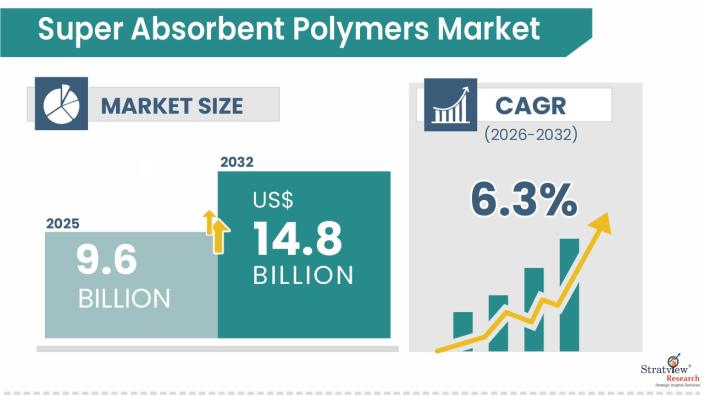
The super absorbent polymers market was estimated at USD 9.6 billion in 2025 and is likely to grow at a CAGR of 6.3% during 2026-2032 to reach USD 14.8 billion in 2032.
Want to have a closer look at this report? Register Here
Super absorbent polymers (SAPs) are a type of polymer material that has the ability to absorb and retain large amounts of liquid relative to their own weight. It is a cross-linked polymer that contains sodium atoms.
These polymers are widely used in a variety of applications, including personal hygiene products, agriculture, medical applications, construction materials, and more. SAPs, after reaching their capacity of absorption, swell and become a gel-like substance that can hold liquid without leaking or losing shape.
Super absorbent polymers are witnessing increasing adoption across hygiene, agriculture, medical, and industrial applications due to their exceptional water absorption and retention capabilities.
Applications of super absorbent polymers are expanding rapidly across baby diapers, adult incontinence products, feminine hygiene products, soil conditioning, and wound care, driven by strong market demand for high-performance absorbent materials. A key market trend shaping the industry is the development of bio-based and biodegradable SAPs, which is accelerating the adoption of sustainable super absorbent polymer solutions globally.
Rising Demand for Baby Diapers and Adult Incontinence Products
The rising demand for baby diapers and adult incontinence products is contributing significantly to the super absorbent polymers (SAPs) market growth. Increasing population aging, along with sustained birth rates in several emerging economies, continues to drive the need for high-performance hygiene products that utilize SAPs for enhanced absorbency and leakage protection.
Increasing Awareness of Personal Hygiene
Growing awareness of personal hygiene, coupled with improving healthcare access and urbanization, is driving the adoption of feminine hygiene products and disposable diapers across developing economies. This trend is supporting demand for super absorbent polymers used in a wide range of absorbent hygiene applications.
Environmental Concerns Regarding Disposal
The widespread use of petroleum-based, non-biodegradable super absorbent polymers is raising environmental concerns related to waste generation and landfill accumulation. Growing regulatory scrutiny and consumer preference for sustainable products are increasing pressure on manufacturers to develop eco-friendly alternatives, posing a challenge to market growth.
According to the Organisation for Economic Co-operation and Development (OECD), the global plastic waste generation exceeded 350 million tonnes annually, highlighting increasing pressure on manufacturers to reduce the environmental impact of non-biodegradable materials, including conventional super absorbent polymers.
The OECD estimates that only 9% of global plastic waste is recycled, while the remaining waste is landfilled, incinerated, or leaked into the environment, raising concerns about the disposal of SAP-containing hygiene products.
Dependence on Petrochemical-Based Raw Materials
Most commercial super absorbent polymers are produced using acrylic acid and other petrochemical derivatives, making manufacturers vulnerable to fluctuations in crude oil and feedstock prices. Volatility in raw material costs can increase production expenses, impact profit margins, and create pricing challenges across the super absorbent polymers value chain.
According to the International Energy Agency (IEA), global oil demand averaged approximately 103.8–105.2 million barrels per day in 2025. The continued reliance on petroleum-based feedstocks highlights the exposure of super absorbent polymer manufacturers to fluctuations in crude oil and derivative prices, which can affect production costs and profit margins.
Expansion of SAP Applications in Agriculture
The use of super absorbent polymers in agriculture is gaining traction as farmers seek solutions to improve water-use efficiency and crop productivity. SAPs help retain soil moisture, reduce irrigation requirements, and enhance crop resilience in water-stressed regions, making them an increasingly important component of sustainable agricultural practices.
Development of Bio-Based and Biodegradable SAPs
Growing sustainability initiatives and environmental concerns are accelerating the development of bio-based and biodegradable super absorbent polymers derived from renewable materials such as starch, cellulose, and other natural feedstocks. As manufacturers seek to reduce dependence on fossil-based raw materials, investments in sustainable polymer technologies are expected to support SAP market growth.
According to the European Commission, the EU bioeconomy generates approximately EUR 900 billion in value added annually, creating a favorable environment for the development and commercialization of bio-based materials, including biodegradable super absorbent polymers.
According to the International Energy Agency (IEA), bioenergy and other bio-based industries continue to attract increasing investment as countries pursue decarbonization and circular economy goals. This transition is encouraging research into renewable feedstocks for next-generation super absorbent polymers.
|
Segmentations |
List of Sub-Segments |
Segments with High Growth Opportunity |
|
Product Type Analysis |
Sodium Polyacrylate, Polyacrylate/Polyacrylamide, and Copolymers |
The sodium polyacrylate segment held the largest share of the market in 2022 and is expected to remain dominant during the forecast period. |
|
Application Type Analysis |
Personal Hygiene, Agriculture, Medical, Industrial, Packaging, Construction, and Oil & Gas |
The personal hygiene segment is the largest segment. |
|
Regional Analysis |
North America, Europe, Asia-Pacific, and Rest of the World |
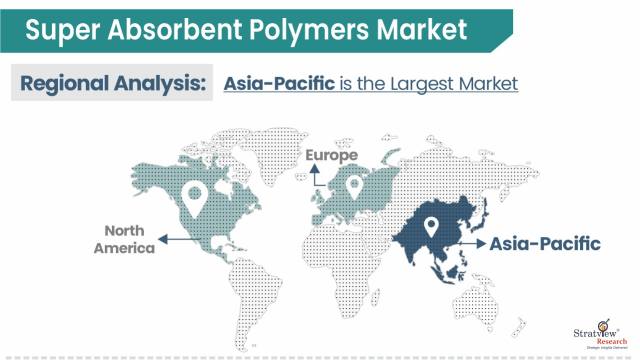
Asia-Pacific is estimated to be the largest and fastest-growing market during the forecast period. |
Based on the product type, the market is segmented as sodium polyacrylate, polyacrylate/polyacrylamide, and copolymers. The sodium polyacrylate segment held the largest share of the market in 2022 and is expected to remain dominant during the forecast period. Sodium polyacrylate is widely preferred for personal hygiene products and water absorbent applications as it is a super absorber of water.
Based on the application type, the market is segmented as personal hygiene, agriculture, medical, industrial, packaging, construction, and oil & gas. The personal hygiene segment is the largest segment, as it is widely used in sanitary napkins, baby diapers, and protective underwear.
In terms of regions, Asia-Pacific is estimated to be the largest and fastest-growing market during the forecast period. India and China are the major countries with lucrative growth opportunities, owing to the growing population and awareness of personal hygiene in the region.
Know which region offers the best growth opportunities. Register Here
Some of the major manufacturers are:
Note: The above list does not necessarily include all the top players in the market.
Are you the leading player in this market? We would love to include your name. Write to us at [email protected]
Recent mergers & acquisitions and other developments in the super absorbent polymers market reflect evolving market trends, and impact the market. Below given are a few recent developments in the market –
In April 2025, ZymoChem secured additional financing led by lululemon, with participation from Toyota Ventures, GS Futures, and FreshTracks Capital, to accelerate the commercialization of bio-based materials. Although the transaction value was not disclosed, the funding will support manufacturing expansion, global partnerships, and the development of personal hygiene applications, including the company's BAYSE bio-based superabsorbent polymer platform.
In December 2025, BASF, Essity, and TU Wien successfully demonstrated a pilot-scale recycling process for used diapers and other absorbent hygiene products. The gasification process operated at temperatures above 600°C, converting post-consumer hygiene waste into carbon monoxide and hydrogen for use as chemical production feedstocks.
In February 2025, BASF introduced HySorb® B 6610 ZeroPCF, the first polyacrylate-based superabsorbent polymer marketed with a zero product carbon footprint for hygiene applications. Produced in Antwerp using renewable energy and biomass-balanced raw materials, the ISCC PLUS-certified grade serves as a drop-in replacement without requiring production-line modifications.
In February 2025, ZymoChem announced the commercial-scale production of the key biopolymer used in BAYSE BioSAP, advancing the commercialization of bio-based and biodegradable superabsorbent polymers. The company completed multi-metric-ton production in a 45,000-liter fermentation system and initiated additional commercial manufacturing runs to support future annual production in the thousands of metric tons.
This report provides market intelligence in the most comprehensive way. The report structure has been kept such that it offers maximum business value. It provides critical insights into market dynamics and will enable strategic decision-making for existing market players as well as those willing to enter the market. The following are the key features of the report:
This report studies the market covering a period of 12 years of trend and forecast. The report provides detailed insights into the market dynamics to enable informed business decision-making and growth strategy formulation based on the opportunities present in the market.
The super absorbent polymers market is segmented into the following categories:
By Product Type
By End-Use Industry Type
By Region
This strategic assessment report, from Stratview Research, provides a comprehensive analysis that reflects today’s super absorbent polymers market realities and future market possibilities for the forecast period of 2026 to 2032. After a continuous interest in our super absorbent polymers market report from the industry stakeholders, we have tried to further accentuate our research scope to the super absorbent polymers market to provide the most crystal-clear picture of the market. The report segments and analyses the market in the most detailed manner to provide a panoramic view of the market. The vital data/information provided in the report can play a crucial role for the market participants as well as investors in the identification of the low-hanging fruits available in the market as well as to formulate the growth strategies to expedite their growth process.
This report offers high-quality insights and is the outcome of a detailed research methodology comprising extensive secondary research, rigorous primary interviews with industry stakeholders, and validation and triangulation with Stratview Research’s internal database and statistical tools. More than 1000 authenticated secondary sources, such as company annual reports, fact books, press releases, journals, investor presentations, white papers, patents, and articles, have been leveraged to gather the data. We conducted more than 15 detailed primary interviews with the market players across the value chain in all four regions and industry experts to obtain both qualitative and quantitative insights.
With this detailed report, Stratview Research offers one of the following free customization options to our respectable clients:
Company Profiling
Market Segmentation
Competitive Benchmarking
Custom Research: Stratview Research offers custom research services across sectors. In case of any custom research requirement related to market assessment, competitive benchmarking, sourcing and procurement, target screening, and others, please send your inquiry to [email protected].
The report is delivered digitally through our online portal. Buyers receive login credentials from our team to access the report and may update their credentials at any time after the initial login.
Delivery timelines depend on the status of the report:
For the most accurate delivery timeline, please contact us to confirm the current status of the report.
Yes. You may request a complimentary preview of the report through a video conference with our team.
Yes. The scope of the report can be fully customized to align with your specific research objectives and information requirements.
Please contact us at [email protected], and our team will be happy to discuss your requirements and propose a tailored solution.
Yes. Selected sections of the report can be purchased separately based on your requirements. Please contact us at [email protected] to discuss your needs.
Yes, AI can help gather publicly available information, but its outputs are only as reliable as the data it accesses. Stratview Research reports are built using validated data, extensive primary interviews with industry stakeholders, and the expertise of our experienced research team.
Additionally, many critical insights, including market dynamics, competitive intelligence, and industry-specific trends, are not publicly available and therefore cannot be captured through AI alone.
Super absorbent polymers are polymers that can absorb large amounts of liquid. They absorb water as much as 500 times its mass. Super absorbent polymers are widely used in personal hygiene products.
The super absorbent polymers market was estimated at USD 9.6 billion in 2025.
The forecasted value of the super absorbent polymers market is expected to be USD 14.8 billion in 2032.
The major factor driving the market is the rise in awareness of personal hygiene and eco-friendly products.
The sodium polyacrylate and personal hygiene segment are expected to be the most dominant Segment in the market.
Asia-pacific is expected to be the largest share in the market during the forecast period.
Nippon Shokubai, BASF SA, Evonik Industries, Sumitomo Corporation, LG Chem Ltd., SDP Global Co., Ltd., Formosa Plastics, Yixing Danson, Satellite Science & Technology Co., Ltd., and Kao Corporation.
The super absorbent polymers market was estimated at USD 9.6 billion in 2025 and is likely to grow at a CAGR of 6.3% during 2026-2032 to reach USD 14.8 billion in 2032.


WE ACCEPT