




404
+1-313-307-4176

Small Satellites Market | 2025-2032

Small Satellites Market Size, Share, Trend, Forecast, Competitive Landscape & Growth Opportunities: 2025-2032
"Small satellites market size was USD 6.8 billion in 2024.”
The market is expected to reach USD 7.0 billion in 2025, witnessing an annual growth of 4.3%.
The market size will reach USD 8.0 billion in 2032, witnessing a market growth (CAGR) of 1.9% during the forecast period of 2025-2032.
The annual demand for small satellites was USD 6.8 billion in 2024 and is expected to reach USD 7.0 billion in 2025, up 4.3% than the value in 2024.
During the forecast period (2025 to 2032), the small satellites market is expected to grow at a CAGR of 1.9%. The annual demand will reach of USD 8.0 billion in 2032.
During 2025-2032, the small satellites industry is expected to generate a cumulative sales opportunity of USD 63.3 billion.
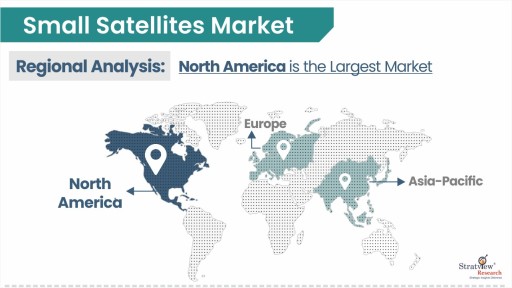
North America is expected to maintain its reign over the forecast period.
By Application type, Communication is likely to account for the major market share as well as to remain the demand generator in the coming years.
By Type, Smallsats are to remain the dominant and fastest-growing method in the market during the forecast period.
By End-Use type, Commercial is likely to maintain its lead in the market by 2032.
Have a look at the sales opportunities presented by the small satellites market in terms of growth and market forecast.
|
Small Satellites Market Data & Statistics |
|
||
|
Market Statistics |
Value (in USD Billion) |
Market Growth (%) |
|
|
Annual Market Size in 2024 |
USD 6.8 billion |
- |
|
|
Annual Market Size in 2025 |
USD 7.0 billion |
YoY Growth in 2025: 4.3% |
|
|
Annual Market Size in 2032 |
USD 8.0 billion |
CAGR 2025-2032: 1.9% |
|
|
Cumulative Sales Opportunity during 2025-2032 |
USD 63.3 billion |
- |
|
|
Top 10 Countries’ Market Share in 2024 |
USD 5.4 billion+ |
> 80% |
|
|
Top 10 Company’s Market Share in 2024 |
USD 3.4 billion to 4.7 billion |
50% - 70% |
|
Small satellites, often called SmallSats, represent a new era in space technology. Unlike traditional, bulky satellites, these compact and lightweight satellites are designed to perform a wide range of missions while being cost-effective and faster to develop. They come in various sizes, from tiny femto- and pico-satellites weighing less than a kilogram, to micro- and mini-satellites up to a few hundred kilograms, but all share the advantage of easy deployment, versatility, and affordability.ower cost, easier integration with launch vehicles, and frequent deployment cycles are central to small satellite growth. Commercial satellite launch services directly support this driver by enabling operators to place multiple compact spacecraft into orbit efficiently, supporting constellation expansion and faster mission rollout.
The rise of commercial constellations creates opportunities for small satellite manufacturers, operators, and service providers focused on scalable low-orbit infrastructure. Linking to LEO satellite helps readers understand how small satellites fit into broader orbit strategies for broadband, observation, and data-driven services. Rising demand for high-speed internet and digital connectivity is strengthening small satellite adoption across commercial networks. As operators expand distributed constellations to improve coverage and reduce latency, satellite communication becomes a key driver connecting small satellite deployment with real-world broadband and enterprise connectivity needs.
|
Segmentations |
List of Sub-Segments |
Segments with High Growth Opportunity |
|
Type Analysis |
Pico, Nano, Micro, Mini, and Smallsats |
Smallsats is likely to remain the dominant as well as the fastest-growing segment during 2024-2030. |
|
Application-Type Analysis |
Earth Observation & Meteorology, Communication, Scientific Research & Exploration, and Others |
Communication is likely to account for the major market share as well as to remain the demand generator in the coming years. |
|
End-User-Type Analysis |
Civil, Commercial, Defense, and Others |
Commercial is expected to remain the largest as well as the fastest-growing end-user in the forthcoming years. |
|
Regional Analysis |
North America, Europe, Asia-Pacific, and The Rest of the Word |
North America is expected to maintain its reign over the forecast period. |
“Smallsats are expected to remain dominant as well as the fastest-growing satellite during the forecast period.”
The market is segmented into picosatellite nanosatellites, microsatellites, minisatellites, and smallsats. Smallsats weigh less than 1,200 kg. These satellites are simpler and use similar technologies as larger satellites. SpaceX is a prominent leader in the small satellite industry, utilizing satellites primarily for communication and broadband internet services. The Starlink V2 Mini is in high demand in the small satellite market due to its 4x data capacity and advanced technology.
“Communication is expected to remain the demand generator during the forecast period.”
The market is segmented into earth observation & meteorology, communication, scientific research & exploration, and others. Rising demand for high-speed internet services, coupled with growing digitalization across various verticals, is augmenting the demand for small devices, especially for communication purposes. Their lower orbital altitude compared to traditional satellites results in faster signal travel times, which is crucial for real-time communication services.

Want to know more about the market scope? Click Here
“Commercial is expected to remain the dominant and fastest-growing end-user of the market during the forecast period.”
The market is segmented into civil, commercial, defense, and others. This growth is attributed to the increasing demand for internet services and mobile consumers. The market is also being driven by the growing use of small satellites for surveillance purposes. Satellites can serve various commercial purposes such as weather forecasting, communication, and navigation.
“North America is expected to remain the largest market for small satellites during the forecast period.”
The market is dominated by Starlink, which has launched nearly 6,000 small satellites to date. Starlink plans to launch 12,000 satellites to provide global broadband connectivity. Recently, the US government has also approved satellite constellations for the project Kuiper. These factors pave the way for the regional market.
Want to know more about the market scope? Register Here
Most of the major players compete in some of the factors, including price, service offerings, regional presence, etc. The following are the key players in the small satellites market -
Here is the list of the Top Players (Based on Dominance)
Amazon Kuiper
SpaceX (Starlink)
OneWeb Satellites
Planet Labs Inc.
Spire Global
Chang Guang Satellite Technology Co., Ltd.
Satellogic
Capella Space
Note: The above list does not necessarily include all the top players in the market.
Are you the leading player in this market? We would love to include your name. Write to us at [email protected].
A huge number of strategic alliances, including M&As, JVs, etc,. have been performed over the past few years:
In August 2023, Planet Labs acquired Sinergise, including Sentinel Hub, to accelerate the advancement of its Earth Data Platform and the delivery of Earth Observation (EO) data to customers. This acquisition also reflected Planet Labs' eagerness to invest in Europe and develop EO data applications.
In August 2021, SpaceX acquired Swarm Technologies, a company that manufactures and operates ultra-small satellites for IoT devices. Swarm's services will benefit from better capitalization and access to resources available to SpaceX.
This report provides market intelligence most comprehensively. The report structure has been kept so that it offers maximum business value. It provides critical insights into market dynamics and will enable strategic decision-making for existing market players as well as those willing to enter the market.
The following are the key features of the report:
Market structure: Overview, industry life cycle analysis, supply chain analysis.
Market environment analysis: Growth drivers and constraints, Porter’s five forces analysis, SWOT analysis.
Market trend and forecast analysis.
Market segment trend and forecast.
Competitive landscape and dynamics: Market share, Service portfolio, New Product Launches, etc.
COVID-19 impact and its recovery curve.
Attractive market segments and associated growth opportunities.
Emerging trends.
Strategic growth opportunities for the existing and new players.
Key success factors.
|
Market Study Period |
2019-2032 |
|
Base Year |
2024 |
|
Forecast Period |
2025-2032 |
|
Trend Period |
2019-2023 |
|
Number of Tables & Figures |
>100 |
|
Number of Segments Analysed |
4 (Type, By Application Type, End-Use Type, and Region) |
|
Number of Regions Analysed |
4 (North America, Europe, Asia-Pacific, Rest of the World) |
|
Countries Analysed |
15 (The USA, Canada, Mexico, Germany, France, Italy, The UK, China, Japan, India, Brazil, Saudi Arabia, Rest of Europe, Rest of APAC, and Rest of the World) |
|
Free Customization Offered |
10% |
|
After Sales Support |
Unlimited |
|
Report Presentation |
Complimentary |
|
Market Dataset |
Complimentary |
|
Further Deep Dive & Consulting Services |
10% Discount |
The report provides detailed insights into the market dynamics to enable informed business decision-making and growth strategy formulation based on the opportunities present in the market.
The small satellites market is segmented into the following categories.
By Type
Picosatellite
Nanosatellite
Microsatellite
Minisatellite
Smallsats
By Application Type
Earth Observation & Meteorology
Communication
Scientific Research & Exploration
Others
By End-User Type
Civil
Commercial
Defense
Others
By Region
North America (Country Analysis: The USA and Rest of North America)
Europe (Country Analysis: The UK, Russia, and Rest of Europe)
Asia-Pacific (Country Analysis: Japan, China, India, and Rest of Asia-Pacific)
Rest of the World (Country Analysis: Latin America and the Middle East)
This strategic assessment report from Stratview Research provides a comprehensive analysis that reflects today’s Small Satellites market realities and future market possibilities for the forecast period.
The report segments and analyzes the market in the most detailed manner to provide a panoramic view of the market.
The vital data/information provided in the report can play a crucial role for market participants and investors in identifying the low-hanging fruits available in the market and formulating growth strategies to expedite their growth process.
This report offers high-quality insights and is the outcome of a detailed research methodology comprising extensive secondary research, rigorous primary interviews with industry stakeholders, and validation and triangulation with Stratview Research’s internal database and statistical tools.
More than 1,000 authenticated secondary sources, such as company annual reports, fact books, press releases, journals, investor presentations, white papers, patents, and articles, have been leveraged to gather the data.
We conducted more than 15 detailed primary interviews with market players across the value chain in all four regions and industry experts to obtain both qualitative and quantitative insights.
With this detailed report, Stratview Research offers one of the following free customization options to our respectable clients:
Company Profiling
Detailed profiling of additional market players (up to three players)
SWOT analysis of key players (up to three players)
Competitive Benchmarking
Benchmarking of key players on the following parameters: Service portfolio, geographical reach, regional presence, and strategic alliances.
Custom Research: Stratview Research offers custom research services across sectors. In case of any custom research requirement related to market assessment, competitive benchmarking, sourcing and procurement, target screening, and others, please send your inquiry to [email protected].
The report is delivered digitally through our online portal. Buyers receive login credentials from our team to access the report and may update their credentials at any time after the initial login.
Delivery timelines depend on the status of the report:
For the most accurate delivery timeline, please contact us to confirm the current status of the report.
Yes. You may request a complimentary preview of the report through a video conference with our team.
Yes. The scope of the report can be fully customized to align with your specific research objectives and information requirements.
Please contact us at [email protected], and our team will be happy to discuss your requirements and propose a tailored solution.
Yes. Selected sections of the report can be purchased separately based on your requirements. Please contact us at [email protected] to discuss your needs.
Yes, AI can help gather publicly available information, but its outputs are only as reliable as the data it accesses. Stratview Research reports are built using validated data, extensive primary interviews with industry stakeholders, and the expertise of our experienced research team.
Additionally, many critical insights, including market dynamics, competitive intelligence, and industry-specific trends, are not publicly available and therefore cannot be captured through AI alone.
Small satellites market size was USD 6.8 billion in 2024 and is expected to grow from USD 7.0 billion in 2025 to USD 8.0 billion in 2032, witnessing an impressive market growth (CAGR) of 1.9%during the forecast period (2025-2032).
SpaceX, OneWeb Satellites, Planet Labs Inc., Spire Global, Chang Guang Satellite Technology Co., Ltd., Satellogic, and Capella Space are the leading players in the small satellites market.
North America is estimated to remain dominant in the small satellites market during the forecast period. The market is dominated by Starlink, which has launched nearly 6,000 smallsats to date and further has plans to launch 12,000 satellites to provide global broadband connectivity.


WE ACCEPT