




404
+1-313-307-4176

Military Radars Market Analysis | 2025-2032

Military Radars Market Size, Share, Trends, Dynamics, Forecast, & Growth Analysis: 2025-2032
Military Radars Market is segmented by Component Type (antennas, transmitters, receivers, power amplifiers, duplexers, digital signal processors, stabilization system, graphical user interfaces), by Platform Type (land, naval, airborne, and space), by Application Type (airspace monitoring & traffic management, maritime patrolling, search and rescue, air & missile defence, weapon guidance, ground surveillance & intruder detection, airborne mapping, navigation, mine detection & underground mapping, ground force protection & counter mapping, weather monitoring, space situational awareness, and others), by End-User Type (navy, army, air force, space), by Waveform Type (frequency modulated continuous wave (FMCW) And doppler), by Technology Type (software-defined radar (SDR), quantum radar, and conventional radar), by Frequency band Type (hf/uhf/vhf-band, l-band, s-band, c-band, x-band, ku-band, ka-band, multi-band), by Range Type (Long range, medium range, short range, very short range, very long range), by Product Type (surveillance and airborne early warning radar, tracking & fire control radar, multi-function radar, weapon locating & c-ram radar, aircraft bird strike avoidance radar, ground penetrating radar, air traffic control radar, airborne moving target indicator, weather radar, counter-drone radar, and others), by Dimension Type (2D radars, 3D radars, And 4D radars), by Services Type (installation/integration, support and maintenance, and training and consulting), and by Region (North America [The USA, Canada, and Mexico], Europe [Germany, France, The U.K., Russia, and Rest of Europe], Asia-Pacific [China, Japan, India, South Korea, and Rest of Asia-Pacific], and Rest of the World [Brazil, Saudi Arabia, Israel, and Others]).
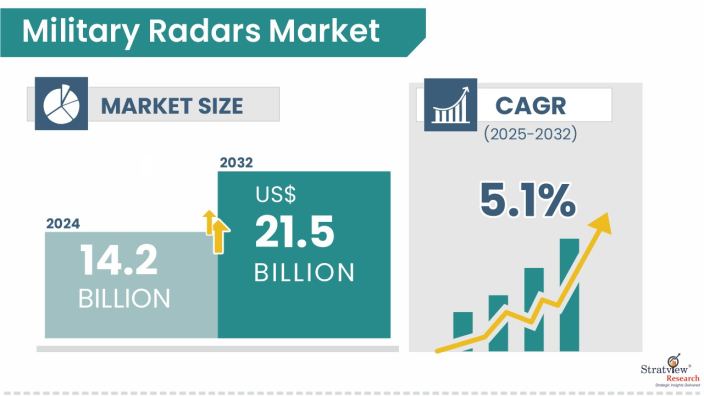
The military radars market was estimated at USD 14.2 billion in 2024 and is likely to grow at a CAGR of 5.1% during 2025-2032 to reach USD 21.5 billion in 2032.
Wish to get a free sample? Click Here
Rising Global Defense Expenditure
Higher defense spending gives military forces greater capacity to replace aging radar infrastructure and invest in advanced surveillance radar, tracking, fire-control, and multifunction radar systems. As procurement budgets expand, armed forces can accelerate modernization programs across land, naval, airborne, and missile-defense platforms. This increases market demand for radar systems capable of detecting a broader range of targets while integrating with modern command-and-control networks.
According to SIPRI, global military expenditure reached USD 2.887 trillion in 2025, representing a 2.9% increase in real terms from 2024. The increase provides governments with additional resources for military modernization, including investments in advanced sensing and air-defense capabilities.
Intensifying Air and Missile Defense Requirements
The growing range of aerial threats, including cruise missiles, ballistic missiles, drones, and low-altitude aircraft, is increasing the need for continuous detection and tracking. Military forces are therefore strengthening integrated air and missile defense networks that depend on long-range surveillance and fire-control radars to identify threats early and provide accurate targeting information. This shift toward layered defense architectures is supporting market growth for high-performance radar systems with greater detection range, tracking accuracy, and multifunction capabilities.
As reported by SIPRI, military expenditure in Europe increased 14% in real terms in 2025. Rising European defense budgets are enabling governments to strengthen air-defense infrastructure and procure radar systems needed to counter increasingly complex aerial threats.
Lengthy Radar Development and Integration Cycles
Advanced military radars require extensive hardware development, software integration, environmental testing, platform integration, and qualification before entering operational service. These requirements become particularly demanding for airborne platforms, where radars used for airborne ISR must operate within existing aircraft architectures and communicate with other mission systems. Development delays can therefore postpone deliveries, increase program costs, and slow the replacement of legacy radar fleets.
High Development and Testing Costs
The increasing sophistication of military radar systems is raising development costs as manufacturers incorporate electronically scanned arrays, advanced signal processing, electronic-warfare resistance, and multi-target tracking capabilities. Extensive testing is also required to verify radar performance against different threat types and operating environments. Higher engineering and qualification expenses can place pressure on defense budgets and make it more difficult for suppliers to commercialize new radar architectures at the required scale.
As reported by the U.S. Government Accountability Office, the U.S. Army had requested approximately USD 2.6 billion cumulatively for the LTAMDS radar program by FY2025. The scale of investment illustrates the substantial financial resources required to develop and field advanced air-and-missile-defense radar capabilities.
Rapid Expansion of Counter-UAS Radar Demand
The proliferation of small drones is creating a requirement for radar systems capable of detecting and tracking low-altitude, slow-moving, and small radar-cross-section targets. Unlike conventional aircraft, many drones operate close to the ground and can be difficult to distinguish from background objects, increasing the need for specialized low-altitude surveillance and sensor-fusion capabilities. Military forces are consequently expanding counter-UAS architectures that combine radar with electro-optical and electronic-warfare systems, creating new opportunities for compact, mobile, and networked radar solutions.
In February 2025, 15 NATO Allies committed to developing solutions for lower-level air threats operating below 500 feet (150 meters), according to NATO. The initiative highlights increasing military attention to low-altitude threats and creates opportunities for radar suppliers supporting counter-UAS and layered air-defense systems.
Homeland Air and Missile Defense Modernization
Growing government investment in homeland protection is creating opportunities for radar suppliers to support long-range surveillance, target tracking, fire control, and integrated air-defense networks. Governments seeking protection against drones, aircraft, cruise missiles, and ballistic missiles require both new radar installations and upgrades to existing sensor infrastructure. Dedicated defense programs can therefore expand the market opportunity for multifunction radars while generating demand for supporting integration, maintenance, and modernization services.
The UK Government committed up to £1 billion in new funding for homeland air and missile defense under its 2025 Strategic Defence Review. The investment is intended to strengthen the country's ability to detect and respond to aerial threats, supporting procurement and modernization of radar-enabled defense capabilities.
|
Segmentations |
List of Sub-Segments |
Segments with High Growth Opportunity |
|
Component Analysis |
Antennas, Transmitters, Receivers, Power Amplifiers, Duplexers, Digital Signal Processors, Stabilization System, Graphical User Interfaces |
The Antenna is expected to remain the largest market for military radars in the forecast period. |
|
Platform Type Analysis |
Land, Naval, Airborne, and Space |
The airborne segment is anticipated to register highest CAGR throughout the forecast period. |
|
Application Type Analysis |
Airspace Monitoring & Traffic Management, Maritime Patrolling, Search and Rescue, Air & Missile Defense, Weapon Guidance, Ground Surveillance & Intruder Detection, Airborne Mapping, Navigation, Mine Detection & Underground Mapping, Ground Force Protection & Counter Mapping, Weather Monitoring, Space Situational awareness, and Others |
The airspace monitoring & traffic management segment accounts for the largest market share in 2024. |
|
Waveform Type Analysis |
Frequency Modulated Continuous Wave (FMCW) and Doppler |
The FMCW accounts for the largest market share in 2024. |
|
Dimension Type Analysis |
2D Radars, 3D Radars, And 4D Radars |
The 3D radars segment accounts for the largest market share in 2024. |
|
Services Type Analysis |
Installation/Integration, Support and Maintenance, and Training and Consulting |
The installation/integration segment will account for the largest market share in 2024. |
|
Technology Type Analysis |
Software-Defined Radar (SDR), Quantum Radar, and Conventional Radar |
The software-defined radar segment account for the largest market share in 2024. |
|
Band Type Analysis |
HF/UHF/VHF-band, I-band, S-band, C-band, X-band, Ku-band, Ka-band, Multi-band |
The HF/UHF/VHF-band segment will account for the largest market share in 2024. |
|
Range Type Analysis |
Long Range, Medium Range, Short Range, Very Short Range, Very Long Range |
The medium-range segment will account for the largest market share in 2024. |
|
Regional Analysis |
North America, Europe, Asia-Pacific, and Rest of the World |
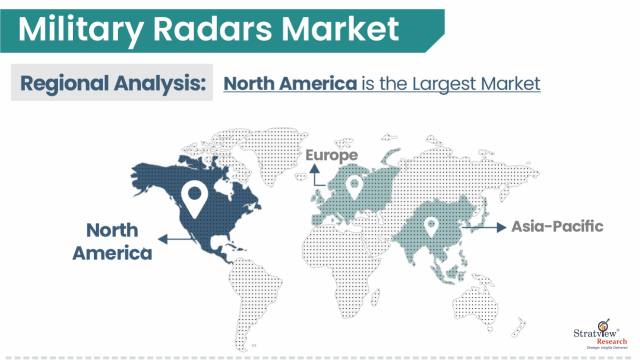
North America is likely to maintain its supremacy in the market throughout the forecast period. |
The market is divided into antennas, transmitters, receivers, power amplifiers, duplexers, digital signal processors, stabilization systems, and graphical user interfaces. Antennas are further subdivided into Parabolic Reflector Antennas, Slotted Waveguide Antennas, Planar Phased Array Antennas, Active Scanned Array Antennas, and Passive Scanned Array Antennas.
The Antenna is expected to remain the largest market for military radars in the forecast period. Due to the increasing demand for military spending in various emerging countries, Antennas play an essential role in detecting and guiding weapons.
The market is bifurcated into land, naval, airborne, and space. The airborne segment is anticipated to register the highest CAGR throughout the forecast period. Across the world, to detect fighter aircraft and helicopters, Airborne platforms have evolved to support multi-mission warfare machines capable of conducting various missions. Airborne is further sub-segmented into Manned aircraft radars, UAV radars, and aerostat/balloon-based radars.
The market is segmented as airspace monitoring & traffic management, maritime patrolling, search and rescue, air & missile defense, weapon guidance, ground surveillance & intruder detection, airborne mapping, navigation, mine detection & underground mapping, ground force protection & counter-mapping, weather monitoring, space situational awareness, and others.
The airspace monitoring & traffic management segment accounts for the largest market share in 2024, attributed to high-adoption land, airborne, and naval platforms for surface-to-air warfare to engage with main battle tanks and other armored fighting vehicles.
The market is segmented as frequency modulated continuous wave (FMCW) and doppler. The FMCW accounts for the largest market share in 2024, the doppler is again segmented into Conventional Doppler and Pulse-Doppler.
The market is segmented into 2D radars, 3D radars, and 4D radars. The 3D radar segment accounts for the largest market share in 2024.
The market is segmented as installation/integration, support and maintenance, and training and consulting. The installation/integration segment will account for the largest market share in 2024.
The market is segmented as software-defined radar (SDR), quantum radar, and conventional radar. The software-defined radar segment accounted for the largest market share in 2024, attributed to the high adoption of new-generation air and missile defense systems.
The market is segmented as HF/UHF/VHF-band, l-band, s-band, c-band, x-band, Ku-band, ka-band, multi-band. The HF/UHF/VHF-band segment will account for the largest market share in 2024.
The market is segmented as long-range, medium-range, short-range, very short-range, and very long-range. The medium-range segment will account for the largest market share in 2024.
North America is likely to maintain its supremacy in the market throughout the forecast period. Rapid modernization and technological advancements in various sectors have resulted in a high rate of Military Radars systems.
Concurrently, Asia Pacific is expected to witness the fastest military radar market growth during the forecast period. This Asia Pacific region's growth can be attributed to the increasing investments by China, India, and Japan in the defense industry. Globally, China’s defense budget stands second after the US.
Know the high-growth countries in this report. Register Here
This strategic assessment report, from Stratview Research, provides a comprehensive analysis that reflects today’s military radars market realities and future market possibilities for the forecast period of 2025 to 2032. After a continuous interest in our military radars market report from the industry stakeholders, we have tried to further accentuate our research scope to the military radars market to provide the most crystal-clear picture of the market. The report segments and analyses the market in the most detailed manner to provide a panoramic view of the market. The vital data/information provided in the report can play a crucial role for the market participants as well as investors in the identification of the low-hanging fruits available in the market as well as to formulate the growth strategies to expedite their growth process.
This report offers high-quality insights and is the outcome of a detailed research methodology comprising extensive secondary research, rigorous primary interviews with industry stakeholders, and validation and triangulation with Stratview Research’s internal database and statistical tools. More than 1000 authenticated secondary sources, such as company annual reports, fact books, press releases, journals, investor presentations, white papers, patents, and articles, have been leveraged to gather the data. We conducted more than 15 detailed primary interviews with the market players across the value chain in all four regions and industry experts to obtain both qualitative and quantitative insights.
This report provides market intelligence in the most comprehensive way. The report structure has been kept such that it offers maximum business value. It provides critical insights into market dynamics and will enable strategic decision-making for existing market players as well as those willing to enter the market. The following are the key features of the report:
This report studies the market, covering a period of 12 years of trends and forecasts. The report provides detailed insights into the market dynamics to enable informed business decision-making and growth strategy formulation based on the opportunities present in the market.
The military radars market is segmented into the following categories:
By Component Type
By Platform Type
By Application Type
By End-User Type
By Waveform Type
By Technology Type
By Frequency Band Type
By Range Type
By Product Type
By Dimension Type
By Services Type
By Region

Click Here, to learn the market segmentation details.
The following are the major players in the market:
There is stiff competition in the market. The growth of the companies is directly dependent on industry conditions and government support. These companies differentiate their Military Radars based on their quality and penetration in the target and emerging markets.
Also, some major mergers and acquisitions in the industry recently have significantly influenced the competitive dynamics. For example:
Stratview Research offers one of the following free customization options to our respectable clients:
Company Profiling
Competitive Benchmarking
Benchmarking of key players on the following parameters: Product portfolio, geographical reach, regional presence, and strategic alliances.
Custom Research: Stratview Research offers custom research services across sectors. In case of any custom research requirement related to market assessment, competitive benchmarking, sourcing and procurement, target screening, and others, please send your inquiry to [email protected].
The report is delivered digitally through our online portal. Buyers receive login credentials from our team to access the report and may update their credentials at any time after the initial login.
Delivery timelines depend on the status of the report:
For the most accurate delivery timeline, please contact us to confirm the current status of the report.
Yes. You may request a complimentary preview of the report through a video conference with our team.
Yes. The scope of the report can be fully customized to align with your specific research objectives and information requirements.
Please contact us at [email protected], and our team will be happy to discuss your requirements and propose a tailored solution.
Yes. Selected sections of the report can be purchased separately based on your requirements. Please contact us at [email protected] to discuss your needs.
Yes, AI can help gather publicly available information, but its outputs are only as reliable as the data it accesses. Stratview Research reports are built using validated data, extensive primary interviews with industry stakeholders, and the expertise of our experienced research team.
Additionally, many critical insights, including market dynamics, competitive intelligence, and industry-specific trends, are not publicly available and therefore cannot be captured through AI alone.
The military radars market was estimated at USD 14.2 billion in 2024.
The forecasted value of the military radars market is expected to be USD 21.5 billion in 2032.
The military radars market is likely to grow at a CAGR of 5.1% during 2025-2032.
The major players in the market are Israel Aerospace Industries (Israel), Leonardo S.P.A. (Italy), Northrop Grumman Corporation, Thales Group, Lockheed Martin Corporation.
North America is likely to maintain its supremacy in the market throughout the forecast period.
Asia Pacific is expected to witness the fastest market growth during the forecast period.
The Antenna is expected to remain the largest market during the forecast period.


WE ACCEPT