Medical Nonwoven Market | 2024-2030

Medical Nonwoven Market | 2024-2030

Medical Nonwoven Market | 2024-2030
Report code - SR2936
Published by: Stratview Research Published On : Aug,2024 No. of Pages: 120
Medical Nonwoven Market Size, Share, Trends, Forecast, & Growth Analysis: 2024-2030
See less...

Market Insights

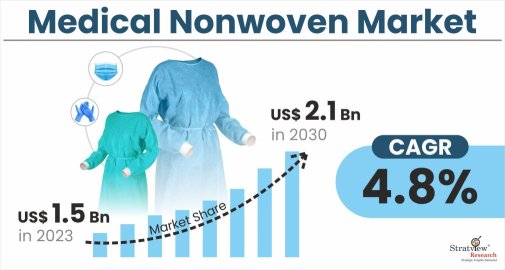
“The medical nonwoven market size was estimated at USD 1.5 billion in 2023 and is likely to grow at a decent CAGR of 4.8% during 2024-2030 to reach USD 2.1 billion in 2030.”
Medical-Nonwoven-Market-Insights

Want to know more about the market scope? Click Here

Market Dynamics

Introduction

Medical nonwoven is a specialized fabric used extensively in healthcare settings for its unique properties. These fabrics are manufactured using processes that bond fibers together mechanically, chemically, or thermally, rather than weaving or knitting. They are designed to meet strict medical standards, offering characteristics, like high absorbency, barrier protection against liquids and contaminants, breathability, and comfort.

Nonwovens in the medical field are highly valued for their ability to provide sterile environments, their unique structure allows for high filtration efficiency, making them essential in ensuring both patient and healthcare worker safety. It offers exceptional versatility in medical applications, being easily customizable to meet specific requirements such as varying levels of fluid resistance. In this era of multi-drug-resistant bacteria and viruses, medical nonwovens play a highly imperative role in preventing cross-contamination and the spread of infections in a medical and surgical environment. Because these medical nonwovens are for single-use and incinerated after use, the risk of contaminant spread also gets reduced.

Market Drivers

Persistent Healthcare-Associated Infection Burden

Healthcare-associated infections continue to reinforce the need for disposable protective products that limit contamination between patients, healthcare workers, and clinical surfaces. Medical nonwovens are widely used in surgical gowns, drapes, masks, wipes, and other barrier products because their filtration, fluid-resistance, absorbency, and single-use characteristics support infection-control protocols. A persistent infection burden therefore translates into recurring consumption of these products across hospitals, operating rooms, outpatient facilities, and other care settings, supporting market demand.

According to the U.S. Centers for Disease Control and Prevention, U.S. acute-care hospitals recorded an estimated 518,000 healthcare-associated infections in 2023. The continued prevalence of these infections reinforces the need for effective disposable barriers and hygiene products in healthcare facilities.

Expanding Hospital and Ambulatory Care Infrastructure

Expansion of hospitals, ambulatory surgical centers, and outpatient services increases the number of procedures and patient interactions requiring disposable medical supplies. Each procedure can require products such as surgical gowns, drapes, wipes, wound-care materials, and sterile packaging, many of which rely on nonwoven substrates. As healthcare delivery shifts toward outpatient and same-day procedures, higher procedure volumes can increase the recurring consumption of lightweight, standardized medical nonwoven products.

As reported by the U.S. Centers for Medicare & Medicaid Services, its 2026 outpatient payment policies covered approximately 4,000 hospitals and 6,000 ambulatory surgical centers in the United States. The broad facility base demonstrates the scale of healthcare settings where procedure-related disposable products are consumed.

Market Challenges

Growing Healthcare Waste from Single-Use Products

The extensive use of disposable medical nonwovens creates a waste-management challenge because gowns, drapes, masks, wipes, and other products are typically discarded after use to maintain hygiene and prevent cross-contamination. Rising healthcare waste is increasing pressure on hospitals and manufacturers to reduce material consumption and improve recyclability without compromising sterility, fluid protection, filtration, or patient safety. This can increase product-development costs and encourage manufacturers to invest in alternative fibers, lightweight structures, and lower-impact production methods.

The World Health Organization reported in 2025 that an average university hospital generates approximately 1,634 tonnes of healthcare waste annually, with waste volumes increasing by around 2% to 3% per year. Rising waste volumes strengthen pressure on healthcare providers and suppliers to address the environmental impact of disposable medical products.

Stringent Barrier-Performance and Compliance Requirements

Medical nonwoven products used in critical applications must meet strict requirements for barrier protection, filtration, fluid resistance, sterility, labeling, and quality consistency. Manufacturers introducing new fibers, coatings, antimicrobial treatments, or sustainable substrates must therefore conduct extensive testing and validation before commercialization. These requirements increase development costs and can lengthen approval timelines, particularly when suppliers attempt to replace established materials without reducing protective performance.

According to the U.S. Food and Drug Administration, recognized surgical-gown requirements under ANSI/AAMI PB70 classify gowns into four levels of barrier protection. The tiered requirements mean manufacturers must develop and validate products according to specific protection levels, increasing the technical and compliance requirements associated with medical nonwovens.

Market Opportunities

Rising Demand for Adult Incontinence Products

Population ageing is expanding the need for absorbent healthcare products used in hospitals, nursing facilities, and home-based care. Medical nonwovens provide softness, breathability, fluid absorption, and liquid retention in adult incontinence products, making them suitable for frequent-use applications. As the number of older adults increases, healthcare providers and caregivers require larger volumes of absorbent products, creating opportunities for manufacturers developing thinner, more comfortable, higher-absorbency nonwoven structures.

According to the United Nations, approximately 1.2 billion people worldwide were aged 60 years or older in 2025. The expanding older population increases the potential user base for adult incontinence products and strengthens long-term demand for absorbent nonwoven materials.

Asia-Pacific Healthcare Infrastructure Expansion

Improving healthcare infrastructure across Asia-Pacific is creating opportunities for medical nonwoven suppliers as new and upgraded healthcare facilities increase their consumption of disposable protective and hygiene products. Expansion of hospitals, public-health facilities, outpatient services, and standardized clinical practices can increase demand for gowns, drapes, masks, wipes, wound-care materials, and sterile packaging. Suppliers able to provide cost-efficient, certified polypropylene and spunlaid nonwovens can therefore benefit as healthcare systems expand access while strengthening infection-control standards.

As reported by the Government of India, states and union territories were committed to achieving Indian Public Health Standards compliance in 50% of healthcare facilities by 2025–26. Greater standardization of healthcare facilities can increase the adoption of compliant medical consumables and create additional opportunities for domestic and regional medical nonwoven suppliers.

Segments Analysis

Segmentations

List of Sub-Segments

Segments with High Growth Opportunity

Application-Type Analysis

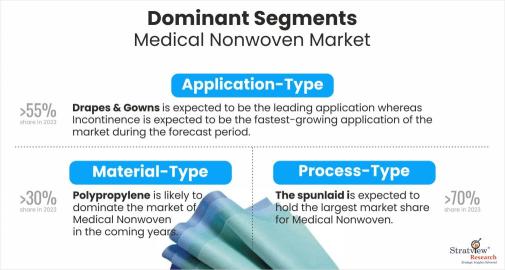
Drapes & Gowns, Sterile Packaging, Other Medical Apparel, Wound Care, Incontinence Products, Medical Wipes, and Others.

Drapes & Gowns is expected to be the leading application whereas Incontinence is expected to be the fastest-growing application of the market during the forecast period.

Process-Type Analysis

Drylaid [Needle Punched, Thermal Bond, Chemical Bond, Others], Spunlaid [Spunbond and Meltblown & Others], Wetlaid, Airlaid, and Others

The spunlaid is expected to hold the largest market share for Medical Nonwoven.

Material-Type Analysis

Polyethylene, Polypropylene, Polyester fiber, Cotton, and Others.

Polypropylene is likely to dominate the market of Medical Nonwoven in the coming years.

Region Analysis

North America, Europe, Asia-Pacific, and The Rest of the World.

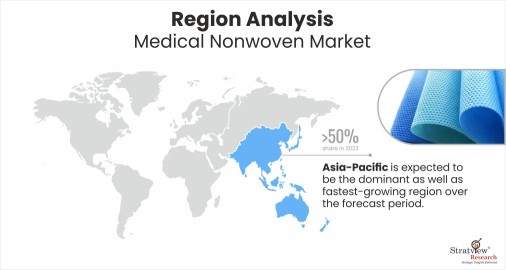
Asia-Pacific is expected to be the dominant as well as fastest-growing region over the forecast period.

By Application Type

Drapes & Gowns application is expected to be the leading segment in terms of market share whereas incontinence is expected to be the fastest-growing market during the forecast period.

  • The drape & gown application is expected to be the leading segment in the medical nonwoven market due to its important role in infection control as it provides excellent barrier protection.
  • The convenience of single-use products ensures sterility and reduces the need for laundering, and it can make drapes & Gown grow faster.
  • The incontinence application is the fastest-growing segment in the medical nonwoven market due to the aging population, which is leading to an increase in the usage of incontinence products
  • Advances in nonwoven technology have made these products more comfortable and effective, making them more popular. Greater awareness and reduced stigma around incontinence are also encouraging more people to use these products.

By Process Type

The spunlaid process is expected to hold the largest share of the medical nonwoven market during the forecast period.

  • The spunlaid process is expected to be the widely used process for the medical nonwoven market as it has superior blocking properties and versatility in fabric production, with the possibility of adding special substances to the nonwoven fabric during its manufacturing process to give it extra useful features.
  • For example, adding antimicrobial agents to the fabric can help kill bacteria and viruses, making the fabric safer for medical use. Besides that, spunbond nonwovens are soft, comfortable, and produced from recyclable raw materials, so they are very appropriate for many medical applications.

Medical-Nonwoven-Market-Segments-Analysis-By-Process-Type

Want to have a closer look at this report? Click Here

By Material Type

Polypropylene is expected to dominate the market of medical nonwoven during the forecast period.

  • Polypropylene is expected to dominate the market of medical nonwoven due to its unique combination of properties tailored to meet healthcare needs.
  • As a thermoplastic polymer, polypropylene offers an exceptional strength-to-weight ratio, ensuring durability without compromising on comfort.
  • Its ability to resist moisture and chemicals makes it ideal for applications, polypropylene's versatility in processing allows for the production of various nonwoven structures, such as spun bond and melt-blown tailored to specific medical applications like surgical masks, gowns, and wound dressings.

Regional Insights

Asia-Pacific is expected to be the fastest-growing region for medical nonwoven market during the forecast period.

  • Asia-Pacific is expected to be the fastest-growing market region for medical nonwovens due to the large and growing population increasing the need for healthcare products, significant investments in healthcare infrastructure boost the demand for medical nonwovens, and rapid economic development supporting higher production and consumption of these products.
  • The region's status as a major manufacturing hub with advanced technology and lower production costs also contributes. Additionally, increased demand for medical supplies during pandemics has accelerated market growth.

Medical-Nonwoven-Market-Regional-Insights

Know the high-growth countries in this report. Register Here

Key Players

The market is highly fragmented with the presence of over 100 players. Most of the major players compete in some of the governing factors including price, service offerings, regional presence, etc. The following are the key players in the medical nonwoven market:

Here is the list of the Top Players (Based on Dominance)

  • Kimberly-Clark Corporation
  • Freudenberg Group
  • Ahlstrom Oyj
  • E.I. Du Pont De Nemours and Company
  • Cardinal Health, Inc
  • Domtar Corporation
  • Berry Global Group, Inc
  • Global Non-Wovens Limited
  • Eximius Tech Innovation Private Limited

Note: The above list does not necessarily include all the top players of the market.

Are you the leading player in this market? We would love to include your name. Write to us at [email protected]

Recent Developments of Medical Nonwoven Market

In July 2026, Ahlstrom introduced ChemoGard BVB, a breathable protective-apparel fabric for handling chemotherapy drugs in clinical, laboratory and operating-room environments. It is designed to combine barrier protection with improved comfort for personnel exposed to hazardous pharmaceuticals.

In May 2026, Mölnlycke and Zhende formed Mölnlycke Zhende, a majority-Mölnlycke-owned Chinese joint venture integrating both companies’ advanced wound-care portfolios and commercial capabilities. The venture will reach nearly 10,000 hospitals and 200,000 pharmacies and may expand into product co-development.

In December 2025, Platinum Equity completed the acquisition of Owens & Minor’s Products & Healthcare Services business following a $375 million cash agreement plus a 5% retained seller stake. The acquired platform includes vertically integrated manufacturing and distribution of medical-surgical supplies, including HALYARD surgical and infection-prevention products.

In December 2025, Magnera launched a proprietary nonwoven liquid-barrier technology providing fluid repellency without intentionally added PFAS. The solution targets surgical gowns, drapes and other protective nonwoven applications requiring barrier performance, breathability and regulatory readiness.

Report Features

This report provides market intelligence most comprehensively. The report structure has been kept such that it offers maximum business value. It provides critical insights into market dynamics and will enable strategic decision-making for existing market players as well as those willing to enter the market. The following are the key features of the report:

  • Market structure: Overview, industry life cycle analysis, supply chain analysis.
  • Market environment analysis: Growth drivers and constraints, Porter’s five forces analysis, SWOT analysis.
  • Market trend and forecast analysis.
  • Market segment trend and forecast.
  • Competitive landscape and dynamics: Market share, Service portfolio, New Product Launches, etc.
  • COVID-19 impact and its recovery curve.
  • Attractive market segments and associated growth opportunities.
  • Emerging trends.
  • Strategic growth opportunities for the existing and new players.
  • Key success factors.

The medical nonwoven market is segmented into the following categories.

By Application Type

  • Drapes & Gowns (Regional Analysis: North America, Europe, Asia-Pacific, and The Rest of the World)
  • Sterile Packaging (Regional Analysis: North America, Europe, Asia-Pacific, and The Rest of the World)
  • Other Medical Apparel (Regional Analysis: North America, Europe, Asia-Pacific, and The Rest of the World)
  • Wound Care (Regional Analysis: North America, Europe, Asia-Pacific, and The Rest of the World)
  • Incontinence Products (Regional Analysis: North America, Europe, Asia-Pacific, and The Rest of the World)
  • Medical Wipes (Regional Analysis: North America, Europe, Asia-Pacific, and The Rest of the World)
  • Others (Regional Analysis: North America, Europe, Asia-Pacific, and The Rest of the World)

By Process Type

  • Drylaid
    • (Regional Analysis: North America, Europe, Asia-Pacific, and The Rest of the world)
    • (Process Analysis: Needle Punched, Thermal Bond, Chemical Bond, Others)
  • Spunlaid
    • (Regional Analysis: North America, Europe, Asia-Pacific, and The Rest of the World)
    • (Process Analysis: Spunbond and Meltblown & Others)
  • Wetlaid (Regional Analysis: North America, Europe, Asia-Pacific, and The Rest of the World)
  • Airlaid (Regional Analysis: North America, Europe, Asia-Pacific, and The Rest of the World)
  • Others (Regional Analysis: North America, Europe, Asia-Pacific, and The Rest of the World)

By Material Type      

  • Polyethylene (Regional Analysis: North America, Europe, Asia-Pacific, and The Rest of the world)
  • Polypropylene (Regional Analysis: North America, Europe, Asia-Pacific, and The Rest of the World)
  • Polyester (Regional Analysis: North America, Europe, Asia-Pacific, and The Rest of the World)
  • Cotton (Regional Analysis: North America, Europe, Asia-Pacific, and The Rest of the world)
  • Others (Regional Analysis: North America, Europe, Asia-Pacific, and The Rest of the World)

By Region

  • North America (Country Analysis: The USA, Canada, and Mexico)
  • Europe (Country Analysis: Germany, France, The UK, Russia, and Rest of Europe)
  • Asia-Pacific (Country Analysis: Japan, China, India, and Rest of Asia-Pacific)
  • Rest of the World (Country Analysis: Brazil, Saudi Arabia, and Others)

Research Methodology

  • This strategic assessment report from Stratview Research provides a comprehensive analysis that reflects today’s Medical Nonwoven Market realities and future market possibilities for the forecast period.
  • The report segments and analyzes the market in the most detailed manner in order to provide a panoramic view of the market.
  • The vital data/information provided in the report can play a crucial role for market participants as well as investors in the identification of the low-hanging fruits available in the market as well as to formulate growth strategies to expedite their growth process.
  • This report offers high-quality insights and is the outcome of a detailed research methodology comprising extensive secondary research, rigorous primary interviews with industry stakeholders, and validation and triangulation with Stratview Research’s internal database and statistical tools.
  • More than 1,000 authenticated secondary sources, such as company annual reports, fact books, press releases, journals, investor presentations, white papers, patents, and articles, have been leveraged to gather the data.
  • We conducted more than 15 detailed primary interviews with market players across the value chain in all four regions and industry experts to obtain both qualitative and quantitative insights.

Report Customization Options

With this detailed report, Stratview Research offers one of the following free customization options to our respectable clients:

Company Profiling

  • Detailed profiling of additional market players (up to three players)
  • SWOT analysis of key players (up to three players)

Competitive Benchmarking

  • Benchmarking of key players on the following parameters: Service portfolio, geographical reach, regional presence, and strategic alliances

Custom Research: Stratview Research offers custom research services across sectors. In case of any custom research requirement related to market assessment, competitive benchmarking, sourcing and procurement, target screening, and others, please send your inquiry to [email protected]

Frequently Asked Questions (FAQs)

The report is delivered digitally through our online portal. Buyers receive login credentials from our team to access the report and may update their credentials at any time after the initial login.

Delivery timelines depend on the status of the report:

  • Published reports are typically delivered within 24 hours.
  • If the dataset is ready but the report is still being prepared, the dataset is usually delivered within 24 hours, while the completed report is delivered within 2 weeks.
  • For ongoing studies, both the dataset and the final report are generally delivered within 4–5 weeks .

For the most accurate delivery timeline, please contact us to confirm the current status of the report.

Yes. You may request a complimentary preview of the report through a video conference with our team.

Yes. The scope of the report can be fully customized to align with your specific research objectives and information requirements.
Please contact us at [email protected], and our team will be happy to discuss your requirements and propose a tailored solution.

Yes. Selected sections of the report can be purchased separately based on your requirements. Please contact us at [email protected] to discuss your needs.

Yes, AI can help gather publicly available information, but its outputs are only as reliable as the data it accesses. Stratview Research reports are built using validated data, extensive primary interviews with industry stakeholders, and the expertise of our experienced research team.

Additionally, many critical insights, including market dynamics, competitive intelligence, and industry-specific trends, are not publicly available and therefore cannot be captured through AI alone.

Medical nonwovens are fabrics created by bonding fibers without weaving or knitting, specifically designed for healthcare use. They provide crucial benefits such as high absorbency, strong barrier protection, and comfort. These fabrics are used in products like surgical gowns, masks, and wound dressings, helping to prevent infections and maintain hygiene in medical environments.

The medical nonwoven market size was estimated at USD 1.5 billion in 2023.

The medical nonwoven market is likely to reach USD 2.1 billion in 2030.

The medical nonwoven market is estimated to grow at a CAGR of 4.8% by 2030, due to increased healthcare spending, a growing population, increasing infection control measures, technological advancements, and the sustained demand for disposable medical supplies after the pandemic has further driven this growth.

Asia-Pacific has the highest market growth due to its large and increasing population, significant investments in healthcare infrastructure, and rapid economic development. and the region has strong manufacturing capabilities and the production costs are also low so it strengthens a leading position in the market.

Kimberly-Clark Corporation, Freudenberg Group, Ahlstrom Oyj, E.I. Du Pont De Nemours & Company, Cardinal Health, Inc., Domtar Corporation, Berry Global Group, Inc., Global Nonwovens Limited, Eximius Tech Innovation Private Limited are the leading players in the medical nonwoven.

Incontinence product is the leading segment by application type due to the increasing demand for the management of everyday life by people suffering from problems relating to bladder control or bowel control. The high population of elderly citizens and the increasing prevalence of chronic diseases are major forces driving it forward. Improved technologies in nonwoven enhance the comfort and efficiency of the product.