



404
+1-313-307-4176

Green Water Treatment Chemicals Market Analysis | 2025-2032

Green Water Treatment Chemicals Market Size, Share, Trends, Dynamics, Forecast, & Growth Analysis: 2025-2032
"Green water treatment chemicals market size was USD 1.61 billion in 2024.”
Want to know more about the market scope? Register Here
Have a look at the sales opportunities presented by the green water treatment chemicals market in terms of growth and market forecast.
|
Green Water Treatment Chemicals Market Data & Statistics |
||
|
Market Statistics |
Value (in USD Billion) |
Market Growth (%) |
|
Annual Market Size in 2023 |
USD 1.49 billion |
- |
|
Annual Market Size in 2024 |
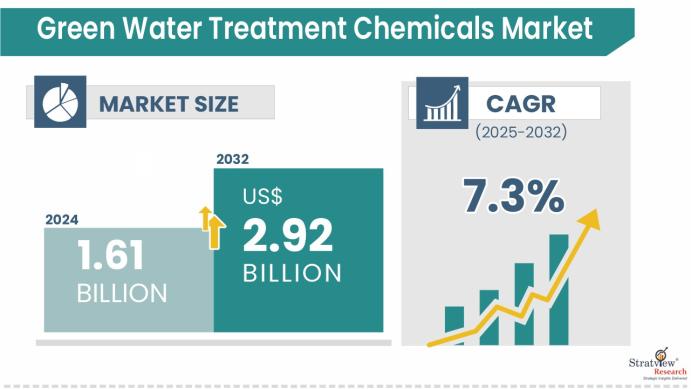
USD 1.61 billion |
YoY Growth in 2024: 7.7% |
|
Annual Market Size in 2025 |
USD 1.78 billion |
YoY Growth in 2025: 8% |
|
Annual Market Size in 2032 |
USD 2.92 billion |
CAGR 2025-2032: 7.3% |
|
Cumulative Sales Opportunity during 2025-2032 |
USD 18.59 billion |
- |
|
Top 10 Countries’ Market Share in 2024 |
USD 1.2 billion + |
> 80% |
|
Top 10 Company’s Market Share in 2024 |
USD 0.8 billion to USD 1.1 billion |
50% - 70% |
Introduction:
What are green water treatment chemicals?
Green Water Treatment Chemicals are environmentally friendly formulations used to purify or treat water without harming ecosystems or human health. These chemicals are typically biodegradable, non-toxic, and derived from natural or renewable sources such as plants, enzymes, or minerals. They are designed to minimize environmental impact, reduce hazardous chemical discharge, and comply with stringent sustainability and safety regulations. Common applications include municipal water treatment, industrial wastewater management, and environmentally responsible cooling systems.
Stringent Environmental Regulations Driving Sustainable Water Treatment Adoption
Increasingly stringent regulations on drinking water quality, wastewater discharge, and hazardous substances are driving green water treatment chemicals market growth as municipalities and industries seek lower-toxicity, biodegradable, and environmentally compatible alternatives to conventional treatment chemicals. Regulatory restrictions on persistent contaminants are also encouraging treatment providers to adopt chemistries that reduce secondary environmental impacts.
According to the U.S. Environmental Protection Agency (EPA), the final national drinking water standards for six PFAS are expected to reduce PFAS exposure for approximately 100 million people in the United States. The introduction of enforceable limits is increasing treatment requirements for utilities and encouraging investment in advanced and environmentally responsible water treatment solutions.
Rising Wastewater Treatment and Water Reuse Initiatives
Growing water scarcity, urbanization, and industrial water consumption are increasing green water treatment chemicals market demand as municipalities and industries expand wastewater treatment, recycling, and reuse systems. Sustainable chemicals are increasingly important in these applications because they enable effective treatment while reducing the environmental burden associated with conventional chemical formulations.
According to UN-Water, approximately 2.2 billion people lacked safely managed drinking water in 2022, including 703 million people without basic access to water. Persistent gaps in water access are increasing investments in treatment and reuse infrastructure, creating demand for sustainable chemicals used in municipal and industrial water-treatment processes.
Higher Production Costs Compared with Conventional Chemicals
Higher production costs can constrain green water treatment chemicals market growth because many sustainable formulations rely on bio-based feedstocks, specialized processing, and comparatively smaller production volumes than established synthetic chemicals. These cost differences can make green alternatives less competitive for municipal utilities and industrial users operating under strict procurement budgets.
According to the International Energy Agency (IEA), global investment in clean energy reached approximately USD 2.2 trillion in 2025, reflecting the continued expansion of technologies and supply chains associated with the energy transition. The capital-intensive nature of scaling sustainable production technologies highlights the investment required to expand lower-carbon manufacturing capacity, including bio-based chemical production.
Performance Limitations in Complex Industrial Applications
Performance variability remains a challenge to green water treatment chemicals market expansion because some bio-based and biodegradable formulations may not consistently match conventional chemicals when treating highly contaminated industrial wastewater containing heavy metals, oils, salts, and persistent pollutants. Treatment providers therefore require green formulations that maintain high removal efficiency across changing wastewater conditions without increasing chemical consumption or treatment time.
According to the United Nations Environment Programme (UNEP), approximately 80% of the world's wastewater is discharged without adequate treatment. The enormous diversity and complexity of untreated wastewater streams increases the need for high-performance treatment technologies, creating a technical barrier for green chemicals that must demonstrate reliable performance across demanding applications.
Expansion of Circular Water Management and Industrial Water Reuse
The shift toward circular water management is creating opportunities in the green water treatment chemicals market forecast as industries increasingly recycle and reuse treated wastewater to reduce freshwater withdrawals and operating risks. Closed-loop systems require effective treatment chemicals for coagulation, filtration, corrosion control, and membrane protection, creating opportunities for biodegradable and low-toxicity formulations.
According to the European Commission, the EU Water Reuse Regulation became applicable in June 2023, supporting the safe reuse of treated wastewater for agricultural irrigation. With agriculture accounting for approximately 70% of global freshwater withdrawals, expanding water reuse is creating opportunities for green treatment chemicals that enable efficient wastewater recycling.
Growing Development of Bio-Based Water Treatment Chemicals
The increasing availability of renewable feedstocks such as starch, cellulose, chitosan, and tannins is creating a green water treatment chemicals market trend toward bio-based coagulants, flocculants, corrosion inhibitors, and other treatment formulations. Advances in green chemistry and biorefining are enabling manufacturers to develop chemicals that combine treatment performance with improved biodegradability and lower environmental impact.
According to the European Commission, the EU's bioeconomy generated approximately EUR 2.7 trillion in turnover and supported around 17.2 million jobs in 2023. The expanding bio-based economy is strengthening investment in renewable feedstocks and biobased manufacturing technologies, creating opportunities to develop and commercialize next-generation green chemicals for water treatment applications.
|
Segmentations |
List of Sub-Segments |
Segments with High-Growth Opportunity |
|
Type Analysis |
Coagulants & Flocculants, Corrosion & Scale Inhibitors, Biocides & Disinfectants, Chelating Agents |
Coagulants & Flocculants segment is anticipated to experience the fastest growth in the future. |
|
Source Analysis |
Plant-Based Sources, Animal-Based Sources, Mineral-Based Sources |
Plant-Based Sources segment is expected to be the largest green water treatment chemicals market segment during the forecast period. |
|
Application Analysis |
Wastewater Treatment, Drinking Water Treatment, Process Water Treatment |
Wastewater Treatment segment is anticipated to grow at the highest CAGR during the forecast period. |
|
End-Use Analysis |
Municipal, Industrial |
Industrial segment is anticipated to hold the highest market share during the forecast period. |
|
Regional Analysis |
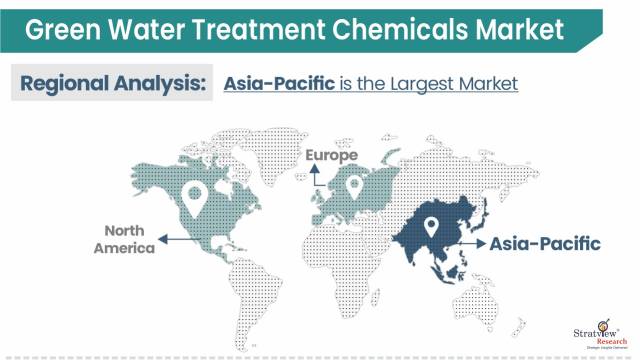
North America, Europe, Asia-Pacific, and The Rest of the World |
Asia-Pacific is expected to lead the Green Water Treatment Chemicals Market during the forecast period. |
“Coagulants & Flocculants, Corrosion & Scale Inhibitors, Biocides & Disinfectants, Chelating Agents”
“Plant-Based Sources segment is expected to be the largest green water treatment chemicals market segment during the forecast period.”
“Asia-Pacific is expected to lead the Green Water Treatment Chemicals Market during the forecast period.”
Know the high-growth countries in this report. Register Here
Most of the major players compete in some of the factors, including price, service offerings, regional presence, etc. The following are the key players in the green water treatment chemicals market:
Note: The above list does not necessarily include all the top players in the market.
Are you a leading player in this market? We would love to include your name. Please write to us at [email protected]
This report provides market intelligence most comprehensively. The report structure has been kept so that it offers maximum business value. It provides critical insights into market dynamics and will enable strategic decision-making for existing market players as well as those willing to enter the market.
The following are the key features of the report:
|
Market Study Period |
2019-2032 |
|
Base Year |
2024 |
|
Forecast Period |
2025-2032 |
|
Trend Period |
2019-2023 |
|
Number of Tables & Figures |
>100 |
|
Number of Segments Analysed |
5 (Type, Source Type, Application Type, End-Use Type, and Region) |
|
Number of Regions Analysed |
4 (North America, Europe, Asia-Pacific, Rest of the World) |
|
Countries Analysed |
15 (The USA, Canada, Mexico, Germany, France, Italy, The UK, China, Japan, India, Brazil, Saudi Arabia, Rest of Europe, Rest of APAC, and Rest of the World) |
|
Free Customization Offered |
10% |
|
After Sales Support |
Unlimited |
|
Report Presentation |
Complimentary |
|
Market Dataset |
Complimentary |
|
Further Deep Dive & Consulting Services |
10% Discount |
This report studies the market, covering a period of 15 years of trend and forecast. The report provides detailed insights into the market dynamics to enable informed business decision-making and growth strategy formulation based on the opportunities present in the market.
The green water treatment chemicals market is segmented into the following categories.
By Type
By Source Type
By Application Type
By End-Use Type
By Region
With this detailed report, Stratview Research offers one of the following free customization options to our respected clients:
Company Profiling
Competitive Benchmarking
Custom Research: Stratview Research offers custom research services across industries. In case of any custom research requirement related to market assessment, competitive benchmarking, sourcing and procurement, target screening, and others, please send your inquiry to [email protected].
The report is delivered digitally through our online portal. Buyers receive login credentials from our team to access the report and may update their credentials at any time after the initial login.
Delivery timelines depend on the status of the report:
For the most accurate delivery timeline, please contact us to confirm the current status of the report.
Yes. You may request a complimentary preview of the report through a video conference with our team.
Yes. The scope of the report can be fully customized to align with your specific research objectives and information requirements.
Please contact us at [email protected], and our team will be happy to discuss your requirements and propose a tailored solution.
Yes. Selected sections of the report can be purchased separately based on your requirements. Please contact us at [email protected] to discuss your needs.
Yes, AI can help gather publicly available information, but its outputs are only as reliable as the data it accesses. Stratview Research reports are built using validated data, extensive primary interviews with industry stakeholders, and the expertise of our experienced research team.
Additionally, many critical insights, including market dynamics, competitive intelligence, and industry-specific trends, are not publicly available and therefore cannot be captured through AI alone.
The green water treatment chemicals market encompasses eco-friendly, biodegradable, and low-toxicity chemical solutions used to treat municipal, industrial, and process water. These green alternatives, derived from plant-based, mineral, or bio-sources, aim to enhance water quality while minimizing environmental impact and aligning with sustainability regulations and corporate ESG objectives.
The forecasted value for the market is US$ 2.92 billion in 2032.
The green water treatment chemicals market size was USD 1.61 billion in 2024 and is expected to grow from USD 1.78 billion in 2025 to USD 2.92 billion in 2032, witnessing an impressive market growth (CAGR) of 7.3% during the forecast period (2025-2032).
The key drivers of the global market are stringent environmental regulations and regulatory compliance pressure and accelerated industrialization coupled with sustainability-centric operational models.
The top players in the market include Kemira (Finland), Veolia (France), Ecolab (US), Kurita (Japan), Solenis (US), etc.
The APAC region is the fastest-growing market for green water treatment chemicals.


WE ACCEPT