




404
+1-313-307-4176

Fuel Cells in Aerospace and Defense Market Analysis | 2025-2032

Fuel Cells in Aerospace and Defense Market Size, Share, Trends, Dynamics, Forecast, & Growth Analysis: 2025-2032
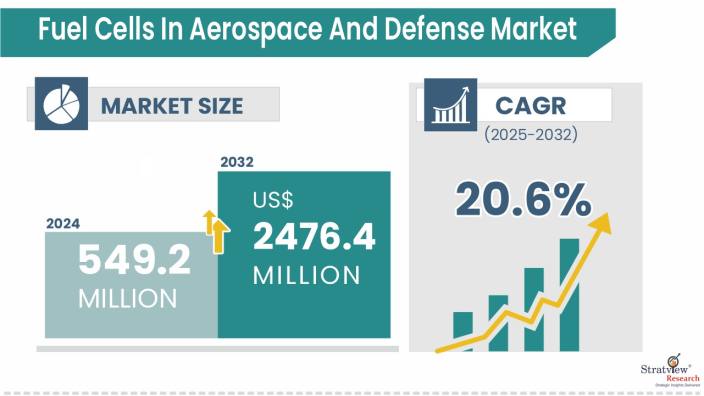
"Fuel cells in aerospace and defense market size was USD 549.2 million in 2024.”
Want to know more about the market scope? Register Here
Have a look at the sales opportunities presented by the fuel cells in aerospace and defense market in terms of growth and market forecast.
|
Fuel Cells in Aerospace and Defense Market Data & Statistics |
||
|
Market Statistics |
Value (in USD Million) |
Market Growth (%) |
|
Annual Market Size in 2023 |
USD 452.8 million |
- |
|
Annual Market Size in 2024 |
USD 549.2 million |
YoY Growth in 2024: 21.3% |
|
Annual Market Size in 2025 |
USD 664.5 million |
YoY Growth in 2025: 20.9% |
|
Annual Market Size in 2032 |
USD 2476.4 million |
CAGR 2025-2032: 20.6% |
|
Cumulative Sales Opportunity during 2025-2032 |
USD 11267.2 million |
|
|
Top 10 Countries’ Market Share in 2024 |
USD 439.4 million + |
> 80% |
|
Top 10 Company’s Market Share in 2024 |
USD 274.6 million to USD 384.4 million |
50% - 70% |
Aerospace and defense fuel cells are power systems that transform chemical energy into electricity for the propulsion of aircraft, spacecraft, and defense equipment. Fuel cells produce clean, efficient, and silent power, making them suitable for use in UAVs, satellites, and defense equipment where reliability, minimum emissions, and stealth are essential operating parameters.
The aerospace and defense fuel cells market involves the creation and deployment of innovative electrochemical energy systems for military and aviation uses. This encompasses integration in satellites, UAVs, aircraft propulsion, APUs, and portable power units. With the need for low-emission, efficient, and lightweight power sources driving the market, growth is stimulated by rising defense expenditure, energy sustainability objectives, and innovation in proton exchange membrane and solid oxide fuel cell (SOFC) technology.
Decarbonization Initiatives in Aviation and Defense
According to the International Energy Agency (IEA), global electrolyzer manufacturing capacity doubled in 2023 to 25 GW per year, while installed water-electrolyzer capacity reached 1.4 GW. The expansion of hydrogen-production infrastructure is strengthening the technology base required for future hydrogen fuel-cell applications in aerospace and defense.
Global hydrogen production reached 97 million tonnes in 2023, although less than 1% came from low-emissions sources, according to the IEA. The limited share of low-emissions hydrogen highlights the need for continued investment in cleaner hydrogen production to support the market growth of fuel-cell technologies.
Rising Defense Investments Support Advanced Power Systems
European NATO Allies and Canada invested USD 486 billion in defense during 2024, representing a 19.4% increase in real terms from 2023, according to NATO. Rising defense expenditure provides greater funding for modernization programs and advanced power technologies, supporting the market demand for fuel cell in aerospace and defense applications.
Technological Advances in PEM Fuel Cells Improve Aerospace Feasibility
Continuous improvements in Proton Exchange Membrane Fuel Cells (PEMFCs), hydrogen storage, and lightweight materials are increasing power density and reliability for aerospace applications. Higher power density can reduce the weight penalty of onboard fuel-cell systems while extending aircraft and UAV operating endurance, improving their suitability for aerospace applications and supporting fuel cell in aerospace and defense market growth.
The U.S. Department of Energy’s Hydrogen Shot Initiative targets a USD 1/kg clean hydrogen cost within one decade, representing an 80% reduction from current costs. Lower hydrogen costs could improve the operating economics of fuel-cell systems and strengthen their commercial viability across aerospace and defense applications.
Limited Hydrogen Refueling and Storage Infrastructure
The IEA reported that announced electrolyzer projects could bring global capacity close to 520 GW by 2030, but only 4% of the announced capacity had reached final investment decision or construction in 2024. The gap indicates that substantial hydrogen infrastructure remains at the planning stage, limiting near-term availability for fuel-cell applications.
Stringent Aerospace Certification and Safety Requirements
High System Costs and Hydrogen Supply Economics
Growing Adoption of Hydrogen-Powered UAVs
The requirement for longer-endurance and low-signature unmanned aircraft is creating opportunities for hydrogen fuel cells. Compared with battery-only systems, fuel cells can support extended operation through continuous electricity generation from hydrogen while maintaining low acoustic emissions. These characteristics are particularly relevant to surveillance and reconnaissance missions, creating new market opportunities for lightweight aerospace fuel-cell systems.
According to the U.S. Department of Defense (DoD), the Replicator initiative aims to field multiple thousands of attritable autonomous systems within 18 months, highlighting the scale at which the U.S. military is accelerating deployment of unmanned and autonomous platforms. This expansion creates opportunities for lightweight, long-endurance power systems such as hydrogen fuel cells.
Expansion of Hydrogen-Powered Commercial Aviation Programs
Global capital spending on low-emissions hydrogen projects reached USD 4.3 billion in 2024, an 80% increase from 2023, according to the IEA. Based on recent investment decisions, spending could approach USD 8 billion in 2025, strengthening the investment environment for hydrogen technologies relevant to future aerospace applications.
Government Funding for Hydrogen Innovation and Aerospace R&D
The U.S. Department of Energy allocated up to USD 7 billion to establish six to 10 Regional Clean Hydrogen Hubs, as part of an USD 8 billion hydrogen hub program. These hubs are designed to connect hydrogen producers, consumers, and infrastructure, creating a stronger ecosystem for future fuel-cell applications.
|
Segmentations |
List of Sub-Segments |
Segments with High-Growth Opportunity |
|
Product Type |
PEMFC, SOFC |
SOFC is expected to account for the largest revenue share during the forecast period. |
|
Application in Aerospace Type |
Commercial Aircraft, Rotorcraft |
Rotorcraft segment is expected to grow at the highest CAGR during the forecast period. |
|
Application in Defense Type |
Military Drones/UAV, Military Vehicles |
Military Drones/UAV is anticipated to lead the market during the forecast year. |
|
Regional Analysis |
North America, Europe, Asia-Pacific, and The Rest of the World |
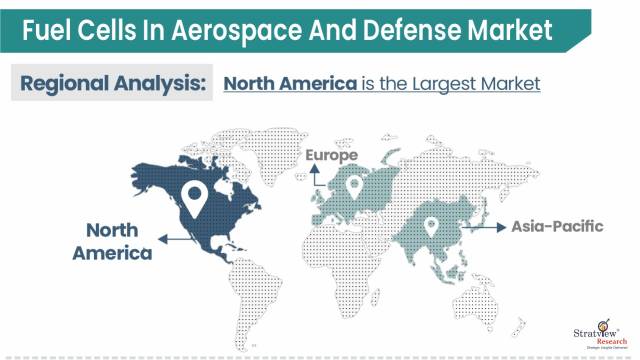
North America is projected to hold the largest share of the fuel cells in the aerospace and defense market over the forecast period. |
“SOFC is expected to account for the largest revenue share during the forecast period.”
“Rotorcraft segment is expected to grow at the highest CAGR during the forecast period.”
“Military Drones/UAV is anticipated to lead the market during the forecast year.”
“North America is projected to hold the largest share of the fuel cells in the aerospace and defense market over the forecast period.”
Know the high-growth countries in this report. Register Here
Most of the major players compete in some of the factors, including price, service offerings, regional presence, etc. The following are the key players in the global fuel cells in aerospace and defense market:
Note: The above list does not necessarily include all the top players in the market.
Are you a leading player in this market? We would love to include your name. Please write to us at [email protected]
This report provides market intelligence most comprehensively. The report structure has been kept so that it offers maximum business value. It provides critical insights into market dynamics and will enable strategic decision-making for existing market players as well as those willing to enter the market.
The following are the key features of the report:
|
Market Study Period |
2019-2032 |
|
Base Year |
2024 |
|
Forecast Period |
2025-2032 |
|
Trend Period |
2019-2023 |
|
Number of Tables & Figures |
>100 |
|
Number of Segments Analysed |
4 (Product Type, Application in Aerospace Type, Application in Defense Type, and Region) |
|
Number of Regions Analysed |
4 (North America, Europe, Asia-Pacific, Rest of the World) |
|
Countries Analysed |
15 (The USA, Canada, Mexico, Germany, France, Italy, The UK, China, Japan, India, Brazil, Saudi Arabia, Rest of Europe, Rest of APAC, and Rest of the World) |
|
Free Customization Offered |
10% |
|
After Sales Support |
Unlimited |
|
Report Presentation |
Complimentary |
|
Market Dataset |
Complimentary |
|
Further Deep Dive & Consulting Services |
10% Discount |
This report studies the market, covering a period of 15 years of trend and forecast. The report provides detailed insights into the market dynamics to enable informed business decision-making and growth strategy formulation based on the opportunities present in the market.
The fuel cells in aerospace and defense market is segmented into the following categories.
By Product Type
By Application in Aerospace Type
By Application in Defense Type
By Region
With this detailed report, Stratview Research offers one of the following free customization options to our respected clients:
Company Profiling
Competitive Benchmarking
Custom Research: Stratview Research offers custom research services across industries. In case of any custom research requirement related to market assessment, competitive benchmarking, sourcing and procurement, target screening, and others, please send your inquiry to [email protected].
The report is delivered digitally through our online portal. Buyers receive login credentials from our team to access the report and may update their credentials at any time after the initial login.
Delivery timelines depend on the status of the report:
For the most accurate delivery timeline, please contact us to confirm the current status of the report.
Yes. You may request a complimentary preview of the report through a video conference with our team.
Yes. The scope of the report can be fully customized to align with your specific research objectives and information requirements.
Please contact us at [email protected], and our team will be happy to discuss your requirements and propose a tailored solution.
Yes. Selected sections of the report can be purchased separately based on your requirements. Please contact us at [email protected] to discuss your needs.
Yes, AI can help gather publicly available information, but its outputs are only as reliable as the data it accesses. Stratview Research reports are built using validated data, extensive primary interviews with industry stakeholders, and the expertise of our experienced research team.
Additionally, many critical insights, including market dynamics, competitive intelligence, and industry-specific trends, are not publicly available and therefore cannot be captured through AI alone.
The international fuel cells in aerospace and defense market is the global industry that deals with the creation, manufacture, and utilization of fuel cell technology in aerospace and defense systems. It involves propelling aircraft, unmanned aerial vehicles (UAVs), satellites, military vehicles, and portable defense systems through the use of fuel cells that convert hydrogen or other fuels to electricity. The market caters to the increasing need for clean, efficient, light-weight, and reliable energy solutions in mission-critical and mission-oriented settings.
The forecasted value for the market is USD 2476.4 million in 2032.
Fuel cells in aerospace and defense market size was USD 549.2 million in 2024 and is expected to grow from USD 664.5 million in 2025 to USD 2476.4 million in 2032, witnessing an impressive market growth (CAGR) of 20.6% during the forecast period (2025-2032).
The key drivers of the global fuel cells in aerospace and defense market are the rising technological advancements and the formation of fiscal laws and regulations by the governments to promote the market globally.
The top players in the global fuel cells in aerospace and defense market include Advent Technologies, Australian Fuel Cells Pty Ltd., Cummins Inc., ElringKlinger AG, GenCell Ltd., etc.
North America is projected to hold the largest share of the fuel cells in the aerospace and defense market over the forecast period.


WE ACCEPT