




404
+1-313-307-4176

Flame Retardants for Aerospace Plastics Market Analysis | 2025-2032

Flame Retardants for Aerospace Plastics Market Size, Share, Trends, Dynamics, Forecast, & Growth Analysis: 2025-2032
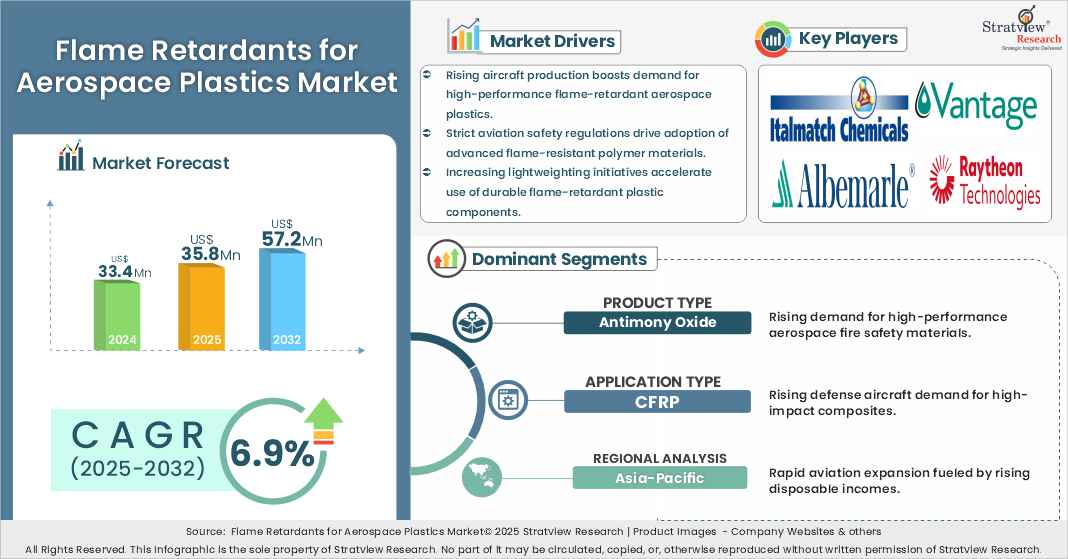
"Flame retardants for aerospace plastics market size was USD 33.4 million in 2024.”
Want to get a free sample? Register Here
Have a look at the sales opportunities presented by the flame retardants for aerospace plastics market in terms of growth and market forecast.
|
Flame Retardants for Aerospace Plastics Market Data & Statistics |
||
|
Market Statistics |
Value (in USD Million) |
Market Growth (%) |
|
Annual Market Size in 2023 |
USD 31.2 million |
- |
|
Annual Market Size in 2024 |
USD 33.4 million |
YoY Growth in 2024: 7.1% |
|
Annual Market Size in 2025 |
USD 35.8 million |
YoY Growth in 2025: 7.3% |
|
Annual Market Size in 2032 |
USD 57.2 million |
CAGR 2025-2032: 6.9% |
|
Cumulative Sales Opportunity during 2025-2032 |
USD 367.6 million |
|
|
Top 10 Countries’ Market Share in 2024 |
USD 26.7 million + |
> 80% |
|
Top 10 Company’s Market Share in 2024 |
USD 16.7 million to USD 23.4 million |
50% - 70% |
Aerospace plastics flame retardants are high-performance chemical additives that prevent or resist fire spread in aircraft-used polymer materials. They provide increased passenger safety by adhering to strict fire, smoke, and toxicity (FST) standards, providing materials that function properly under severe conditions without causing any compromise to structural integrity or weight savings.
The flame retardants for aerospace plastics market analysis indicates strong market demand, supported by emerging trends. Below given are a few factors influencing overall market size.
Growing Adoption of Lightweight Aerospace Plastics and Composites
The flame retardants for aerospace plastics market growth are being supported by the increasing shift toward lightweight aerospace plastics and composite materials in modern aircraft manufacturing. These materials require advanced flame-retardant solutions to meet strict aviation safety standards.
According to the International Air Transport Association (IATA), global air passenger traffic reached 104% of pre-pandemic levels in 2024, reflecting strong recovery in air travel demand and supporting continued aircraft production and fleet expansion. This growth is directly increasing the use of composite-based aerospace plastics, thereby driving demand for flame-retardant materials.
Stringent Aviation Fire Safety Regulations
The flame retardants for aerospace plastics market demand is being strongly influenced by increasingly stringent aviation fire safety regulations that enforce strict flammability, smoke density, and toxicity limits for aerospace materials. These requirements are driving widespread adoption of advanced flame-retardant systems across aircraft applications.
Aircraft materials used in interiors, wiring systems, insulation components, and structural composites must comply with FAR 25.853 standards set by the Federal Aviation Administration (FAA), which define rigorous flame resistance and fire safety performance criteria for cabin materials. This regulatory pressure continues to reinforce the need for high-performance flame-retardant technologies in aerospace plastics.
Recovery and Expansion of Global Aircraft Production
The flame retardants for aerospace plastics market demand is being supported by the recovery in global aviation and the expansion of aircraft production driven by rising commercial and defense aviation requirements. Increasing aircraft manufacturing activity is directly boosting the consumption of aerospace-grade plastics and associated flame-retardant compounds used in interior, structural, and insulation applications.
According to the Airbus Global Market Forecast, more than 42,000 new passenger and freighter aircraft are expected to be delivered globally over the next two decades. This long-term production outlook, supported by Boeing and Airbus ramp-up plans, is reinforcing sustained demand for flame-retardant materials used in aerospace plastics across next-generation aircraft platforms.
Lengthy Aerospace Qualification and Certification Processes
The flame retardants for aerospace plastics market demand is being constrained by the lengthy and highly regulated qualification and certification processes required for aerospace materials. These strict approval frameworks significantly delay the adoption of new flame-retardant formulations in aircraft applications.
According to FAA and EASA qualification practices, new aerospace materials, including flame-retardant formulations, typically require 2 to 3 years of testing and validation before certification. This extended process increases costs and delays commercialization in aerospace plastic applications.
Raw Material Supply Chain Risks
The flame retardants for aerospace plastics market demand is being impacted by supply chain risks linked to specialty chemicals used in flame-retardant formulations such as antimony trioxide and phosphorus compounds. Disruptions in supply and export restrictions, including China’s controls on antimony compounds, are increasing raw material uncertainty and affecting pricing stability for manufacturers.
Environmental and Regulatory Pressure on Traditional Flame Retardants
The flame retardants for aerospace plastics market demand is being affected by environmental and regulatory pressure from agencies such as the European Chemicals Agency (ECHA) and the U.S. Environmental Protection Agency (EPA), which are restricting several halogenated flame-retardant chemistries due to environmental and health concerns. This is increasing R&D requirements for manufacturers to develop compliant alternatives without compromising performance.
Growth of Aerospace Manufacturing in Asia-Pacific
The flame retardants for aerospace plastics market demand are being supported by the rapid expansion of aerospace manufacturing activities across Asia-Pacific, driven by increasing aircraft production and rising aviation demand in the region.
According to the International Civil Aviation Organization (ICAO), Asia-Pacific remains one of the fastest-growing aviation markets globally, supported by strong growth in air traffic and increasing investments in aircraft manufacturing capabilities across China, India, Japan, and Southeast Asia, which is driving demand for aerospace-grade plastics and flame-retardant materials.
Development of Halogen-Free and Sustainable Flame Retardants
The flame retardants for aerospace plastics market forecast is being positively influenced by the increasing transition toward halogen-free and environmentally sustainable flame-retardant systems in aerospace applications, driven by regulatory and material safety requirements.
According to U.S. Environmental Protection Agency (EPA) TSCA regulatory updates (2025) and ongoing European Chemicals Agency (ECHA) REACH restriction actions, several halogenated flame-retardant chemistries are under regulatory scrutiny due to environmental and health concerns. This is accelerating the shift toward alternative systems such as phosphorus-based, mineral-based, and intumescent flame retardants, which are increasingly being adopted in advanced aerospace polymer formulations to ensure compliance and sustainability.
Development of High-Performance Thermoplastics in Aerospace Applications
The flame retardants for aerospace plastics market forecast is being supported by the increasing adoption of high-performance thermoplastics such as PEEK, PEI, and PPS in next-generation aircraft due to their lightweight, thermal stability, and inherent flame-retardant properties.
According to NASA technical documentation (2025–2026 Structures, Materials and Mechanisms reports), thermoplastics including PEEK, PEKK, and PPS are widely used in aerospace applications and are considered high-performance materials due to their ability to withstand continuous temperatures above 200°C, while also offering inherent flame resistance and low smoke emission characteristics.
|
Segmentations |
List of Sub-Segments |
Segments with High-Growth Opportunity |
|
Product Analysis |
Antimony Oxide, Aluminum Trihydrate, Organophosphates/Phosphorous Compounds, Boron Compounds, Others |
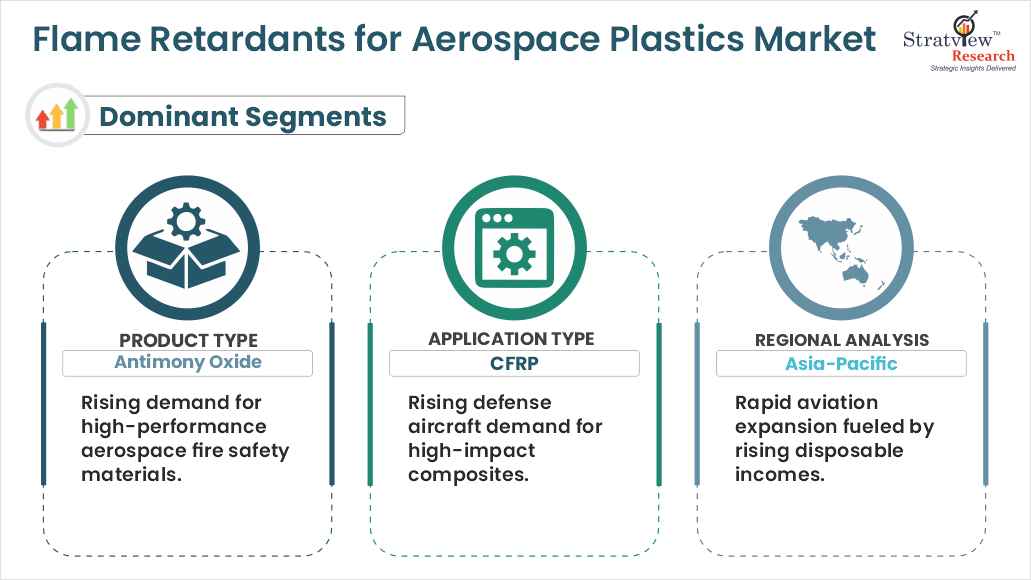
Antimony Oxide segment is anticipated to experience more growth in the future. |
|
Application Analysis |
Carbon Fiber Reinforced Plastic (CFRP), Glass Reinforced Plastic (GRP), Polycarbonate, Thermoset Polyimide, Acrylonitrile Butadiene Styrene (ABS), Acetal/Polyoxymethylene (POM), Epoxies, Others |
CFRP segment is anticipated to hold the highest CAGR during the forecast period. |
|
Regional Analysis |
North America, Europe, Asia-Pacific, and The Rest of the World |
Asia-Pacific is expected to be the dominant and fastest-growing region over the forecasted period. |
“Antimony Oxide segment is anticipated to experience more growth in the future.”
"The CFRP segment is anticipated to hold the highest CAGR during the forecast period.”
Want to get more details about the segmentations? Register Here
“Asia-Pacific is expected to be the dominant and fastest-growing region over the forecasted period.”
Most of the major players compete in some of the factors, including price, service offerings, regional presence, etc. The following are the key players in the flame retardants for aerospace plastics market:
Note: The above list does not necessarily include all the top players in the market.
Are you a leading player in this market? We would love to include your name. Please write to us at [email protected]
In March 2026, Americhem launched ColorFast® SFT5500, a PFAS-free thermoplastic platform for aircraft interior components. The material is engineered to meet 55/55 OSU heat-release performance while offering low smoke generation and low toxicity, supporting aerospace manufacturers seeking fluorine-free materials that meet stringent cabin fire-safety requirements.
In June 2025, Hexcel highlighted a PEKK/carbon-fiber thermoplastic component developed through the HELUes project with Arkema and other partners. The development advances the validation of high-performance thermoplastic composites for aerospace structures, increasing the relevance of heat-resistant polymers and compatible flame-retardant systems.
In June 2025, Toray Advanced Composites, Daher, and TARMAC Aerosave, in collaboration with Airbus, launched an end-of-life recycling program for aerospace thermoplastic composites. The initiative focuses on recovering and reusing continuous-fiber thermoplastic aircraft components, supporting circular material strategies while maintaining fire, smoke, and toxicity requirements.
In March 2025, Bemis Associates' Protechnic business announced that its CoPA and CoPES thermoplastic web adhesives had passed FAR 25.853 Appendix F flammability requirements. The qualification expands compliant bonding options for aircraft seating and cabin interiors, including assemblies combining foams, fabrics, plastics, and other substrates.
In March 2025, Airbus and Boeing outlined industry efforts toward next-generation single-aisle aircraft production rates of potentially around 100 aircraft per month, with thermoplastic composites among the technologies being evaluated for faster automated manufacturing. Higher-volume use of thermoplastic materials could increase demand for aerospace-qualified flame-retardant additives, resins, films, and surface treatments.
In February 2025, Avient introduced Hammerhead™ FR thermoplastic composite panels with integrated flame retardance. The approach eliminates the need for separate flame-retardant sheets or secondary coatings, potentially reducing processing steps and weight in lightweight sandwich structures.
In January 2025, Airbus announced that its Multifunctional Fuselage Demonstrator consortium received a JEC Innovation Award for large-scale thermoplastic-composite technologies. The recognition highlights advances in faster production of lightweight aircraft structures and supports the broader adoption of thermoplastic matrices requiring aerospace-qualified fire-performance solutions.
This report provides market intelligence most comprehensively. The report structure has been kept so that it offers maximum business value. It provides critical insights into market dynamics and will enable strategic decision-making for existing market players as well as those willing to enter the market.
The following are the key features of the report:
|
Market Study Period |
2019-2032 |
|
Base Year |
2024 |
|
Forecast Period |
2025-2032 |
|
Trend Period |
2019-2023 |
|
Number of Tables & Figures |
>100 |
|
Number of Segments Analysed |
3 (Application Type, Product Type, and Region) |
|
Number of Regions Analysed |
4 (North America, Europe, Asia-Pacific, Rest of the World) |
|
Countries Analysed |
15 (The USA, Canada, Mexico, Germany, France, Italy, The UK, China, Japan, India, Brazil, Saudi Arabia, Rest of Europe, Rest of APAC, and Rest of the World) |
|
Free Customization Offered |
10% |
|
After Sales Support |
Unlimited |
|
Report Presentation |
Complimentary |
|
Market Dataset |
Complimentary |
|
Further Deep Dive & Consulting Services |
10% Discount |
This report studies the market, covering a period of 15 years of trend and forecast. The report provides detailed insights into the market dynamics to enable informed business decision-making and growth strategy formulation based on the opportunities present in the market.
The flame retardants for aerospace plastics market is segmented into the following categories.
By Product Type
By Application Type
By Region
With this detailed report, Stratview Research offers one of the following free customization options to our respected clients:
Company Profiling
Competitive Benchmarking
Custom Research: Stratview Research offers custom research services across industries. In case of any custom research requirement related to market assessment, competitive benchmarking, sourcing and procurement, target screening, and others, please send your inquiry to [email protected].
The report is delivered digitally through our online portal. Buyers receive login credentials from our team to access the report and may update their credentials at any time after the initial login.
Delivery timelines depend on the status of the report:
For the most accurate delivery timeline, please contact us to confirm the current status of the report.
Yes. You may request a complimentary preview of the report through a video conference with our team.
Yes. The scope of the report can be fully customized to align with your specific research objectives and information requirements.
Please contact us at [email protected], and our team will be happy to discuss your requirements and propose a tailored solution.
Yes. Selected sections of the report can be purchased separately based on your requirements. Please contact us at [email protected] to discuss your needs.
Yes, AI can help gather publicly available information, but its outputs are only as reliable as the data it accesses. Stratview Research reports are built using validated data, extensive primary interviews with industry stakeholders, and the expertise of our experienced research team.
Additionally, many critical insights, including market dynamics, competitive intelligence, and industry-specific trends, are not publicly available and therefore cannot be captured through AI alone.
The flame retardants for aerospace plastics market is the business segment that deals with the manufacture, production, and utilization of chemical additives that improve the fire-resistance properties of plastic materials for use in aerospace parts. The flame retardants are designed to adhere to specific safety and regulatory requirements, and they ensure that aerospace plastics applied in interior panels, structural parts, and insulation products exhibit lower flammability, smoke formation, and harmful gas release during fires.
The forecasted value for the market is US$ 57.2 million in 2032.
Flame retardants for aerospace plastics market size was USD 33.4 million in 2024 and is expected to grow from USD 35.8 million in 2025 to USD 57.2 million in 2032, witnessing an impressive market growth (CAGR) of 6.9% during the forecast period (2025-2032).
The key drivers of the flame retardants for aerospace plastics market are Innovations in high-performance polymer additives, nanocomposite flame retardants, and intumescent coatings are enhancing the fire resistance of aerospace plastics and advancements in AI-powered material science.
The top players in the flame retardants for aerospace plastics market include Huber Engineered Materials, Clariant Corporation, RTP Company, Vantage Specialty Chemicals, Italmatch Chemicals, etc.
The APAC region is the fastest-growing market for flame retardants for aerospace plastics.


WE ACCEPT