




404
+1-313-307-4176

Electric Vehicle Plastics Market Analysis | 2024-2032

Electric Vehicle Plastics Market Size, Share, Trends, Dynamics, Forecast, & Growth Analysis: 2024-2032
Electric Vehicle Plastics Market is segmented by Plastic Type (PA, PP, PC, and Others), by Application Type (Interior, Exterior, Powertrain/Underhood, and Lighting & Electric Wiring), and by Region (North America [The USA, Canada, and Mexico], Europe [Germany, France, The UK, Russia, and Rest of Europe], Asia-Pacific [China, Japan, India, and Rest of Asia-Pacific], and Rest of the World [Brazil, Saudi Arabia, and Others]).
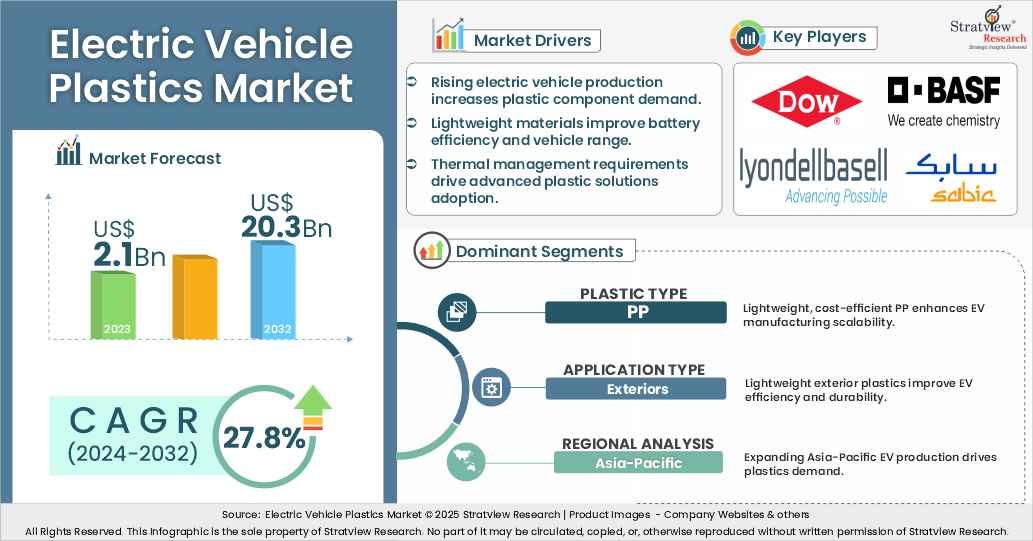
The electric vehicle plastics market was estimated at USD 2.1 billion in 2023 and is likely to grow at a CAGR of 27.8% during 2024-2032 to reach USD 20.3 billion in 2032.
Want to get a free sample? Register Here
The electric vehicle plastics market is witnessing strong growth, driven by the rapid adoption of electric vehicles and increasing demand for lightweight materials that improve battery efficiency and vehicle performance. Growing use of engineering plastics in battery systems, interiors, and structural components is supporting market expansion, while advancements in recyclable and bio-based plastics are emerging as key trends shaping the industry's long-term growth.
Rising Global EV Adoption is Expanding Market Share
The rising adoption of electric vehicles is expanding the market share of the electric vehicle plastics market. Increasing EV production is driving demand for lightweight plastics used in battery packs, wiring systems, interiors, and exterior components to improve vehicle efficiency and driving range.
Lightweighting Requirements are Driving Market Growth
Growing lightweighting requirements are driving the growth of the electric vehicle plastics market. Automakers are increasingly replacing metal components with engineering plastics to reduce vehicle weight, improve battery efficiency, and enhance overall vehicle performance.
Recycling Complexity of EV Plastics Restrains Market Growth
The recycling complexity of EV plastics is restraining the growth of the electric vehicle plastics market. Multi-material assemblies, reinforced polymers, and flame-retardant plastics make recycling more difficult, creating challenges for circularity and sustainable end-of-life vehicle management.
Regulatory Pressure and Compliance Costs Challenge Market Demand
Increasing regulatory pressure and compliance costs are challenging demand in the electric vehicle plastics market. Stricter requirements for recycled content, waste management, and end-of-life vehicle recovery are increasing development costs and extending material qualification timelines.
Development of Recyclable and Bio-Based Plastics is Emerging as a Key Market Trend
The development of recyclable and bio-based plastics is emerging as a key trend in the electric vehicle plastics market. Growing sustainability initiatives are creating opportunities for advanced polymer solutions that support circular material use and reduce lifecycle emissions.
Expansion of Battery-Related Plastic Applications Strengthens Market Forecast
The expansion of battery-related plastic applications is strengthening the market forecast for the electric vehicle plastics market. Increasing deployment of EV batteries is driving demand for high-performance engineering plastics that provide electrical insulation, flame retardancy, thermal management, and lightweighting benefits.
|
Segmentations |
List of Sub-Segments |
Segments with High Growth Opportunity |
|
Plastic-Type Analysis |
PA, PP, PC, and Others |
PP is expected to be the demand generator in the coming years. |
|
Application Analysis |
Interior, Exterior, Powertrain/Underhood, and Lighting & Electric Wiring |
Exteriors are expected to dominate the future market. |
|
Region Analysis |
North America, Europe, Asia-Pacific, and the Rest of the World |
Asia-Pacific is expected to maintain its reign over the forecast period. |
“PP is expected to remain the dominant plastic type in the market during the forecast period.”
The electric vehicle plastics market is segmented into PA, PP, PC, and Others. PP is a lightweight material, contributing to vehicle weight reduction, which improves EV energy efficiency and driving range. PP is relatively inexpensive compared to other engineering plastics, making it a cost-effective option for the mass production of EV components. PP can be used in a wide range of applications, including battery covers, interior trim, bumpers, and exterior panels, making it highly versatile in EV manufacturing. PP offers excellent resistance to chemicals, which is crucial for components exposed to various fluids, such as coolant reservoirs and battery casings.
“Exteriors are expected to remain the dominant application in the market during the forecast period.”
The market is segmented into interior, exterior, powertrain/underhood, lighting & electric wiring. EV manufacturers prioritize lightweight materials like plastics for exterior parts such as bumpers, body panels, and hoods to improve energy efficiency and extend vehicle range. Plastics used in exterior applications, such as polypropylene and polycarbonate, offer excellent impact resistance and durability, making them ideal for parts exposed to harsh conditions. Plastics offer great design freedom, allowing car makers to mold complicated, smooth shapes that enhance car performance and looks. Plastics used in exterior components of EVs are usually not susceptible to corrosion and environmental conditions such as moisture, unlike metals; therefore, the chances of the parts degrading are reduced.
_67100.webp)
Want to get more details about the segmentations? Register Here
“Asia-Pacific is expected to remain the largest market for electric vehicle plastics during the forecast period.”
Asia-Pacific, particularly China, is the global leader in EV production, with a high concentration of EV manufacturers, driving significant demand for EV plastics. Strong government policies and incentives promoting EV adoption in countries like China, Japan, and South Korea are boosting the demand for lightweight materials like plastics to improve EV efficiency. The region has a well-established plastics manufacturing industry with lower production costs, making it an attractive hub for automotive component manufacturing, including EV plastics. The rapid increase in EV sales across Asia-Pacific, driven by consumer demand for eco-friendly transportation, further fuels the demand for plastics used in electric vehicles.
The following are the key players in the electric vehicle plastics market:
Here is the list of the Top Players (Based on Dominance)
Note: The above list does not necessarily include all the top players in the market.
Are you the leading player in this market? We would love to include your name. Write to us at [email protected]
Recent mergers & acquisitions and other developments in the electric vehicle plastics market reflect evolving market trends, and impact the market. Below given are a few recent developments in the market –
This strategic assessment report from Stratview Research provides a comprehensive analysis that reflects today’s electric vehicle plastics market realities and future market possibilities for the forecast period. The report segments and analyzes the market in the most detailed manner in order to provide a panoramic view of the market. The vital data/information provided in the report can play a crucial role for market participants as well as investors in the identification of the low-hanging fruits available in the market, as well as in the formulation of growth strategies to expedite their growth process.
This report offers high-quality insights and is the outcome of a detailed research methodology comprising extensive secondary research, rigorous primary interviews with industry stakeholders, and validation and triangulation with Stratview Research’s internal database and statistical tools. More than 1,000 authenticated secondary sources, such as company annual reports, fact books, press releases, journals, investor presentations, white papers, patents, and articles, have been leveraged to gather the data. We conducted more than 15 detailed primary interviews with market players across the value chain in all four regions and industry experts to obtain both qualitative and quantitative insights.
This report provides market intelligence most comprehensively. The report structure has been kept such that it offers maximum business value. It provides critical insights into market dynamics and will enable strategic decision-making for existing market players as well as those willing to enter the market. The following are the key features of the report:
This report studies the market, covering a period of 12 years of trends and forecasts. The report provides detailed insights into the market dynamics to enable informed business decision-making and growth strategy formulation based on the opportunities present in the market.
The electric vehicle plastics market is segmented into the following categories:
By Plastic Type
By Application Type
By Region
With this detailed report, Stratview Research offers one of the following free customization options to our respected clients:
Company Profiling
Competitive Benchmarking
Custom Research: Stratview Research offers custom research services across sectors. In case of any custom research requirement related to market assessment, competitive benchmarking, sourcing and procurement, target screening, and others, please send your inquiry to [email protected].
The report is delivered digitally through our online portal. Buyers receive login credentials from our team to access the report and may update their credentials at any time after the initial login.
Delivery timelines depend on the status of the report:
For the most accurate delivery timeline, please contact us to confirm the current status of the report.
Yes. You may request a complimentary preview of the report through a video conference with our team.
Yes. The scope of the report can be fully customized to align with your specific research objectives and information requirements.
Please contact us at [email protected], and our team will be happy to discuss your requirements and propose a tailored solution.
Yes. Selected sections of the report can be purchased separately based on your requirements. Please contact us at [email protected] to discuss your needs.
Yes, AI can help gather publicly available information, but its outputs are only as reliable as the data it accesses. Stratview Research reports are built using validated data, extensive primary interviews with industry stakeholders, and the expertise of our experienced research team.
Additionally, many critical insights, including market dynamics, competitive intelligence, and industry-specific trends, are not publicly available and therefore cannot be captured through AI alone.
The electric vehicle plastics market refers to the generation and application of lightweight, wear-resistant plastics in the manufacturing of EVs as a means of optimizing energy performance, lowering the vehicle’s overall weight, and increasing car efficiency. These plastics are used in various parts such as battery cases, interior and exterior parts along electrical systems.
The forecasted value of the electric vehicle plastics market is expected to reach USD 20.3 billion in 2032.
The electric vehicle plastics market is estimated to grow at a CAGR of 27.8% by 2032, fueled by the demand for stronger and lighter materials to enhance the efficiency, range, and performance of the next generation of electric vehicles.
The electric vehicle plastics market is primarily fueled by the growing need for lightweight materials that help extend the range of EVs and improve energy density. As the number of EVs on the streets rises, along with the higher standards set by the authorities in terms of environmental care, the trend toward the use of more sustainable and recyclable plastic items in the automobile industry emerges. Another reason for using plastics in the production of EVs is that plastics are cheaper to manufacture and can be designed in a way that guarantees high durability. Technological advancement in advanced polymer materials in the market also positively affects market development.
Asia-Pacific would continue to dominate the market for electric vehicle (EV) plastics mainly due to higher production and use of EVs, especially in China. Government stimulus measures and policies aimed at boosting the uptake of EVs in nations such as China, Japan, and South Korea also boost demand. The benefits of economies of scale in manufacturing make electric vehicle plastics production achievable and the established automotive supply chain infrastructure makes the production of large batches of EV plastics achievable. Further, increasing concerns over the carbon footprint in vehicles and innovations in plastics production fortify the market. This growth is drawn to weight-conscious materials aimed at boosting EV efficiency as well.
BASF SE, LyondellBasell Industries Holdings B.V., Sabic, Dow, and Dupont are the leading players in the market.
PP is also expected to retain its leadership in the market because it contributes to the efficiency and range of electric vehicles because of its light weight. This makes it a viable tool for manufacturing different EV parts such as battery covers, headlights, bumpers, and interior trims at a large scale. PP’s nonstick properties and resistance to chemicals locate it under the hood yet outside the hood as well as under the bonnet as well as outside the bonnet. Also, its recyclability is beneficial in today’s world of heightened concern for the environment in the EV market.


WE ACCEPT