




404
+1-313-307-4176

Digital Twin Market | 2026-2032

Digital Twin Market Size, Share, Trend, Forecast, Competitive Landscape & Growth Opportunities: 2026-2032
Digital Twin Market: Analyst Insights
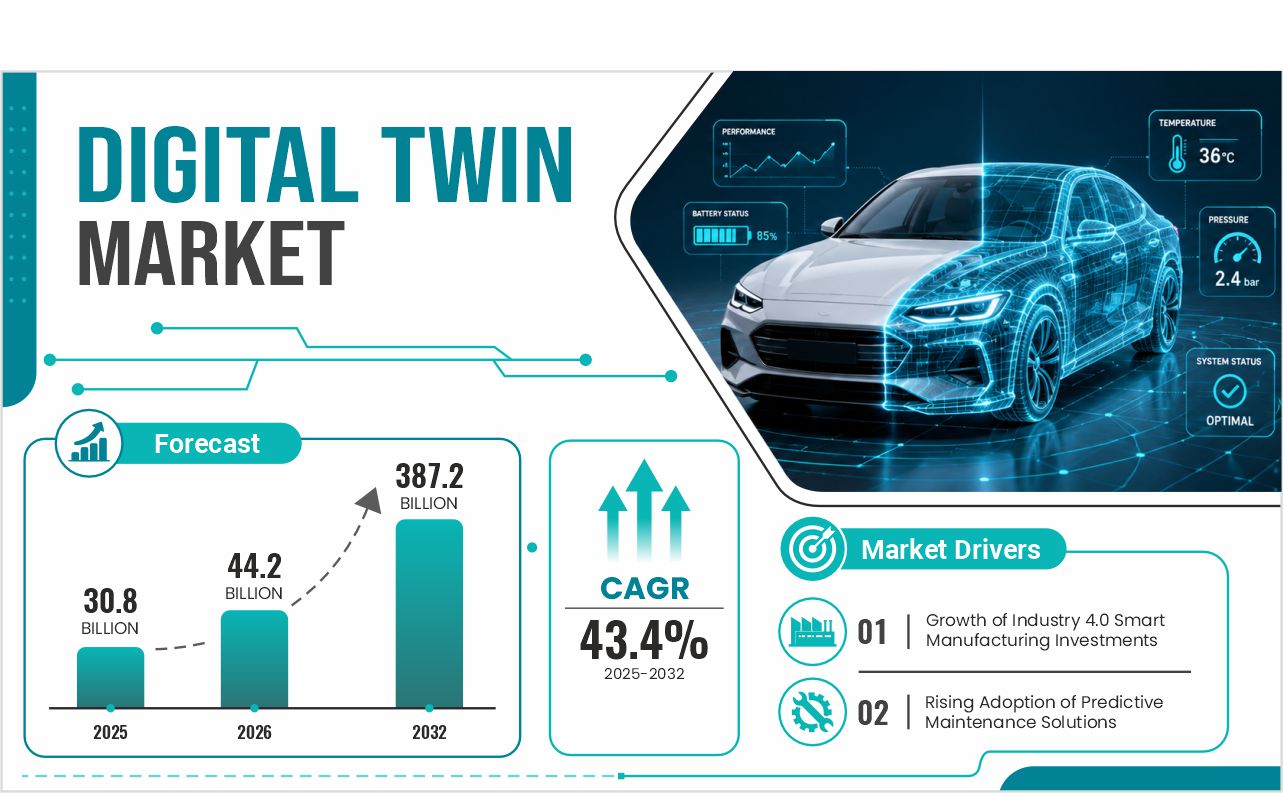
“The digital twin market size was valued at USD 30.8 billion in 2025 and offers robust growth opportunities for the market stakeholders. With the market expected to grow at a CAGR of 43.4%, the annual sales will hit USD 1,183 billion mark in 2032, highlighting the increasing shift toward additive manufacturing for full-scale industrial production.”
“We are also witnessing a key digital twin market trend in healthcare and smart infrastructure, driven by human-centric and urban-scale applications. From patient-specific simulation models to AI-powered smart city systems, digital twins are expanding beyond industrial use cases. Supported by IoT, cloud computing, and AI analytics, the technology is emerging as a core enabler of next-generation digital ecosystems.”
The annual demand for digital twin was USD 30.8 billion in 2025 and is expected to reach USD 44.2 billion in 2026, up 44.5% than the value in 2025.
During the forecast period (2026-2032), digital twin market size is expected to grow at a CAGR of 43.4%. The annual demand will reach USD 387.2 billion in 2032, which is almost 12.6 times the demand in 2025.
As per the market analysis, during 2026-2032, the digital twin industry is expected to generate a cumulative sales opportunity of USD 1183 billion.
Sharpen Your Strategies by Knowing the Opportunity Pockets. Here
A comprehensive digital twin market analysis indicates that segment-level performance varies significantly based on evolving market trends.
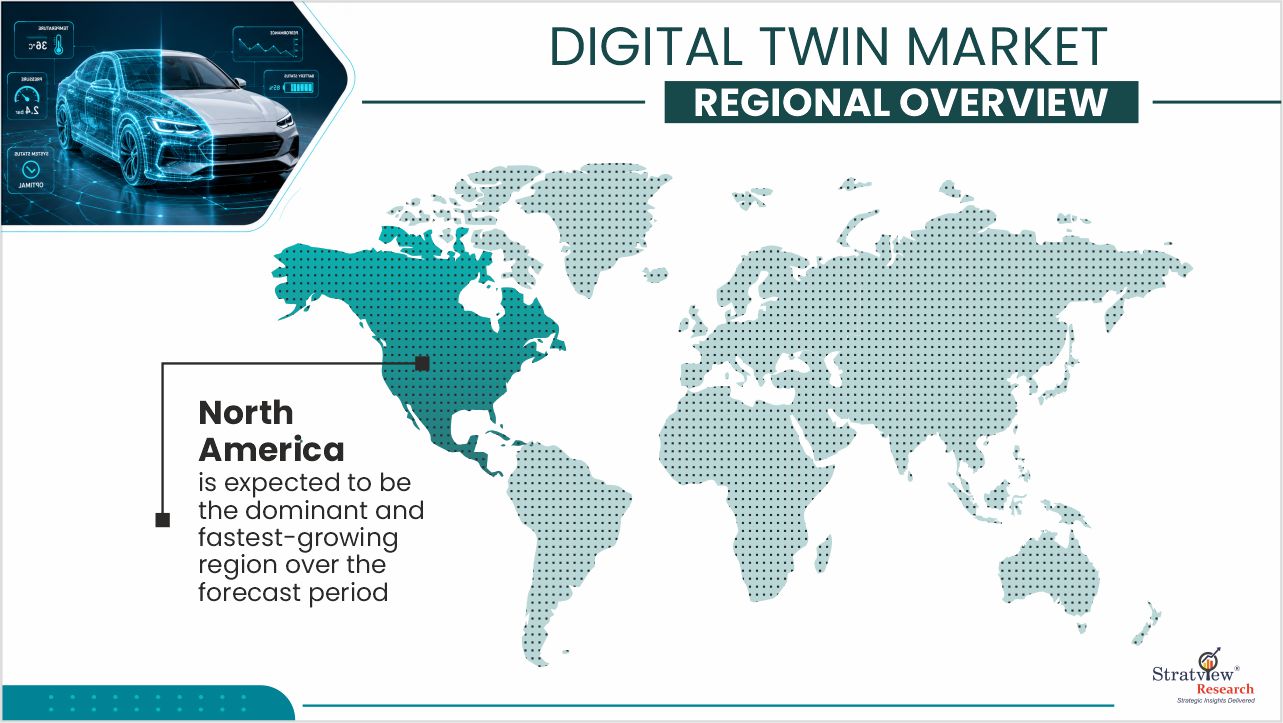
North America is expected to remain the dominant region for the digital twin market during the forecast period.
By component type, software segment is expected to dominate the market during the forecast period due
By type, system digital twin segment is anticipated to hold the largest digital twin market share in the forecast period.
By platform type, cloud segment is projected to be the fastest-growing platform during the forecast period.
By application type, predictive maintenance segment is anticipated to be the dominant during the forecast period.
Have a look at the sales opportunities presented by the digital twin market in terms of growth and market forecast.
|
Market Statistics |
Value (in USD Billion) |
Market Growth (%) |
|
Annual Market Size in 2025 |
USD 30.8 billion |
- |
|
Annual Market Size in 2026 |
USD 44.5 billion |
YoY Growth in 2026: 44.5% |
|
Annual Market Size in 2032 |
USD 387.2 billion |
CAGR 2026-2032: 43.4% |
|
Cumulative Sales Opportunity during 2026-2032 |
USD 1183 billion |
- |
|
Top 10 Countries’ Market Share in 2025 |
USD 24.6 billion + |
> 80% |
|
Top 10 Company’s Market Share in 2025 |
USD 15.4 billion to USD 27.5 billion |
50% - 70% |
Want to Explore the Market Opportunities? Get Free Sample “Here”.
Digital Twin refers to a virtual representation of a physical object, system, or process that continuously receives real-time data from its physical counterpart. The technology combines IoT sensors, artificial intelligence, cloud computing, and simulation software to monitor performance, predict failures, and optimize operations in a digital environment.
Digital twins are increasingly used across manufacturing, automotive, aerospace, healthcare, energy, and smart infrastructure industries to improve operational efficiency, reduce downtime, and support predictive maintenance. The growing adoption of Industry 4.0 technologies and connected devices is accelerating market demand for digital twin solutions globally. In addition, the integration of AI-driven analytics and real-time simulation capabilities is emerging as a key market trend supporting long-term market growth.
The digital twin market analysis indicates strong market demand, supported by emerging trends. Below given are a few factors influencing overall market size.
Growth of Industry 4.0 and Smart Manufacturing Investments
As industries transition toward connected and data-driven production systems, the rapid adoption of Industrial Internet of Things (IIoT) technologies is generating vast volumes of real-time operational data, accelerating the deployment of digital twins for real-time monitoring, predictive maintenance, and operational optimization across industrial environments.
For instance, India’s RAMP programme supported by World Bank has an outlay of ₹6,062.45 crore to strengthen MSME competitiveness and smart manufacturing adoption. It includes a work package for standardized digital twin implementation across 750 MSME units till 2027.
Whereas, the U.S. Department of Commerce awarded US$ 285 million under the CHIPS for America programme to establish the SMART USA Institute focused on digital twin applications in semiconductor manufacturing. The initiative is expected to support a combined investment exceeding US$ 1 billion to accelerate digital twin adoption across domestic manufacturing operations.
Rising Adoption of Predictive Maintenance Solutions
By continuously analyzing real-time operational data from connected assets, digital twins allow organizations to detect early-stage anomalies, improve asset reliability, and optimize maintenance planning across multiple industrial sectors.
As stated by the Information Technology and Innovation Foundation, unplanned downtime in automotive parts manufacturing can cost approximately US$1.3 million per hour, making predictive maintenance essential for limiting failure-related losses.
Additionally, the International Federation of Robotics highlights that predictive maintenance helps significantly lower machine downtime costs across manufacturing industries by enabling earlier fault detection and intervention.
Align with the Mega Trends Shaping the Industry. Get Free Sample “Here”.
Connectivity Limitations Affecting Real-Time Insights
Unreliable and inconsistent network connectivity can undermine the effectiveness of digital twin systems by disrupting real-time data transmission and analytics.
This leads to delayed or incomplete insights, limiting the accuracy of predictive modeling and operational decision-making, thereby acting as a restraint on digital twin market growth in highly distributed industrial environments.
Cybersecurity and Data Privacy Risks
According to the World Economic Forum Global Cybersecurity Outlook 2025, 72% of organizations reported an increase in cyber risks, while over 40% experienced successful social engineering attacks in the past year, highlighting growing vulnerabilities in connected digital ecosystems.
These rising threats pose significant concerns for data security and privacy, acting as a restraint on digital twin market growth due to continuous data exchange across industrial network
Development of Human-Centric Digital Twins
The growing focus on human-centric simulation models is emerging as a key digital twin market trend, enabling real-time replication of human behaviour, health parameters, and performance in virtual environments.
For instance, Platforms such as Siemens Healthineers’ AI-enabled imaging ecosystem and Dassault Systèmes’ “Living Heart” model are being advanced to support patient-specific digital replicas for clinical analysis and treatment planning.
These developments are opening new application areas beyond manufacturing, particularly in precision medicine, surgical planning, and workforce safety training, thereby expanding digital twin market growth into human-focused industries.
Urban-Scale Digital Twins for Smart Cities
Urban digital twins are enabling real-time simulation of complex city systems, including transportation networks, utilities, infrastructure, and energy flows, allowing planners and governments to test scenarios before implementation.
The emergence of Smart Cities 2.0 initiatives in India is driving the adoption of urban digital twins to support real-time planning, infrastructure monitoring, and scenario-based decision-making.
Europe is scaling urban digital twins in 2026, through EU-backed programs like Local Digital Twins and Destination Earth to support smart city planning and climate-focused urban management.
In China, smart city development is evolving toward AI-powered “city brain” systems that integrate digital twins, IoT, and big data analytics to enable real-time urban management, including traffic optimization, public safety monitoring, and infrastructure planning.
Collectively, these initiatives are creating strong opportunities for the global digital twin market by accelerating adoption across urban infrastructure ecosystems.
|
Segmentations |
List of Sub-Segments |
Segments with High-Growth Opportunity |
|
Component Analysis |
Software, Hardware, Services |
Software segment is expected to dominate the market during the forecast period due to rising demand for simulation platforms and analytics-driven solutions. |
|
Type Analysis |
Product Digital Twin, Process Digital Twin, System Digital Twin |
System Digital Twin segment is anticipated to hold the largest digital twin market share owing to its ability to replicate entire operational ecosystems. |
|
Platform Analysis |
Cloud, On-Premises |
Cloud segment is projected to be the fastest-growing platform due to scalability, flexibility, and lower deployment costs. |
|
Application Analysis |
Predictive Maintenance, Business Optimization, Product Design & Development, Operational Monitoring |
Predictive Maintenance segment is expected to lead growth due to increasing focus on reducing downtime and improving asset efficiency. |
|
Regional Analysis |
North America, Europe, Asia-Pacific, and The Rest of the World |
North America is expected to dominate the market, while Asia-Pacific is projected to register the fastest growth due to rapid industrial digitalization |
Get Insights on High-Growth Segments. Get Free Sample “Here”.
“Software segment is projected to be the dominant segment during the forecast period.”
The digital twin market is segmented by component type into software, hardware, and services.
Software segment is projected to be the dominant segment during the forecast period due to the rising demand for simulation platforms, analytics tools, and AI-enabled modeling capabilities that form the core of digital twin deployment.
The dominance of this segment is driven by the increasing integration of advanced technologies such as artificial intelligence, machine learning, and IoT-based analytics, which enable real-time data processing and predictive insights. Additionally, enterprises across manufacturing, energy, and automotive sectors are increasingly investing in software platforms to enhance operational efficiency, optimize asset performance, and support virtual testing environments, further accelerating adoption.
“System digital twin segment is projected to be the dominant segment during the forecast period.”
The digital twin market is segmented by type into product digital twin, process digital twin, and system digital twin.
System digital twin segment is projected to be the dominant segment during the forecast period owing to its ability to replicate entire operational ecosystems, enabling end-to-end simulation of interconnected systems and processes.
This dominance is supported by increasing demand for holistic operational visibility across complex industrial environments. System-level digital twins are widely adopted in large-scale manufacturing, aerospace, and smart infrastructure projects where integrated performance monitoring, predictive maintenance, and system optimization are critical. The growing focus on reducing operational risk and improving lifecycle efficiency further strengthens the adoption of this segment.
“Cloud segment is projected to be the fastest-growing segment during the forecast period.”
The digital twin market is segmented by platform into cloud and on-premise.
Cloud segment is projected to be the fastest-growing segment during the forecast period due to its scalability, flexibility, and cost-efficiency in managing large volumes of real-time operational data.
The rapid expansion of IoT-connected systems and the increasing need for remote accessibility and real-time collaboration are key factors driving cloud adoption. Additionally, cloud platforms enable seamless integration of AI and analytics tools, making them highly suitable for complex digital twin applications across industries such as manufacturing, healthcare, and smart cities.
“Predictive maintenance segment is projected to be the dominant segment during the forecast period.”
The digital twin market is segmented by application into predictive maintenance, product design & development, business optimization, and operational monitoring.
Predictive maintenance segment is projected to be the dominant segment during the forecast period due to the growing need to reduce unplanned downtime and improve asset reliability across industrial operations
The increasing cost of equipment failures and operational disruptions is pushing industries to adopt digital twin-based predictive models for early fault detection and maintenance planning. This is particularly significant in asset-intensive sectors such as manufacturing, energy, automotive, and aerospace, where operational efficiency directly impacts profitability.
Regional Analysis
“North America is expected to be the dominant and fastest-growing region over the forecast period.”
Based on region, the digital twin market has been segmented into North America, Europe, Asia Pacific, and Rest of the World.
North America is expected to be the dominant and fastest-growing region over the forecast period due to strong investments in advanced digital infrastructure, early adoption of Industry 4.0 technologies, and widespread deployment of IoT and AI-driven solutions.
The presence of major technology providers and high adoption across manufacturing, aerospace, and automotive sectors further strengthens regional leadership. Additionally, increasing investments in smart infrastructure, cloud computing, and digital transformation initiatives are accelerating market expansion across the region.
Get Country/Region Specific Report. Here
The market is fragmented with the presence of less than 100 global and regional players. Some of the major players also manufacture digital twin parts. Leading players hold excellent market positions with a vast product portfolio, a wide distribution network, and years of track record.
The following are the key players in the digital twin market
PTC
GE Vernova
ANSYS Inc
Note: The above list does not necessarily include all the top players in the market.
Are you the leading player in this market? We would love to include your name. Please write to us at [email protected]
Recent mergers & acquisitions and other developments in the digital twin market reflect evolving market trends, and impact the market. Below given are a few recent developments in the market –
In March 2026, TPG-backed consolidation of PTC’s Kepware and ThingWorx businesses led to the launch of Velotic, strengthening industrial IoT and digital twin connectivity capabilities.
In February 2026, PTC Inc. acquired a niche digital twin and IoT analytics startup to enhance its ThingWorx platform, focusing on predictive maintenance and smart factory applications.
In January 2026, Siemens AG acquired a simulation and digital twin software company to expand its Siemens Xcelerator ecosystem and strengthen industrial digital twin capabilities.
In March 2025, Siemens completed its acquisition of Altair Engineering for approximately US$10 billion, significantly boosting its simulation and AI-driven digital twin portfolio.
In 2025, Synopsys completed its acquisition of Ansys, integrating advanced engineering simulation capabilities to enhance digital twin and design optimization solutions.
This strategic assessment report, from Stratview Research, provides a comprehensive analysis that reflects today’s digital twin market realities and future market possibilities for the forecast period of 2026 to 2032. After a continuous interest in our digital twin market report from the industry stakeholders, we have tried to further accentuate our research scope to the digital twin market to provide the most crystal-clear picture of the market. The report segments and analyses the market in the most detailed manner to provide a panoramic view of the market. The vital data/information provided in the report can play a crucial role for the market participants as well as investors in the identification of the low-hanging fruits available in the market as well as to formulate the growth strategies to expedite their growth process.
This report offers high-quality insights and is the outcome of a detailed research methodology comprising extensive secondary research, rigorous primary interviews with industry stakeholders, and validation and triangulation with Stratview Research’s internal database and statistical tools. More than 1000 authenticated secondary sources, such as company annual reports, fact books, press releases, journals, investor presentations, white papers, patents, and articles, have been leveraged to gather the data. We conducted more than 15 detailed primary interviews with the market players across the value chain in all four regions and industry experts to obtain both qualitative and quantitative insights.
This report provides market intelligence most comprehensively. The report structure has been kept so that it offers maximum business value. It provides critical insights into market dynamics and will enable strategic decision-making for existing market players as well as those willing to enter the market.
The following are the key features of the report:
Market structure: Overview, industry life cycle analysis, supply chain analysis.
Market environment analysis: Growth drivers and constraints, Porter’s five forces analysis, SWOT analysis.
Market trend and forecast analysis.
Market segment trend and forecast.
Competitive landscape and dynamics: Market share, Service portfolio, New Product Launches, etc.
COVID-19 impact and its recovery curve.
Attractive market segments and associated growth opportunities.
Emerging trends.
Strategic growth opportunities for the existing and new players.
Key success factors.
|
Market Study Period |
2019-2031 |
|
Base Year |
2025 |
|
Forecast Period |
2026-2035 |
|
Trend Period |
2019-2024 |
|
Number of Tables & Figures |
>100 |
|
Number of Segments Analysed |
4 (Component Type, Type, Platform Type, Application Type and Region) |
|
Number of Regions Analysed |
4 (North America, Europe, Asia-Pacific, Rest of the World) |
|
Countries Analysed |
15 (The USA, Canada, Mexico, Germany, France, Italy, The UK, China, Japan, India, Brazil, Saudi Arabia, Rest of Europe, Rest of APAC, and Rest of the World) |
|
Free Customization Offered |
10% |
|
After Sales Support |
Unlimited |
|
Report Presentation |
Complimentary |
|
Market Dataset |
Complimentary |
|
Further Deep Dive & Consulting Services |
10% Discount |
Want a Report Tailor-Made to Your Objectives? Speak with Our Analyst
Market Segmentation
The report provides detailed insights into the market dynamics to enable informed business decision-making and growth strategy formulation based on the opportunities present in the market.
The digital twin market is segmented into the following categories:
Digital Twin Market, By Material Type
Digital Twin Market, By Metal Type
Digital Twin Market, By Platform Type
Digital Twin Market, By Application Type
Digital Twin Market, By Region
This strategic assessment report from Stratview Research provides a comprehensive analysis that reflects today’s digital twin market realities and future market possibilities for the forecast period.
The report segments and analyzes the market in the most detailed manner to provide a panoramic view of the market.
The vital data/information provided in the report can play a crucial role for market participants and investors in identifying the low-hanging fruits available in the market and formulating growth strategies to expedite their growth process.
This report offers high-quality insights and is the outcome of a detailed research methodology comprising extensive secondary research, rigorous primary interviews with industry stakeholders, and validation and triangulation with Stratview Research’s internal database and statistical tools.
More than 1,000 authenticated secondary sources, such as company annual reports, fact books, press releases, journals, investor presentations, white papers, patents, and articles, have been leveraged to gather the data.
We conducted more than 15 detailed primary interviews with market players across the value chain in all four regions and industry experts to obtain both qualitative and quantitative insights.
With this detailed report, Stratview Research offers one of the following free customization options to our respected clients:
Company Profiling
Detailed profiling of additional market players (up to three players)
SWOT analysis of key players (up to three players)
Competitive Benchmarking
Custom Research: Stratview Research offers custom research services across industries. In case of any custom research requirement related to market assessment, competitive benchmarking, sourcing and procurement, target screening, and others, please send your inquiry to [email protected]
The report is delivered digitally through our online portal. Buyers receive login credentials from our team to access the report and may update their credentials at any time after the initial login.
Delivery timelines depend on the status of the report:
For the most accurate delivery timeline, please contact us to confirm the current status of the report.
Yes. You may request a complimentary preview of the report through a video conference with our team.
Yes. The scope of the report can be fully customized to align with your specific research objectives and information requirements.
Please contact us at [email protected], and our team will be happy to discuss your requirements and propose a tailored solution.
Yes. Selected sections of the report can be purchased separately based on your requirements. Please contact us at [email protected] to discuss your needs.
Yes, AI can help gather publicly available information, but its outputs are only as reliable as the data it accesses. Stratview Research reports are built using validated data, extensive primary interviews with industry stakeholders, and the expertise of our experienced research team.
Additionally, many critical insights, including market dynamics, competitive intelligence, and industry-specific trends, are not publicly available and therefore cannot be captured through AI alone.
The digital twin market refers to the ecosystem of technologies and solutions that enable the creation of virtual replicas of physical assets, systems, or processes that are continuously updated using real-time data. It supports monitoring, simulation, and optimization across industries such as manufacturing, automotive, healthcare, and energy.
The digital twin market was valued at US$ 44.5 billion in 2026.
The forecasted value for the market is US$ 387.2 billion in 2032.
Key drivers of the digital twin market include Industry 4.0 adoption, rising predictive maintenance demand, and integration of IoT, AI, and cloud technologies, improving real-time monitoring and operational efficiency.
Key applications driving the digital twin market include predictive maintenance, product design, and operational monitoring, improving efficiency and reducing downtime across industries.
The digital twin market size was USD 30.8 billion in 2025 and is expected to grow from USD 44.5 billion in 2026 to USD 387.2 billion by 2032, witnessing a strong market growth (CAGR) of 43.4% during the forecast period (2026–2032).


WE ACCEPT