




404
+1-313-307-4176

Digital Oilfield Market Growth Analysis | 2023-2028

Digital Oilfield Market Size, Share, Trends, Dynamics, Forecast, & Growth Analysis: 2023-2028
Digital Oilfield Market is segmented by Process Type (Production Optimization, Drilling Optimization, Reservoir Optimization, and Others), by Solutions Type (Hardware Solutions, Software & Service Solutions, and Data Storage Solutions), by Application Type (Onshore, Offshore), and by Region (North America, Europe, Asia-Pacific, and Rest of the World).
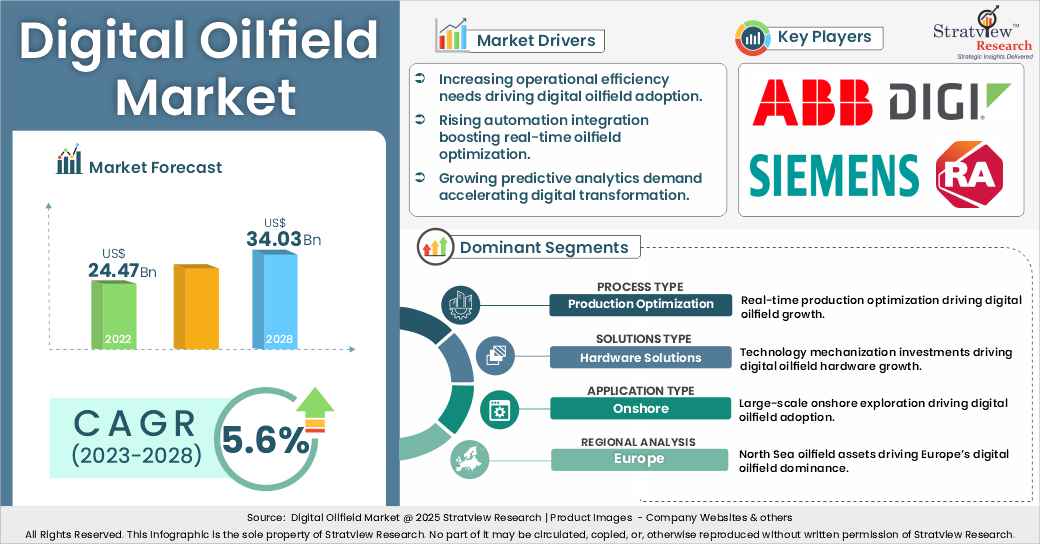
The digital oilfield market was estimated at USD 24.47 billion in 2022 and is likely to grow at a healthy CAGR of 5.6% during 2023-2028 to reach USD 34.03 billion in 2028.
Want to get a free sample? Register Here
|
Digital Oilfield Market Report Overview |
|
|
Market Size in 2022 |
USD 24.47 Billion |
|
Market Size in 2028 |
USD 34.03 Billion |
|
Market Growth (2023-2028) |
5.6% |
|
Base Year of Study |
2022 |
|
Trend Period |
2017-2021 |
|
Forecast Period |
2023-2028 |
A digital oilfield refers to the integration of advanced technologies and data analytics in the oil and gas industry to enhance exploration, production, and operational efficiency. It involves the collection, analysis, and interpretation of real-time data from various sources such as sensors, drones, and remote monitoring systems. This data-driven approach enables better decision-making, reduces downtime, optimizes production processes, and enhances safety.
By leveraging technologies like IoT, artificial intelligence, and cloud computing, companies can remotely monitor equipment, predict maintenance needs, optimize drilling techniques, and streamline operations.
Rising Investments in Digital Oilfields
Rising capital allocation toward upstream oil and gas operations is significantly driving the adoption of digital oilfield technologies. Increasing investments are enabling operators to deploy advanced digital solutions for exploration, production optimization, and asset management.
This sustained investment growth is accelerating the deployment of sensors, automation systems, remote monitoring tools, and analytics platforms, thereby strengthening the adoption of digital oilfield solutions across upstream operations.
Increasing Demand for Oil and Gas
Rising global energy demand driven by population growth and industrial expansion is reinforcing the need for efficient oil and gas exploration and production. Digital oilfield technologies are increasingly being adopted to improve operational efficiency, optimize resource extraction, and support the digital oilfield market growth.
This increasing demand is driving the adoption of digital tools such as real-time monitoring systems, drones, and sensor-based analytics to enhance production efficiency and improve decision-making across oilfield operations.
Lack of Manual Workforce
The oil and gas industry is increasingly shifting toward automation and digitalization, reducing dependence on manual labor while improving operational efficiency and safety.
The integration of digital oilfield technologies, including automated drilling systems and remote monitoring platforms, is helping operators streamline workflows, reduce human intervention in hazardous environments, and improve productivity. This transition is further accelerating the adoption of digital solutions across upstream operations.
Cybersecurity Risks
The increasing digitalization of oilfield operations has exposed the industry to growing cybersecurity risks. As connectivity expands across upstream systems, the vulnerability to cyberattacks, data breaches, and ransomware incidents has also increased.
These risks are creating concerns around data security and operational reliability, acting as a key restraint for the adoption of digital oilfield technologies.
High Implementation Costs
The adoption of digital oilfield solutions requires significant upfront investment in infrastructure, software, and integration systems. This high capital requirement can limit adoption, particularly among small and mid-sized operators.
The cost of implementing advanced technologies such as IoT systems, AI platforms, and cloud-based monitoring solutions remains a major barrier, restricting widespread deployment and slowing market penetration in cost-sensitive regions.
Expansion of AI, IoT, and Cloud-Enabled Oilfield Operations
The integration of AI, IoT, cloud computing, and digital twins is creating strong opportunities in the digital oilfield market trend, enabling predictive and automated field operations. Oil and gas operators are increasingly using AI analytics, IoT sensors, and cloud platforms for real-time monitoring, predictive maintenance, and improved production efficiency.
According to the U.S. Department of Energy (DOE, 2023), AI and advanced analytics in upstream operations can improve oil recovery efficiency by up to 10%–15%, while reducing operating costs by 5%–10% in digitally enabled fields.
The International Energy Agency (IEA, 2024) highlights that global upstream digitalization investments are rising as operators deploy connected sensors and data platforms across new and existing assets to improve production efficiency and reduce unplanned downtime.
As per IEA tracking of upstream investment trends (2025 outlook), digital technologies such as IoT-based monitoring and cloud-enabled field management are increasingly embedded in new oil and gas projects to support efficiency gains and emissions reduction targets.
This ongoing digital transformation is expected to enhance operational efficiency, reduce downtime, and improve resource recovery, thereby creating strong growth opportunities for digital oilfield solution providers across upstream operations globally.
|
Segmentations |
List of Sub-Segments |
Segments with High-Growth Opportunity |
|
Component Analysis |
Hardware, Software, Services |
Software segment is expected to account for the largest market share during the forecast period due to increasing adoption of digital platforms, analytics, and real-time monitoring solutions in oilfield operations. |
|
Process Analysis |
Drilling Optimization, Production Optimization, Reservoir Optimization |
Production Optimization segment is projected to hold a significant share owing to rising focus on improving output efficiency, reducing downtime, and enhancing recovery from mature oilfields. |
|
Application Analysis |
Onshore, Offshore |
Onshore segment is expected to dominate the market during the forecast period due to higher number of active wells and relatively lower operational complexity compared to offshore operations. |
|
Technology Analysis |
IoT, Artificial Intelligence & Analytics, Automation & Robotics, Cloud Computing, Digital Twin |
Artificial Intelligence & Analytics segment is anticipated to be the fastest-growing due to increasing demand for predictive insights, operational efficiency, and real-time decision-making. |
|
Regional Analysis |
North America, Europe, Asia-Pacific, and The Rest of the World |
North America is expected to hold the largest market share, while Asia-Pacific is projected to witness the fastest growth driven by rising upstream investments and accelerating digitalization of oilfield operations. |
“Software segment is projected to be the dominant segment during the forecast period.”
The digital oilfield market is segmented by component type into hardware, software, and services.
Software segment is projected to be the dominant segment during the forecast period due to the rising adoption of advanced analytics platforms, real-time monitoring systems, and digital automation solutions across upstream oil and gas operations.
The dominance of this segment is driven by increasing deployment of AI, IoT-based data analytics, and cloud-enabled platforms that enable predictive maintenance, drilling optimization, and production efficiency improvements. Oilfield operators are increasingly investing in software solutions to enhance reservoir performance, reduce operational downtime, and improve decision-making accuracy across complex field environments.
“Production optimization segment is projected to be the dominant segment during the forecast period.”
The digital oilfield market is segmented by process type into drilling optimization, production optimization, and reservoir optimization.
Production optimization segment is projected to be the dominant segment during the forecast period owing to the growing need to maximize hydrocarbon output while minimizing operational costs in both mature and new oilfields.
This dominance is supported by rising demand for real-time production monitoring, enhanced recovery techniques, and automation-driven workflow optimization. Operators are increasingly leveraging digital oilfield solutions to improve asset utilization, reduce production losses, and extend the lifecycle of existing wells.
“Onshore segment is projected to be the dominant segment during the forecast period.”
The digital oilfield market is segmented by application into onshore and offshore.
Onshore segment is projected to be the dominant segment during the forecast period due to the higher number of active wells, easier accessibility, and lower operational complexity compared to offshore fields.
The segment’s dominance is further supported by increasing digitalization of mature onshore fields, where operators are focusing on cost-efficient production enhancement, remote monitoring, and predictive maintenance to improve overall field productivity.
“Artificial Intelligence & Analytics segment is projected to be the fastest-growing segment during the forecast period.”
The digital oilfield market is segmented by technology into IoT, artificial intelligence & analytics, automation & robotics, cloud computing, and digital twin.
Artificial Intelligence & Analytics segment is projected to be the fastest-growing segment during the forecast period due to its ability to enable predictive insights, optimize drilling operations, and improve real-time decision-making across upstream activities.
The rapid growth of this segment is driven by increasing integration of AI-powered predictive maintenance, machine learning-based reservoir modeling, and advanced data analytics platforms. These technologies are helping oil and gas operators improve operational efficiency, reduce non-productive time, and enhance overall asset performance.
“North America is expected to be the dominant and fastest-growing region over the forecast period.”
Based on region, the digital oilfield market has been segmented into North America, Europe, Asia Pacific, Latin America, and Middle East & Africa.
North America is expected to be the dominant and fastest-growing region over the forecast period due to strong digital infrastructure, early adoption of advanced oilfield technologies, and high investment in upstream automation and optimization solutions.
The region’s leadership is further supported by the presence of major oilfield service providers and extensive deployment of AI, IoT, and cloud-based platforms across shale and conventional oil operations. Increasing focus on maximizing production efficiency and reducing operational costs continues to drive strong adoption of digital oilfield solutions across the region.
The market is highly populated with the presence of several local, regional, and global players. Most of the major players compete in some of the governing factors including price, product offerings, regional presence, etc.
The following are the key players in the digital oilfield market (arranged alphabetically).
Note: The above list does not necessarily include all the top players in the market.
Are you the leading player in this market? We would love to include your name. Write to us at [email protected]
This strategic assessment report, from Stratview Research, provides a comprehensive analysis that reflects today’s digital oilfield market realities and future market possibilities for the forecast period of 2023 to 2028. After a continuous interest in our digital oilfield market report from the industry stakeholders, we have tried to further accentuate our research scope to the digital oilfield market to provide the most crystal-clear picture of the market. The report segments and analyses the market in the most detailed manner to provide a panoramic view of the market. The vital data/information provided in the report can play a crucial role for the market participants as well as investors in the identification of the low-hanging fruits available in the market as well as to formulate the growth strategies to expedite their growth process.
This report offers high-quality insights and is the outcome of a detailed research methodology comprising extensive secondary research, rigorous primary interviews with industry stakeholders, and validation and triangulation with Stratview Research’s internal database and statistical tools. More than 1000 authenticated secondary sources, such as company annual reports, fact books, press releases, journals, investor presentations, white papers, patents, and articles, have been leveraged to gather the data. We conducted more than 15 detailed primary interviews with the market players across the value chain in all four regions and industry experts to obtain both qualitative and quantitative insights.
This report provides market intelligence in the most comprehensive way. The report structure has been kept such that it offers maximum business value. It provides critical insights into market dynamics and will enable strategic decision-making for existing market players as well as those willing to enter the market. The following are the key features of the report:
This report studies the market, covering a period of 12 years of trend and forecast. The report provides detailed insights into the market dynamics to enable informed business decision-making and growth strategy formulation based on the opportunities present in the market.
The digital oilfield market is segmented into the following categories:
Digital Oilfield Market, By Component Analysis
Hardware
Software
Services
Digital Oilfield Market, By Process Analysis
Drilling Optimization
Production Optimization
Reservoir Optimization
Digital Oilfield Market, By Application Analysis
Onshore
Offshore
Digital Oilfield Market, By Technology Analysis
Internet of Things (IoT)
Artificial Intelligence & Analytics
Automation & Robotics
Cloud Computing
Digital Twin
Digital Oilfield Market, By Regional Analysis
North America (Country Analysis: The USA, Canada, and Mexico)
Europe (Country Analysis: Germany, France, The UK, Russia, and the Rest of Europe)
Asia-Pacific (Country Analysis: Japan, China, India, and Rest of Asia-Pacific)
Rest of the World (Country Analysis: Brazil and Others)
With this detailed report, Stratview Research offers one of the following free customization options to our respectable clients:
Company Profiling
Competitive Benchmarking
Custom Research: Stratview Research offers custom research services across sectors. In case of any custom research requirement related to market assessment, competitive benchmarking, sourcing and procurement, target screening, and others, please send your inquiry to [email protected].
The report is delivered digitally through our online portal. Buyers receive login credentials from our team to access the report and may update their credentials at any time after the initial login.
Delivery timelines depend on the status of the report:
For the most accurate delivery timeline, please contact us to confirm the current status of the report.
Yes. You may request a complimentary preview of the report through a video conference with our team.
Yes. The scope of the report can be fully customized to align with your specific research objectives and information requirements.
Please contact us at [email protected], and our team will be happy to discuss your requirements and propose a tailored solution.
Yes. Selected sections of the report can be purchased separately based on your requirements. Please contact us at [email protected] to discuss your needs.
Yes, AI can help gather publicly available information, but its outputs are only as reliable as the data it accesses. Stratview Research reports are built using validated data, extensive primary interviews with industry stakeholders, and the expertise of our experienced research team.
Additionally, many critical insights, including market dynamics, competitive intelligence, and industry-specific trends, are not publicly available and therefore cannot be captured through AI alone.
A digital oilfield refers to the integration of advanced technologies and data analytics in the oil and gas industry to enhance exploration, production, and operational efficiency. It involves the collection, analysis, and interpretation of real-time data from various sources such as sensors, drones, and remote monitoring systems. This data-driven approach enables better decision-making, reduces downtime, optimizes production processes, and enhances safety.
The digital oilfield market was estimated at USD 24.47 billion in 2022.
The digital oilfield market is likely to reach USD 34.03 billion in 2028.
The digital oilfield market is likely to grow at a healthy CAGR of 5.6% during 2023-2028.
Some of the digital oilfield manufacturers are Schlumberger Limited, Weatherford International, Halliburton Company, National Oilwell Varco Corporation, ABB Group, The Emerson Electric Company, Rockwell Automation, Inc., Siemens AG, Honeywell International Inc., and Digi International.
Europe is estimated to dominate the market in the coming five years.
The onshore segment is expected to lead the market in the coming five years.
The digital oilfield concept aims to maximize resource utilization, minimize costs, and improve overall productivity in the oil and gas sector. The rising production activities in the Middle Eastern region, the prevalence of alternative reserves, and the increasing investments offshore in Asia-Pacific are the factors that are bolstering the growth of the digital oilfield market globally.


WE ACCEPT


