




404
+1-313-307-4176

Data Center Wires And Cables Market Report
Data Center Wires & Cables Market Size, Share, Trend, Forecast, Competitive Landscape & Growth Opportunities: 2026-2032
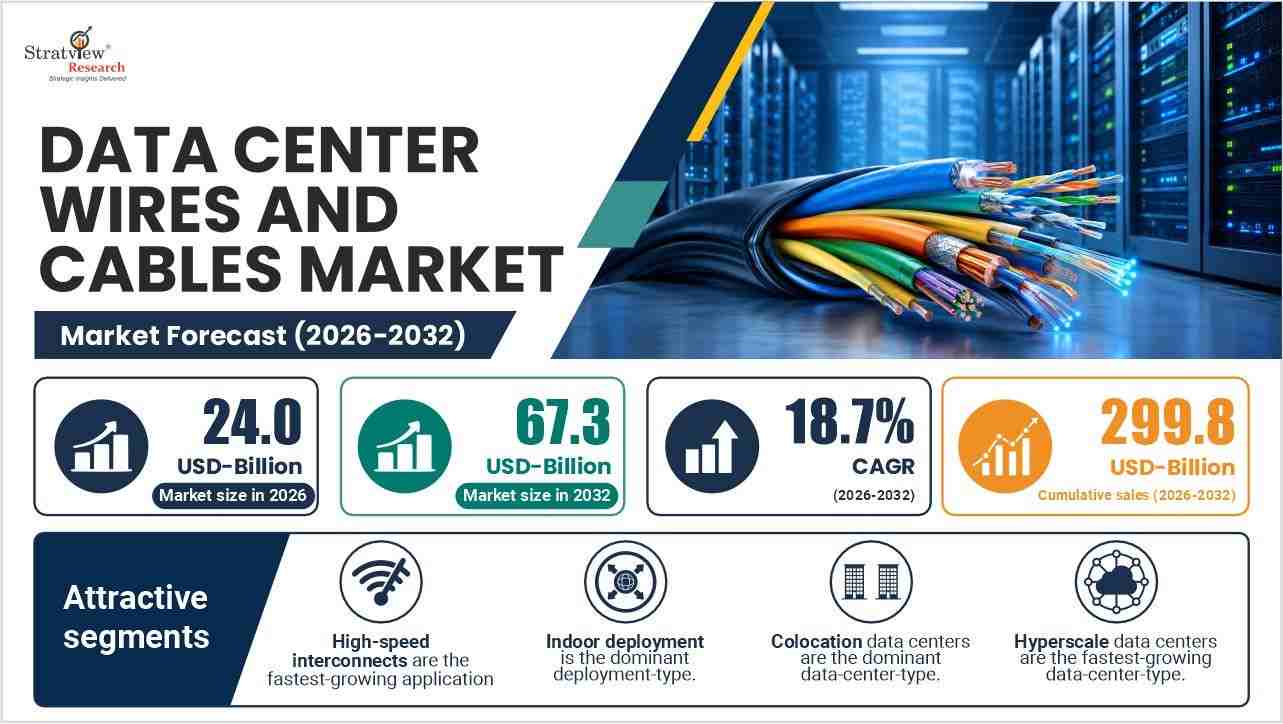
“The data center wires and cables market size will reach USD 24.0 billion in 2026 and is expected to create substantial opportunities for cable manufacturers, connectivity solution providers, data center operators, and investors. Driven by an impressive 18.7% CAGR, the market is projected to reach USD 67.3 billion by 2032, driven by the quick growth of cloud and hyperscale data centers, increased investments in digital infrastructure and data center modernization.”
Global Demand Analysis & Sales Opportunities in Data Center Wires and Cables Market
The annual demand for data center wires & cables was USD 20.4 billion in 2025 and is expected to reach USD 24.0 billion in 2026, up 17.8% from the value in 2025.
During the forecast period (2026–2032), the market is projected to expand at a CAGR of 18.7%. Annual demand is expected to reach USD 67.3 billion by 2032, more than 3 times the 2025 market size.
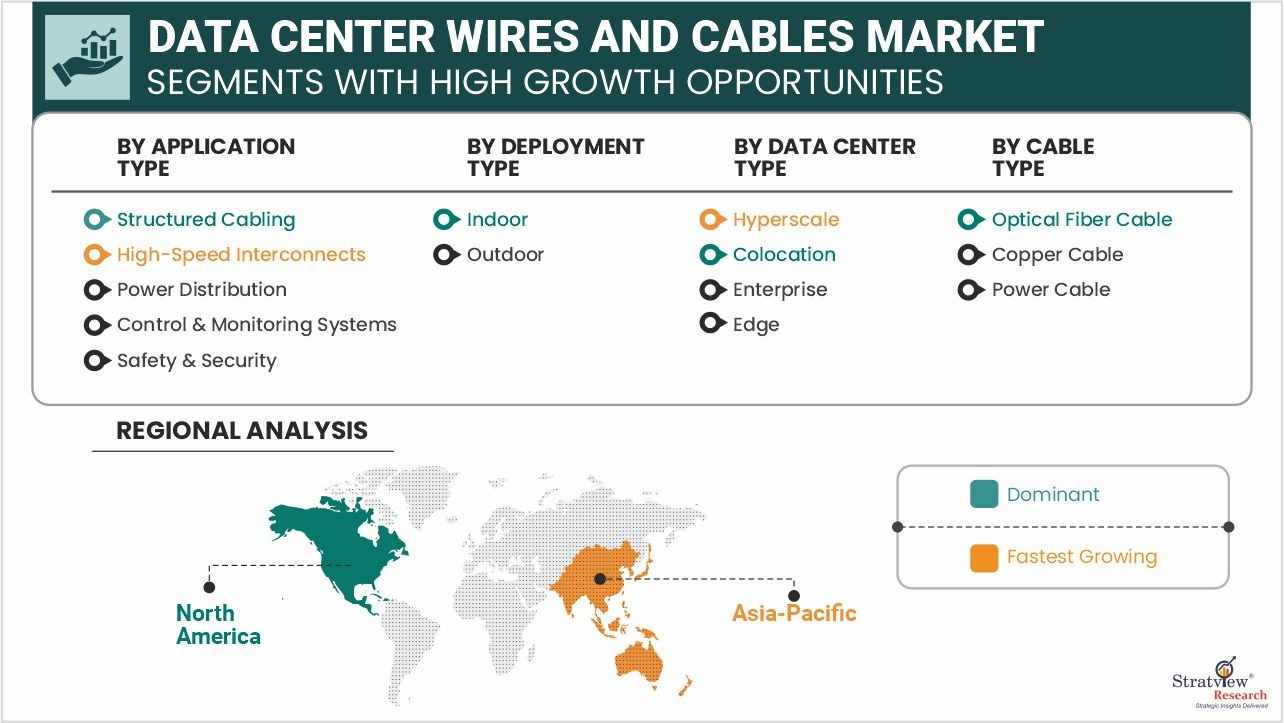
North America accounted for the largest share of the global data center wires and cables market in 2025. The substantial concentration of hyperscale facilities, established colocation infrastructure, and ongoing investments from cloud and technology providers support the region's highest demand.
Optical Fiber Cable in the upcoming years, single-mode fiber is anticipated to develop at the fastest rate because of its greater bandwidth capacity, lower signal loss, and appropriateness for long-distance, high-speed communication.
Structured cabling is expected to have the most market share of all application types, while high-speed interconnects are expected to increase at the fastest rate due to AI workloads, hyperscale deployments, and growing network speed requirements.
Due to the significant cabling needs in server rooms, racks, and networking equipment, indoor installations are predicted to maintain their leading position during the course of the forecast period.
By data center type, colocation facilities are expected to remain the largest demand generator, while hyperscale data centers are projected to witness the fastest growth owing to expanding cloud infrastructure and AI-driven data center investments.
“According to a senior analyst at Stratview Research, between 2026 and 2032, the global market for data center wires and cables is projected to produce a total sales potential of about USD 299.8 billion. Fiber optic cables, especially single-mode fiber, high-speed interconnect applications, hyperscale data centers, and the Asia-Pacific region, are expected to present high-potential prospects over the next six years, making these segments crucial areas of attention for market participants.”
Sharpen Your Strategies to Explore this USD ~300 billion Opportunity. Get a Free Sample of Our Report: “Here”.
Have a look at the sales opportunities presented by the data center wires & cables market in terms of growth and market forecast.
|
Market Statistics |
Value (in USD Billion) |
Market Growth (%) |
|
Market Size in 2025 |
USD 20.4 billion |
- |
|
Market Size in 2026 |
USD 24.0 billion |
YoY Growth in 2025: 17.8% |
|
Market Size in 2032 |
USD 67.3 billion |
CAGR 2026-2032: 18.7% |
|
Cumulative Sales Opportunity during 2026-2032 |
USD 299.8 billion |
- |
|
Top 10 Countries’ Market Share in 2025 |
USD 16 billion + |
> 75% |
|
Top 10 Companies’ Market Share in 2024 |
USD 8 billion to USD 10 billion |
40% - 50% |
Want to Explore the Market Opportunities? Get Free Sample “Here”.
The fast growth of hyperscale and cloud data centers, rising data traffic, and rising demand for high-speed, low-latency connectivity infrastructure are driving the global data center wires and cables market. By enabling dependable data transmission and power distribution across servers, storage systems, networking equipment, and support infrastructure, data center wires and cables, including optical fiber cables, copper cables, and power cables, serve as the essential foundation of contemporary digital infrastructure. The demand for sophisticated cabling solutions that can handle increased bandwidth, reduced latency, and improved network.
The market is changing concurrently as a result of growing cloud use, ongoing digital transformation projects, and ongoing infrastructure upgrades. The overall performance and operational efficiency of data centers are being improved by the shift to faster networks, the growing demand for scalable cabling solutions, and the growing desire for single-mode fiber. In order to meet changing connectivity needs and support the increasing complexity of contemporary data center environments, manufacturers are investing in cutting-edge fiber technologies, high-density interconnect solutions, and creative cable designs.
Growth of Hyperscale and AI-Driven Data Centers
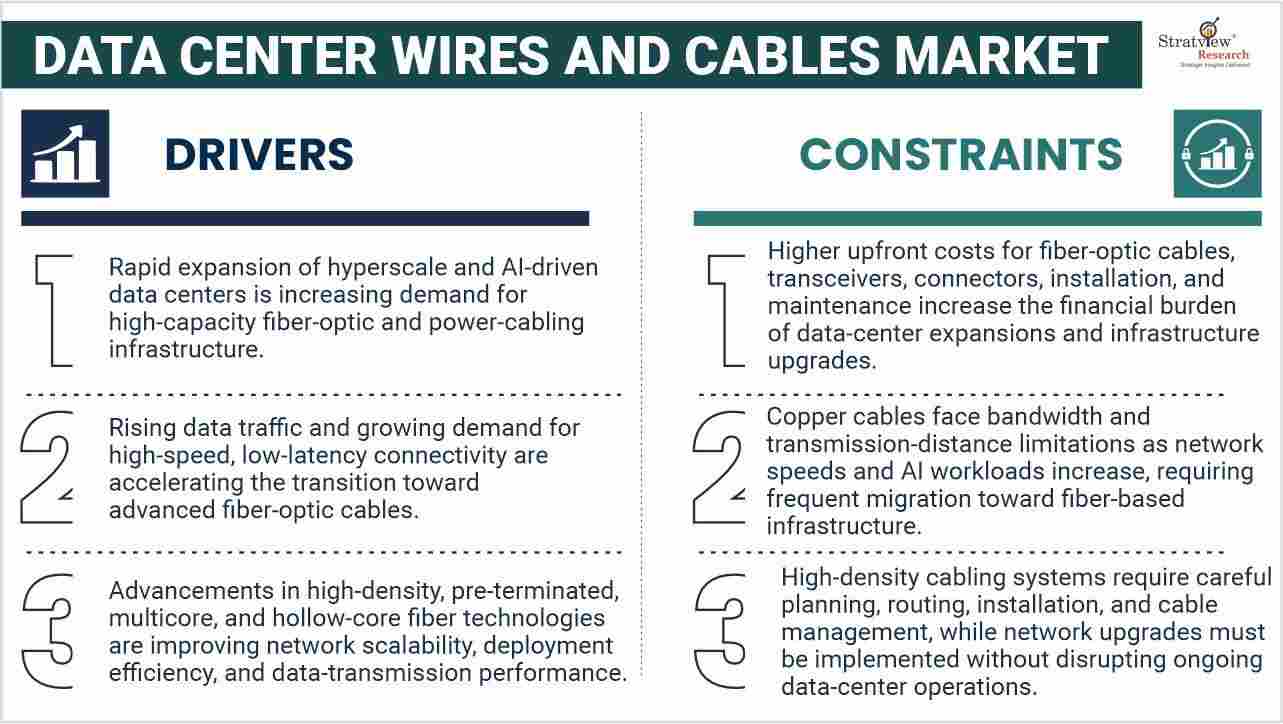
The fast growth of hyperscale and AI-driven data centers is one of the biggest factors propelling the data center wires and cables market. There is a significant need for high-capacity connectivity infrastructure due to the expanding use of cloud computing, AI, machine learning, and high-performance computing applications. Extensive fiber optic and electrical cabling networks are necessary for hyperscale facilities in order to manage massive data transmission volumes while upholding high-performance and reliability standards. The need for sophisticated cabling solutions that can support next-generation network designs is anticipated to increase dramatically as investments in AI infrastructure continue to pick up speed. The fast growth of hyperscale and AI-driven data centers is one of the biggest factors propelling the data center wires and cables market. There is a significant need for high-capacity connectivity infrastructure due to the expanding use of cloud computing, AI, machine learning, and high-performance computing applications. Extensive fiber optic and electrical cabling networks are necessary for hyperscale facilities in order to manage massive data transmission volumes while upholding high performance and reliability standards.
Rising Data Traffic and Demand for Low-Latency Connectivity
Another important element propelling market expansion is the ongoing increase in global data traffic. Data center networks are under increasing pressure due to the growing use of cloud services, video streaming, digital applications, and enterprise workloads. Operators are investing in high-speed, low-latency connectivity solutions that can effectively handle growing bandwidth requirements in order to meet these demands. Due to their capacity to provide faster transmission speeds, more bandwidth, and reduced signal loss over longer distances, fiber optic cables, especially single-mode fiber, are becoming more and more popular. The shift to sophisticated cabling infrastructure in contemporary data centers is being accelerated by this trend.
Advancements in Fiber Optic and High-Density Cabling Technologies
The market for data center wires and cables is seeing substantial expansion due to ongoing advancements in cabling technologies. High-density fiber solutions, pre-terminated cabling systems, and next-generation connectivity technologies that increase network scalability and deployment efficiency are becoming more and more popular in the business. Faster data transmission, lower latency, and more effective use of space in data center environments are made possible by innovations like multicore fibers, hollow-core fiber technologies, and sophisticated interconnect systems. Investments in cutting-edge cabling technologies are anticipated to promote long-term market growth as data centers continue to expand toward faster network speeds and greater infrastructure density.
“As per our analyst, the global data center wires and cables market is evolving rapidly. It became clear from conducting the market analysis and speaking with top industry players that major trends like the growing adoption of single-mode fiber and high-density cabling solutions, as well as the increasing shift toward fiber optic cabling for high-bandwidth and low-latency connectivity, will shape the next ten years. In order to enhance network performance, scalability, and deployment efficiency, the sector is also seeing an increase in investments in cutting-edge fiber technologies and next-generation connectivity solutions."
Align with the Mega Trends Shaping the Industry. Get Free Sample “Here”.
Higher Upfront Costs and Installation Complexity of Fiber Infrastructure
The greater initial cost of fiber optic deployment when compared to conventional copper-based solutions is one of the main issues facing the data center wires and cables business. Although fiber optic connections provide better bandwidth, reduced latency, and more scalability, they frequently necessitate larger expenditures for transceivers, connectors, installation, and upkeep. These expenses can rise dramatically for large-scale data center expansions and infrastructure upgrades, posing financial difficulties for operators. Therefore, for data center owners and network architects, striking a balance between infrastructure costs and performance needs is still crucial.
Bandwidth Limitations, Network Upgrades, and Cabling Complexity
Data center cabling infrastructure management is getting more difficult as network speeds rise and AI-driven workloads become more demanding. In high-speed applications, copper cables have inherent bandwidth and distance constraints that necessitate ongoing fiber-based network upgrades. In order to preserve performance and operational efficiency, the implementation of high-density cabling systems necessitates careful design, routing, and cable management. For data center operators, keeping up with changing connectivity standards while avoiding disturbance to current operations is a major problem, especially in large-scale and quickly growing facilities.
“Fiber optic cables lead the market, with single-mode fiber expected to grow at the fastest pace.”
The data center wires and cables market is segmented by cable type into optical fiber cables, copper cables, and power cables. Fiber optic cables dominate the market as they are best suited for handling the high-speed, low-latency data transmission required in modern data centers, especially as network speeds move toward 400G and beyond. Their adoption is largely driven by hyperscale deployments and increasing data traffic within facilities.
Within this segment, single-mode fiber is growing the fastest and is increasingly preferred over multimode fiber, as it supports higher bandwidth over longer distances with lower signal loss. Multimode fiber continues to be used for shorter-distance connections within data centers. Copper cables, mainly Cat6A, are typically used for management and control applications and have limited use in high-speed environments. Power cables, categorized into low, medium, and high-voltage, support the overall functioning of the facility by supplying power to IT and cooling infrastructure.
“Structured cabling systems dominate current deployments, while high-speed interconnects exhibit the fastest growth.”
The data center wires and cables market is segmented by application into structured cabling, high-speed interconnects, power distribution, control and monitoring systems, and safety and security. Structured cabling accounts for the largest share, as it forms the core connectivity layer within data centers, linking servers, storage, and networking equipment through a mix of fiber and copper cables.
High-speed interconnects are growing the fastest, driven by increasing demand for faster data transfer in hyperscale and AI-focused data centers. These applications rely heavily on fiber optic cables to support low-latency and high bandwidth requirements. Power distribution remains a critical application, ensuring reliable electricity supply across the facility, while control and monitoring systems and safety and security applications continue to see steady demand as part of overall data center operations.
“Indoor deployments account for the majority of cable installations in data centers.”
The data center wires and cables market is segmented into indoor and outdoor cables. Indoor deployments make up most of the installations, as cabling is mainly used within the facility to connect servers, racks, and networking equipment.
Outdoor cabling is used in specific cases like connecting multiple buildings within a data center campus. These cables are usually protected with stronger outer jackets, commonly made of polyethylene (PE), and in some cases may also include additional armoring for durability. While important, outdoor cabling represents a smaller share compared to indoor deployments.
“Colocation facilities drive substantial demand for wires and cables, while Hyperscale data centers demonstrate the fastest growth.”
The data center wires and cables market is segmented by data center type into Hyperscale, Colocation, Enterprise, and Edge. Colocation centers are another large segment because they host multiple tenants and require extensive cabling to manage connectivity, segregation, and service-level requirements across different customers.
Facilities that are hyperscale exhibit the most rapid growth, due to their huge scale of infrastructure and increasing demand for high-speed, high-capacity connectivity, especially in cloud and AI-driven environments. These facilities require dense fiber optic cabling to support high-performance network architectures. Enterprise data centers continue to see steady demand, largely driven by ongoing upgrades and modernization of existing infrastructure. Edge data centers, on the other hand, are gradually gaining traction as more computing is being pushed closer to end users to support low-latency applications and distributed workloads.
“North America leads the data center wires and cables market, driven by hyperscale infrastructure concentration and technology sector maturity, while Asia-Pacific demonstrates the fastest regional growth, fueled by aggressive digital transformation and data center construction programs.”
North America holds the largest share, supported by a strong base of hyperscale data centers and continued investments from cloud and technology providers, which drive demand for high-speed fiber and supporting cabling infrastructure.
Europe continues to see steady demand, mainly supported by the expansion of colocation facilities and a growing focus on data regulations and energy-efficient operations.
Asia Pacific is the quickest-expanding region, with data localization policies of China at the forefront, the operational rigour of Japan, and the growing capacity of India for hyperscale.
The Rest of the World, Latin America, and the Middle East experience the emergence of adoption due to the growth of colocation and digital transformation programs and regulatory modernization, and Africa is nascent but growing slowly with rising regional investments in data centers.
“The study indicates that a significant share of the global data center wires and cables market is concentrated within a limited number of leading countries, led by the United States, China, Japan, India, and key European economies. These countries will continue to drive global demand for industry stakeholders throughout the forecast period, supported by large-scale investments in hyperscale data centers, cloud infrastructure, artificial intelligence workloads, and digital transformation initiatives.”
Speak to Us for Deep Diving into a Country/Region Specific Opportunity. Contact Us “Here”.
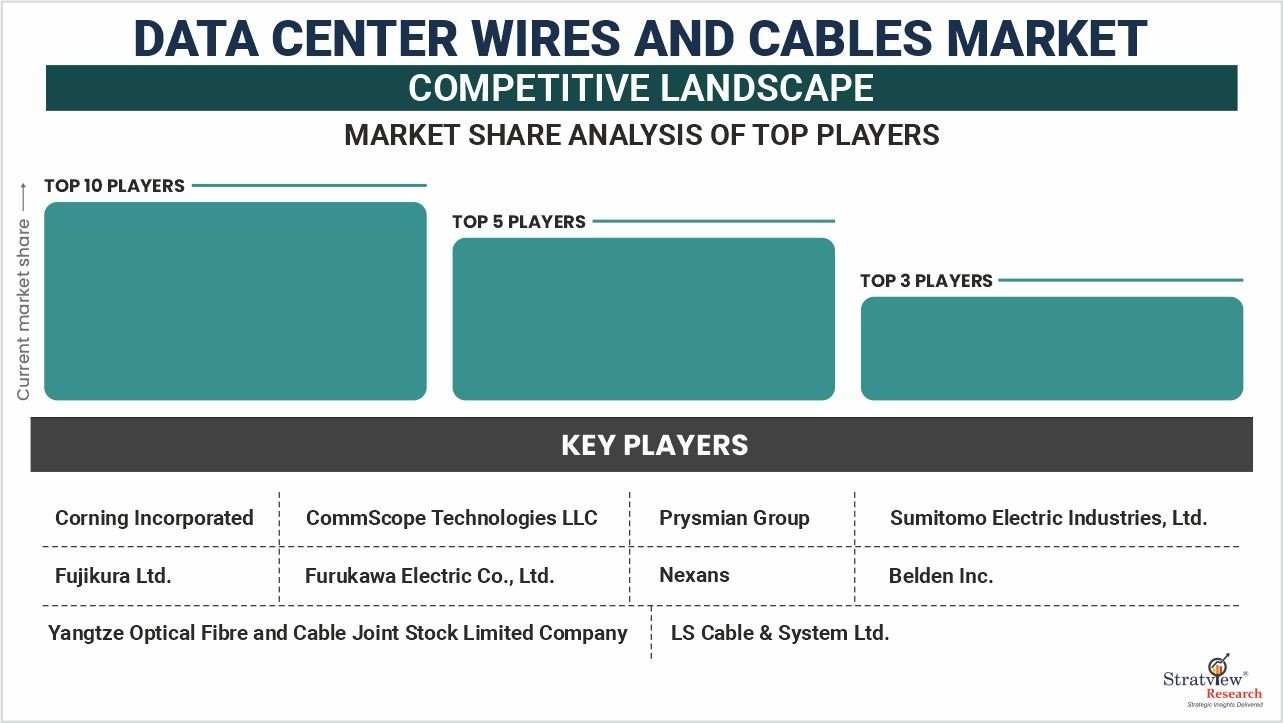
The market is moderately fragmented, with more than 80 players operating across different segments of the value chain. Most of the major players compete based on factors such as product portfolio, technological innovation, manufacturing capabilities, pricing, regional presence, and strategic partnerships. Several leading companies maintain strong market positions through extensive connectivity solutions portfolios, global manufacturing footprints, strong distribution networks, and long-standing relationships with hyperscale data center operators, cloud service providers, telecom companies, and enterprise customers.
The following are the key players in the data center wires and cables market.
Corning Incorporated
CommScope Technologies LLC
Prysmian Group
Sumitomo Electric Industries, Ltd.
Fujikura Ltd.
Furukawa Electric Co., Ltd.
Nexans
Belden Inc.
Yangtze Optical Fibre and Cable Joint Stock Limited Company
LS Cable & System Ltd.
Note: The above list is not an exhaustive list of the key players in the market. If your company is active in this market and would like to be considered for inclusion in future editions of this study, please contact us at [email protected].
Have the Competitive Edge with Our Intelligence. Get Free Sample “Here”.
Recent mergers & acquisitions and other developments in the data center wires and cables market reflect evolving technology trends and their impact on the industry. Below are a few recent developments in the market –
Corning Incorporated and Meta declared in January 2026 a multiyear contract for up to US$6 billion to provide Meta's U.S. data centers with optical fiber, cable, and connectivity solutions. The agreement emphasizes the growing significance of high-performance cabling infrastructure in hyperscale and AI-driven data centers and calls for the expansion of Corning's North Carolina production facilities.
Prysmian Group partnered with Relativity Networks in March 2025 to make it possible to produce next-generation hollow-core fiber-optic cables for data centers on a big scale. In order to meet the growing connectivity needs of hyperscale and AI-focused facilities, the alliance focuses on developing fiber technologies that offer quicker data transmission and lower latency.
Amphenol Corporation announced the acquisition of CommScope’s Connectivity and Cable Solutions (CCS) business for roughly US$10.5 billion in August 2025; the deal was finalized in January 2026. Amphenol's position in the worldwide connectivity market is strengthened by the acquisition, which broadens its range of fiber optic, cable, and connectivity solutions across enterprise, broadband, and data communications networks.
Aside from that, the competitive landscape is still changing due to the advancement of next-generation fiber connectivity technologies. To meet higher bandwidth, lower latency, and faster deployment requirements in hyperscale and AI-driven data center environments, industry players are making significant investments in multicore fibers, hollow-core fiber technologies, high-density interconnect systems, and pre-assembled fiber solutions.
Specialized connectivity and power transmission components called data center wires and cables are made to help with power distribution and data transfer in data center settings. These cables, which link servers, storage systems, networking hardware, and supporting infrastructure to guarantee dependable operations and smooth data transfer between sites, include optical fiber, copper, and power cables. Numerous applications, such as structured cabling, high-speed interconnects, power distribution, control and monitoring systems, and safety and security infrastructure, are supported by data center wires and cables. They provide a special blend of high bandwidth, low latency, dependability, scalability, and operational efficiency, allowing contemporary data centers to satisfy growing demands for connectivity and performance.
This report provides market intelligence most comprehensively. The report structure has been kept so that it offers maximum business value. It provides critical insights into market dynamics and will enable strategic decision-making for existing market players as well as those willing to enter the market.
The following are the key features of the report:
Market structure: Overview, industry life cycle analysis, supply chain analysis.
Market environment analysis: Growth drivers and constraints, Porter’s five forces analysis, SWOT analysis.
Market trend and forecast analysis.
Market segment trend and forecast.
Competitive landscape and dynamics: Market share, Service portfolio, New Product Launches, etc.
Attractive market segments and associated growth opportunities.
Emerging trends.
Strategic growth opportunities for the existing and new players.
Key success factors.
|
Market Study Period |
2019-2032 |
|
Base Year |
2025 |
|
Forecast Period |
2026-2032 |
|
Trend Period |
2019-2024 |
|
Number of Tables & Figures |
>100 |
|
Number of Segments Analyzed |
5 (Cable Type, Application Type, Deployment Type, Data Center Type, and Region) |
|
Number of Regions Analyzed |
4 (North America, Europe, Asia-Pacific, Rest of the World) |
|
Countries Analyzed |
12 (The USA, Canada, Mexico, Germany, UK, France, China, Australia, Japan, India, Brazil, Africa, Rest of Europe, Rest of APAC, and Rest of the World) |
|
Free Customization Offered |
10% |
|
After Sales Support |
Unlimited |
|
Report Presentation |
Complimentary |
|
Market Dataset |
Complimentary |
|
Further Deep Dive & Consulting Services |
10% Discount |
Want a Report Tailor-Made to Your Objectives? Speak with Our Analyst
The report provides detailed insights into the market dynamics to enable informed business decision-making and growth strategy formulation based on the opportunities present in the market.
Data Center Wires and Cables Market, By Cable Type
Optical Fiber Cable
Single-Mode Fiber
Multimode Fiber
Copper Cable
Twisted Pair Cables (Cat6A, Cat8)
Direct Attach Copper (DAC)
Other
Power Cable
Low Voltage (LV)
Medium Voltage (MV)
High Voltage (HV)
Data Center Wires and Cables Market, By Application Type
Structured Cabling
High-Speed Interconnects
Power Distribution
Control & Monitoring Systems
Safety & Security
Data Center Wires and Cables Market, By Deployment Type
Indoor
Outdoor
Data Center Wires and Cables Market, By Data Center Type
Hyperscale
Colocation
Enterprise
Edge
Data Center Wires and Cables Market, By Region
North America (Country Analysis: The USA, Canada, and Mexico)
Europe (Country Analysis: Germany, France, The UK, and Rest of Europe)
Asia-Pacific (Country Analysis: China, Japan, India, Australia, and Rest of Asia-Pacific)
Rest of the World (Country Analysis: Brazil, Africa, and Others)
Looking for a Deep Dive? Speak with Our Analyst
This strategic assessment report from Stratview Research provides a comprehensive analysis that reflects today’s data center wires & cables market realities and future market possibilities for the forecast period.
The report segments and analyzes the market in the most detailed manner to provide a panoramic view of the market. The vital data/information provided in the report can play a crucial role for market participants and investors in identifying the low-hanging fruit available in the market and formulating growth strategies to expedite their growth process.
This report offers high-quality insights and is the outcome of a detailed research methodology comprising extensive secondary research, rigorous primary interviews with industry stakeholders, and validation and triangulation with Stratview Research’s internal database and statistical tools.
More than 1,000 authenticated secondary sources, such as company annual reports, fact books, press releases, journals, investor presentations, white papers, patents, and articles, have been leveraged to gather the data.
We conducted more than 10 detailed primary interviews with market players across the value chain in all four regions and industry experts to obtain both qualitative and quantitative insights.
With this detailed report, Stratview Research offers one of the following free customization options to our respected clients:
Company Profiling
Detailed profiling of additional market players (up to three players)
SWOT analysis of key players (up to three players)
Competitive Benchmarking
Benchmarking of key players on the following parameters: Service portfolio, geographical reach, regional presence, and strategic alliances
Custom Research: Stratview Research offers custom research services across industries. In case of any custom research requirement related to market assessment, competitive benchmarking, sourcing and procurement, target screening, and others, please send your inquiry to [email protected]
The report is delivered digitally through our online portal. Buyers receive login credentials from our team to access the report and may update their credentials at any time after the initial login.
Delivery timelines depend on the status of the report:
For the most accurate delivery timeline, please contact us to confirm the current status of the report.
Yes. You may request a complimentary preview of the report through a video conference with our team.
Yes. The scope of the report can be fully customized to align with your specific research objectives and information requirements.
Please contact us at [email protected], and our team will be happy to discuss your requirements and propose a tailored solution.
Yes. Selected sections of the report can be purchased separately based on your requirements. Please contact us at [email protected] to discuss your needs.
Yes, AI can help gather publicly available information, but its outputs are only as reliable as the data it accesses. Stratview Research reports are built using validated data, extensive primary interviews with industry stakeholders, and the expertise of our experienced research team.
Additionally, many critical insights, including market dynamics, competitive intelligence, and industry-specific trends, are not publicly available and therefore cannot be captured through AI alone.
The data center wires and cables market size was US$ 20.4 billion in 2025. The market is expected to grow from USD 24.0 billion in 2026 to USD 67.3 billion in 2032, witnessing an impressive market growth (CAGR) of 18.7% during the forecast period (2026-2032).
With the high concentration of hyperscale facilities, developed colocation infrastructure, technological leadership, and ongoing expenditures from cloud service providers, North America has the biggest market share for data center wires and cables worldwide.
Optical fiber cable can provide high-speed, low-latency data transmission; it now dominates the market. Because of its greater bandwidth capacity, less signal loss, and appropriateness for long-distance communication, single-mode fiber is anticipated to develop at the quickest rate within this category.
The top players in the data center wires and cables market include Corning Incorporated, CommScope Technologies LLC, Prysmian Group, Sumitomo Electric Industries, Ltd., Fujikura Ltd., Furukawa Electric Co., Ltd., Nexans, Belden Inc., Yangtze Optical Fibre and Cable Joint Stock Limited Company, and LS Cable & System Ltd.
Key emerging trends include the increasing shift toward fiber optic cabling, growing adoption of single-mode fiber, rising deployment of high-density and pre-terminated cabling systems, development of multicore and hollow-core fiber technologies, and growing demand from AI-driven data centers.


WE ACCEPT