




404
+1-313-307-4176

Composite Rebar Market Analysis | 2026-2031

Composite Rebar Market Size, Share, Trends, Dynamics, Forecast, & Growth Analysis: 2026-2031
Composite Rebar Market is segmented by Product Type (Glass Fiber Reinforced Polymer Rebar (GFRP Rebar), Carbon Fiber Reinforced Polymer Rebar (CFRP Rebar), and Basalt Fiber Reinforced Polymer Rebar (BFRP Rebar)), by End-Use Type (Construction, Electrical Isolation, Industrial, Marine, and Others), and by Region (North America [The USA, Canada, and Mexico], Europe [Germany, France, The UK, Russia, Italy, and Rest of Europe], Asia-Pacific [China, Japan, India, South Korea, and Rest of Asia-Pacific], and Rest of the World [Brazil, Argentina, and Others]).
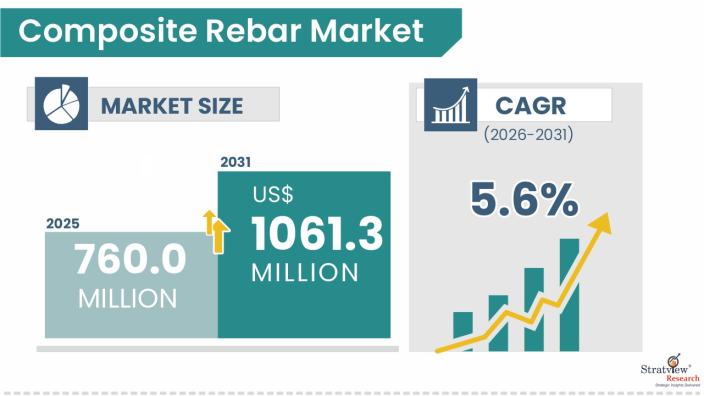
The composite rebar market was estimated at USD 765 million in 2025 and is likely to grow at a CAGR of 5.6% during 2026-2031 to reach USD 1061.3 million in 2031.
Want to know more about the market scope? Register Here
The composite rebar market is gaining momentum due to rising investments in durable infrastructure, increasing demand for corrosion-resistant reinforcement materials, and growing focus on reducing lifecycle maintenance costs. Composite rebar offers high strength, lightweight properties, and excellent resistance to corrosion, making it a preferred alternative to conventional steel reinforcement in demanding construction environments. A key market trend is the increasing adoption of composite rebar in marine, transportation, and renewable energy infrastructure projects.
Rising Demand for Corrosion-Resistant Infrastructure is Driving Market Growth
The growing need for corrosion-resistant construction materials is driving the market growth of the composite rebar market. Composite rebar is increasingly used in bridges, marine structures, tunnels, and wastewater facilities owing to its superior resistance to corrosion, longer service life, and lower maintenance requirements compared with conventional steel reinforcement.
According to the U.S. Federal Highway Administration (FHWA), more than 42,400 bridges in the United States were classified as being in poor condition in 2024, highlighting the growing need for durable reinforcement materials in bridge rehabilitation and infrastructure modernization.
Expanding Global Infrastructure Investment is Increasing Market Demand
Increasing investments in transportation, urban development, and public infrastructure are driving the market demand for composite rebar. Governments across developed and emerging economies are investing in highways, bridges, ports, and smart-city projects, where long-lasting reinforcement materials help reduce maintenance costs and improve structural durability.
According to the World Bank, global infrastructure investment needs are estimated to reach approximately USD 94 trillion by 2040, creating substantial demand for advanced reinforcement materials capable of extending infrastructure service life.
High Initial Material Costs Restrain Market Growth
Higher upfront costs continue to restrain the market growth of the composite rebar market. Compared with conventional steel rebar, composite rebar requires advanced fibers, resin systems, and specialized manufacturing processes, increasing initial project costs despite offering lower lifecycle maintenance expenses.
The higher production cost of glass fiber, carbon fiber, and resin systems remains a key barrier to wider adoption, particularly in cost-sensitive public infrastructure projects where procurement decisions are often based on initial capital expenditure.
Limited Design Standards and Industry Familiarity Challenge Market Adoption
Limited design standards and contractor familiarity continue to challenge the market demand for composite rebar. Although engineering guidelines are expanding, many designers, contractors, and project owners remain more experienced with conventional steel reinforcement, resulting in slower adoption and longer project approval processes.
The continued development of national and international design standards is expected to improve industry confidence and accelerate the adoption of composite reinforcement in structural applications.
Expansion of Marine and Coastal Infrastructure Creates Market Opportunities
Growing investments in marine, coastal, and water infrastructure are creating significant market opportunities for the composite rebar market. Its immunity to chloride-induced corrosion makes composite rebar well suited for seawalls, ports, desalination plants, wastewater treatment facilities, and coastal protection projects, where long-term durability is essential.
According to the United Nations, nearly 40% of the global population lives within 100 km of a coastline, increasing investments in resilient coastal infrastructure and supporting demand for corrosion-resistant reinforcement materials.
Renewable Energy Infrastructure is Emerging as a Key Market Trend
The rapid expansion of offshore wind farms and other marine renewable energy projects is emerging as a key market trend for the composite rebar market. Composite rebar provides excellent durability in harsh marine environments, making it suitable for offshore foundations and coastal energy infrastructure that require long service life and reduced maintenance.
According to the Global Wind Energy Council (GWEC), approximately 19 GW of new offshore wind capacity was installed globally in 2025, supporting demand for durable construction materials used in marine renewable energy projects.
|
Segmentations |
List of Sub-Segments |
Dominant and Fastest-Growing Segments |
|
Product-Type Analysis |
Glass Fiber Reinforced Polymer Rebar (GFRP Rebar), Carbon Fiber Reinforced Polymer Rebar (CFRP Rebar), and Basalt Fiber Reinforced Polymer Rebar (BFRP Rebar) |
GFRP rebars are expected to remain the most sought-after product type in the market during the forecast period. |
|
End-Use-Type Analysis |
Construction, Electrical Isolation, Industrial, Marine, and Others |
Construction is expected to remain the dominant as well as the fastest-growing segment of the market during the forecast period. |
|
Regional Analysis |
North America, Europe, Asia-Pacific, and Rest of the World |
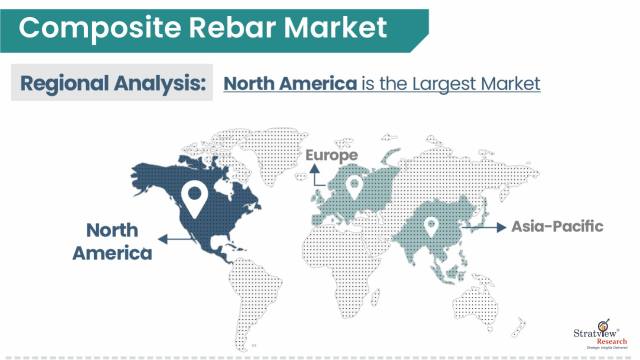
North America is expected to remain the largest region in the market for composite rebars during the forecast period. |
“GFRP rebars will be the most in-demand product in the composite rebar market during the forecast period.”
The composite rebar market is segmented as GFRP rebar (Glass Fiber-Reinforced Polymer), CFRP rebar (Carbon Fiber-Reinforced Plastic), and BFRP rebar (Basalt Fiber-Reinforced Polymer).
Among these, GFRP rebars are expected to remain the most sought-after product type in the composite rebar market during the forecast period owing to their increasing demand in roads, bridges, tunnels, MRI rooms, marine structures, and waterfronts.
“Construction will be the dominant and fastest-growing market segment during the forecast period.”
The market is segmented as construction, electrical isolation, industrial, marine, and others. Construction is expected to remain the dominant as well as the fastest-growing segment of the market during the forecast period.
The demand for composite rebars in the construction industry is being driven by increasing investments in infrastructure development, including bridges, buildings, highways, water distribution systems, and other facilities.
“North America is anticipated to stay as the dominant region in the composite rebars market throughout the forecast period.”
The market is broken down geographically into areas, namely North America, Europe, Asia-Pacific, and the Rest of the World (RoW). In terms of regions, North America is expected to remain the largest region in the market for composite rebars during the forecast period.
The region is witnessing high growth in the construction industry with the replacement of existing infrastructure and the development of new ones. As a result, the region serves as the growth engine for the industry. Asia-Pacific and Europe are also likely to generate sizeable opportunities in the coming five years.
Know the high-growth countries in this report. Register Here
Most of the major players compete in some of the governing factors, including price, product offerings, regional presence, etc.
The following are the key players in the market (arranged alphabetically):
Note: The above list does not necessarily include all the top players in the market.
Are you the leading player in this market? We would love to include your name. Write to us at [email protected]
This report provides market intelligence in the most comprehensive way. The report structure has been kept such that it offers maximum business value. It provides critical insights into market dynamics and will enable strategic decision-making for existing market players as well as those willing to enter the market. The following are the key features of the report:
This report studies the market, covering a period of 12 years of trends and forecasts. The report provides detailed insights into the market dynamics to enable informed business decision-making and growth strategy formulation based on the opportunities present in the market.
The composite rebar market is segmented into the following categories:
By Product Type
By End-Use Type
By Region
This strategic assessment report, from Stratview Research, provides a comprehensive analysis that reflects today’s composite rebar market realities and future market possibilities for the forecast period of 2026 to 2031. After a continuous interest in our composite rebar market report from the industry stakeholders, we have tried to further accentuate our research scope to the composite rebar market to provide the most crystal-clear picture of the market. The report segments and analyses the market in the most detailed manner to provide a panoramic view of the market. The vital data/information provided in the report can play a crucial role for the market participants as well as investors in the identification of the low-hanging fruits available in the market as well as to formulate the growth strategies to expedite their growth process.
This report offers high-quality insights and is the outcome of a detailed research methodology comprising extensive secondary research, rigorous primary interviews with industry stakeholders, and validation and triangulation with Stratview Research’s internal database and statistical tools. More than 1000 authenticated secondary sources, such as company annual reports, fact books, press releases, journals, investor presentations, white papers, patents, and articles, have been leveraged to gather the data. We conducted more than 15 detailed primary interviews with the market players across the value chain in all four regions and industry experts to obtain both qualitative and quantitative insights.
With this detailed report, Stratview Research offers one of the following free customization options to our respectable clients:
Company Profiling
Competitive Benchmarking
Custom Research:
Stratview Research offers custom research services across sectors. In case of any custom research requirements related to market assessment, competitive benchmarking, sourcing and procurement, target screening, and others, please send your inquiry to [email protected].
The report is delivered digitally through our online portal. Buyers receive login credentials from our team to access the report and may update their credentials at any time after the initial login.
Delivery timelines depend on the status of the report:
For the most accurate delivery timeline, please contact us to confirm the current status of the report.
Yes. You may request a complimentary preview of the report through a video conference with our team.
Yes. The scope of the report can be fully customized to align with your specific research objectives and information requirements.
Please contact us at [email protected], and our team will be happy to discuss your requirements and propose a tailored solution.
Yes. Selected sections of the report can be purchased separately based on your requirements. Please contact us at [email protected] to discuss your needs.
Yes, AI can help gather publicly available information, but its outputs are only as reliable as the data it accesses. Stratview Research reports are built using validated data, extensive primary interviews with industry stakeholders, and the expertise of our experienced research team.
Additionally, many critical insights, including market dynamics, competitive intelligence, and industry-specific trends, are not publicly available and therefore cannot be captured through AI alone.
Composite rebar is used in corrosive and challenging environments. It has a unique combination of mechanical properties that make it a superior alternative to other types of rebar, especially when working in aggressive environments. It is corrosion-free, has a high tensile strength, is extremely durable, and weighs four times less than steel. Because composite rebar is lightweight, it is less expensive to transport and install.
The composite rebar market was estimated at USD 765 million in 2025.
The forecasted value of the composite rebar market is expected to be USD 1061.3 million in 2031
The composite rebar market is likely to grow at a CAGR of 5.6% during 2026-2031.
North America is estimated to remain dominant in the market in the foreseeable future. The key factor driving the region’s demand for composite rebars is the high growth in the construction industry with the replacement of existing infrastructure and the development of new ones.
Construction is expected to remain the dominant as well as the fastest-growing segment of the market during the forecast period. Rising infrastructure investments in bridges, buildings, highways, and water systems are boosting the demand for composite rebars in the construction industry.
The growth of the composite rebar market is driven by the rise in new transportation construction and growing commercial and residential construction.
Armastek, BP Composites Ltd., Dextra Group, FiReP Rebar Technology GmbH, Galen, Marshall Composite Technologies LLC, Mateenbar Limited, Owens Corning, Pultron Composites Ltd, Schoeck are the leading players in the market.


WE ACCEPT