




404
+1-313-307-4176

Composite Pressure Vessels Market Analysis | 2026-2031

Composite Pressure Vessels Market Size, Share, Growth, Trend, Forecast, Competitive Landscape & Growth Opportunities: 2026–2031 ... See more
“The composite pressure vessels market size will reach USD 2.73 billion in 2026 and offers robust growth opportunities for market stakeholders. With the market expected to grow at a CAGR of 17.7%, annual sales will hit the USD 6.13 billion mark by 2031, driven by accelerating adoption of hydrogen and CNG storage solutions, rapid clean energy infrastructure expansion, and increasing demand for lightweight, high-performance storage systems across automotive, aerospace, industrial, and energy sectors.”
The annual demand for composite pressure vessels was USD 2.32 billion in 2025 and reached USD 2.73 billion in 2026, up 17.2% year-on-year, signalling robust market momentum driven by accelerating clean energy transitions globally.
According to the analysis, during the forecast period (2026–2031), the composite pressure vessels market is expected to grow at a CAGR of 17.7%. Annual demand will reach USD 6.13 billion in 2031, representing more than 2x the market size in 2026.
The market is projected to generate a cumulative sales opportunity of USD 26+ billion during 2026–2031, presenting compelling investment and expansion opportunities across the value chain.
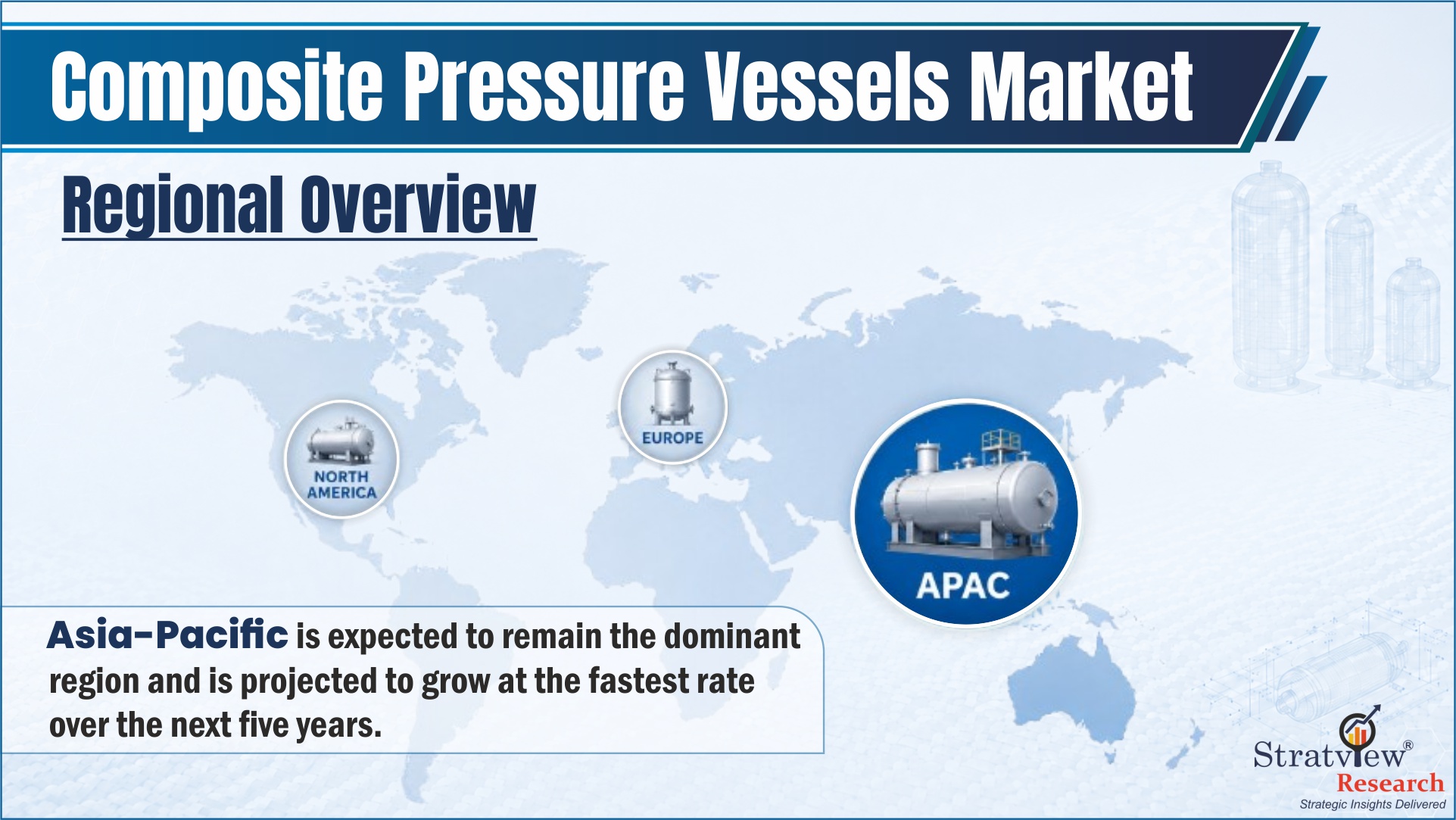
Asia-Pacific is expected to remain the dominant region and is likely to grow at the fastest rate during the forecast period, underpinned by massive clean energy investments, strong government hydrogen policies, and rapid industrialization.
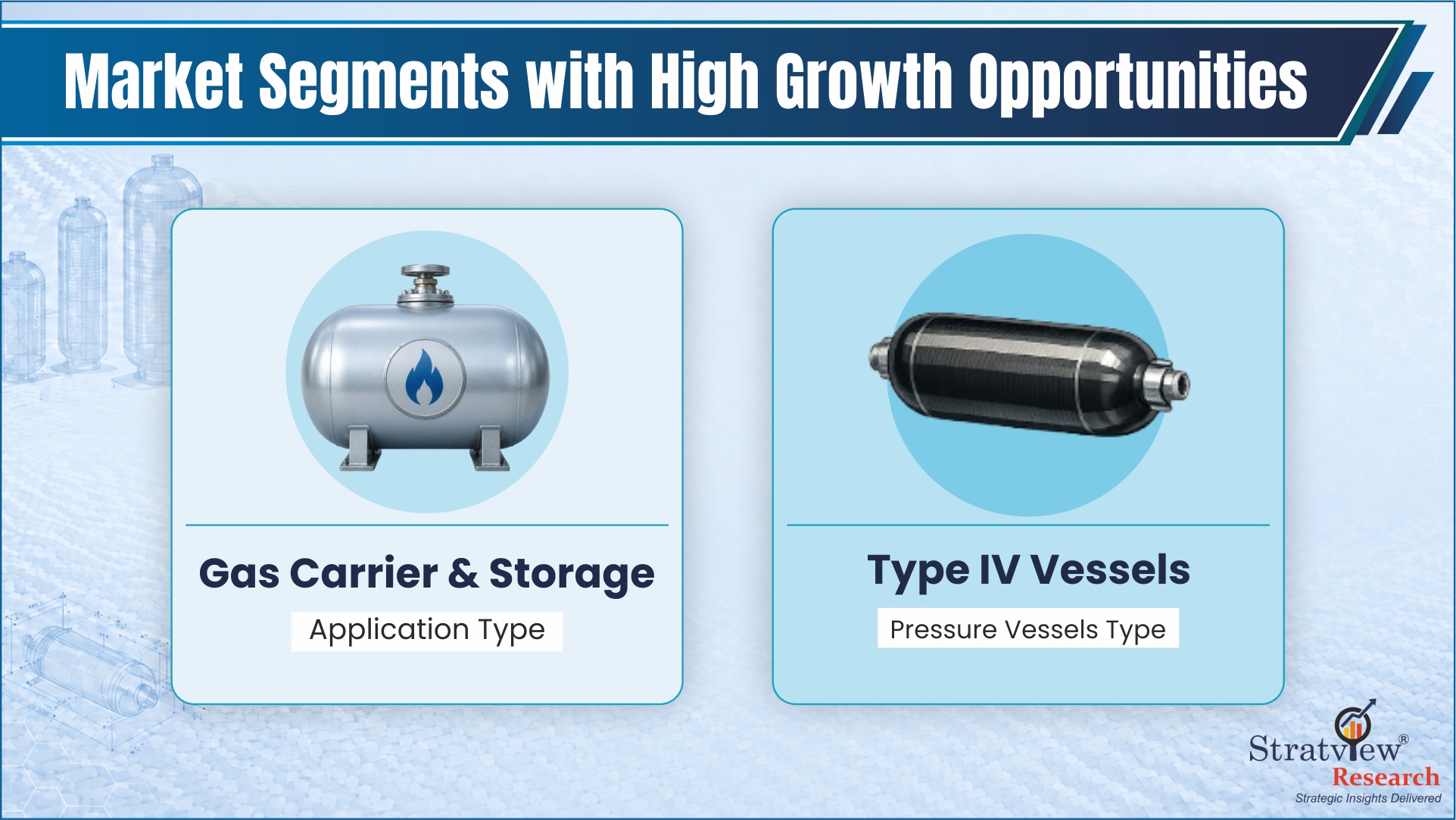
By pressure vessel type, Type IV vessels are anticipated to contribute the largest share of the market and are likely to grow at the fastest rate, driven by their all-composite fully-plastic liner construction, which offers the highest weight savings and is the preferred vessel type for hydrogen fuel cell vehicle (FCEV) applications.
By application type, Gas Carrier & Storage is expected to be the leading demand generator and is likely to grow at the fastest rate, propelled by rising adoption of hydrogen and CNG as cleaner transportation and industrial fuels worldwide.
“According to a Lead Analyst at Stratview Research, the global composite pressure vessels market will generate a cumulative sales opportunity worth USD 26+ billion during 2026–2031. Gas Carrier & Storage, Type IV Vessels, and Asia-Pacific are the high-opportunity segments to bank upon during the next five years.”
_71995.webp)
Sharpen your strategies to explore this USD 26+ billion Opportunity. Get a free sample of our report here.
Have a look at the sales opportunities presented by the composite pressure vessels market in terms of growth and market forecast.
|
Market Statistics |
Value (in USD Billion) |
Market Growth (%) |
|
Market Size in 2025 |
USD 2.32 billion |
YoY Growth in 2025: 23.8% |
|
Market Size in 2026 |
USD 2.73 billion |
YoY Growth in 2026: 17.2% |
|
Market Size in 2031 |
USD 6.13 billion |
CAGR 2026–2031: 17.7% |
|
Cumulative Sales Opportunity during 2026–2031 |
USD 26+ billion |
– |
|
Top 10 Countries’ Market Share in 2025 |
USD 1.85 billion+ |
> 80% |
|
Top 10 Company’s Market Share in 2025 |
USD 1.16 billion to USD 1.62 billion |
50% – 70% |
Want to explore the market opportunities? Get a free sample here.
Composite pressure vessels are witnessing increasing adoption across hydrogen storage, compressed natural gas (CNG) transportation, industrial gas distribution, aerospace, defense, and space applications. The growing application of composite pressure vessels across the clean-energy and transportation sectors is creating significant opportunities for the global composite pressure vessels industry
Stringent CO₂ Reduction Targets Accelerating Demand for Hydrogen-Powered Heavy Vehicles
Governments worldwide are tightening emission regulations to reduce transportation-related carbon emissions, particularly in the heavy-duty vehicle segment, where battery-electric solutions face limitations in range, payload capacity, and charging time. As a result, hydrogen fuel-cell vehicles are increasingly being adopted for long-haul trucking, buses, and commercial transportation applications.
The European Union's revised heavy-duty vehicle emission regulations require average CO₂ emissions from new trucks to be reduced by 45% by 2030, 65% by 2035, and 90% by 2040. To meet these targets, industry roadmaps indicate that Europe could deploy more than 45,000 fuel-cell trucks by 2030. Since hydrogen-powered vehicles store compressed hydrogen at pressures of up to 700 bar, every vehicle requires multiple high-pressure storage cylinders. The growing deployment of fuel-cell trucks and buses will therefore directly increase the demand for Type III and Type IV composite pressure vessels.
Government Hydrogen Programs Expanding the Installed Base of High-Pressure Storage Systems
Government-backed hydrogen programs are accelerating investments across hydrogen production, transportation, refueling, and vehicle deployment, creating long-term demand for composite pressure vessels.
China has announced plans to expand its hydrogen economy with a target of approximately 100,000 fuel-cell vehicles by 2030, compared with an existing deployment base of around 40,000 vehicles. To support this growth, the government is providing incentives of up to 1.6 billion yuan (approximately USD 220 million) for selected hydrogen city clusters.
Similarly, India's National Green Hydrogen Mission targets annual production of 5 million tonnes of green hydrogen by 2030, supported by approximately 125 GW of renewable energy capacity. In Europe, the REPowerEU strategy aims to produce 10 million tonnes of renewable hydrogen and import another 10 million tonnes by 2030.
As hydrogen vehicle fleets, refueling stations, and production facilities expand, demand rises for high-pressure storage cylinders, transport modules, and stationary storage systems, all of which rely heavily on composite pressure vessel technology.
Growing Hydrogen Storage and Transportation Requirements Driving Composite Pressure Vessel Consumption
The rapid growth of hydrogen production is creating a parallel need for storage and transportation infrastructure. Unlike conventional fuels, hydrogen must be stored and transported under high pressure, making composite pressure vessels a critical component of the hydrogen value chain.
Hydrogen transportation systems typically operate at pressures between 350 and 700 bar and increasingly utilize 20-foot and 40-foot tube trailer containers equipped with carbon fiber and glass fiber composite vessels to maximize payload efficiency.
Advanced composite-based transport systems can carry up to approximately 1,100 kg of hydrogen per trailer while remaining within road weight limits, making them the preferred solution for large-scale hydrogen logistics.
Demand is also increasing at refueling stations. More than 1,000 hydrogen refueling stations are currently operational worldwide, including over 574 stations in China. Each station requires multiple high-pressure storage banks and cascade systems to store and dispense hydrogen efficiently. As hydrogen production, distribution, and consumption continue to scale globally, the number of composite pressure vessels required across transportation, storage, and refueling infrastructure is expected to increase significantly.
“As per the analyst, the global composite pressure vessels industry is evolving at an unprecedented pace. During our market analysis and primary interactions with leading players, it is evident that the next five years will be shaped by trends like accelerating FCEV commercialization, rapid expansion of hydrogen refueling and distribution infrastructure, scaling of Type IV vessel production for heavy-duty transport, and progressive replacement of metal cylinders with composite alternatives across industrial gas logistics. These trends are creating a powerful and durable demand environment that transcends any single end market.”
Align with the mega trends shaping the Industry. Get a free sample here.
High Manufacturing Cost of Carbon Fiber Composite Vessels
Despite their performance advantages, composite pressure vessels remain significantly more expensive than conventional steel cylinders. Carbon fiber is the largest cost component and can account for approximately 50–70% of the manufacturing cost of a Type IV vessel.
Although lower maintenance requirements and improved operating efficiency often offset part of the cost over the vessel's lifetime, the higher upfront investment remains a key barrier in cost-sensitive markets.
Regulatory Complexity and Standards Harmonization
Composite pressure vessels must comply with stringent safety and certification standards that vary across regions. Requirements for hydrogen storage systems continue to evolve, particularly for heavy-duty transportation, marine, and stationary storage applications. Differences among standards such as ISO, ECE, DOT, and various national regulations increase certification complexity for manufacturers serving multiple markets. As a result, companies often face lengthy qualification cycles, higher compliance costs, and longer commercialization timelines when introducing new vessel designs.
|
Segmentations |
List of Sub-Segments |
Segments with High Growth Opportunity |
|
Application-Type Analysis |
Life Support, Transportation, Recreational, Industrial, Gas Carrier & Storage, and Other Applications |
Gas Carrier & Storage is the dominant demand generator driven by hydrogen, CNG, and bulk industrial gas logistics. |
|
Pressure Vessel-Type Analysis |
Type II Vessels, Type III Vessels, and Type IV Vessels |
Type IV Vessels are anticipated to hold the largest share and grow fastest due to polymer liners and carbon fiber overwraps. |
|
Regional Analysis |
North America, Europe, Asia-Pacific, and Rest of the World |
Asia-Pacific is expected to remain dominant and grow at the highest rate, led primarily by infrastructure scaling in China and India. |
Get insights on high-growth segments. Get a free sample here.
“Gas carrier & storage is expected to drive the demand for composite pressure vessels and is projected to grow at the fastest rate in the coming years.”
Based on application type, the market is segmented into Life Support, Transportation, Recreational, Industrial, Gas Carrier & Storage, and Other Applications. Gas Carrier & Storage is expected to remain the largest demand generator and is projected to grow at the fastest rate during the forecast period.
The segment's growth is primarily driven by increasing demand for hydrogen, compressed natural gas (CNG), and industrial gas storage and transportation solutions. The global expansion of hydrogen production, refueling infrastructure, and gas distribution networks is creating substantial demand for lightweight, high-pressure storage systems.
Composite pressure vessels are increasingly preferred for gas carrier and storage applications due to their superior strength-to-weight ratio, corrosion resistance, and ability to safely store gases at pressures ranging from 350 to 700 bar. The growing use of tube trailers, cascade storage systems, transport modules, and industrial gas distribution networks is expected to further strengthen demand for composite pressure vessels in this segment.
“Type IV vessels are expected to hold the largest share of the market and are projected to grow at the fastest rate during the forecast period.”
Based on pressure vessel type, the market is segmented into Type II, Type III, and Type IV vessels, representing the major types of composite pressure vessels used across transportation, industrial, aerospace, and hydrogen storage applications.
Type IV vessels are anticipated to account for the largest market share and are expected to register the fastest growth during the forecast period. Type IV vessels utilize a polymer liner fully wrapped with carbon fiber composites, enabling significant weight reduction compared with conventional pressure vessel technologies. Their lightweight construction, corrosion resistance, and high-pressure capabilities make them particularly suitable for hydrogen storage, fuel cell vehicles, gas transportation modules, and aerospace applications. As hydrogen infrastructure investments continue to expand globally, demand for Type IV vessels is expected to accelerate, supported by their ability to improve storage efficiency and transportation economics.
“Asia-Pacific is expected to remain the dominant region and is projected to grow at the fastest rate during the forecast period (2026–2031).”
Asia-Pacific is expected to remain the dominant region and is projected to grow at the fastest rate over the next five years. The region benefits from strong investments in hydrogen infrastructure, growing adoption of CNG-powered transportation, expanding industrial gas consumption, and increasing manufacturing capacity for composite materials and pressure vessels.
China remains the key growth engine for the regional market, supported by large-scale hydrogen mobility programs, expanding hydrogen refueling infrastructure, and significant investments in clean-energy technologies. India, Japan, and South Korea are also contributing to market growth through hydrogen development initiatives, transportation decarbonization programs, and industrial gas infrastructure expansion. The combination of strong policy support, expanding end-use industries, and rising energy-transition investments is expected to sustain Asia-Pacific's leadership position throughout the forecast period.
Get a country/region-specific report here.
The composite pressure vessels industry is moderately concentrated, with the top 10 players collectively holding an estimated 50–70% of global market share. Competition is characterized by advanced composite manufacturing capabilities, geographic reach, established OEM relationships, regulatory certifications across multiple jurisdictions, and R&D investment in next-generation vessel designs for hydrogen and CNG applications. Leading composite pressure vessels companies are increasingly pursuing strategic acquisitions, joint ventures, and capacity expansions to strengthen their positions as demand accelerates
The following are some of the leading composite pressure vessels manufacturers and companies operating in the global market:
Hexagon Composites ASA
Worthington Enterprises, Inc.
ILJIN Composites Co., Ltd.
Forvia SE
Sinoma Science & Technology Co., Ltd.
CIMC Enric Holdings Limited
Drägerwerk AG & Co. KGaA
Beijing Tianhai Industry Co., Ltd
Note: The above list is not an exhaustive list of the key players in the market.
If your company is active in this market and would like to be considered for inclusion in future editions of this study, please contact us at [email protected]
Have the competitive edge with our intelligence. Get a free sample here.
Recent mergers & acquisitions and other key developments in the composite pressure vessels market reflect evolving market strategies and competitive dynamics. Below are selected notable developments –
February 2026 | Hexagon Agility Expands into Commercial Aerospace Applications
February 2026 | Hexagon Agility Reaches Major Carbon Fiber Cylinder Deployment Milestone
December 2025 | FORVIA Expands Hydrogen Transportation Solutions
August 2025 | Hexagon Agility Receives Mobile Pipeline® Order for CNG Distribution in Jordan
May 2025 | UMOE Advanced Composites Receives U.S. DOT Approval for Type IV Hydrogen Storage Trailers
Composite Pressure Vessels are high-pressure storage and transport containers manufactured using fiber-reinforced polymer (FRP) composite materials, primarily carbon fiber, glass fiber, or aramid fiber, combined with a thermoplastic or metal liner and a polymer resin matrix. They are classified by construction type: Type II (metal liner, partial composite overwrap), Type III (metal liner, full composite overwrap), and Type IV (polymer liner, full composite overwrap).
Composite vessels offer superior strength-to-weight ratios, corrosion immunity, design flexibility, and longer service life compared to all-metal alternatives, making them ideal for applications in hydrogen and CNG vehicle fuel storage, aerospace life support and propellant storage, industrial gas transport, recreational diving and SCBA systems, and stationary energy storage. The market is analyzed by the major types of composite pressure vessels, their applications, competitive landscape, market share distribution, and future growth opportunities across key regions.
This report provides market intelligence most comprehensively. The report structure has been kept so that it offers maximum business value. It provides critical insights into market dynamics and will enable strategic decision-making for existing market players as well as those willing to enter the market
The following are the key features of the report:
Market structure: Overview, industry life cycle analysis, supply chain analysis.
Market environment analysis: Growth drivers and constraints, Porter’s five forces analysis, SWOT analysis.
Market trend and forecast analysis.
Market segment trend and forecast.
Competitive landscape and dynamics: Market share, Service portfolio, New Product Launches, etc.
Attractive market segments and associated growth opportunities.
Emerging trends.
Strategic growth opportunities for the existing and new players.
Key success factors
|
Market Study Period |
2019–2031 |
|
Base Year |
2025 |
|
Forecast Period |
2026–2031 |
|
Trend Period |
2019–2025 |
|
Number of Tables & Figures |
>100 |
|
Number of Segments Analysed |
3 (Application Type, Pressure Vessel Type, and Region) |
|
Number of Regions Analysed |
4 (North America, Europe, Asia-Pacific, Rest of the World) |
|
Countries Analysed |
15 (The USA, Canada, Mexico, Germany, France, Italy, The UK, China, Japan, India, Brazil, Saudi Arabia, Rest of Europe, Rest of APAC, and Rest of the World) |
|
Free Customization Offered |
10% |
|
After Sales Support |
Unlimited |
|
Report Presentation |
Complimentary |
|
Market Dataset |
Complimentary |
|
Further Deep Dive & Consulting Services |
10% Discoun |
Want a report tailor-made to your objectives? Write to us at [email protected]
The report provides detailed insights into the market dynamics to enable informed business decision-making and growth strategy formulation based on the opportunities present in the market
Composite Pressure Vessels Market, by Application Type
Life Support (Regional Analysis: North America, Europe, Asia-Pacific, and Rest of the World)
Transportation (Regional Analysis: North America, Europe, Asia-Pacific, and Rest of the World)
Recreational (Regional Analysis: North America, Europe, Asia-Pacific, and Rest of the World)
Industrial (Regional Analysis: North America, Europe, Asia-Pacific, and Rest of the World)
Gas Carrier & Storage (Regional Analysis: North America, Europe, Asia-Pacific, and Rest of the World)
Other Applications (Regional Analysis: North America, Europe, Asia-Pacific, and Rest of the World)
Composite Pressure Vessels Market, by Pressure Vessel Type
Type II Vessels (Regional Analysis: North America, Europe, Asia-Pacific, and Rest of the World)
Type III Vessels (Regional Analysis: North America, Europe, Asia-Pacific, and Rest of the World)
Type IV Vessels (Regional Analysis: North America, Europe, Asia-Pacific, and Rest of the World)
Composite Pressure Vessels Market, by Region
North America (Country Analysis: The USA, Canada, and Mexico)
Europe (Country Analysis: Germany, The UK, Italy, France, and Rest of Europe)
Asia-Pacific (Country Analysis: China, Japan, India, Australia, and Rest of Asia-Pacific)
Rest of the World (Country Analysis: Brazil, Saudi Arabia, and Others
Looking for a deep dive? Write to us at [email protected]
This strategic assessment report from Stratview Research provides a comprehensive analysis that reflects today’s composite pressure vessels market realities and future market possibilities for the forecast period
The report segments and analyzes the market in the most detailed manner to provide a panoramic view of the market
The vital data/information provided in the report can play a crucial role for market participants and investors in identifying the low-hanging fruits available in the market and formulating growth strategies to expedite their growth process
This report offers high-quality insights and is the outcome of a detailed research methodology comprising extensive secondary research, rigorous primary interviews with industry stakeholders, and validation and triangulation with Stratview Research’s internal database and statistical tools
More than 1,000 authenticated secondary sources, such as company annual reports, fact books, press releases, journals, investor presentations, white papers, patents, and articles, have been leveraged to gather the data.
We conducted more than 15 detailed primary interviews with market players across the value chain in all four regions and industry experts to obtain both qualitative and quantitative insights.
With this detailed report, Stratview Research offers one of the following free customization options to our respected clients:
Company Profiling
Competitive Benchmarking
Custom Research: Stratview Research offers custom research services across sectors. In case of any custom research requirement related to market assessment, competitive benchmarking, sourcing and procurement, target screening, and others, please send your inquiry to [email protected].
The report is delivered digitally through our online portal. Buyers receive login credentials from our team to access the report and may update their credentials at any time after the initial login.
Delivery timelines depend on the status of the report:
For the most accurate delivery timeline, please contact us to confirm the current status of the report.
Yes. You may request a complimentary preview of the report through a video conference with our team.
Yes. The scope of the report can be fully customized to align with your specific research objectives and information requirements.
Please contact us at [email protected], and our team will be happy to discuss your requirements and propose a tailored solution.
Yes. Selected sections of the report can be purchased separately based on your requirements. Please contact us at [email protected] to discuss your needs.
Yes, AI can help gather publicly available information, but its outputs are only as reliable as the data it accesses. Stratview Research reports are built using validated data, extensive primary interviews with industry stakeholders, and the expertise of our experienced research team.
Additionally, many critical insights, including market dynamics, competitive intelligence, and industry-specific trends, are not publicly available and therefore cannot be captured through AI alone.
Composite pressure vessels are widely used for hydrogen storage, CNG transportation, industrial gas distribution, aerospace systems, life-support equipment, recreational diving, and stationary energy storage. The growing application of composite pressure vessels across clean-energy and transportation sectors is a key factor supporting market expansion.
Type IV vessels offer the highest weight savings, corrosion resistance, and hydrogen storage efficiency among composite vessel types. Their lightweight construction makes them particularly suitable for hydrogen fuel cell vehicles, aerospace systems, and high-pressure gas transportation applications.
The composite pressure vessels market size was USD 2.32 billion in 2025 and is expected to grow from USD 2.73 billion in 2026 to USD 6.13 billion by 2031, at a CAGR of 17.7% during the forecast period (2026–2031).
Asia-Pacific is estimated to remain dominant in the composite pressure vessels market in the foreseeable future, driven by its leadership in hydrogen fuel cell commercial vehicles, large CNG vehicle fleet, rapid industrialization, and strong government support for clean energy infrastructure.
The composite pressure vessels market is estimated to grow at a CAGR of 17.7% during 2026–2031, driven by the global clean energy transition, accelerating adoption of hydrogen and CNG as transportation fuels, surging investment in hydrogen infrastructure, lightweighting requirements in aerospace and automotive applications, and advancements in composite manufacturing technologies.
Gas Carrier & Storage is the leading demand generator and fastest-growing application type. Type IV composite pressure vessels are the dominant and fastest-growing vessel type. Asia-Pacific is the dominant and fastest-growing region. These three segments collectively represent the highest-opportunity investment areas for the 2026–2031 forecast period.
Leading composite pressure vessels manufacturers include Hexagon Composites ASA, Luxfer Holdings PLC, Worthington Enterprises, ILJIN Composites, FORVIA, Sinoma Science & Technology, CIMC Enric, Quantum Fuel Systems, Drägerwerk, and Beijing Tianhai Industry.


WE ACCEPT