




404
+1-313-307-4176

Battery Management IC Market Analysis | 2024-2032

Battery Management IC Market Size, Share, Trends, Dynamics, Forecast, & Growth Analysis: 2024-2032
Battery Management IC Market is segmented by Type (Fuel Gauge IC, Battery Charger IC, and Authentication IC), by Application Type (Automotive, Consumer Electronics, Industrial, Communication, and Others), and by Country (The USA, Canada, and Mexico) or by Region (North America [The USA, Canada, and Mexico], Europe [Germany, France, The UK, Russia, and Rest of Europe], Asia-Pacific [China, Japan, India, and Rest of Asia-Pacific], and Rest of the World [Brazil, Saudi Arabia, and Others]).
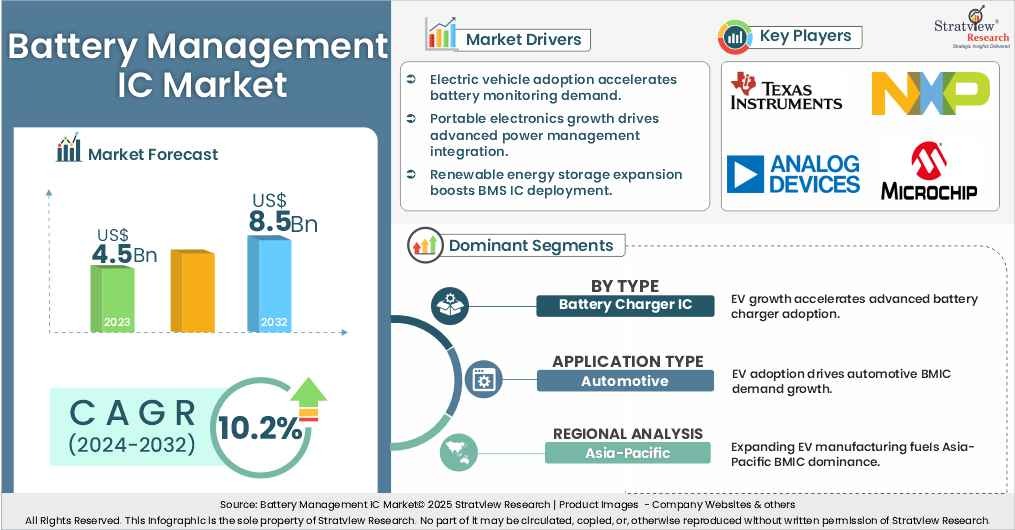
The battery management IC market was estimated at USD 4.5 billion in 2023 and is likely to grow at a CAGR of 10.2% during 2024-2032 to reach USD 8.5 billion in 2032.
Want to get a free sample? Register Here
Battery Management IC is a specialized integrated circuit designed to manage, monitor, and control the operations of rechargeable batteries, ensuring optimal performance, longevity, and safety. These ICs are critical for applications that require efficient power management, such as electric vehicles, consumer electronics (smartphones, laptops, etc.), industrial equipment, and renewable energy storage systems
These ICs are essential in maximizing battery life, ensuring safe operation, and enabling features such as fast charging and accurate power monitoring. The growing use of battery-powered devices and electric vehicles drives the demand for more advanced and efficient battery management ICs
As EV batteries become larger and more complex, automakers require advanced electronic controls that improve charging efficiency, extend operating life and provide dependable protection against unsafe electrical conditions across cells, modules and complete battery packs.
Rapid Growth in Electric Vehicle Production
Rapid growth in electric vehicle (EV) production is accelerating battery management IC market demand. Battery management ICs continuously monitor cell voltage, temperature, and state of charge to improve battery safety, efficiency, and lifespan. As automakers deploy larger battery packs and higher-voltage architectures, demand for highly integrated battery management ICs continues to increase across passenger vehicles, commercial EVs, and electric two-wheelers.
According to the International Energy Agency (IEA), nearly 14 million electric cars were sold globally in 2023, an increase of around 35% compared with 2022. Rising EV production is significantly increasing demand for battery management ICs used to monitor and protect high-capacity lithium-ion battery packs.
The IEA also reported that electric cars accounted for around 18% of global new car sales in 2023, up from 14% in 2022. The growing adoption of EVs is accelerating deployment of advanced battery management systems incorporating highly integrated monitoring ICs.
Expansion of Battery Energy Storage Systems
The rapid deployment of battery energy storage systems (BESS) is driving battery management IC market growth. Utilities, renewable energy developers, and industrial operators increasingly require intelligent battery monitoring solutions to improve battery safety, optimize charging cycles, and extend operational life, creating significant demand for advanced battery management ICs.
According to the International Energy Agency (IEA), global battery energy storage deployment more than doubled in 2023, with nearly 42 GW of new capacity installed worldwide. The rapid growth of stationary battery storage is increasing demand for battery management ICs capable of ensuring safe and efficient battery operation.
The International Renewable Energy Agency (IRENA) reported that global renewable power capacity expanded by 473 GW in 2023, the largest annual increase on record. Growing renewable energy deployment is accelerating investments in battery energy storage systems, supporting long-term demand for battery management ICs.
Increasing Design Complexity of Battery Management ICs
Battery management IC manufacturers face increasing design complexity as batteries become larger, operate at higher voltages, and support ultra-fast charging. Meeting stringent automotive functional safety requirements while minimizing power consumption, improving measurement accuracy, and supporting multiple battery chemistries significantly increases development costs and extends product qualification cycles.
Rapid Evolution of Battery Chemistries
Rapid evolution of battery chemistries, including LFP, sodium-ion, and high-nickel lithium-ion batteries, requires battery management IC vendors to continuously redesign algorithms and hardware architectures. Supporting multiple chemistries while maintaining accuracy, reliability, and compliance across global automotive standards increases engineering complexity and product development costs.
Development of Intelligent Battery Management Technologies
Integration of AI-enabled diagnostics, predictive maintenance, wireless battery management, and cybersecurity features is creating significant opportunities for the battery management IC market forecast. Advanced battery management ICs enable real-time battery monitoring, improve battery lifespan, reduce wiring complexity, and enhance safety across electric vehicles and stationary energy storage systems.
In 2024, the U.S. Department of Energy's National Renewable Energy Laboratory (NREL) continued advancing research on wireless battery management systems capable of reducing battery pack wiring while improving monitoring accuracy and battery safety. These innovations are creating opportunities for next-generation battery management ICs
Localization of Battery Manufacturing and Supply Chains
Government initiatives supporting domestic battery manufacturing are creating significant opportunities for the battery management IC market demand. Investments in regional gigafactories, localized battery supply chains, and semiconductor manufacturing are increasing demand for battery management ICs used in next-generation battery packs across North America, Europe, and Asia-Pacific.
According to the International Energy Agency (IEA), announced global battery manufacturing capacity reached nearly 8 TWh by the end of 2023, supported by rapid expansion of gigafactory projects across North America and Europe. This expansion is creating strong demand for battery management ICs integrated into locally manufactured battery systems.
In 2024, the U.S. Department of Energy announced USD 3.5 billion in funding under the Bipartisan Infrastructure Law to strengthen domestic battery manufacturing and battery materials processing. The continued localization of battery production is creating long-term opportunities for battery management IC suppliers.
|
Segmentations |
List of Sub-Segments |
Segments with High Growth Opportunity |
|
Type Analysis |
Fuel Gauge IC, Battery Charger IC, and Authentication IC |
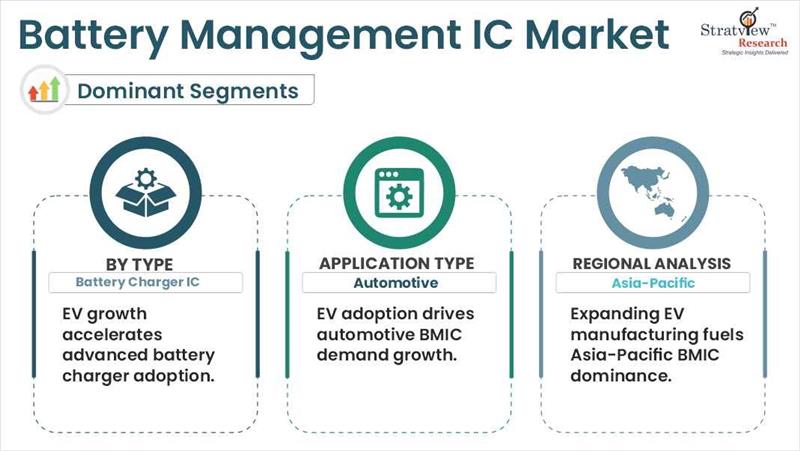
The battery charger IC is the largest and fastest-growing segment. Battery Charger ICs are essential components in rechargeable battery systems. They regulate the charging process by controlling voltage and current, ensuring the battery operates within safe limits and is charged efficiently and reliably. |
|
Application-Type Analysis |
Automotive, Consumer Electronics, Industrial, Communication, and Others |
The automotive is projected to experience substantial growth during the forecast period, primarily driven by the surge in electric vehicle adoption. Battery management ICs play a vital role in overseeing charging and other crucial functions. Additionally, advancements in product innovation, designed to meet the rising demand, have further accelerated the growth of the IC market. |
|
Regional Analysis |
North America, Europe, Asia-Pacific, and The Rest of the World |
The Asia-Pacific region is anticipated to experience the fastest growth rate. This region dominates the BMIC market, driven by the rapid expansion of the consumer electronics industry in countries like China, Japan, and South Korea. The region also leads in EV production, contributing to the high demand for battery management ICs. |
“The largest and most dominant segment, battery charger ICs are responsible for controlling the charging process of rechargeable batteries, ensuring they are charged within safe voltage and current limits. These ICs also offer additional protection features, such as overvoltage and overcurrent protection, ensuring battery safety and longevity.”
“The automotive segment is the most dominant, driven primarily by the rise in electric vehicles (EVs) and hybrid vehicles, where efficient battery management is crucial.”
“Asia-Pacific is the largest and fastest-growing market for Battery Management IC, driven by strong demand from the automotive industry.”
Want to get more details about the segmentations? Register Here
The market is fragmented with the presence of over 200 players across the region. Most of the major players compete in some of the governing factors including price, service offerings, regional presence, etc. The following are the key players in the battery management IC market. Some of the major players provide a complete range of Battery Management ICs.
Texas Instruments Incorporated
NXP Semiconductors
Analog Devices, Inc.
Microchip Technology Inc.
Maxim Integrated
Renesas Electronics Corporation
Rohm Co., Ltd.
Richtek Technology Corporation
Semiconductor Components Industries, LLC
Semtech Corporation
Note: The above list does not necessarily include all the top players of the market.
Are you the leading player in this market? We would love to include your name. Write to us at [email protected]
A decent number of strategic alliances including M&As, JVs, etc. have been performed over the past few years:
NXP Semiconductors and EEMBC collaboration - This partnership is focused on developing energy-efficient IC solutions for battery management systems, particularly for the EV and IoT sectors.
Renesas Electronics and Dialog Semiconductor - Renesas acquired Dialog Semiconductor, aiming to strengthen its portfolio in battery management and power management ICs for automotive and industrial markets.
Analog Devices and Maxim Integrated - Analog Devices acquired Maxim Integrated, combining their battery management system portfolios to focus on automotive and industrial solutions, particularly for electric vehicle applications.
In April 2022, Infineon Technologies launched new battery management ICs, enhancing monitoring and balancing capabilities in battery cells.
This report provides market intelligence most comprehensively. The report structure has been kept such that it offers maximum business value. It provides critical insights into market dynamics and will enable strategic decision-making for existing market players as well as those willing to enter the market. The following are the key features of the report:
This report studies the market, covering a period of 12 years of trend and forecast. The report provides detailed insights into the market dynamics to enable informed business decision-making and growth strategy formulation based on the opportunities present in the market.
The battery management IC market is segmented into the following categories.
By Type
By Application Type
By Region
This strategic assessment report, from Stratview Research, provides a comprehensive analysis that reflects today’s battery management IC market realities and future market possibilities for the forecast period of 2024 to 2032. After a continuous interest in our battery management IC market report from the industry stakeholders, we have tried to further accentuate our research scope to the battery management IC market to provide the most crystal-clear picture of the market. The report segments and analyses the market in the most detailed manner to provide a panoramic view of the market. The vital data/information provided in the report can play a crucial role for the market participants as well as investors in the identification of the low-hanging fruits available in the market as well as to formulate the growth strategies to expedite their growth process.
This report offers high-quality insights and is the outcome of a detailed research methodology comprising extensive secondary research, rigorous primary interviews with industry stakeholders, and validation and triangulation with Stratview Research’s internal database and statistical tools. More than 1000 authenticated secondary sources, such as company annual reports, fact books, press releases, journals, investor presentations, white papers, patents, and articles, have been leveraged to gather the data. We conducted more than 15 detailed primary interviews with the market players across the value chain in all four regions and industry experts to obtain both qualitative and quantitative insights.
With this detailed report, Stratview Research offers one of the following free customization options to our respectable clients:
Company Profiling
Competitive Benchmarking
Custom Research: Stratview Research offers custom research services across sectors. In case of any custom research requirement related to market assessment, competitive benchmarking, sourcing and procurement, target screening, and others, please send your inquiry to [email protected]
The report is delivered digitally through our online portal. Buyers receive login credentials from our team to access the report and may update their credentials at any time after the initial login.
Delivery timelines depend on the status of the report:
For the most accurate delivery timeline, please contact us to confirm the current status of the report.
Yes. You may request a complimentary preview of the report through a video conference with our team.
Yes. The scope of the report can be fully customized to align with your specific research objectives and information requirements.
Please contact us at [email protected], and our team will be happy to discuss your requirements and propose a tailored solution.
Yes. Selected sections of the report can be purchased separately based on your requirements. Please contact us at [email protected] to discuss your needs.
Yes, AI can help gather publicly available information, but its outputs are only as reliable as the data it accesses. Stratview Research reports are built using validated data, extensive primary interviews with industry stakeholders, and the expertise of our experienced research team.
Additionally, many critical insights, including market dynamics, competitive intelligence, and industry-specific trends, are not publicly available and therefore cannot be captured through AI alone.
Battery management ICs (BMICs) are integrated circuits designed to monitor and manage the charging and discharging processes of batteries, ensuring safety, reliability, and optimal performance. They regulate voltage, current, and temperature while also providing data for battery status, capacity estimation, and health monitoring.
The battery management IC market is likely to reach USD 8.5 billion in 2032.
The battery management IC market is likely to grow at a CAGR of 10.2% during 2024-2032.
Asia-Pacific holds the largest market share for battery management IC. The region is seeing significant investments in automotive battery technology and innovation, including the development and integration of advanced battery management ICs.
The Asia-Pacific region, particularly China and India, is witnessing rapid growth due to robust manufacturing capabilities, increasing demand for consumer electronics, and the proliferation of electric vehicles.
The leading companies in the Battery Management IC market include Texas Instruments Incorporated, NXP Semiconductors, Analog Devices, Inc., Microchip Technology Inc., Maxim Integrated, Renesas Electronics Corporation, Rohm Co., Ltd., Richtek Technology Corporation, Semiconductor Components Industries, LLC, and Semtech Corporation.
The fastest-growing application type in the market is the automotive segment, primarily due to the increasing adoption of electric vehicles and the need for sophisticated battery management solutions.
The key market drivers of the market include the rapid adoption of electric vehicles (EVs) and advancements in battery technologies. Rising demand for renewable energy storage systems. Growth in consumer electronics requiring efficient battery management.


WE ACCEPT