




404
+1-313-307-4176

AI in Supply Chain Management Market Analysis | 2026-2030
AI in Supply Chain Management Market Size, Share, Trend, Forecast, Competitive Analysis, and Growth Opportunity: 2026-2030
AI in supply chain management market, by Offering Type (Hardware, Software, and Services), Technology Type (Machine learning, Natural Language Processing (NLP), Context-Aware Computing, and Computer Vision), Application Type (Fleet Management, Supply Chain Planning, Warehouse Management, Virtual Assistant, Risk Management, Freight Brokerage, and Others), End-User Type (Automotive, Aerospace, Logistics, Manufacturing, Retail, Healthcare, Consumer-packaged Goods, Food & Beverages, and Others), and Region (North America [The USA, Canada, and Mexico], Europe [Germany, France, The UK, Russia, Italy, and Rest of Europe], Asia-Pacific [China, Japan, India, South Korea, and Rest of Asia-Pacific], and Rest of the World [Brazil, Argentina, and Others]).
“The AI in supply chain management market size was valued at US$ 6,045 million in 2025 and is likely to grow at a dynamic CAGR of 30% in the long run to reach US$ 22,705 million in 2030.”
AI in supply chain management refers to the use of artificial intelligence technologies to optimize, automate, and enhance various processes involved in managing a supply chain. Supply chains encompass all the steps and activities involved in producing and delivering a product or service, from sourcing raw materials and manufacturing to logistics, warehousing, inventory management, and customer delivery.
Want to explore the market opportunities? Get a free sample here.
Artificial intelligence in supply chain management is gaining rapid adoption as organizations seek to improve demand forecasting, inventory optimization, supply chain visibility, and operational efficiency through data-driven decision-making.
Growing adoption of big data and AI technologies, along with increasing demand for intelligent business process automation, is accelerating the AI in supply chain management market growth. However, challenges related to data integration, inconsistent data quality, and limited data availability continue to hinder widespread AI implementation across supply chain operations.
Increasing Adoption of Big Data and AI Across Supply Chain
The growing adoption of big data and AI technologies is accelerating the AI in supply chain management market growth by enabling organizations to analyse vast volumes of supply chain data in real time. AI-powered analytics improve demand forecasting, inventory optimization, logistics planning, and operational decision-making, helping businesses enhance efficiency and resilience across increasingly complex supply chains.
According to the OECD, AI adoption among firms increased from 14.2% in 2024 to 20.2% in 2025, more than doubling from 8.7% in 2023, reflecting the rapid implementation of AI technologies across business operations.
The OECD also reported that 57.3% of ICT firms were using AI in 2025, highlighting the growing adoption of AI and big data across data-intensive industries.
Increasing Need for Enhanced Supply Chain Visibility
The increasing need for end-to-end supply chain visibility is contributing to the AI in supply chain management market share by enabling organizations to monitor inventory, shipments, supplier performance, and disruptions in real time. AI-powered solutions improve operational transparency, enhance decision-making, and strengthen supply chain resilience across increasingly complex global networks.
According to the U.S. Census Bureau, U.S. e-commerce sales reached US$1.19 trillion in 2024, increasing supply chain complexity and reinforcing the need for AI-powered visibility and real-time inventory management.
According to the World Trade Organization (WTO), global merchandise trade volume is projected to grow by 2.7% in 2025, increasing cross-border supply chain activity and reinforcing the need for AI-enabled visibility across global logistics networks.
Complexity in Integrating Disparate Supply Chain Data Systems
The complexity of integrating data from multiple enterprise systems remains a key challenge affecting the AI in supply chain management market outlook. Supply chain data is often fragmented across ERP, warehouse management, transportation, and legacy systems, making seamless AI deployment difficult. Inconsistent data formats and poor interoperability can limit the accuracy of AI models and delay implementation.
According to the European Commission, over 80% of industrial data remains unused, largely due to fragmented data environments and interoperability challenges, limiting the effective adoption of AI and advanced analytics across enterprises (2025).
Inconsistent Data Quality and Limited Data Availability
Inconsistent data quality and limited data availability are hindering the AI in supply chain management market forecast. AI models rely on large volumes of accurate, standardized, and timely data to generate reliable insights. However, fragmented data sources, missing information, and inconsistent data formats can reduce model accuracy, delay implementation, and limit the effectiveness of AI-driven supply chain decision-making.
Growing Demand for Intelligent Business Process Automation
The growing demand for intelligent business process automation is creating new opportunities for AI in the supply chain management market. Organizations are increasingly adopting AI to automate routine supply chain functions, optimize workflows, and improve decision-making across procurement, inventory management, warehousing, and logistics, enabling greater operational efficiency and business agility.
According to the World Economic Forum's Future of Jobs Report 2025, 86% of employers expect AI and information processing technologies to transform their businesses by 2030, highlighting the accelerating demand for intelligent automation across enterprise operations.
Additionally, they found that 77% of employers plan to upskill and reskill their workforce by 2030 to work more effectively alongside AI, reflecting growing investments in AI-enabled business process transformation and automation
Increasing Focus on AI-Driven Operational Efficiency
Improving operational efficiency through AI is emerging as a key trend in the AI in supply chain management market. AI enables organizations to streamline supply chain operations by optimizing inventory levels, enhancing demand planning, reducing manual intervention, and improving logistics performance, resulting in lower operating costs and greater supply chain agility.
According to the European Commission's AI Continent Action Plan (2025), the EU plans to mobilize €200 billion in public and private investments for artificial intelligence, including €20 billion for AI gigafactories, to accelerate AI deployment and improve productivity and operational efficiency across industries.
Get insights on high-growth segments. Get a free sample here.
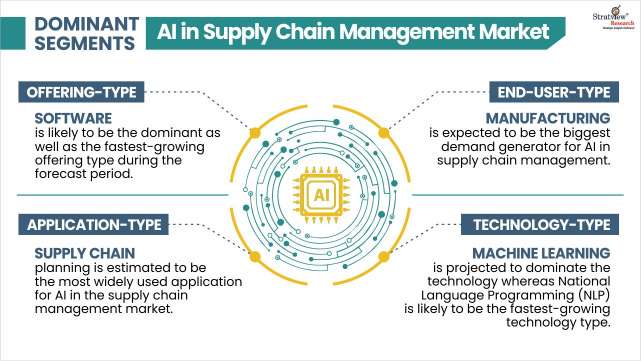
“Software is expected to maintain its indisputable lead and is likely to grow at the fastest rate for the AI in supply chain management market during the forecast period.”
The AI in the supply chain management market is segmented into hardware, software, and services.
Software solutions can be customized to various supply chain functions, including demand forecasting, inventory management, transportation optimization, and quality control.
The software can easily scale up or down to meet changing business needs, making it a flexible and cost-effective solution.
AI software offers powerful analytics and insights critical for optimizing supply chain operations. Predictive analytics, real-time monitoring, and machine learning algorithms aid organizations in making data-driven decisions, improving forecasting, and enhancing operational efficiency.
“Machine learning's adaptability, maturity, and data-driven approach establish it as the leading technology of the market.”
The market is segmented into machine learning (ML), natural language processing (NLP), context-aware computing, and computer vision.
ML is inherently data-driven, making it well-suited for supply chain applications, which depend on large amounts of data to make informed decisions, proving its dominance in the market share forecast.
ML can be scaled to handle large datasets and complex models, ensuring that it can meet the needs of even the largest businesses.
NLP's ability to automate, analyze, and enhance textual data processing is driving its rapid growth in the AI supply chain management market. NLP-powered chatbots provide automated customer support by answering questions and resolving issues.
“Supply chain planning is expected to remain the forerunner of the market throughout the forecast period.”
The market is segmented into fleet management, supply chain planning, warehouse management, virtual assistant, risk management, freight brokerage, and others.
Supply chain planning deals with the major challenges of supply chain management, including demand variability, complexity, cost efficiency, risk management, and customer expectations.
AI algorithms can analyze data to predict future demand, helping businesses optimize inventory and production planning.
Supply chain planning is projected to experience rapid growth due to increasing complexity in global trade and the necessity for efficient, resilient supply chains to fulfill evolving customer demands and mitigate risks.
“Manufacturing is projected to remain the dominant, whereas retail is expected to be the fastest-growing end-user of the market during the forecast period.”
The market is segmented into automotive, aerospace, logistics, manufacturing, retail, healthcare, consumer-packaged goods, food & beverages, and others.
The manufacturing industry is at the forefront of accepting Industry 4.0 initiatives, which highlight the use of AI, IoT, and automation to develop smart factories. These technologies improve productivity, flexibility, and efficiency, leading to increased AI adoption in supply chain management.
Manufacturing creates large amounts of data, which AI can use to spot trends, optimize processes, and improve decision-making.
The retail industry is expected to register the fastest growth in the upcoming years due to factors such as the rapid expansion of e-commerce, evolving consumer preferences, the necessity for real-time inventory management, and the digital transformation of the retail industry.
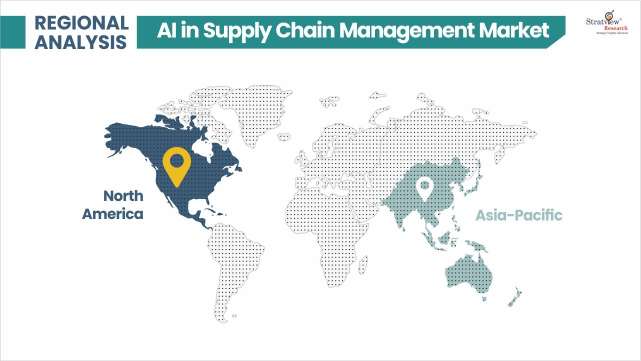
“North America is expected to remain the largest market for AI in supply chain management, whereas Asia-Pacific is projected to witness the fastest growth during the forecast period.”
The region's significant share can be attributed to the presence of developed economies that prioritize enhancing existing supply chain solutions.
Additionally, key players in the industry, such as Microsoft Corporation, Inc., Oracle Corporation, Amazon.com, Inc., and IBM Corporation, contributed to this share.
Asia-Pacific’s rapid economic growth, e-commerce expansion, large consumer market, increased adoption of advanced technologies, complex supply chains, and the need for cost optimization, resilience, and sustainability are the key reasons behind the region’s fastest growth.
Increasing adoption of deep learning and Natural Language Processing (NLP) technologies for applications in automotive, retail, and manufacturing industries in the Asia-Pacific region.
Speak to us for a deep dive into a country/region specific opportunity. Contact us here.
The market is consolidated with the presence of a few players. Most of the major players compete in some of the governing factors, including price, product & service offerings, regional presence, etc. The following are the key players in the AI in Supply Chain Management Market.
Here is the list of the Top Players (Based on Dominance)
Microsoft Corporation, Inc.
Oracle Corporation
SAP SE
IBM Corporation
Amazon.com Inc.
Google LLC
Note: The above list does not necessarily include all the top players in the market.
Are you the leading player in this market? We would love to include your name. Write to us at [email protected]
Have the competitive edge with our intelligence. Get a free sample here.
Recent mergers & acquisitions and other developments in the AI in supply chain management market reflect evolving market trends and impact the market. Below are a few recent developments in the market –
In April 2026, project44 acquired LunaPath.ai to strengthen its AI agent orchestration capabilities across global supply chains by integrating AI-native logistics automation with its real-time supply chain decision intelligence platform.
In January 2026, Aptean acquired OpsVeda to enhance its Logility supply chain planning platform with AI-driven command center capabilities and end-to-end agentic supply chain orchestration.
In January 2026, Algo acquired Demand Driven Technologies (Intuiflow) to develop a unified AI-powered demand-to-supply planning platform for manufacturers, suppliers, and retailers.
In November 2025, Blue Yonder developed new AI agents within its Cognitive Solutions portfolio to automate inventory management, demand planning, and supply chain execution using generative AI capabilities.
Artificial intelligence (AI) in supply chain management refers to the use of AI technologies such as machine learning, predictive analytics, and natural language processing to optimize and automate supply chain operations. It processes large volumes of real-time and historical data to improve demand forecasting, inventory management, logistics planning, and supplier coordination. By enabling faster and more accurate decision-making, AI enhances efficiency, visibility, and resilience across supply chain networks in industries such as manufacturing, retail, logistics, and e-commerce.
This report provides market intelligence most comprehensively. The report structure has been kept so that it offers maximum business value. It provides critical insights into market dynamics and will enable strategic decision-making for existing market players as well as those willing to enter the market.
The following are the key features of the report:
Market structure: Overview, industry life cycle analysis, supply chain analysis.
Market environment analysis: Growth drivers and constraints, Porter’s five forces analysis, SWOT analysis.
Market trend and forecast analysis.
Market segment trend and forecast.
Competitive landscape and dynamics: Market share, Service portfolio, New Product Launches, etc.
Attractive market segments and associated growth opportunities.
Emerging trends.
Strategic growth opportunities for the existing and new players.
Key success factors.
|
Market Study Period |
2019-2030 |
|
Base Year |
2025 |
|
Forecast Period |
2026-2030 |
|
Trend Period |
2019-2025 |
|
Number of Tables & Figures |
>100 |
|
Number of Segments Analysed |
5 (Offering Type, Technology Type, Application Type, End-User Type and Region) |
|
Number of Regions Analysed |
4 (North America, Europe, Asia-Pacific, Rest of the World) |
|
Countries Analysed |
15 (The USA, Canada, Mexico, Germany, France, Italy, The UK, China, Japan, India, Brazil, Saudi Arabia, Rest of Europe, Rest of APAC, and Rest of the World) |
|
Free Customization Offered |
10% |
|
After Sales Support |
Unlimited |
|
Report Presentation |
Complimentary |
|
Market Dataset |
Complimentary |
|
Further Deep Dive & Consulting Services |
10% Discount |
Want a Report Tailor-Made to Your Objectives? Speak with Our Analyst at [email protected]
The report provides detailed insights into the market dynamics to enable informed business decision-making and growth strategy formulation based on the opportunities present in the market.
AI in Supply Chain Management Market, By Offering Type
Hardware
Software
Services
AI in Supply Chain Management Market, By Technology Type
Machine Learning
Natural Language Processing (NLP)
Context-Aware Computing
Computer Vision
AI in Supply Chain Management Market, By Application Type
Fleet Management
Supply Chain Planning
Warehouse Management
Virtual Assistant
Risk Management
Freight Brokerage
Others
AI in Supply Chain Management Market, By End-User Type
Automotive
Aerospace
Logistics
Manufacturing
Retail
Healthcare
Virtual Assistant
Risk Management
Freight Brokerage
Others
AI in Supply Chain Management Market, By Region
North America (Country Analysis: The USA, Canada, and Mexico)
Europe (Country Analysis: Germany, France, The UK, Russia, and the Rest of Europe)
Asia-Pacific (Country Analysis: Japan, China, India, and Rest of Asia-Pacific)
Rest of the World (Country Analysis: Brazil and Others)
This strategic assessment report from Stratview Research provides a comprehensive analysis that reflects today’s AI in supply chain management market realities and future market possibilities for the forecast period.
The report segments and analyzes the market in the most detailed manner to provide a panoramic view of the market.
The vital data/information provided in the report can play a crucial role for market participants as well as investors in the identification of the low-hanging fruits available in the market as well as to formulate growth strategies to expedite their growth process.
This report offers high-quality insights and is the outcome of a detailed research methodology comprising extensive secondary research, rigorous primary interviews with industry stakeholders, and validation and triangulation with Stratview Research’s internal database and statistical tools.
More than 1,000 authenticated secondary sources, such as company annual reports, fact books, press releases, journals, investor presentations, white papers, patents, and articles, have been leveraged to gather the data.
We conducted more than 15 detailed primary interviews with market players across the value chain in all four regions and with industry experts to obtain both qualitative and quantitative insights.
With this detailed report, Stratview Research offers one of the following free customization options to our respectable clients:
Company Profiling
Detailed profiling of additional market players (up to three players)
SWOT analysis of key players (up to three players)
Competitive Benchmarking
Benchmarking of key players on the following parameters: Product portfolio, geographical reach, regional presence, and strategic alliances
Custom Research: Stratview Research offers custom research services across sectors. In case of any custom research requirement related to market assessment, competitive benchmarking, sourcing and procurement, target screening, and others, please send your inquiry to [email protected]
The report is delivered digitally through our online portal. Buyers receive login credentials from our team to access the report and may update their credentials at any time after the initial login.
Delivery timelines depend on the status of the report:
For the most accurate delivery timeline, please contact us to confirm the current status of the report.
Yes. You may request a complimentary preview of the report through a video conference with our team.
Yes. The scope of the report can be fully customized to align with your specific research objectives and information requirements.
Please contact us at [email protected], and our team will be happy to discuss your requirements and propose a tailored solution.
Yes. Selected sections of the report can be purchased separately based on your requirements. Please contact us at [email protected] to discuss your needs.
Yes, AI can help gather publicly available information, but its outputs are only as reliable as the data it accesses. Stratview Research reports are built using validated data, extensive primary interviews with industry stakeholders, and the expertise of our experienced research team.
Additionally, many critical insights, including market dynamics, competitive intelligence, and industry-specific trends, are not publicly available and therefore cannot be captured through AI alone.
The forecasted value of the AI in the supply chain management market is US$ 22,705 million in 2030.
The AI in supply chain management market is estimated to grow at a CAGR of 30% by 2030, driven by the increasing volume of big data, the demand for greater visibility and transparency into the supply chain, and AI's ability to analyze data, automate processes, and provide actionable insights.
North America held the largest share of AI in the supply chain management market in 2023. The USA acts as the growth driver for AI in supply chain management fuelled by the presence of major players coupled with the strong technological ecosystem, complex supply chain networks, and high adoption of advanced technologies.
Asia-Pacific is estimated to be the fastest-growing market for AI in supply chain management in the foreseeable future due to China’s and India’s ongoing developments, rapid digitalization, Industry 4.0, and increased adoption of advanced technologies across industries.
The manufacturing industry is estimated to be the pioneer in the market due to its pivotal role in driving economic growth, technological innovation, and supply chain integration while adapting to emerging trends like Industry 4.0.
Microsoft Corporation, Inc., Oracle Corporation, SAP SE, IBM Corporation, Amazon.com Inc., and Google LLC are the leading players for the AI in supply chain management market.


WE ACCEPT