




404
+1-313-307-4176

Aerospace and Defense Telemetry Market Analysis | 2026-2032

Aerospace and Defense Telemetry Market Size, Share, Trends, Dynamics, Forecast, & Growth Analysis: 2026-2032
Aerospace and Defense Telemetry Market is segmented by Platform Type (Airborne, Ground, Marine, Space, UAVs, and Weapons), by Technology Type (Wireless and Wired Telemetry), by Component Type (Antenna, Processors, Receiver, and Transmitter), and by Region (North America [The USA, Canada, and Mexico], Europe [Germany, France, The U.K., Russia, and Rest of Europe], Asia-Pacific [China, Japan, India, South Korea, and Rest of Asia-Pacific], and Rest of the World [Brazil, Saudi Arabia, Israel, and Others]).
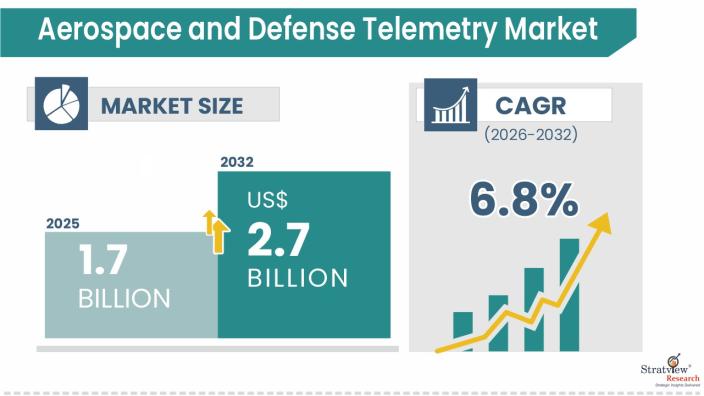
The aerospace and defense telemetry market was estimated at USD 1.7 billion in 2025 and is likely to grow at a CAGR of 6.8% during 2026-2032 to reach USD 2.7 billion in 2032.
Want to know more about the market scope? Register Here
Telemetry is an automated measurement and wireless transmission of data from remote sources, which is then transmitted to the receiving points to be analyzed and monitored. This important information is transmitted through various paths such as audio, ultrasonic, infrared, satellite, and GSM, which depends on its application area. Therefore, the growing demand for data admittance from remote locations upholds the federal database of the organizations, which in turn helps organizations to save time as well as make better decisions. Aerospace & defense telemetry intends to transfer data on a real-time basis. The aeronautical telemetry (ATM) spectrum is vital for aerospace flight testing for both military and commercial applications, for instance, flight testing, rocketry, and space exploration to facilitate real-time monitoring of flight ecological circumstances. The WRC bands allowed the implementation of a full-band telemetry link up into flight test operations, which eventually influenced the growth in the aerospace & defense telemetry market.
|
Segmentations |
List of Sub-Segments |
Segments with High Growth Opportunity |
|
Technology Type Analysis |
Wireless and Wired Telemetry |
The wireless technology market is predicted to expand more quickly. |
|
Platform Type Analysis |
Airborne, Ground, Marine, Space, UAVs, and Weapons |
Ground-based holds the largest market share in the platform segment in 2025. |
|
Regional Analysis |
North America, Europe, Asia-Pacific, and Rest of the World |
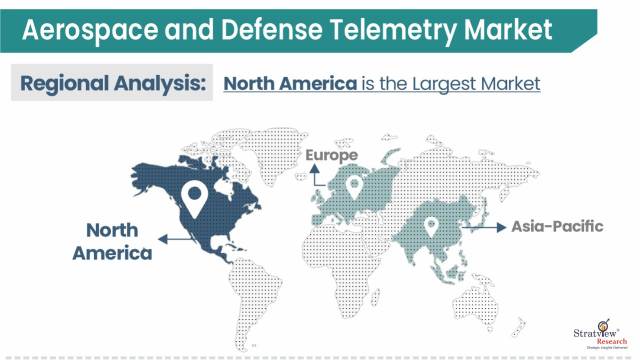
North America is likely to maintain its supremacy in the aerospace & defense telemetry market throughout the forecast period. |
Wired and wireless networks are the two types of technology. Due to its platform independence and cost-effectiveness, the wireless technology market is predicted to expand more quickly. Hardware and software are both included in the architecture sector. The software market is anticipated to grow more quickly due to the increasing need for middleware software in telemetry systems. The demand for wireless technology is also backed by the advantages such as ease of maintenance and operation of such technology. The high demand for wireless technology for space shuttles and UAVs also contributes to a significant growth opportunity for wireless technology in aerospace and defense telemetry.
Airborne, Ground, Marine, Space, UAVs, and Weapons comprise the platform category. Ground-based holds the largest market share in the platform segment in 2025. The high share is mainly attributed to the widespread use of ground-based solutions in emerging nations like China and India; the land-based category is anticipated to expand at the highest rate. Furthermore, the UAVs segment is expected to register the highest growth rate during the forecast period. The high growth in the UAVs segment is mainly due to the high demand for UAVs across commercial and military applications. With the high need for border surveillance, the demand for UAVs is increasing exponentially, which is attributed to the demand for telemetry solutions for UAVs.
In terms of regions, North America is likely to maintain its supremacy in the aerospace & defense telemetry market throughout the forecast period. Rapid modernization and technological advancements in various sectors have resulted in a high aerospace & defense telemetry rate. Strict government regulations in North America and Western Europe are anticipated to encourage manufacturers to develop better aerospace and defense telemetry solutions, which is expected to result in the dominance of North America in the market during the forecast duration.
Concurrently, the aerospace & defense telemetry market in the Asia Pacific is anticipated to expand at the highest CAGR during the forecast period. The major economies in this region emphasize modernizing their existing military systems, driving the growth of the Asia Pacific aerospace & defense telemetry market. Additionally, The information age's increased need for technologically superior defense equipment and the rise of networked UAVs utilized by emerging nations for border surveillance are two factors propelling the expansion of this market. On the other hand, recent adjustments in military budgets of emerging countries for cutting-edge marine, land, and air defense systems are anticipated to benefit the regional market.
Know the high-growth countries in this report. Register Here
Market players have impacted the overall competitive landscape because of new product development and investment. The following are the major players in the market:
Note: The above list does not necessarily include all the top players in the market.
Are you the leading player in this market? We would love to include your name. Write to us at [email protected]
This strategic assessment report, from Stratview Research, provides a comprehensive analysis that reflects today’s aerospace & defense telemetry market realities and future market possibilities for the forecast period of 2026 to 2032. After a continuous interest in our aerospace & defense telemetry market report from the industry stakeholders, we have tried to further accentuate our research scope to the aerospace & defense telemetry market to provide the most crystal-clear picture of the market. The report segments and analyses the market in the most detailed manner to provide a panoramic view of the market. The vital data/information provided in the report can play a crucial role for the market participants as well as investors in the identification of the low-hanging fruits available in the market as well as to formulate the growth strategies to expedite their growth process.
This report offers high-quality insights and is the outcome of a detailed research methodology comprising extensive secondary research, rigorous primary interviews with industry stakeholders, and validation and triangulation with Stratview Research’s internal database and statistical tools. More than 1000 authenticated secondary sources, such as company annual reports, fact books, press releases, journals, investor presentations, white papers, patents, and articles, have been leveraged to gather the data. We conducted more than 15 detailed primary interviews with the market players across the value chain in all four regions and industry experts to obtain both qualitative and quantitative insights.
This report provides market intelligence in the most comprehensive way. The report structure has been kept such that it offers maximum business value. It provides critical insights into market dynamics and will enable strategic decision-making for existing market players as well as those willing to enter the market. The following are the key features of the report:
This report studies the market, covering a period of 12 years of trends and forecasts. The report provides detailed insights into the market dynamics to enable informed business decision-making and growth strategy formulation based on the opportunities present in the market.
The aerospace & defense telemetry market is segmented into the following categories:
By Platform Type
By Technology Type
By Component Type
By Region
With this detailed report, Stratview Research offers one of the following free customization options to our respectable clients:
Company Profiling
Competitive Benchmarking
Custom Research: Stratview Research offers custom research services across sectors. In case of any custom research requirement related to market assessment, competitive benchmarking, sourcing and procurement, target screening, and others, please send your inquiry to [email protected].
The report is delivered digitally through our online portal. Buyers receive login credentials from our team to access the report and may update their credentials at any time after the initial login.
Delivery timelines depend on the status of the report:
For the most accurate delivery timeline, please contact us to confirm the current status of the report.
Yes. You may request a complimentary preview of the report through a video conference with our team.
Yes. The scope of the report can be fully customized to align with your specific research objectives and information requirements.
Please contact us at [email protected], and our team will be happy to discuss your requirements and propose a tailored solution.
Yes. Selected sections of the report can be purchased separately based on your requirements. Please contact us at [email protected] to discuss your needs.
Yes, AI can help gather publicly available information, but its outputs are only as reliable as the data it accesses. Stratview Research reports are built using validated data, extensive primary interviews with industry stakeholders, and the expertise of our experienced research team.
Additionally, many critical insights, including market dynamics, competitive intelligence, and industry-specific trends, are not publicly available and therefore cannot be captured through AI alone.
The aerospace and defense telemetry market is likely to grow at a CAGR of 6.8% during 2026-2032.
The aerospace and defense telemetry market was estimated at USD 1.7 billion in 2025.
The forecasted value of the aerospace and defense telemetry market is expected to be USD 2.7 billion in 2032.
The major players in the market are BAE Systems PLC (U.S.), General Dynamics Corporation (U.S.), Honeywell International Inc (U.S.), L3harris Technologies (U.S.), Lockheed Martin (U.S.), Maxar Technologies (U.S.).
North America is likely to maintain its supremacy in the market throughout the forecast period.
The aerospace & defense telemetry market in the Asia Pacific is anticipated to expand at the highest CAGR during the forecast period.
The UAVs segment is expected to register the highest growth rate during the forecast period.
Ground-based has the largest market share in the platform segment in 2025.


WE ACCEPT