




404
+1-313-307-4176

Data Center Power Market | 2026-2032

Data Center Power Market Size, Share, Trend, Forecast, Competitive Landscape & Growth Opportunities: 2026-2032
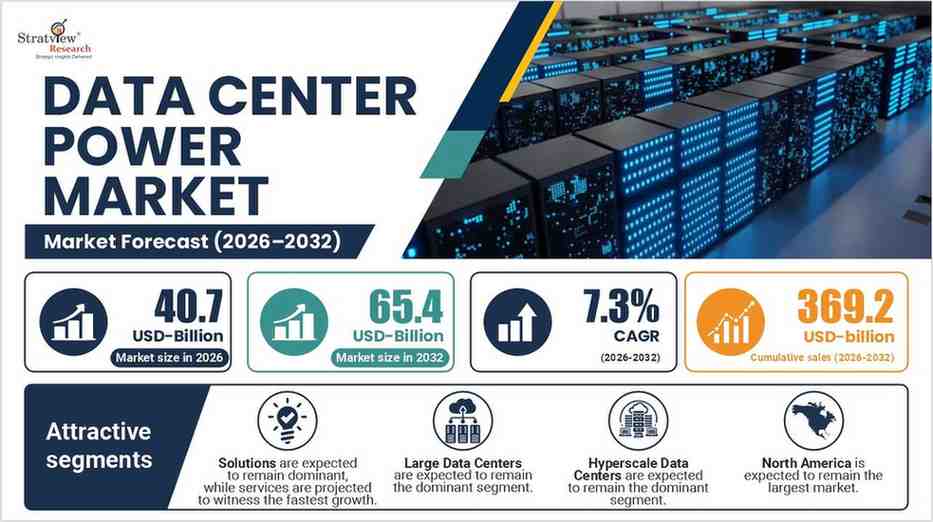
“The data center power market size will reach USD 40.7 billion in 2026 and offers robust growth opportunities for the market stakeholders. With the market expected to grow at a CAGR of 7.3%, the annual sales will hit USD 65.4 billion mark in 2032, highlighting the accelerating investments in AI-ready, hyperscale, and energy-efficient data center power infrastructure.”
The annual demand for data center power was USD 37.1 billion in 2025 and is expected to reach USD 40.7 billion in 2026, up 9.8% than the value in 2025.
During the forecast period (2026-2032), the market is expected to grow at a CAGR of 7.3%. The annual demand will reach USD 65.4 billion in 2032, which is almost 1.8 times the demand in 2025.
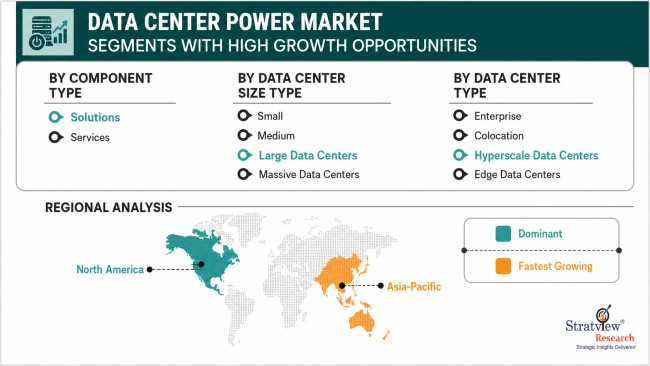
North America is expected to remain the largest market, while Asia-Pacific is projected to be the fastest-growing region during the forecast period.
By component, solutions are expected to remain dominant, while services are projected to witness the fastest growth.
By data center size, large data centers are expected to remain dominant, while massive data centers are projected to witness the fastest growth.
By data center type, hyperscale data centers are expected to remain both the largest and the fastest-growing segment.
By enterprise vertical, healthcare is expected to remain dominant, while IT is projected to witness the fastest growth.
“According to the Senior Analyst at Stratview Research, the global data center power market is expected to generate a cumulative opportunity of around USD 369.2 billion during 2026–2032. This growth is driven by rising hyperscale and AI data center investments and growing demand for reliable, energy-efficient power infrastructure. Key high-opportunity areas include North America, AI-driven deployments, and advanced power system segments.”
Sharpen Your Strategies to Explore this USD 360+ billion Opportunity. Get Free Sample of Our Report: “Here”.
|
Market Statistics |
Value (in USD Billion) |
Market Growth (%) |
|
|
Market Size in 2025 |
USD 37.1 billion |
- |
|
|
Market Size in 2026 |
USD 40.7 billion |
YoY Growth in 2025: 9.8% |
|
|
Market Size in 2032 |
USD 65.4 billion |
CAGR 2026-2032: 7.3% |
|
|
Cumulative Sales Opportunity during 2026-2032 |
USD 369.2 billion |
- |
|
|
Top 10 Countries’ Market Share in 2025 |
USD 30 billion + |
> 80% |
|
|
Top 10 Company’s Market Share in 2025 |
USD 18.6 billion to USD 26 billion |
50% - 70% |
|
Want to Explore the Market Opportunities? Get Free Sample “Here”.
The data center power market is witnessing strong growth due to the rapid expansion of hyperscale, colocation, and AI-driven data centers worldwide. Increasing demand for uninterrupted, reliable, and energy-efficient power infrastructure is driving the adoption of advanced power systems, including UPS, generators, switchgear, PDUs, and intelligent power management solutions.
“Solutions are expected to remain the dominant component, whereas services are expected to witness the fastest growth during the forecast period.”
The data center power market is segmented into solutions and services.
Solutions are expected to remain the dominant segment throughout the forecast period owing to their critical role in ensuring uninterrupted, efficient, and reliable power delivery across data center operations. Increasing investments in hyperscale and colocation data centers, coupled with rising rack power densities driven by AI and high-performance computing (HPC) workloads, are accelerating the deployment of UPS systems, power distribution units (PDUs), generators, switchgear, and intelligent power monitoring solutions.
Meanwhile, services are expected to witness the fastest growth, supported by the increasing complexity of power infrastructure and the growing demand for consulting, integration, predictive maintenance, and lifecycle management services. The adoption of AI-enabled infrastructure monitoring and remote asset management is further driving demand for specialized service offerings.
“Large Data Centers are expected to remain the dominant segment, whereas Massive Data Centers are expected to witness the fastest growth during the forecast period.”
The data center power market is segmented into small, medium, large, and massive data centers.
Large data centers are expected to remain the dominant segment owing to their widespread adoption by enterprises, cloud providers, and colocation operators requiring highly reliable and scalable power infrastructure. Meanwhile, massive data centers are expected to witness the fastest growth, driven by increasing investments in AI factories, hyperscale campuses, and high-density computing infrastructure that demand significantly higher power capacities.
Get Insights on High-Growth Segments. Get Free Sample “Here”.
“Hyperscale Data Centers are expected to remain the dominant segment, whereas Edge Data Centers are expected to witness the fastest growth during the forecast period.”
The market is segmented into enterprise, colocation, hyperscale, and edge data centers.
Hyperscale data centers are expected to remain the dominant segment due to continuous investments by cloud service providers to support AI, cloud computing, and high-performance computing workloads. Meanwhile, edge data centers are expected to witness the fastest growth, supported by expanding 5G networks, IoT adoption, and increasing demand for low-latency data processing closer to end users.
“Heathcare is expected to remain the dominant enterprise vertical, whereas IT & Telecom is expected to witness the fastest growth during the forecast period.”
The market is segmented into BFSI, IT & telecom, government, healthcare, retail, manufacturing, energy & utilities, and others.
Healthcare is expected to remain the dominant segment owing to the increasing adoption of electronic health records (EHRs), AI-enabled diagnostics, medical imaging, telemedicine, and other data-intensive healthcare applications that require highly reliable, secure, and uninterrupted data center power infrastructure. Meanwhile, IT & telecom is expected to witness the fastest growth, driven by rapid 5G deployment, expanding cloud services, increasing AI adoption, and rising investments in hyperscale and edge data center infrastructure.
“North America is expected to remain the largest market, whereas Asia-Pacific is expected to witness the fastest growth during the forecast period.”
North America is expected to remain the largest market for data center power throughout the forecast period, driven by the strong presence of hyperscale cloud providers, leading colocation operators, and major technology companies. Continuous investments in AI infrastructure, high-performance computing, and large-scale data center expansion across the United States and Canada continue to generate substantial demand for advanced power infrastructure.
The region also benefits from early adoption of next-generation power technologies, stringent reliability requirements, and ongoing investments in energy-efficient and sustainable data center operations.
Meanwhile, Asia-Pacific is expected to register the fastest growth during the forecast period, supported by rapid digital transformation, increasing cloud adoption, expanding 5G networks, and rising investments in hyperscale and colocation data centers across China, India, Japan, Southeast Asia, and Australia. Government initiatives supporting digital infrastructure and growing demand for AI and cloud services are expected to further accelerate regional market growth.
“Analysis suggests that the Top 10 countries generate >80% of the annual sales for the data center power. A few countries are the demand powerhouses and will drive the regional markets in big ways offering attractive business opportunities.”
The market is fragmented with the presence of less than 100 global and regional players. Some of the major players also manufacture data center power parts. Leading players hold excellent market positions with a vast product portfolio, a wide distribution network, and years of track record.
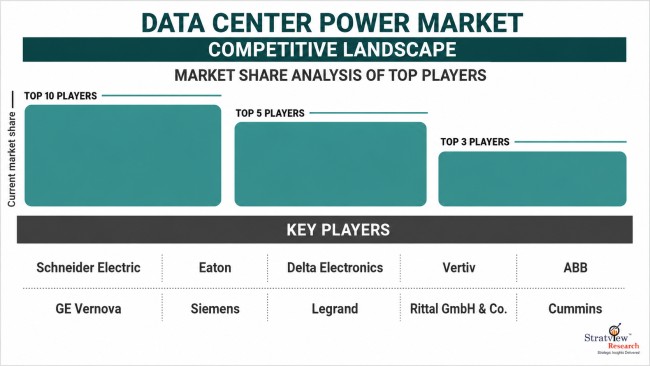
The following are the key players in the data center power market.
Schneider Electric
Eaton
Delta Electronics
Vertiv
ABB
GE Vernova
Siemens
Legrand
Rittal GmbH & Co.
Cummins
Note: The above list is not an exhaustive list of the key players in the market. If your company is active in this market and would like to be considered for inclusion in future editions of this study, please contact us at [email protected].
Have the Competitive Edge with Our Intelligence. Get Free Sample “Here”
Recent mergers & acquisitions and other developments in the data center power market reflect evolving market trends, and impact the market. Below given are a few recent developments in the market –
In June 2026, DigitalBridge acquired ArcLight Capital's power development platform for approximately USD 1.1 billion. The acquisition strengthens DigitalBridge's ability to integrate power generation with data center infrastructure and support the growing electricity requirements of AI-driven data centers.
In May 2026, NextEra Energy announced a proposed USD 66.8 billion merger with Dominion Energy to expand electricity generation, transmission, and grid infrastructure. The combined entity aims to address the rising power demand from hyperscale and AI data centers.
In March 2026, Global Infrastructure Partners (GIP) and EQT agreed to acquire AES Corporation for approximately USD 33.4 billion. The acquisition is expected to enhance investments in power infrastructure and renewable energy assets supporting large-scale data center developments.
In November 2025, Eaton signed an agreement to acquire Boyd Corporation's thermal business for USD 9.5 billion. The acquisition expands Eaton's liquid cooling and thermal management portfolio, strengthening its capabilities to serve AI and high-density data centers.
In November 2025, Vertiv acquired PurgeRite Intermediate for approximately USD 1 billion to strengthen its liquid cooling solutions portfolio. The acquisition enhances Vertiv's ability to address the growing cooling requirements of AI-enabled and hyperscale data centers.
Data center power refers to the electrical systems and infrastructure used to supply, distribute, and manage power within a data center to ensure uninterrupted operation of IT and networking equipment. It includes critical components such as UPS systems, generators, power distribution units (PDUs), switchgear, batteries, and related power management systems that support reliable and continuous power delivery.
This report provides market intelligence most comprehensively. The report structure has been kept so that it offers maximum business value. It provides critical insights into market dynamics and will enable strategic decision-making for existing market players as well as those willing to enter the market.
The following are the key features of the report:
|
Market Study Period |
2019-2032 |
|
Base Year |
2025 |
|
Forecast Period |
2026-2032 |
|
Trend Period |
2019-2024 |
|
Number of Tables & Figures |
>100 |
|
Number of Segments Analysed |
5 (Component Type, Data center size, Data Center Type, Enterprise Vertical Type and Region) |
|
Number of Regions Analysed |
4 (North America, Europe, Asia-Pacific, Rest of the World) |
|
Countries Analysed |
15 (The USA, Canada, Mexico, Germany, France, Italy, The UK, China, Japan, India, Brazil, Saudi Arabia, Rest of Europe, Rest of APAC, and Rest of the World) |
|
Free Customization Offered |
10% |
|
After Sales Support |
Unlimited |
|
Report Presentation |
Complimentary |
|
Market Dataset |
Complimentary |
|
Further Deep Dive & Consulting Services |
10% Discount |
Want a Report Tailor-Made to Your Objectives? Speak with Our Analyst at [email protected]
The report provides detailed insights into the market dynamics to enable informed business decision-making and growth strategy formulation based on the opportunities present in the market.
The data center power is segmented into the following categories:
By Component Type
Solutions
Services
By Data Center Size Type
Small Data Centers
Medium Data Centers
Large Data Centers
Massive Data Centers
By Data Center Type
Edge Data Centers
Enterprise Data Centers
By Enterprise Vertical
BSFI
IT & Telecom
Government
Healthcare
Retail
Manufacturing
Energy & Utilities
Others
By Region
North America (Country Analysis: The USA, Canada, and Mexico)
Europe (Country Analysis: Germany, France, The UK, Russia, and the Rest of Europe)
Asia-Pacific (Country Analysis: Japan, China, India, and Rest of Asia-Pacific)
Rest of the World (Country Analysis: Brazil and Others)
Looking for a Deep Dive? Speak with Our Analyst at [email protected]
The report is delivered digitally through our online portal. Buyers receive login credentials from our team to access the report and may update their credentials at any time after the initial login.
Delivery timelines depend on the status of the report:
For the most accurate delivery timeline, please contact us to confirm the current status of the report.
Yes. You may request a complimentary preview of the report through a video conference with our team.
Yes. The scope of the report can be fully customized to align with your specific research objectives and information requirements.
Please contact us at [email protected], and our team will be happy to discuss your requirements and propose a tailored solution.
Yes. Selected sections of the report can be purchased separately based on your requirements. Please contact us at [email protected] to discuss your needs.
Yes, AI can help gather publicly available information, but its outputs are only as reliable as the data it accesses. Stratview Research reports are built using validated data, extensive primary interviews with industry stakeholders, and the expertise of our experienced research team.
Additionally, many critical insights, including market dynamics, competitive intelligence, and industry-specific trends, are not publicly available and therefore cannot be captured through AI alone.
The data center power market size was USD 37.1 billion in 2025. The market is expected to grow from USD 40.7 billion in 2026 to USD 65.4 billion in 2032, witnessing an impressive market growth (CAGR) of 7.3% during the forecast period (2026-2032).
The forecasted value for the market is US$ 65.4 billion in 2032.
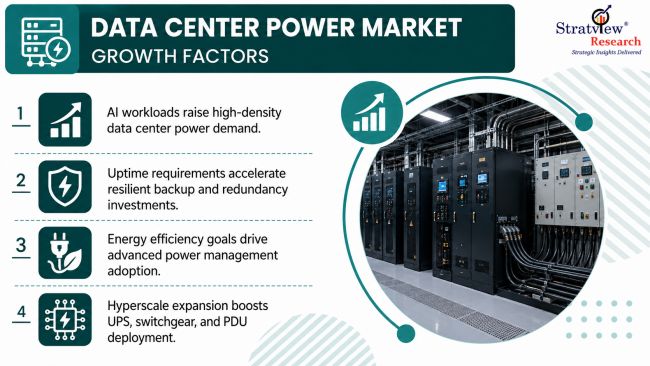
The key drivers of the data center power market include the rapid expansion of hyperscale data centers, increasing AI and cloud computing workloads, and growing investments in reliable and energy-efficient power infrastructure.
The top players in the data center power market include Schneider Electric, Eaton, Delta Electronics, Vertiv, ABB, GE Vernova, Siemens, Legrand, Rittal GmbH & Co. KG, and Cummins Inc.
North America is expected to remain the largest data center power market, driven by strong hyperscale and AI infrastructure investments, while Asia-Pacific is expected to witness the fastest growth due to rapid digitalization and expanding cloud and data center investments.
The increasing adoption of advanced technologies such as cloud computing in numerous end-use industries. The growing use of data centers due to their superior benefits such as efficiency, enhanced scalability, and flexibility of business operations is another key factor propelling market growth. Increasing demand for advanced systems to reduce power consumption and the emergence of modular data centers Enterprises must reduce operational expenses to meet rising demands. State-of-the-art power-saving variants are being introduced, alongside modular data centers, to reduce data centre power consumption.
The telecom & IT segment accounted for the largest market share in 2021.
Distributors, suppliers, manufacturers, logistics organizations, and government bodies.


WE ACCEPT


