As the global aircraft fleet continues to grow, the aftermarket opportunity is expanding alongside it. Every aircraft added to the fleet creates future requirements for engine overhauls, component repairs, airframe checks, and other maintenance services throughout its operating life.
This growing maintenance demand supported a market worth >USD 271 billion in 2025, with another USD 59 billion likely to be added by 2035.
The market also remains fragmented. The top 10 players account for ~40% of the global aircraft MRO market, according to Stratview Research estimates.
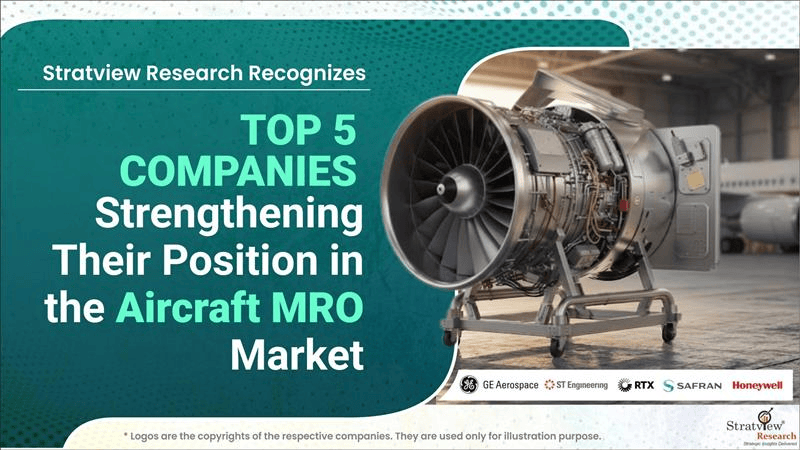
Stratview Research recognizes GE Aerospace, ST Engineering, RTX, Safran, and Honeywell Aerospace among the top 5 aircraft MRO players, backed by their established aftermarket capabilities and presence across the global aircraft MRO market.
1. GE Aerospace
As one of the key players in the global aircraft MRO market, GE Aerospace has established its aftermarket position around its large installed engine base and global network of engine and component repair facilities. The company supports >40,000 commercial engines, providing a substantial installed base for its aftermarket activities.
GE Aerospace has continued to invest in MRO infrastructure . In 2026, the company committed USD 130 million to expand and upgrade MRO facilities across Europe, adding capacity and capabilities to its regional aftermarket network. The investment is part of GE Aerospace’s broader efforts to expand its global MRO footprint.
The company is also extending its aftermarket capabilities through authorized service relationships. In 2026, GE Aerospace signed a five-year service and license agreement with Turkish Technic covering OEM-approved maintenance of Data Link Control and Display Units from its Istanbul facilities.
These developments support GE Aerospace’s engine-focused aftermarket model, combining installed-fleet access with dedicated repair infrastructure and authorized service capabilities.
2. ST Engineering
ST Engineering has established a broad position in the global aircraft MRO industry through its Commercial Aerospace business, covering airframe and engine MRO alongside component-related capabilities and aerostructures services. Its MRO operations across multiple regions provide a geographically distributed platform serving airline and cargo operators.
In the first quarter of 2026, ST Engineering’s Commercial Aerospace business secured approximately USD 1.7 billion in new contracts across its MRO and Aerostructures & Systems businesses. The company said its MRO wins included multi-year agreements covering airframes, engines, and components.
ST Engineering is also continuing to develop its regional MRO capabilities. In 2026, the company reported continued growth in its Commercial Aerospace business, supported by higher revenue from Engine MRO, nacelles, and spares.
This positions ST Engineering as a broad-based independent aircraft MRO service provider with capabilities spanning multiple maintenance requirements and geographic markets.
3. RTX
Raytheon Technologies Corporation’s (RTX) position in the aircraft MRO market is anchored by Pratt & Whitney’s global engine aftermarket network, complemented by Collins Aerospace’s aircraft components and systems business. Pratt & Whitney supports more than 90,000 in-service engines through its global MRO network.
In 2026, Pratt & Whitney announced more than USD 100 million in investment across MRO facilities in Texas, Florida, and Arkansas to increase GTF engine maintenance capacity. The investments include expanded facilities, additional equipment, increased used-serviceable-material inventory, and new repair capabilities.
Pratt & Whitney is also expanding capacity within its existing network. In 2026, the company invested USD 70 million in an expansion of its Columbus Engine Center in Georgia, increasing the facility’s annual capacity by more than 25%.
These investments reinforce RTX’s engine-centered aftermarket position, with additional MRO capacity being developed around its installed fleet and engine service requirements.
4. Safran
Safran has established a broad aftermarket position across propulsion and aircraft equipment, with capabilities spanning engines, landing gear, flight controls, and other aircraft systems.
A significant part of its recent MRO investment has been directed toward LEAP engines. Safran’s EUR 200 million LEAP engine MRO center in Hyderabad, India, is designed to reach a capacity of 300 engine shop visits per year and forms part of the company’s broader investment in its global LEAP MRO network.
Safran is also extending its aircraft-equipment aftermarket activities through long-term support agreements. Safran Landing Systems signed a 10-year Support and Services Agreement with Lufthansa Technik covering landing gear and hydraulic equipment on Airbus A320-family, A330, A340, and A350 aircraft.
5. Honeywell Aerospace
Honeywell Aerospace has established its aftermarket position around aircraft components and systems, with its products supporting multiple aircraft platforms and engine applications.
In 2026, Honeywell Aerospace expanded its regional MRO reach through a licensing agreement with GMR Aero Technic. The agreement covers depot-level maintenance, repair, and overhaul of seven Honeywell line-replaceable units installed on LEAP engines used on Airbus A320neo and Boeing 737 MAX aircraft.
The agreement enables the repair work to be performed through GMR Aero Technic’s MRO capabilities in Hyderabad, creating a regional repair channel for Honeywell components used in these aircraft applications.
The development reflects Honeywell Aerospace’s approach to extending component aftermarket support through licensed repair relationships alongside its existing product and service capabilities.
The Global Aircraft MRO Competitive Landscape
The five companies highlighted in this analysis represent different areas of the global aircraft MRO market. Their recent activities illustrate how aftermarket capabilities are being developed around installed fleets, dedicated repair capacity, regional coverage, and long-term customer support.
As the global aircraft fleet expands, these capabilities will remain relevant to meeting the maintenance requirements of an increasingly diverse aircraft base.
Subscribe to our newsletter
Related Blogs:

Aircraft MRO Industry Update: Key Developments from the Past Week (April 2026)

This Week’s Top Aircraft MRO Developments
Didn’t find what you were looking for?
Tell us about your requirements
(Our team usually responds within a few hours)