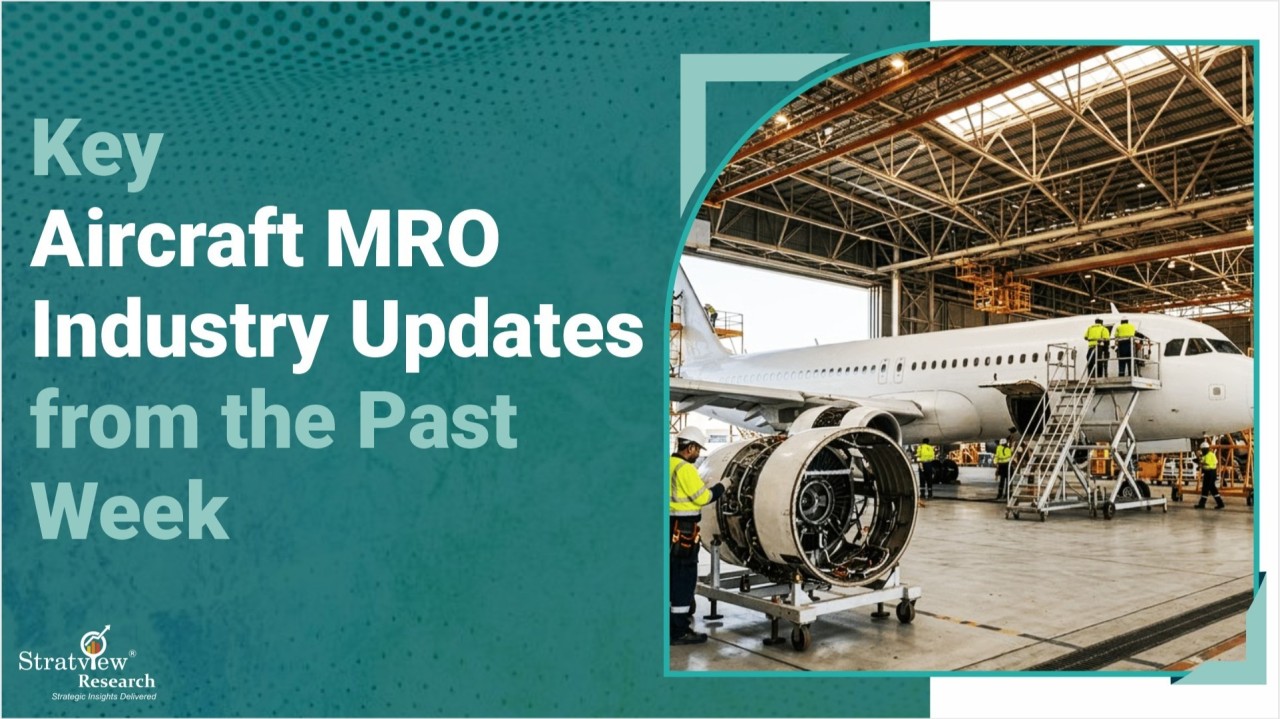
The aircraft maintenance, repair, and overhaul (MRO) industry is rapidly evolving from a support function into a strategic pillar of the global aviation ecosystem. As fleets expand and operational pressures increase, the industry is moving toward more efficient, cost-effective, and integrated maintenance solutions.
If you look at the past week alone (early April 2026), the bigger picture starts to become clear. India is stepping up its efforts to build a strong defense MRO ecosystem, airlines are increasingly opting for long-term, predictable maintenance partnerships, and service providers are expanding their capabilities through strategic acquisitions. Collectively, these developments are not only redefining the MRO ecosystem but also accelerating the market’s growth trajectory by driving demand for more advanced, scalable, and localized maintenance solutions.
As a result, these structural shifts are translating directly into sustained market expansion. According to Stratview Research, the aircraft MRO market was valued at around USD 265 billion in 2024 and is expected to exceed USD 330 billion by 2035, driven not just by rising demand, but by the industry’s transition toward more integrated and efficient maintenance models.
Let’s take a closer look at what’s been happening in the aircraft MRO market recently.
#1 India Accelerates Aerospace & Defense MRO Ambitions with Rafale Ecosystem Overhaul
In a significant move to strengthen its aerospace ecosystem, India’s Ministry of Defence (MoD) is planning a comprehensive restructuring of Dassault Reliance Aerospace Limited (DRAL) to support Rafale fighter jet production and MRO capabilities. Following Dassault Aviation’s increased stake to 51% in late 2025, the company is set to assume majority control, with Reliance Aerostructure’s 49% stake slated for divestment.
The initiative is closely tied to India’s ₹3.25 lakh crore MRFA program, which involves the procurement of 114 Rafale jets, including 96 to be manufactured domestically (as per defence.in). The restructured DRAL facility in Nagpur is expected to evolve into a regional MRO hub, supporting both Indian and international Rafale fleets.
Overall, this move signals India’s intent to build a stronger domestic aerospace manufacturing base and build a self-reliant MRO ecosystem for long-term aerospace & defense sustainability.
#2 ST Engineering and Skymark Deepen Partnership with Long-Term MRO Contracts
ST Engineering has further strengthened its long-standing partnership with Skymark Airlines by securing a Boeing 737 MAX Component Maintenance-By-the-Hour (MBH) program alongside a 737NG landing gear overhaul contract. This collaboration builds on a relationship that began in 2013 and reflects growing trust in integrated MRO solutions.
The MBH model, a form of power-by-the-hour contract, enables airlines to achieve predictable maintenance costs and higher fleet availability, a key priority in today’s competitive aviation landscape. Backed by AI-driven analytics, automation, and smart MRO capabilities, ST Engineering is delivering more proactive and data-driven maintenance services.
This development highlights a broader industry shift toward long-term, performance-based MRO contracts, as airlines increasingly prioritize operational efficiency and cost stability over traditional reactive maintenance approaches.
#3 ATC Group Expands Global Footprint with PAS MRO Acquisition
In a strategic move to strengthen its component repair capabilities, ATC Group has announced the acquisition of PAS MRO, a specialized provider of bearing repair services based in Oklahoma. This acquisition enhances ATC’s existing operations in Tulsa and Gilbert, creating operational synergies and expanding its presence in high-value component MRO segments.
PAS MRO brings strong technical expertise and established customer relationships, enabling ATC to enhance its service offerings for airlines, OEMs, and aftermarket customers. The company will continue operating with its existing leadership, ensuring continuity while leveraging ATC’s broader infrastructure.
This acquisition reflects a growing trend of consolidation in the aircraft MRO market, where companies are building scaled, diversified platforms to meet the rising demand of the global installed aircraft base and improve service efficiency.
A Market Defined by Strategic Evolution
The aircraft MRO industry is entering a phase where strategy matters as much as service execution. From defense-driven localization efforts to the rise of long-term maintenance models and ongoing consolidation in component repair, the industry is steadily becoming more structured and capability-driven.
As fleets continue to grow and operational complexity increases, the focus will shift toward building agile, technology-enabled MRO ecosystems. As the market moves toward USD 330+ billion by 2035, companies that invest in capability expansion, digitalization, and strategic partnerships will be best positioned to capture long-term value.