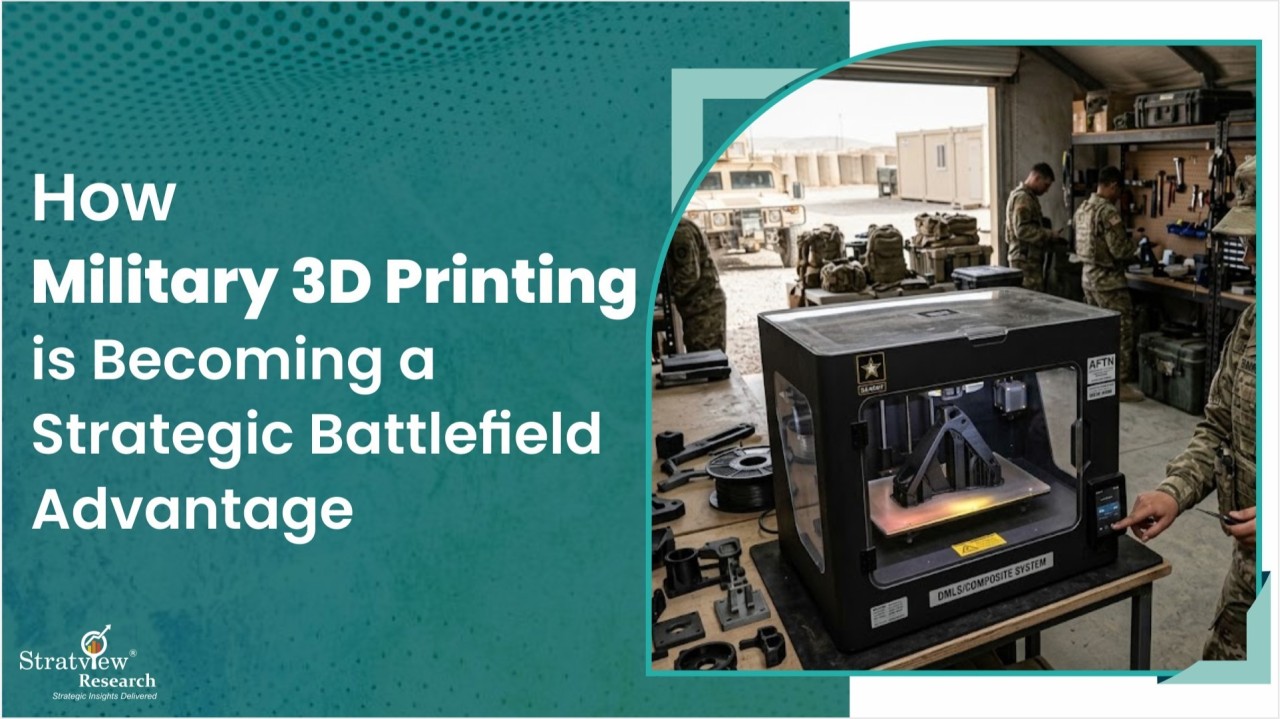
What if a military vehicle component that normally costs US$10,000 and takes 3 months to manufacture could instead be produced in just a few days for around US$800?
That became reality in 2020 when the US Army 3D-printed hatch plugs for combat vehicles after the original manufacturer discontinued the part. The Army not only reduced cost and lead time dramatically but also simplified the design from 10 parts to just 4.
Today, examples like this are driving the rapid rise of military 3D printing. From battlefield repairs and submarine hulls to rapid construction and prototyping, armed forces worldwide are increasingly leveraging additive manufacturing to strengthen supply chains, reduce lead times, and improve operational readiness.
The US Army: Flagbearer of Military 3D Printing
The US military isn't just an early adopter, it's the undisputed global leader. It accounts for over 50% of total military 3D printing spending worldwide, nearly 120% of the combined budgets of the next five largest spenders: China, the UK, Russia, France, and Germany.
In January 2024, the Army's Jointless Hull 3D printer, the world's largest additive and subtractive manufacturing system, received the 2024 Technical Achievement Award for 3D Printing Innovation at the Military Additive Manufacturing Summit & Technology Showcase.
With a massive print volume of 20 ft x 30 ft x 12 ft, the system can manufacture metal structures as large as an entire vehicle. The achievement highlights the US Army’s aggressive investment in military 3D printing R&D.
Battlefield Applications: Speed, Savings, and Supply Chain Resilience
Military operations often take place in remote, rugged, and hostile environments where supply chain disruptions can severely impact mission success. This is where 3D printing delivers significant advantages.
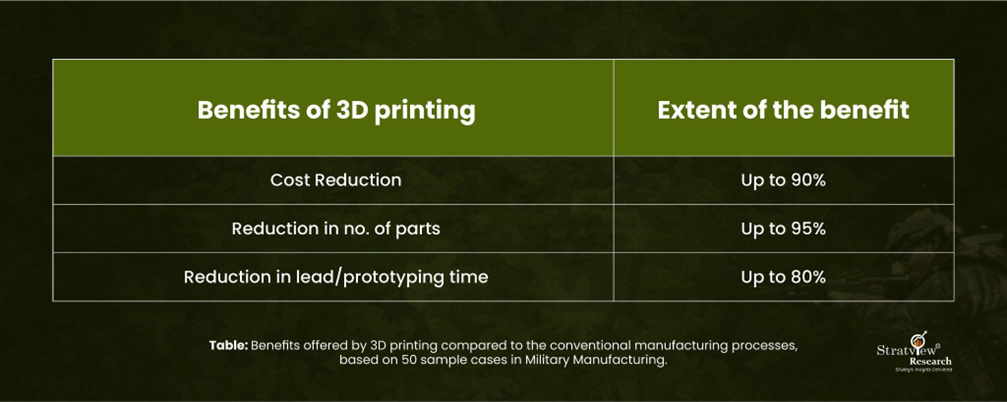
The US Navy demonstrated this by 3D printing submarine hulls. Conventional construction of a small submarine takes ~5 months and costs around $600,000. The US Navy's shift to 3D printing cut production time by 80% (to 4 weeks) and costs by 90% (to ~$60,000).
Beyond cost savings, 3D printing enables rapid prototyping, lightweight production, and on-demand manufacturing. In some industries, additive manufacturing has shortened prototyping cycles by as much as 8 months, allowing defense teams to test multiple iterations much faster.
Supply chain vulnerability is another critical driver. During the war in Ukraine, battlefield repair teams used 3D printing to produce replacement parts on-demand, including specific hinges for M113 armoured fighting vehicles, demonstrating its power to counter global supply chain disruptions.
For onboard repairs, the US Navy installed metal 3D printers on warships, including USS Essex and USS Bataan, enabling sailors to manufacture critical replacement parts at sea, eliminating weeks-long waits for external resupply.
Military construction is another emerging application. The Indian Army successfully 3D printed a two-story, zone-3 earthquake-resistant dwelling unit spanning 71 sq. meters in Ahmedabad within just 4 weeks. In Ladakh, the Army also developed 3D-printed bunkers capable of withstanding direct hits from T90 tanks.
Key Benefits of 3D Printing in Military Manufacturing
Barricades in the Combat Zone
While military 3D printing is gaining momentum, adoption isn't without friction. High upfront printer costs, limited cost-effectiveness for high-tensile parts like gun barrels, and the need for specialized technical training remain real barriers. Additionally, integrating additive manufacturing into existing military supply chains requires reliable power sources, stable operating environments, secure digital infrastructure, and strong cybersecurity measures to protect sensitive design files from cyber threats.
Towards a 3D-Printed Medal of Glory
Even with these challenges, military 3D printing continues to evolve rapidly. Advances in material science, AI-driven autonomous printing, and large-scale fabrication, led by organizations like the US Army Combat Capabilities Development Command, are steadily closing the gap between potential and mainstream adoption.
Growing at a CAGR of ~15%, the global military 3D printing market is projected to reach ~$4.5 billion by 2034. For defense forces navigating supply chain fragility, operational remoteness, and the relentless pressure to innovate, additive manufacturing isn't a future option, it is rapidly becoming a strategic necessity for next-generation warfare.