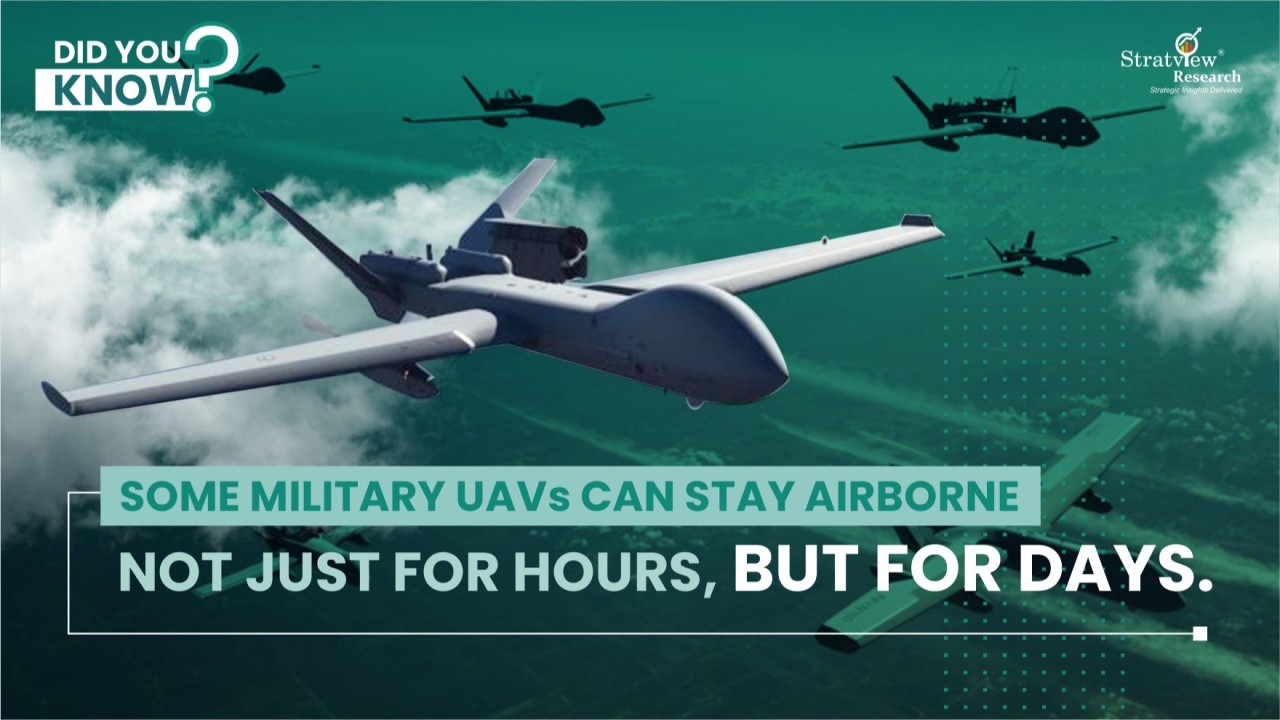
In modern defence operations, endurance has become the new battlefield advantage. As missions demand persistent surveillance, real-time intelligence, and uninterrupted situational awareness, long-endurance UAVs are emerging as the backbone of multi-day operations. Today’s most capable military UAVs can stay airborne not just for hours, but for days, reshaping how nations secure borders, monitor vast territories, and respond to evolving threats. And while many long-endurance UAVs are deployed around the world, this blog highlights a few military platforms that have repeatedly proven their endurance and operational value.
Proven 40+ Hour Platforms
Medium-altitude, long-endurance (MALE) unmanned aerial models such as the MQ-1 Predator, MQ-1C Gray Eagle (ER), and MQ-9B SkyGuardian remain among the most trusted workhorses of long-endurance missions. With endurance exceeding 40 hours and operational ceilings ranging from 25,000 to 29,000 ft, these UAVs deliver continuous, wide-area ISR coverage that manned aircraft simply cannot match. Their ability to carry payloads up to 340 kg (Predator) and execute multi-sensor, multi-role operations – including EO/IR surveillance, SIGINT, radar imaging, target designation, and precision strike enables militaries to maintain persistent situational awareness across complex environments.
Extended-Endurance Vanguard: IAI Heron (~52 Hours)
Taking long-endurance capability a step higher, the IAI Heron stands out with a demonstrated endurance of around 52 hours under operationally realistic conditions. This extended duration enables large-area monitoring, maritime patrols, prolonged border surveillance, and multi-day reconnaissance missions – reducing the need for frequent sortie rotations and improving overall mission persistence.
Next-Gen Ambition: Aurora Orion - 80 Hours Achieved, Aiming for 120
Looking ahead, the Aurora Flight Sciences Orion UAS signals the future of ultra-long endurance UAVs. According to Aurora’s report, the Orion achieved an 80-hour continuous flight, with ambitions to reach a 120-hour endurance target. If validated operationally, such performance would mark a major leap forward – enabling a single UAV to maintain surveillance for over three days non-stop, simplifying logistics and maximizing coverage efficiency.
The Bottom Line: Endurance Is the New Battlespace Advantage
As military forces double down on UAV-driven operations, the demand for longer endurance is rising. Breakthroughs in propulsion, materials, and aerodynamic efficiency are enabling drones to stay airborne far longer than before. Today’s leading systems already sustain 40 to 120 hours of continuous flight, while several emerging platforms aim to exceed even these benchmarks.
This technological momentum, combined with the operational need for multi-day situational awareness, is redefining what UAVs can deliver. As endurance continues to improve, long-duration UAVs will strengthen border security, expand ISR reach, and enhance mission effectiveness across defence operations.