For years, composite innovation has been judged by familiar measures: lower weight, higher strength, and longer service life. Those qualities remain fundamental. But manufacturers are now placing equal value on something less visible and just as critical, the ability to produce advanced composite structures faster.
The economics behind this are straightforward. OEMs are chasing higher build rates to work through record order backlogs, while defence programs operate on tighter delivery schedules. Under that pressure, manufacturing speed stops being a shop-floor detail and becomes a competitive advantage. Every hour trimmed from curing, winding, or layup adds output using equipment that's already on the floor, no new factory required.
At ILA Berlin 2026, Hexcel introduced three composite manufacturing solutions: HexPly® M51, a rapid-curing prepreg - a hot-melt Towpreg portfolio developed with RIMAC; and HexPly® PEKK/IM7 thermoplastic demonstrators developed with Arkema. Each targets a different production constraint.
Together, they map onto exactly where composite manufacturing loses time today: the autoclave, the filament winding line, and the choice of matrix material itself.
A) Reducing Cure Time Without Sacrificing Performance
Prepregs remain the benchmark for primary aerospace structures because of their consistency, but long autoclave cycles occupy tooling and ovens for hours, capping throughput even as build rates climb.
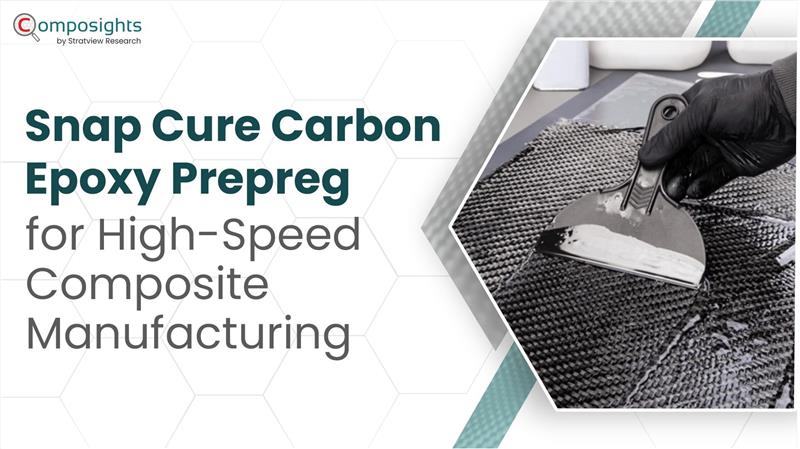
HexPly® M51 is designed for hot-in/hot-out press moulding rather than conventional autoclave processing, targeting a 40-minute cure at 180°C while delivering mechanical performance that Hexcel describes as comparable to conventional 180°C aerospace prepregs. During trials with Duqueine under the CORAC (Conseil pour la Recherche Aéronautique Civile) programme on a fuselage frame component, Hexcel reported more than 50% lower processing time than conventional manufacturing.
That figure represents a specific demonstration rather than a universal production benchmark, and Hexcel has not published the detailed mechanical property comparisons behind its "comparable" performance claim. Even so, the results highlight an important manufacturing trend. Shortening cure time is becoming one of the most practical ways to increase production capacity without significant capital investment.
B) Making Filament Winding More Predictable
The push for speed extends beyond the autoclave. Filament winding underpins the production of composite pressure vessels, hydrogen storage tanks, and electric motor components, all markets expected to expand alongside hydrogen infrastructure and electrification. In these applications, inconsistent resin distribution remains a common source of rework, machine cleaning, and production downtime.
The new hot-melt Towpreg portfolio, developed with RIMAC, uses continuous reinforcement fibres pre-impregnated with a controlled amount of resin before winding, replacing much of the variability associated with conventional wet winding. According to Hexcel, the approach improves resin consistency while reducing machine cleaning and downtime.
The company has not yet published throughput, cost, or productivity data for the system, making its manufacturing benefits directional rather than fully quantified. Nevertheless, the launch reflects a broader industry priority. As demand for filament-wound components continues to grow, manufacturing consistency is becoming just as important as material performance for achieving higher-volume production.
C) Why Thermoplastics Are Gaining Ground
Of the three announcements, HexPly® PEKK/IM7 signals the longest-term manufacturing shift. Unlike thermoset composites, thermoplastic composites do not rely on an irreversible curing reaction. Instead, they can be heated, consolidated, and welded, making them naturally compatible with automated and continuous manufacturing processes.
Developed in collaboration with Arkema, the system combines IM7 carbon fibre with a Polyetherketoneketone (PEKK) matrix, a high-performance thermoplastic known for its excellent temperature resistance, toughness, and chemical durability. At ILA Berlin 2026, Hexcel demonstrated the material through structural profiles and Omega stringers, highlighting its suitability for continuous manufacturing rather than laboratory-scale proof-of-concept parts.
This is the launch that speaks most directly to high-rate manufacturing. However fast a thermoset cure becomes, it remains governed by an irreversible chemical reaction. Thermoplastic composites avoid that limitation, which is why major suppliers including Toray and Solvay continue investing in thermoplastic tape and consolidation technologies. Hexcel is not creating a new category; it is strengthening its position in one that is becoming increasingly competitive.
What the Three Launches Actually Reveal
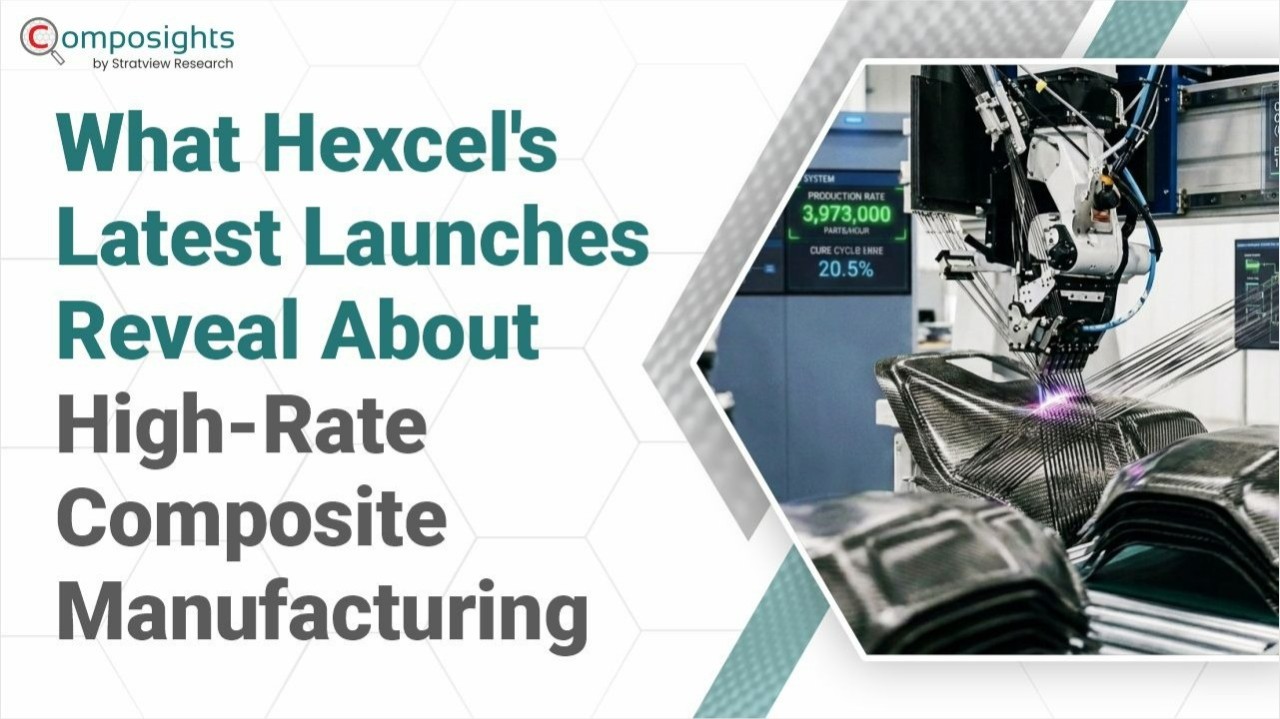
Individually, these are product announcements. Together, they reveal a supplier aligning its research and development priorities with manufacturing throughput rather than focusing solely on incremental improvements in strength-to-weight performance.
Questions around cost and qualification remain. Faster curing and thermoplastic weldability only become meaningful production advantages if they deliver favourable manufacturing economics and successfully complete aerospace qualification. A 40-minute cure cycle, for example, does not shorten the multi-year certification process required before a new material reaches a production aircraft.
That does not diminish the direction these launches represent. They suggest that composite material development is increasingly focused on reducing manufacturing time, improving process repeatability, and making better use of existing production assets. Similar investments are emerging across the composites industry as suppliers respond to the same production challenges.
The next generation of composite innovation is unlikely to be defined by stronger fibres or tougher resins alone. Increasingly, competitive advantage will belong to the companies that can manufacture qualified, cost-effective composite structures faster, more consistently, and at industrial scale.