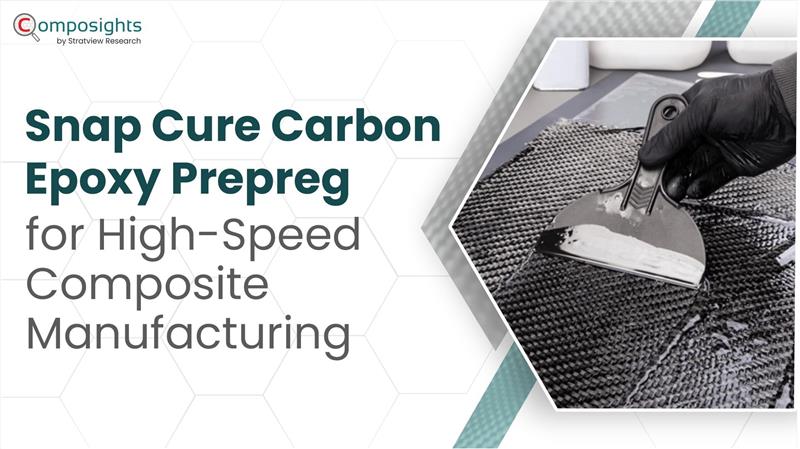
Snap Cure Carbon Epoxy Prepreg for High-Speed Composite Manufacturing
In composite manufacturing, production speed often depends on how quickly a part can move from layup to final curing. In many high-volume production facilities, conventional carbon epoxy prepreg systems still require long heating cycles, keeping tools occupied for hours and limiting daily output. This has led to growing interest in material systems that can support shorter processing windows while maintaining established performance standards.
In this context, snap cure carbon epoxy prepregs are gaining attention as a practical solution for high-throughput composite production. By enabling rapid curing without sacrificing structural performance, these materials help manufacturers improve equipment utilization, production planning, and overall process reliability.
What Makes Snap Cure Carbon Epoxy Prepreg Different?
Snap cure carbon epoxy prepregs consist of carbon fiber reinforcements pre-impregnated with fast-reacting epoxy resin systems. Unlike conventional epoxy prepregs that require extended heating and dwell cycles, snap cure systems are formulated to cure quickly under controlled heat and pressure.
Once the target curing temperature is reached, the resin undergoes accelerated cross-linking, converting layered prepreg stacks into fully consolidated composite parts within minutes. This enables manufacturers to complete molding cycles within a single production window, supporting consistent output and predictable scheduling.
A well-known example is Toray Advanced Composites’ E732 epoxy system, which achieves full cure in approximately four minutes at 160°C. It also supports short cure cycles across a temperature range of 120°C to 160°C, offering flexibility in tooling design and press configurations.
From Layup to Finished Part: How the Process Works
The performance of snap cure prepregs is closely linked to process control and equipment capability.
The workflow begins with controlled storage and conditioning to prevent premature resin reaction. During layup, moderate tack levels support clean handling and automated fiber placement. Once the laminate is placed in a heated mold, pressure and temperature are applied simultaneously.
Within minutes, the resin flows, fills micro-voids, consolidates the fiber layers, and completes curing. Parts can often be demolded while still warm and transferred directly to trimming or inspection. This “hot-in, hot-out” workflow supports continuous production and reduces work-in-progress inventory.
Key Benefits for High-Rate Manufacturing
1. Reduced Cycle Time
Traditional epoxy prepregs typically require cure cycles measured in hours, for example, some conventional epoxy systems may take around 60 minutes or more to cure, depending on formulation and processing conditions. In contrast, snap cure systems can complete polymerization in under 30 minutes, and in optimized conditions, in as little as four minutes at 160 °C, as demonstrated by Toray Advanced Composites’ E732 epoxy prepreg
2. Stable Mechanical and Thermal Performance
Despite fast curing, modern snap cure systems deliver reliable strength, fatigue resistance, and thermal stability. For example, Toray E732 offers an onset glass transition temperature of approximately 170°C, supporting long-term performance in demanding operating environments.
3. Lower Cost per Part
Shorter cycle times reduce energy consumption, labor input, and tooling occupancy. Over high production volumes, these savings contribute to improved manufacturing economics, higher capital utilization, and more predictable return on investment.
4. Support for Automation
Snap cure prepregs are compatible with compression molding, out-of-autoclave processing, and automated layup systems. Controlled resin flow and stable handling behavior support repeatable, high-volume composites production.
Under optimized processing conditions, such systems can support production volumes exceeding 50,000 parts per year, depending on component complexity and line configuration.
Storage, Handling, and Process Optimization
Because snap cure resins react quickly, disciplined material management remains essential.
Typical handling parameters for systems such as E732 include an out-life of around 21 days at 18°C and a frozen storage life of approximately six months at –18°C. These limits require careful coordination between material logistics, production scheduling, and shop-floor operations.
Uniform heating, accurate temperature monitoring, and optimized press parameters are also critical. Initial process development, tooling validation, and part qualification remain important to ensure consistent laminate quality, particularly for thick sections and complex geometries.
Expanding Applications Across Industries
The adoption of snap cure carbon epoxy prepregs continues to expand across multiple sectors.
In automotive and electric mobility, they are used in lightweight body structures, battery enclosure systems, and structural reinforcements. In aerospace and advanced air mobility, they support the production of interior panels, UAV components, and secondary airframe structures. Industrial, energy, and sporting goods manufacturers apply these materials in wind blade components, high-performance bicycles, protective equipment, and electronic housings.
Across applications, the common objective is to balance structural performance with scalable, cost-efficient manufacturing.
Market Outlook and Technology Direction
Global demand for snap cure prepregs is expected to grow steadily as manufacturers invest in automation, electrification, and high-throughput composite production systems. Material suppliers are developing next-generation formulations with extended out-life, lower curing temperatures, and improved sustainability profiles.
Hybrid processing approaches that combine snap cure prepregs with resin transfer molding and thermoplastic overmolding are also expanding design flexibility and application potential.
Looking Ahead for Composite Manufacturing
Snap cure carbon epoxy prepregs are becoming an integral part of modern composite manufacturing strategies. By enabling fully cured, high-performance parts within minutes, they support improved throughput, controlled production costs, and consistent quality standards.
As lightweighting, electrification, and automation continue to shape global manufacturing, these materials are expected to play an increasingly important role in enabling reliable, repeatable, and economically sustainable composite production across industries.
TAGS: Composites carbon composites
Subscribe to our newsletter
Related Blogs:
.jfif)
Automotive Carbon Ceramic Brakes Market - Explained in a Minute
.jpg)
Aircraft Interior Sandwich Panels – 101
Didn’t find what you were looking for?
Tell us about your requirements
(Our team usually responds within a few hours)