
For an electric vehicle, the front trunk, or frunk, has traditionally been a simple storage space. But what if that same component could also contribute to the stiffness of the vehicle’s front structure?
That is exactly what Envalior and Röchling Automotive have developed for a fully electric four-door high-performance sports car from a German premium automaker. The new plastic frunk combines storage functionality with a structural role, using Tepex® continuous glass-fiber-reinforced thermoplastic organosheets to increase front-axle stiffness.
The development is interesting not simply because the component is made from plastic, but because it shows how composite materials can take on structural functions while remaining integrated into an automotive component.
From Storage Box to Structural Component
The frunk measures approximately 1,100 mm × 450 mm × 370 mm and is primarily made from polypropylene. However, Envalior’s Tepex® organosheet reinforcement is incorporated into the rear wall and bolted floor sections where the component experiences significant mechanical loads.
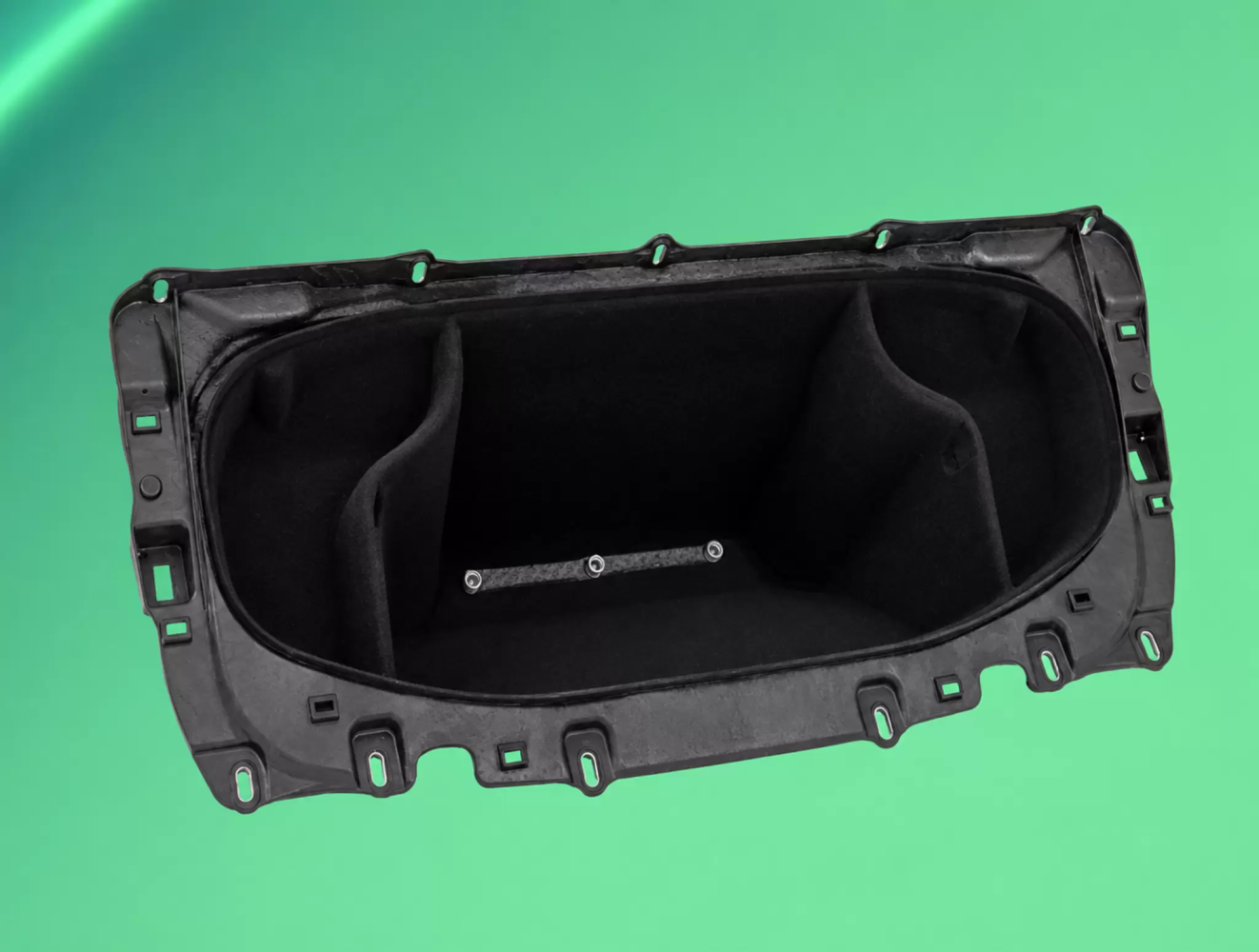
Image Courtesy of Envalior
Once installed, the frunk connects the upper strut brace with the front-axle carrier. It effectively works as a vertical shear panel, helping resist twisting of the front body structure during high-speed cornering, sudden lane changes, crosswinds, or racetrack driving.
In simple terms, the frunk is no longer just carrying luggage. It is also helping the vehicle carry structural loads.
Why the Fiber Direction Matters
The strength of this component comes from more than simply adding glass fiber to plastic. Envalior developed a multilayer Tepex® organosheet with continuous glass fibers arranged in different directions.
The outer layers use 0°/90° fiber orientations, while the inner layers use +45°/-45° orientations.
Why so many directions? Because forces do not act on a vehicle component in just one direction. The frunk has to deal with tensile, bending, shear, and torsional loads. The fiber architecture is therefore matched to the expected load paths. The 0°/90° fibers primarily contribute to crash performance, while the ±45° fibers help handle lateral loads and improve torsional stiffness during dynamic driving.
This is an important principle in automotive composites: rather than simply making a component thicker or adding more material, engineers can place reinforcement where the loads actually occur.
One-Step Manufacturing Makes the Concept More Practical
The material is only one part of the development. Röchling Automotive also developed a hybrid molding process to manufacture the complex frunk. The process combines Tepex® thermoforming and injection molding in a single mold and manufacturing step. This produces a finished component without additional rework.
That is particularly important for automotive applications, where a composite component must not only deliver structural performance but also be suitable for cost-efficient, high-volume production. The process also allows complex features to be integrated directly into the frunk. According to Envalior, future versions could potentially incorporate elements such as drawers, cargo nets, charging-cable holders, or cool boxes.
When One Component Does Two Jobs
The interesting part of this development is not just the use of plastic, but how the frunk has been engineered to serve two functions at once, storage and structural support. Continuous glass fibers, load-specific fiber orientations, and thermoplastic composite processing give it the stiffness needed for demanding driving conditions.
For EVs, this approach shows how one well-engineered component can combine functionality, structural performance, and lightweighting instead of treating storage and structural functions separately.
Subscribe to our newsletter
Related Blogs:
Leaf Springs on the Weighing Scale – Metals Vs. Composites

The Rise of Defense Composites in Modern Warfare
Didn’t find what you were looking for?
Tell us about your requirements
(Our team usually responds within a few hours)