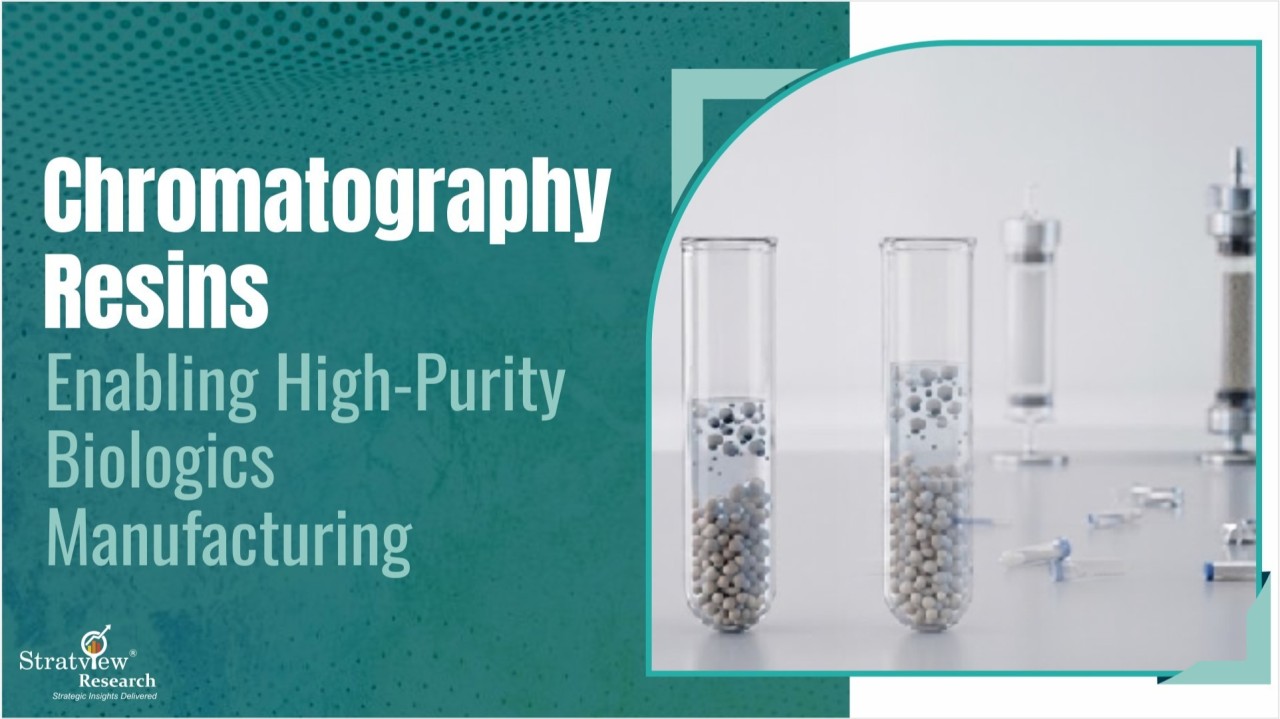
Purifying biologics – medicines like antibodies and gene therapies – is expensive work. The downstream cleaning process alone can account up to 80% of total manufacturing costs. And as the molecules being made grow more complex, that cost burden grows with them.
Chromatography resins are the materials that do this cleaning – separating the target drug from everything else in the mix. They sit at the heart of that cost pressure.
The global market for these resins was worth $2.4 billion in 2020, grew over 30% in five years, and is expected to cross $3.5 billion by 2031, driven by real shifts in how drugs are made and what regulators now demand from them.
Technique Selection – Affinity Leads, Mixed-Mode Climbs
Affinity chromatography commands the field, supporting well over two-thirds of biopharmaceutical protein purification operations. Protein A–based affinity resins remain the workhorse for monoclonal antibody (mAb) capture, high specificity, fewer process steps, consistent yield.
For polishing, mixed-mode resins are gaining ground but remain a distant second to ion-exchange resins, which are expected to hold the second spot for the foreseeable future. Mixed-mode is growing faster in percentage terms; in absolute volume, the gap is still wide.
Natural vs. Synthetic – The Matrix Debate
Over 60% of OEMs still prefer natural resins – agarose-based matrices in particular for large-scale purification. Their biocompatibility, low nonspecific binding, and solid regulatory track record are difficult to argue against when the target molecule is a delicate recombinant protein.
2025 saw notable product launches reinforcing this preference: Purolite Jetted A50 HipH, MabSelect SuRe 70, and MabSelect PrismA X (Cytiva) – all cross-linked agarose. DuPont's AmberChrom TQ1, also agarose-based, targets peptide and oligonucleotide purification.
Synthetic resins – polystyrene and polymethacrylate – are making inroads in high-flow, high-pressure environments and continuous chromatography setups, where mechanical strength is non-negotiable. But they complement, rather than displace, agarose platforms.
Why Pharma Drives ~25% of Global Resin Demand
The pharmaceutical sector accounts for nearly one-quarter of global resin consumption. The reason is straightforward: every biologic – mAbs, vaccines, viral vectors for gene therapy, requires chromatography at multiple stages to meet purity thresholds that often exceed 99.9%. Resins also handle API polishing, removing trace solvents, heavy metals, and unreacted intermediates. FDA and EMA requirements around leaching and contamination further cement resin adoption across the value chain.
The Challenges Nobody Should Ignore
Protein A resins now cost $9,000–12,000 per litre. Supply-chain constraints and validation requirements are extending lead times across the board. On the sustainability side, solvent waste from chromatographic processes is a real regulatory risk. Solutions are emerging, supercritical fluid chromatography (SFC) using CO₂, and ethanol substitution, but adoption is still accelerating.
Innovation in resins designed specifically for gene-therapy vectors and nucleic-acid payloads is where the next growth cycle will anchor. The market has its challenges, but the direction is clear.
Looking for more details? Click here to read our insightful article on “Rising Purity Expectations Are Reshaping the Chromatography Resin Market”. Follow for more such insightful content.
Subscribe to our newsletter
Related Blogs:
Meta-Aramid Fibers 101 – A Material That Resists Burning
Didn’t find what you were looking for?
Tell us about your requirements
(Our team usually responds within a few hours)