In high-temperature environments, material failure is typically governed by thermal exposure rather than mechanical load.
Most synthetic materials, when exposed to flame, soften, shrink, and eventually melt within seconds, often increasing risk instead of containing it.
In critical systems, this leaves little tolerance for material failure. Meta-aramid fibers are used in such environments because they retain structural integrity even under sustained heat exposure.
What Are Meta-Aramid Fibers?
Meta-aramid fibers are a class of aromatic polyamides (aramids) in which the polymer chains are linked in a meta-position along the molecular backbone. Common commercial examples include Nomex and Teijinconex.
Unlike para-aramids, their molecular chains are less linearly aligned, resulting in lower crystallinity and stiffness but greater resistance to thermal degradation under sustained exposure.
This structural arrangement defines their core behavior: thermal stability over mechanical reinforcement.
Key characteristics include:
-
No melting or dripping under heat exposure
-
Carbonization begins at ~370–400°C
-
Stable dimensional performance under prolonged heat
These properties make meta-aramids suitable for environments where material integrity under heat is more critical than load-bearing strength.
Why Meta-Aramid Fibers Behave Differently Under Flame
Under direct flame exposure, conventional synthetic fibers soften, shrink, and in many cases form molten droplets. This can contribute to fire spread and increase the risk of secondary ignition.
In contrast, meta-aramid fibers such as Nomex do not transition into a liquid phase. Instead, they undergo thermal degradation by forming a carbonized char layer.
This char layer acts as a temporary thermal barrier, slowing heat transfer through the material and delaying the progression of thermal damage. In safety-critical environments, this delay can influence whether damage remains localized or spreads across the system.
Meta-aramid fibers do not eliminate heat exposure; they control the rate at which thermal degradation progresses under fire conditions.
Functional Role of Meta-Aramid Fibers
Meta-aramid fibers are primarily used in systems where exposure to heat is continuous and long-duration performance stability is required.
Their role is centered on thermal insulation and maintaining material integrity under sustained thermal conditions, rather than providing mechanical reinforcement.
As a result, they are selected in applications where safety depends on consistent performance under heat, rather than resistance to load or impact.
Industrial Applications of Meta-Aramid Fibers
Meta-aramids are used across industries where thermal stability and fire safety are critical design requirements.
1. Aerospace & Defense Integrated into aircraft interiors and insulation systems, particularly in fire-blocking layers designed to limit flame propagation in confined spaces.
2. Automotive Applied in heat shields, gaskets, and under-hood components exposed to continuous engine heat and thermal cycling.
3. Electrical & Electronics Widely used in transformers, motors, and generators as insulation materials that maintain dielectric strength under long-term thermal exposure.
4. Oil & Gas Deployed in protective clothing and filtration systems operating in high-temperature and chemically aggressive environments.
5. Industrial Used in hot gas filtration systems in cement and power plants, where continuous thermal stress is part of normal operating conditions.
Meta vs Para-Aramids: Structural and Performance Differences
Although both belong to the aramid family, meta- and para-aramids are engineered for fundamentally different performance requirements.
Engineering interpretation:
-
Heat-dominated environments - meta-aramids
-
Load or impact-dominated environments - para-aramids
In many systems, both materials are used in separate functional layers rather than interchangeable roles.
Meta-Aramid Fiber Market Trends and Industry Outlook
The meta-aramid fiber market is driven primarily by regulatory requirements, infrastructure development, and long-term safety standards, rather than short-term technological shifts.
According to our analysis, the global meta-aramid market is projected to grow steadily, reaching approximately USD 1.5-2.0 billion over the next decade (2034).
Growth is supported by:
-
Rising demand for fire-resistant materials
-
Expansion of electrical and industrial infrastructure
-
Stricter global safety and insulation regulations
Demand patterns remain stable, driven largely by compliance requirements and replacement cycles rather than sudden fluctuations.
This reflects how meta-aramids are positioned within material selection. They are not chosen for peak mechanical performance, but for predictable behavior under sustained thermal exposure.
Meta vs Para-Aramids: Structural and Performance Differences
Although both belong to the aramid family, meta- and para-aramids are engineered for fundamentally different performance requirements.
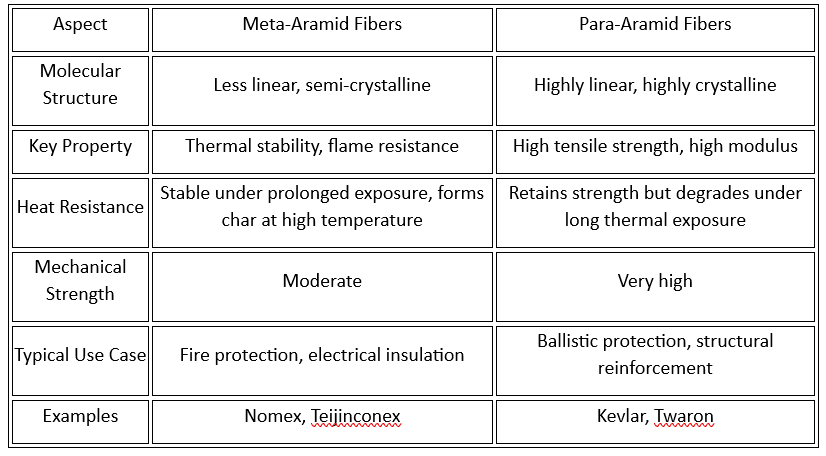
Source: Stratview Research
In high-temperature systems, failure is rarely instantaneous; it develops progressively. Materials either accelerate or slow this process.
Meta-aramids fall into the latter category, which is why they remain critical in applications where controlled thermal performance is essential.