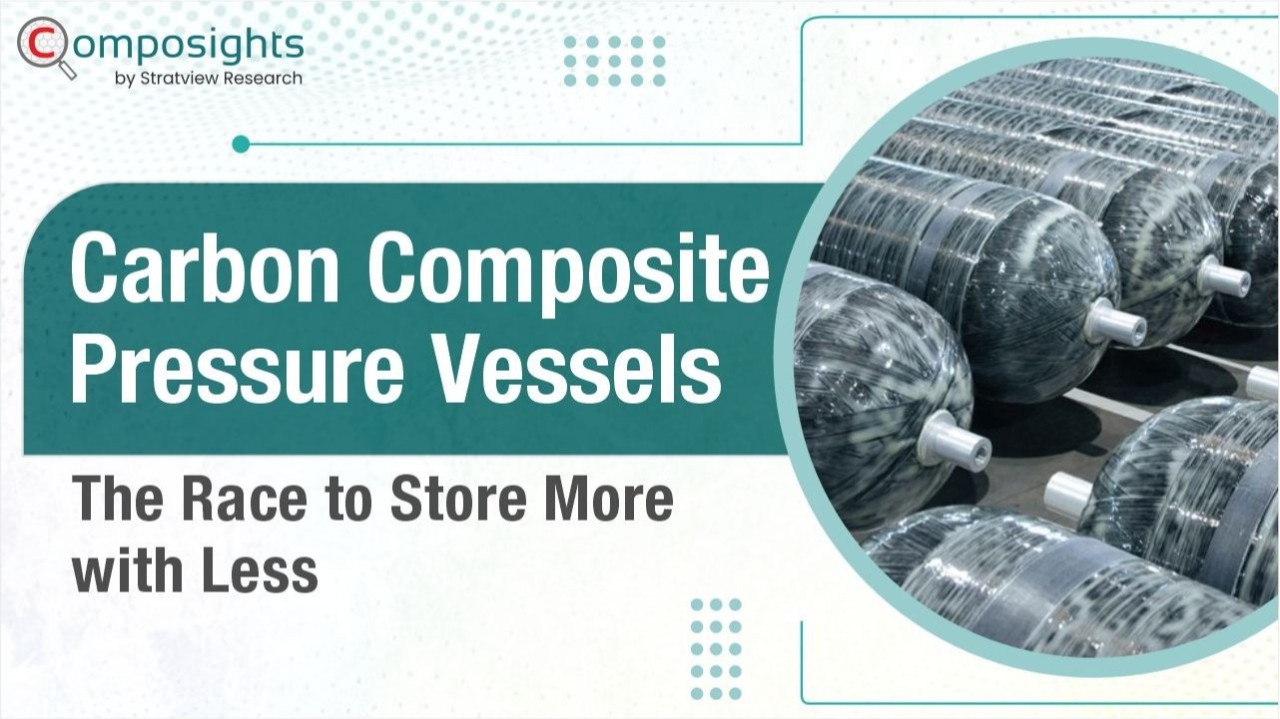
What happens when the world's push toward hydrogen-powered mobility collides with one of engineering's oldest challenges: storing gas safely under extreme pressure?
For decades, pressure vessels were viewed as simple storage hardware. Today, they sit at the center of a much larger transition. As fuel-cell vehicles, alternative fuels, and hydrogen infrastructure continue to expand, conventional metal tanks are increasingly struggling to balance weight, performance, durability, and efficiency.
This is where carbon composite pressure vessels are changing the equation.
Compared with traditional alternatives, carbon composite vessels can reduce weight by approximately 40–50% versus aluminium and 70–80% versus steel. These savings directly translate into longer vehicle range, higher payload capacity, improved fuel efficiency, and lower operating costs. Combined with excellent corrosion resistance, fatigue performance, and design flexibility, carbon composites have become the preferred solution for demanding high-pressure gas storage applications.
Perhaps the clearest indication of this shift is the market itself. Growing hydrogen deployment, increasing fuel-cell vehicle production, and expanding infrastructure investments are translating into strong commercial demand. As a result, the global carbon composite pressure vessels market surpassed USD 2 billion in 2025 and is on course to reach approximately USD 6 billion by 2031, growing at over 18% annually.
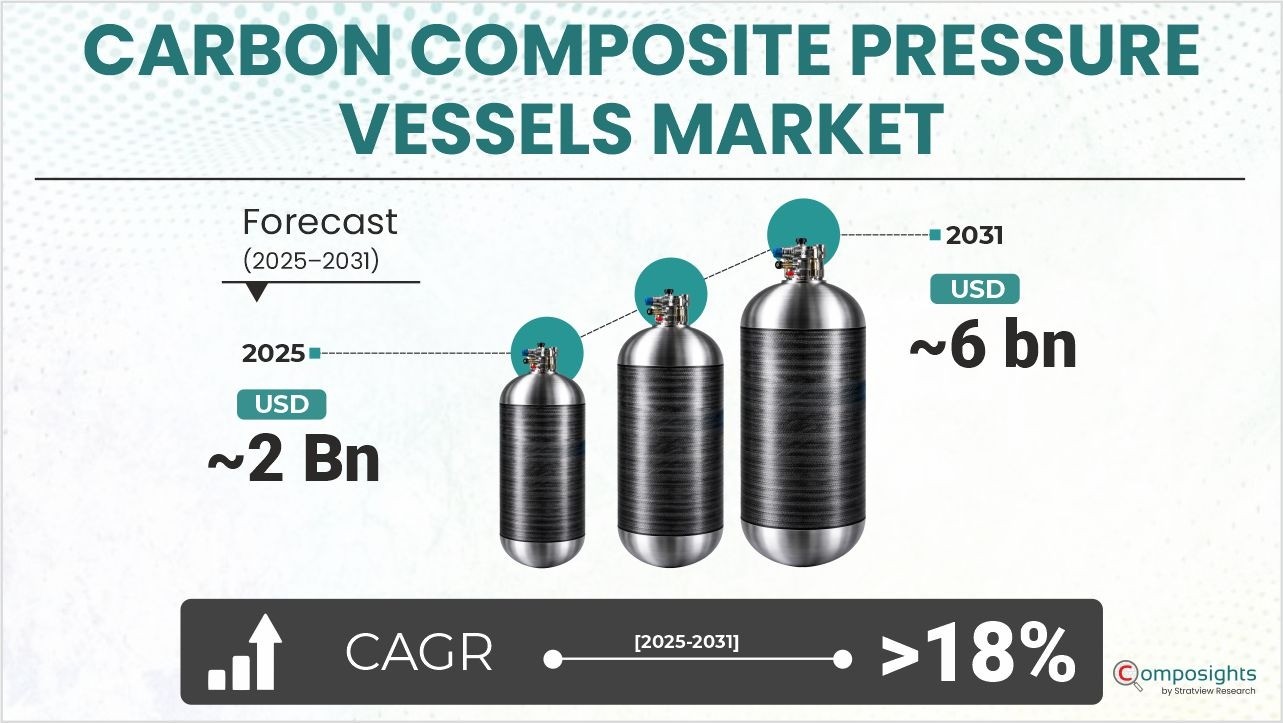
Image Courtesy of Composights
Behind this rapid expansion lies a crucial question: which vessel designs are best positioned to meet the evolving demands of hydrogen and high-pressure gas storage?
The Design Choice Driving Market Growth
Market dynamics are largely determined by vessel architecture, gas storage needs, and application requirements. Structurally, the market revolves mainly around 2 types - Type III and Type IV vessels, with Type IV vessels stepping into the spotlight, capturing over 60% of the global market.
Unlike Type III vessels, which use metallic liners, Type IV designs combine polymer liners with full carbon-composite overwraps, delivering substantial weight reductions without compromising performance. The benefits are particularly important for fuel-cell buses, trucks, passenger vehicles, and hydrogen refueling systems, where every kilogram saved improves overall system efficiency. While Type III vessels continue serving specific applications, industry momentum is increasingly shifting toward fully composite designs.
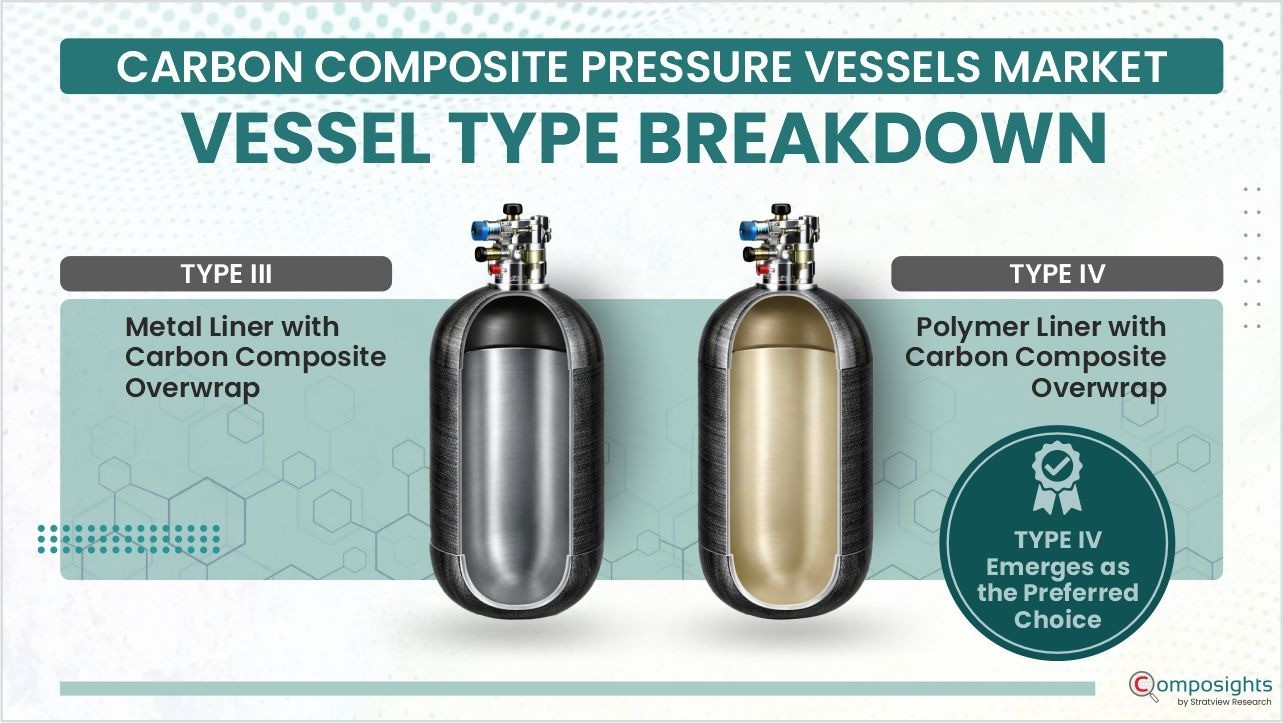 Image Courtesy of Composights
How does the choice of gas influence vessel design? While CNG and LNG lead the global installed base due to extensive natural-gas vehicle deployment, hydrogen’s rapid rise - driven by high-pressure storage needs and clean mobility adoption- is accelerating the transition to lighter, higher-performance Type IV vessels. This shift ensures fuel properties and composite designs work hand in hand to optimize efficiency and safety.
Why Wet Winding has become the Industry Standard
As demand for carbon composite pressure vessels continues to grow, manufacturing efficiency becomes just as important as material performance. This is where wet winding has established itself as the industry's preferred production method. The process offers nearly 40% lower costs than dry winding while delivering excellent fiber alignment, improved airtightness through reduced void formation, lower equipment wear, and production speeds of up to 200 m/min. Together, these advantages enable manufacturers to produce high-quality pressure vessels at scale, making wet winding a key enabler of the expanding hydrogen and CNG mobility ecosystem.
Where Growth is Concentrated and What Comes Next
Where hydrogen mobility scales fastest, demand for composite pressure vessels follows. Backed by strong policy support, expanding fuel-cell vehicle fleets, and early infrastructure investments, Asia-Pacific has emerged as the market’s center of gravity, accounting for around half of global demand. China, Japan, and South Korea are leading both hydrogen vehicle deployment and fuel-cell technology development.
China recently expanded its national hydrogen strategy, targeting 100,000 hydrogen fuel-cell vehicles by 2030, with a particular focus on medium- and heavy-duty transport. South Korea's hydrogen roadmap includes ambitions for 6.2 million FCEVs and 1,200 hydrogen refueling stations by 2040. Japan's long-term mobility plans target 800,000 fuel-cell vehicles and approximately 1,000 hydrogen stations by 2030.
Supported by major manufacturers such as Toyota, Hyundai, Honda, SAIC, and Dongfeng, these initiatives continue to strengthen regional demand for advanced pressure vessel technologies.
Europe is also creating significant opportunities, particularly in commercial fleets, light-duty trucks, and hydrogen-powered logistics applications, supported by favorable hydrogen policies and decarbonization initiatives.
As hydrogen adoption accelerates and lightweight engineering becomes increasingly essential, carbon composite pressure vessels are evolving from specialized components into critical infrastructure. Their ability to safely store high-pressure gases while maximizing efficiency positions them at the center of the next generation of clean energy and mobility systems.