.jpg "Aircraft fastners 101")
Did you know that aircraft fasteners can represent nearly 50% of the total part count in an aircraft? Despite their relatively small size, these components are among the most critical elements in aerospace engineering.
From commercial aircraft and military jets to next-generation UAVs and advanced air mobility platforms, aerospace fasteners form the foundation of modern aircraft assembly. They secure essential structures operating under extreme stress, vibration, and temperature conditions. As aircraft manufacturers increasingly focus on lightweight airframes and composite materials, demand is rising for advanced aerospace fasteners offering superior strength, precision, corrosion resistance, and fatigue performance.
In this blog, we explore the fundamentals of aircraft fasteners, their major types, materials, performance requirements, industry standards, and the future innovations shaping the aerospace fasteners market.
What Are Aircraft Fasteners?
Aircraft fasteners are specialised mechanical components used to join, secure, and assemble various aircraft structures and systems. Unlike conventional industrial fasteners, aerospace fasteners are engineered to withstand extreme operating conditions, including continuous vibration, fluctuating pressure, aerodynamic loads, thermal stress, and corrosive environments. These fasteners are essential for maintaining structural integrity, load distribution, and operational safety throughout an aircraft’s lifecycle. Their applications span across fuselage structures, wing assemblies, landing gear systems, engine nacelles, avionics compartments, and cabin interiors.
Understanding the Core Types of Aircraft Fasteners
Bolts
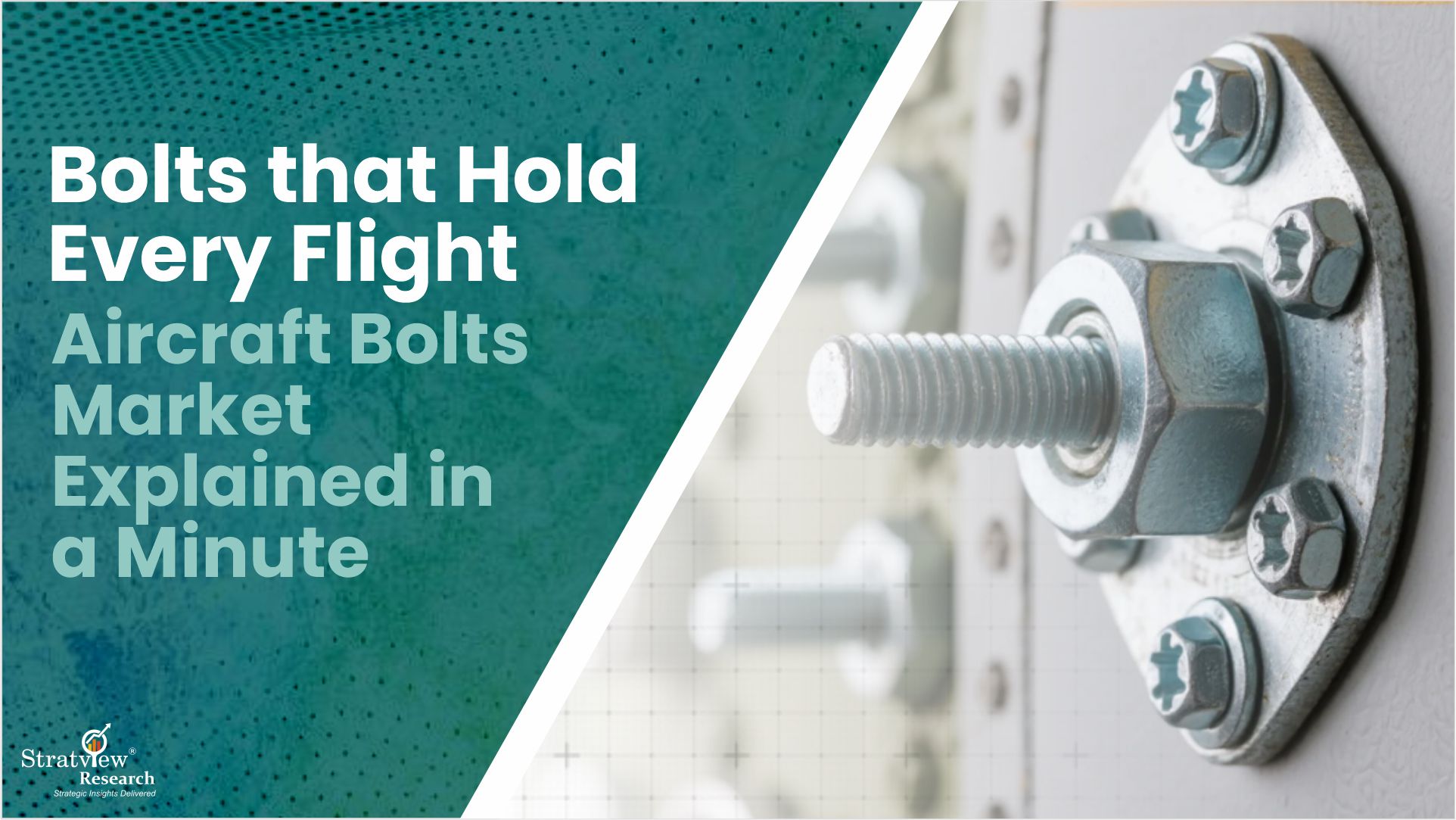
Aircraft bolts are high-strength threaded fasteners primarily used in structural applications where significant tensile and shear loads are involved. Designed for precision and reliability, aerospace bolts are commonly used in wing assemblies, landing gear structures, and engine mounting systems. Their ability to maintain joint integrity under vibration and stress makes them essential in high-load aerospace applications. Common aerospace bolt standards include AN (Air Force-Navy), MS (Military Standard), and NAS (National Aerospace Standard) bolts.
Nuts
Aircraft nuts are designed to securely mate with threaded bolts and studs while preventing loosening under vibration and dynamic flight conditions. Aerospace nuts often incorporate locking mechanisms to maintain structural stability during prolonged operational cycles. They are widely used across airframes, engine systems, and access panels where dependable fastening performance is essential. Common aerospace nut types include plain nuts, self-locking nuts, and castle nuts.
Rivets
Rivets remain one of the most extensively used aircraft fasteners, particularly in fuselage and wing skin assemblies. They offer excellent vibration resistance, lightweight performance, and long-term structural reliability. Riveted joints are especially valuable in aerospace structures where permanent fastening and fatigue resistance are critical. Their ability to maintain airtight seals also makes them ideal for pressurised aircraft cabins. Common aerospace rivet types include solid shank rivets and blind rivets.
The scale of rivet usage in aerospace manufacturing is immense, the Airbus A380 alone reportedly uses nearly 5 million rivets across its structure.
Screws
Aircraft screws are commonly used in non-structural and semi-structural applications where regular removal or maintenance access is required. These fastening systems are frequently found in interior panels, avionics systems, fairings, and access covers. They are available in different head configurations, including flat, round, and pan heads, along with multiple drive styles tailored to specific aerospace applications.
Specialty Fasteners in Aerospace
Hi-Lok Pins – Widely used in commercial aircraft structures, Hi-Lok fasteners combine lightweight performance with high-strength vibration-resistant fastening capabilities.
Lockbolt and Pull-Type Fastening – These permanent aerospace fasteners deliver exceptional shear strength and fatigue resistance in heavily loaded aircraft structures.
Turnlock Fasteners – Turnlock fasteners enable rapid access to aircraft panels and compartments requiring frequent inspection or maintenance.
Blind Bolts and Blind Rivets – Ideal for limited-access assemblies, blind fasteners can be installed from one side while maintaining reliable structural performance.
What Materials Are Used in Aircraft Fasteners?
-
Titanium – Preferred for its exceptional strength-to-weight ratio, corrosion resistance, and fatigue performance in high-performance aerospace structures.
-
Stainless Steel – Widely used in harsh aerospace environments requiring superior durability, corrosion protection, and long-term structural reliability.
-
Aluminium Alloys – Valued for their lightweight properties, cost-effectiveness, and strong machinability in weight-sensitive aircraft applications.
-
Superalloys – Designed for extreme aerospace environments involving high temperatures, mechanical stress, and demanding engine-related applications.
-
Composite Fasteners – Emerging aerospace fastening solutions engineered to support lightweight composite airframes while reducing galvanic corrosion risks.
Key Performance Requirements for Aircraft Fasteners
-
High Strength – Aircraft fasteners must withstand significant structural loads generated during takeoff, turbulence, landing, and high-speed flight operations without deformation or failure.
-
Thermal Resistance – Aerospace fasteners are required to maintain structural stability and mechanical performance across extremely high and low operating temperatures.
-
Corrosion Resistance – Exposure to moisture, chemicals, humidity, and salt-laden environments makes corrosion resistance essential in aircraft fastening systems. Protective coatings such as anodising and cadmium plating are commonly applied.
-
Lightweight Performance – Reducing aircraft weight directly contributes to improved fuel efficiency and payload optimisation. Lightweight titanium and aluminium fasteners help manufacturers achieve stringent weight targets.
-
Vibration Resistance – Continuous vibration generated by engines, airflow, and landing gear operations requires fasteners capable of maintaining tight and secure assemblies over extended service cycles.
-
Fatigue Resistance – Aircraft fasteners experience repeated loading and unloading throughout their lifecycle. High fatigue resistance is essential to prevent crack initiation and long-term structural failure.
Common Standards for Aerospace Fasteners
Standardisation in aerospace fasteners evolved to ensure consistent engineering specifications, quality, and reliability across aviation applications.
SAE AS9100 – It is one of the most widely recognised aerospace quality management standards. It governs the design, production, installation, and servicing of aerospace components, including aircraft fasteners.
ISO/TC 20/SC 4 – This ISO technical committee specifically focuses on aerospace fastener systems, covering fastener dimensions, material specifications, mechanical properties, and design standards.
What’s Next for Aircraft Fasteners?
Rapid advancements in materials, automation, and smart technologies are transforming the aircraft fasteners industry. Innovations such as sensor-enabled smart fasteners are improving predictive maintenance and aircraft safety through real-time stress and vibration monitoring, while additive manufacturing is enabling customised fastener designs that support lightweight performance, rapid prototyping, manufacturing flexibility, and inventory optimisation.
These innovations align with broader aerospace trends, including lightweight airframes, composite structures, digital manufacturing, and intelligent maintenance systems. At the same time, growing production of commercial aircraft, defense platforms, and advanced air mobility vehicles is accelerating demand for high-performance aerospace fasteners. As a result, the global aircraft fasteners market is expected to surpass USD 10 billion by 2032, according to Stratview Research.
Although often overlooked, aircraft fasteners remain essential to aircraft safety, structural integrity, and overall performance. As aviation evolves toward smarter and lighter platforms, these small components will continue playing a critical role in the future of aerospace engineering.