




404
+1-313-307-4176

Aircraft Rivets Market Analysis | 2026-2034

Aircraft Rivets Market Size, Share, Trend, Forecast, Competitive Analysis, and Growth Opportunity: 2026-2034
“The aircraft rivets market size will reach USD 417.8 million in 2026 and offers robust growth opportunities for the market stakeholders. With the market expected to grow at a CAGR of 5.0%, the annual sales will hit USD 617.4 million mark in 2034, reflecting the industry's increasing focus on aircraft production, rising global air passenger traffic, and expanding commercial and military aircraft fleets.”
The annual demand for aircraft rivets was USD 372.4 million in 2025 and is expected to reach USD 417.8 million in 2026.
During the forecast period (2026-2034), the market is expected to grow at a CAGR of 5.0%. The annual demand will reach USD 617.4 million in 2034.
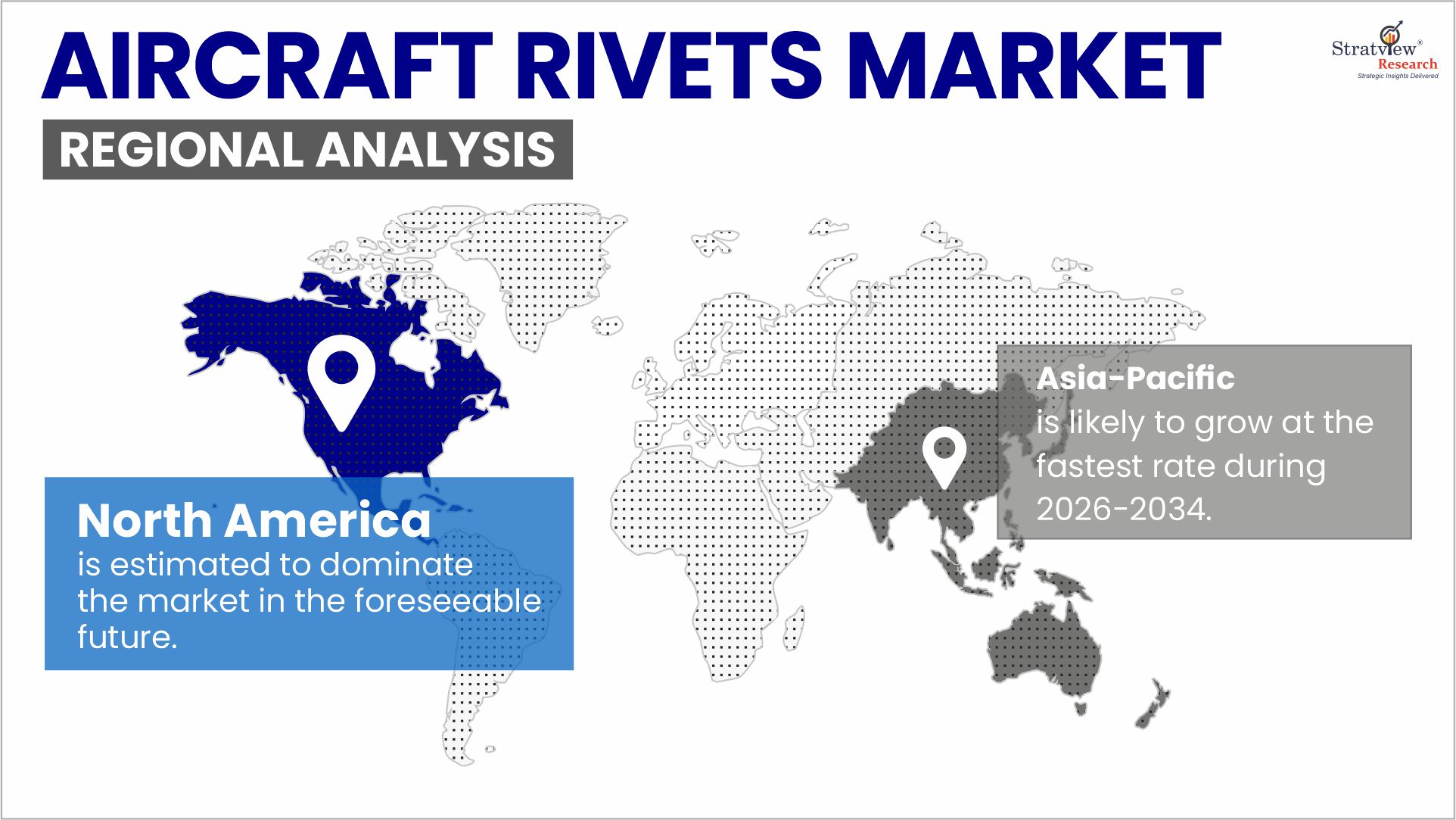
North America is currently the dominant region, whereas the Asia-Pacific is likely to grow at the fastest rate.
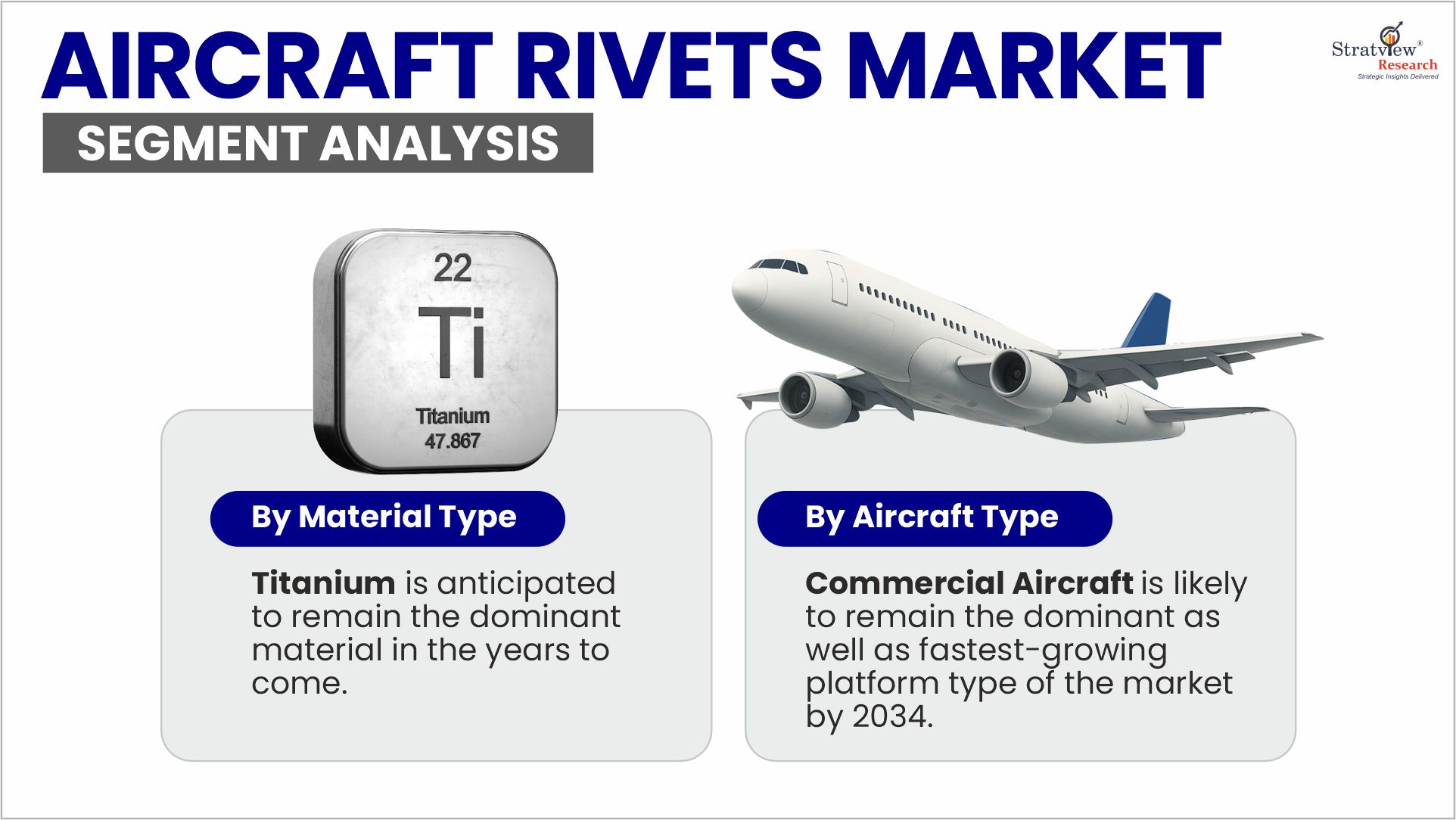
Based on aircraft type, Commercial aircraft is likely to remain the dominant as well as fastest-growing platform type of the market by 2034.
Among the applications, airframe is estimated to remain the dominant as well as fastest-growing application type during the forecast period.
By material type, titanium is expected to remain the largest and fastest-growing material for screws during the forecast period.
Among OE and Aftermarket, OE remains the dominant and faster-growing end-user type over the upcoming years.
By product type, blind rivets are likely to remain the dominant and fastest-growing rivet type by 2034.
“According to a Senior Analyst at Stratview Research, the global aircraft rivets market will generate a cumulative sales opportunity worth USD XX million during 2026-2034. During the forecast period, Commercial Aircraft, Airframe Applications, Titanium Rivets, and Europe are expected to offer the most lucrative opportunities across the value chain.”
Sharpen Your Strategies to Explore this USD XX million Opportunity. Get a Free Sample of Our Report: “Here”.
Have a look at the sales opportunities presented by the aircraft rivets market in terms of growth and market forecast.
|
Market Statistics |
Value (in USD Million) |
Market Growth (%) |
|
Market Size in 2025 |
USD 372.4 million |
- |
|
Market Size in 2026 |
417.8 million |
YoY Growth in 2026: XX% |
|
Market Size in 2034 |
617.4 million |
CAGR 2026-2034: 5.0% |
|
Cumulative Sales Opportunity during 2026-2034 |
USD XX million |
- |
|
Top 10 Countries’ Market Share in 2025 |
USD 297.9 million + |
> 80% |
|
Top 10 Company’s Market Share in 2025 |
USD 186.2 million to USD 260.9 million |
50% - 70% |
Want to Explore the Market Opportunities? Get a Free Sample “Here”.
Aircraft rivets are vital mechanical fasteners used in building and maintaining airplanes. They play a critical role in holding the aircraft's structure together, ensuring its strength and safety during flight. A rivet is essentially a cylindrical metal pin with a head on one end and a tail on the other. The rivet is placed into pre-drilled holes in the joined materials to install it. The tail is then deformed or flattened to create a second head, securing the materials tightly and permanently.
Strong Global Aircraft Production Backlogs Supporting Long-Term Fastener Demand
The aircraft rivets market is fundamentally linked to global aircraft production volumes. Major OEMs such as Airbus and Boeing continue to operate with substantial multi-year order backlogs, providing visibility into production well into the next decade. Airbus reported 793 commercial aircraft deliveries in 2025 and maintained a year-end backlog of 8,754 aircraft entering 2026.
Each commercial aircraft integrates hundreds of thousands to several million aerospace rivets, depending on aircraft size and configuration. As OEM build rates stabilize and gradually increase across narrowbody and selected widebody programs, demand for aircraft rivets remains in structural alignment with production output.
In parallel, the International Air Transport Association projects approximately 4.9% year-over-year growth in global revenue passenger kilometres in 2026, reinforcing fleet expansion and replacement cycles that sustain long-term aircraft manufacturing activity.
Structural Fatigue, Pressurization Cycles, and Regulatory Compliance Requirements
Aircraft rivets remain critical to airframe structural integrity under repeated pressurization cycles, vibration, and aerodynamic loading. Transport category aircraft are certified under strict fatigue and damage-tolerance frameworks governed by authorities such as the Federal Aviation Administration.
Airframes are engineered to withstand tens of thousands of flight cycles during their service life, requiring fastening systems capable of maintaining joint reliability without degrading material properties. Riveting, as a cold mechanical fastening process, avoids heat-affected zones in thin aluminum skins and composite laminates, thereby preserving base material strength. The ability to inspect, remove, and replace rivets during scheduled maintenance further reinforces their continued dominance in aircraft structural assemblies.
Integration of Lightweight Materials and Composite Structures
Modern aircraft platforms incorporate advanced aluminum alloys, titanium components, and carbon fiber reinforced polymers to improve weight efficiency and operational economics. Aircraft rivets play an enabling role in joining thin-gauge skins, frames, stringers, and composite-to-metal interfaces where bonding alone may not meet certification standards.
As composite penetration expands across next-generation commercial and military aircraft, the demand for high-performance rivets, particularly titanium variants, continues to strengthen due to their high strength-to-weight ratio, corrosion resistance, and compatibility with carbon fiber structures. This material evolution directly supports sustained growth in aerospace-grade rivet demand.
Defense and Military Aircraft Production Stability
Beyond commercial aviation, military aircraft programs provide an additional layer of demand stability. Fighter jets, transport aircraft, rotorcraft, and special mission platforms rely extensively on mechanical fastening for structural reliability under high-stress operating conditions. Government-funded procurement cycles and modernization programs create a counter-cyclical buffer against fluctuations in commercial aircraft production, supporting sustained rivet consumption across aerospace supply chains.
Asia-Pacific Fleet Expansion and Localized Manufacturing Growth
Asia-Pacific continues to outperform global averages in air traffic growth. The International Air Transport Association projects approximately 7.3% passenger traffic growth in Asia-Pacific in 2026, exceeding the global average. This sustained expansion is driving aircraft procurement, regional assembly capabilities, and supplier ecosystem development.
As production and MRO capabilities expand within the region, opportunities emerge for rivet manufacturers to establish localized supply partnerships, reduce lead times, and integrate more closely with emerging aerospace hubs.
Aftermarket Demand Through Aging Fleets and Life-Extension Programs
As the global fleet ages and operators implement extended service life programs, maintenance, repair, and overhaul activities increase. Structural inspections, heavy maintenance checks, fuselage skin repairs, and modification programs frequently require rivet removal and reinstallation to maintain airworthiness compliance.
This recurring MRO demand provides a stable revenue stream beyond OEM line-fit volumes, enhancing long-term demand visibility for aircraft rivet suppliers serving both production and aftermarket channels.
"As per our analyst, the global aircraft rivets industry is evolving fast. While conducting the market analysis and speaking with leading players, it is quite clear that the next decade will be defined by trends such as aircraft lightweighting, increasing use of composite materials, and the growing demand for advanced riveting solutions capable of meeting stringent aerospace performance and durability requirements."
Align with the Mega Trends Shaping the Industry. Get a Free Sample “Here”.
|
Segmentations |
List of Sub-Segments |
Dominant and Fastest-Growing Segments |
|
Aircraft -Type Analysis |
Commercial Aircraft, Regional Aircraft, Helicopters, Military Aircraft, and General Aviation |
Commercial Aircraft is likely to remain the dominant as well as fastest-growing platform type of the market by 2034. |
|
Application-Type Analysis |
Airframe, Flight Control Surfaces, Interiors, Engine, and Other Application Types |
Airframe is estimated to remain the dominant as well as fastest-growing application type during the forecast period. |
|
Material-Type Analysis |
Titanium Rivets, Aluminum Rivets, Steel Rivets, and Other Rivets |
Titanium is anticipated to remain the dominant material in the years to come, propelled by its weight-saving advantage along with excellent corrosion-resistant properties. |
|
End-User- Type Analysis |
OE and Aftermarket |
OE is likely to remain the dominant and faster-growing end-user type. |
|
Product-Type Analysis |
Blind Rivets and Solid Rivets |
Blind Rivets are likely to remain the dominant and fastest-growing rivet type by 2034. |
|
Regional Analysis |
North America, Europe, Asia-Pacific, and The Rest of the World |
North America is estimated to dominate the market in the foreseeable future, whereas the Asia-Pacific is likely to grow at the fastest rate. |
Get Insights on High-Growth Segments. Get a Free Sample “Here”.
“Commercial aircraft is expected to remain the dominant and fastest-growing platform in the aircraft rivets market through 2032.”
The aircraft rivets market is segmented into commercial aircraft, regional aircraft, helicopters, military aircraft, and general aviation.
Commercial aircraft are projected to remain the largest and fastest-growing segment in the aircraft rivets market throughout the forecast period. This growth is driven by the substantial number of rivets required for their larger structures compared to other aircraft types. Additionally, increasing production rates of major aircraft programs, the introduction of new models like the C919, B777X, and MC-21, and the expanding global fleet size further contribute to the market's upward trajectory.
Want to get a free sample? Register Here
“Blind rivets are expected to remain the dominant and fastest-growing type of rivet of the market through 2034.”
The market is segmented into blind rivets and solid rivets.
Blind rivets are anticipated to maintain their position as the dominant and fastest-growing type of rivet during the forecast period. Their popularity stems from key advantages such as resistance to vibration, quick installation, reliability, and ease of inspection and maintenance. Additionally, their unique design, allowing installation from only one side, makes them ideal for use in tight or hard-to-reach spaces. This versatility positions blind rivets as an excellent alternative to solid rivets in various applications.
“The airframe segment is expected to remain the dominant and fastest-growing application in the aircraft rivets market throughout the forecast period.”
The market is segmented into airframes, flight control surfaces, interiors, engines, and other application types.
The airframe segment is projected to remain the dominant application type in the aircraft rivets market during the forecast period. As the largest structure in an aircraft, the airframe requires extensive use of rivets, particularly in critical areas such as the wings and fuselage, solidifying its leading position in the market.
“Titanium is expected to remain the dominant material in the aircraft rivets market in the coming years. Its dominance is driven by its weight-saving benefits and exceptional corrosion resistance, making it a preferred choice in aerospace applications.”
The market is segmented into titanium, aluminum, steel, and other material types.
Titanium is projected to remain the leading material type in the aircraft rivets market throughout the forecast period. Titanium rivets are widely used in aircraft due to their numerous advantages, including excellent compatibility with composite materials, superior corrosion resistance, outstanding mechanical properties, heat resistance, and a high strength-to-weight ratio. These attributes make them a preferred choice for modern aerospace applications.
“North America is expected to dominate the aircraft rivets market in the foreseeable future, while the Asia-Pacific region is anticipated to experience the fastest growth during the same period.”
The market is segmented into North America, Europe, Asia-Pacific, and The Rest of the World.
For Deep Diving into a Country/Region Specific Opportunity. Contact Us “Here”.
North America is expected to remain the largest market for aircraft rivets during the forecast period, driven by its status as the manufacturing hub of the aircraft industry. The region is home to numerous aircraft OEMs, tier suppliers, rivet manufacturers, and distributors, contributing to its market dominance.
Meanwhile, the Asia-Pacific region is likely to experience the highest growth due to the expanding aircraft fleet to meet increasing passenger traffic, the establishment of assembly plants by Boeing and Airbus for various aircraft programs, and the development of the indigenous C919 aircraft. China and India are expected to be the key growth drivers in the region.
The market is fragmented with the presence of less than 100 global and regional players. Leading players hold excellent market positions with a vast product portfolio, a wide distribution network, and years of track record.
The following are the key players in the aircraft rivets market.
Precision Castparts Corp Co., Ltd.
Howmet Aerospace
TriMas Corporation
Stanley Black & Decker, Inc.
Note: The above list is not an exhaustive list of the key players in the market. If your company is active in this market and would like to be considered for inclusion in future editions of this study, please contact us at [email protected].
Have the Competitive Edge with Our Intelligence. Get a Free Sample “Here”.
This report provides market intelligence most comprehensively. The report structure has been kept so that it offers maximum business value. It provides critical insights into market dynamics and will enable strategic decision-making for existing market players as well as those willing to enter the market.
The following are the key features of the report:
Market structure: Overview, industry life cycle analysis, supply chain analysis.
Market environment analysis: Growth drivers and constraints, Porter’s five forces analysis, SWOT analysis.
Market trend and forecast analysis.
Market segment trend and forecast.
Competitive landscape and dynamics: Market share, Service portfolio, New Product Launches, etc.
Attractive market segments and associated growth opportunities.
Emerging trends.
Strategic growth opportunities for the existing and new players.
Key success factors.
|
Market Study Period |
2019-2034 |
|
Base Year |
2025 |
|
Forecast Period |
2026-2034 |
|
Trend Period |
2019-2024 |
|
Number of Tables & Figures |
>100 |
|
Number of Segments Analysed |
6 (Aircraft Type, Material Type, Product Type, Application Type, End-User Type, and Region) |
|
Number of Regions Analysed |
4 (North America, Europe, Asia-Pacific, Rest of the World) |
|
Countries Analysed |
15 (The USA, Canada, Mexico, Germany, France, Italy, The UK, China, Japan, India, Brazil, Saudi Arabia, Rest of Europe, Rest of APAC, and Rest of the World) |
|
Free Customization Offered |
10% |
|
After Sales Support |
Unlimited |
|
Report Presentation |
Complimentary |
|
Market Dataset |
Complimentary |
|
Further Deep Dive & Consulting Services |
10% Discount |
Want a Report Tailor-Made to Your Objectives? Write to us at [email protected]
The report provides detailed insights into the market dynamics to enable informed business decision-making and growth strategy formulation based on the opportunities present in the market.
The aircraft rivets market is segmented into the following categories.
Aircraft Rivets Market, by Aircraft Type
Commercial Aircraft (Regional Analysis: North America, Europe, Asia-Pacific, and Rest of the World)
Regional Aircraft (Regional Analysis: North America, Europe, Asia-Pacific, and Rest of the World)
Helicopter (Regional Analysis: North America, Europe, Asia-Pacific, and Rest of the World)
Military Aircraft (Regional Analysis: North America, Europe, Asia-Pacific, and Rest of the World)
General Aviation (Regional Analysis: North America, Europe, Asia-Pacific, and Rest of the World)
Aircraft Rivets Market, by Product Type
Solid Rivets (Regional Analysis: North America, Europe, Asia-Pacific, and Rest of the World)
Blind Rivets (Regional Analysis: North America, Europe, Asia-Pacific, and Rest of the World)
Aircraft Rivets Market, by Application Type
Airframe (Regional Analysis: North America, Europe, Asia-Pacific, and Rest of the World)
Flight Control Surfaces (Regional Analysis: North America, Europe, Asia-Pacific, and Rest of the World)
Interior (Regional Analysis: North America, Europe, Asia-Pacific, and Rest of the World)
Engine (Regional Analysis: North America, Europe, Asia-Pacific, and Rest of the World)
Other Applications (Regional Analysis: North America, Europe, Asia-Pacific, and Rest of the World)
Aircraft Rivets Market, by Material Type
Titanium Rivets (Regional Analysis: North America, Europe, Asia-Pacific, and Rest of the World)
Aluminum Rivets (Regional Analysis: North America, Europe, Asia-Pacific, and Rest of the World)
Steel Rivets (Regional Analysis: North America, Europe, Asia-Pacific, and Rest of the World)
Other Material Rivets (Regional Analysis: North America, Europe, Asia-Pacific, and Rest of the World)
Aircraft Rivets Market, by End-User Type
OE (Regional Analysis: North America, Europe, Asia-Pacific, and Rest of the World)
Aftermarket (Regional Analysis: North America, Europe, Asia-Pacific, and Rest of the World)
Aircraft Rivets Market, by Region
North America (Country Analysis: The USA, Canada, and Mexico)
Europe (Country Analysis: Germany, France, The UK, Russia, and Rest of Europe)
Asia-Pacific (Country Analysis: Japan, China, India, and Rest of Asia-Pacific)
Rest of the World (Country Analysis: Brazil, Saudi Arabia, and Others)
Looking for a Deep Dive? Write to us at [email protected]
This strategic assessment report from Stratview Research provides a comprehensive analysis that reflects today’s aircraft rivets market realities and future market possibilities for the forecast period.
The report segments and analyzes the market in the most detailed manner in order to provide a panoramic view of the market.
The vital data/information provided in the report can play a crucial role for market participants as well as investors in the identification of the low-hanging fruits available in the market as well as to formulate growth strategies to expedite their growth process.
This report offers high-quality insights and is the outcome of a detailed research methodology comprising extensive secondary research, rigorous primary interviews with industry stakeholders, and validation and triangulation with Stratview Research’s internal database and statistical tools.
More than 1,000 authenticated secondary sources, such as company annual reports, fact books, press releases, journals, investor presentations, white papers, patents, and articles, have been leveraged to gather the data.
We conducted more than 15 detailed primary interviews with market players across the value chain in all four regions and industry experts to obtain both qualitative and quantitative insights.
With this detailed report, Stratview Research offers one of the following free customization options to our respectable clients:
Company Profiling
Detailed profiling of additional market players (up to three players)
SWOT analysis of key players (up to three players)
Competitive Benchmarking
Benchmarking of key players on the following parameters: Service portfolio, geographical reach, regional presence, and strategic alliances
Custom Research: Stratview Research offers custom research services across industries. In case of any custom research requirement related to market assessment, competitive benchmarking, sourcing and procurement, target screening, and others, please send your inquiry to [email protected]
The report is delivered digitally through our online portal. Buyers receive login credentials from our team to access the report and may update their credentials at any time after the initial login.
Delivery timelines depend on the status of the report:
For the most accurate delivery timeline, please contact us to confirm the current status of the report.
Yes. You may request a complimentary preview of the report through a video conference with our team.
Yes. The scope of the report can be fully customized to align with your specific research objectives and information requirements.
Please contact us at [email protected], and our team will be happy to discuss your requirements and propose a tailored solution.
Yes. Selected sections of the report can be purchased separately based on your requirements. Please contact us at [email protected] to discuss your needs.
Yes, AI can help gather publicly available information, but its outputs are only as reliable as the data it accesses. Stratview Research reports are built using validated data, extensive primary interviews with industry stakeholders, and the expertise of our experienced research team.
Additionally, many critical insights, including market dynamics, competitive intelligence, and industry-specific trends, are not publicly available and therefore cannot be captured through AI alone.
The forecasted value for the market is USD 617.4 million in 2034.
The aircraft rivets market is estimated to grow at a healthy CAGR of 5.0% by 2034, driven by rising aircraft deliveries which is further fueled by increasing passenger traffic, the introduction of variants of existing programs, the development of lightweight and corrosion-resistant rivets, and changing OEMs preferences from permanent fasteners to blind fasteners.
Precision Castparts Corp., Howmet Aerospace, TriMas Corporation, LISI Aerospace, Stanley Black & Decker, Inc., and Avantus Aerospace are the leading players in the aircraft rivets market.
North America is estimated to remain the dominant aircraft rivets market in the foreseeable future as it is home to some of the world's largest aircraft manufacturers, including Boeing, Airbus, and Bombardier. These companies have a large demand for rivets for use in their aircraft production and a high demand for safety and reliability in their products.
Titanium rivets are expected to remain the dominant material type due to: High strength-to-weight ratio Excellent corrosion resistance Compatibility with carbon fiber reinforced polymers Superior fatigue performance Titanium fasteners are increasingly preferred in composite-intensive aircraft platforms.
Airframe is estimated to remain the dominant application type in the market during the forecast period owing to its large structure, which is made up of a variety of components that are held together with bolts, nuts, and rivets.


WE ACCEPT


