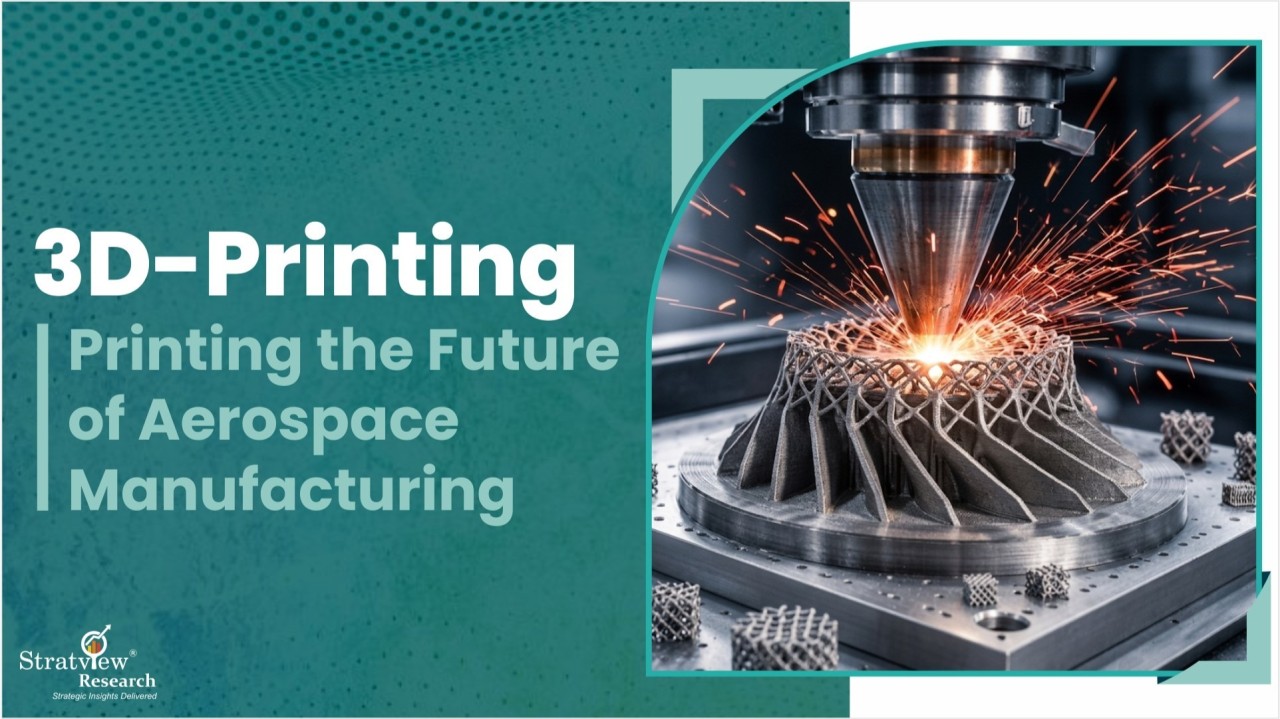
Aerospace was among the early adopters of additive manufacturing, initially using 3D printing for prototyping, tooling, and design validation. Its role has since expanded into aircraft interiors, structural components, space hardware, and engine components, bringing the technology closer to regular aircraft manufacturing.
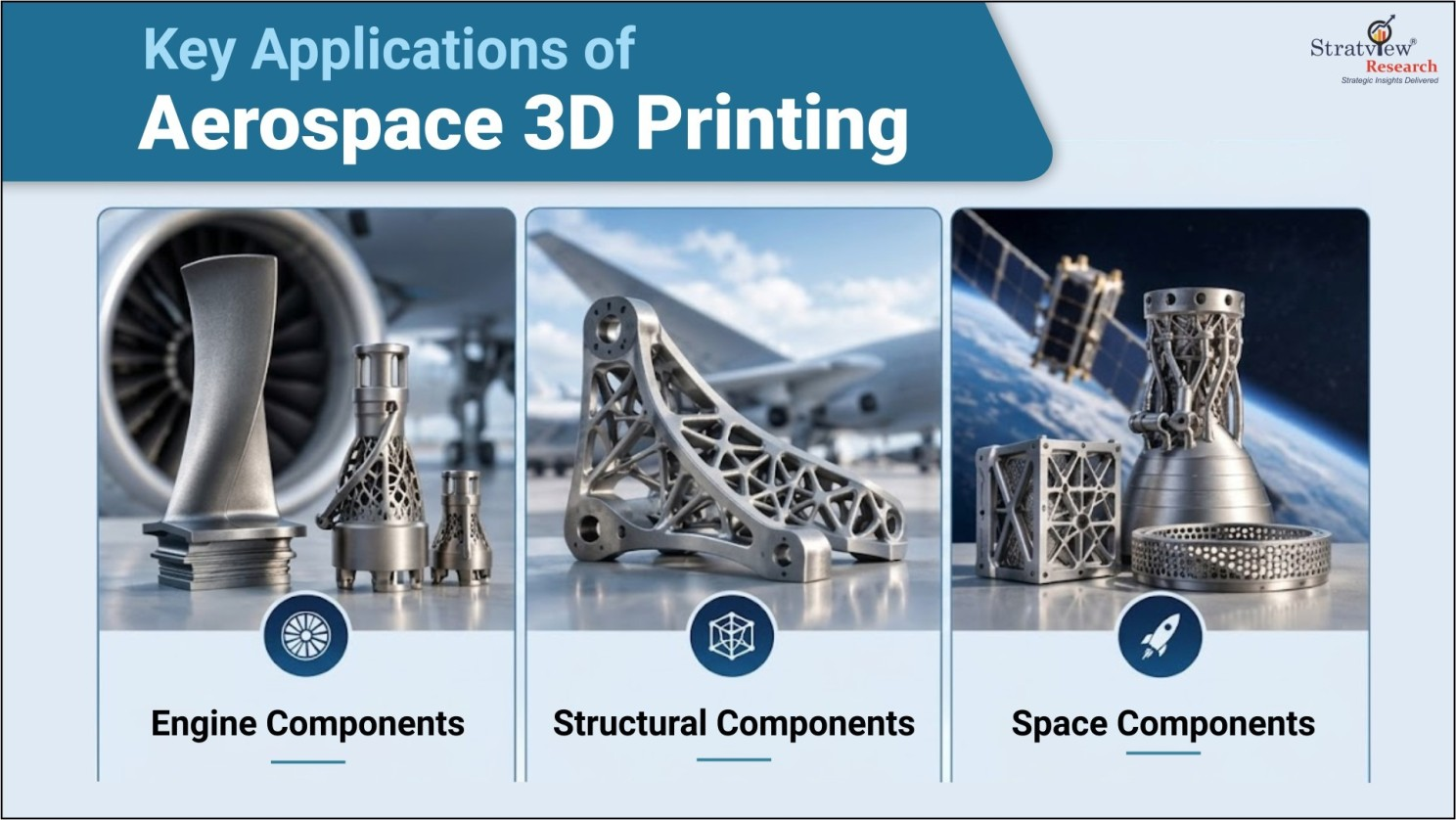
Image Courtesy of Stratview Research
Airbus provides a clear example of this progression. More than 25,000 flight-ready 3D-printed parts were produced annually for Airbus aircraft in 2025 using Stratasys technology, with applications across the A320, A350, and A400M programs. For selected A350 applications using Stratasys technology, the parts delivered a 43% weight reduction and an 85% reduction in lead time.
As more applications move into regular aircraft programs, the opportunity extends well beyond prototyping.
Which Sector Demands Most 3D Printing?
Aerospace 3D printing is already being used across civil aviation, military aircraft, and spacecraft, with civil aviation currently providing the biggest demand base. A key reason is the breadth of applications across commercial aircraft programs, where additive manufacturing is used for cabin and interior parts, structural components, tooling, spare parts, and propulsion applications. Airbus, for example, has integrated 3D-printed parts across its commercial aircraft programs, including the A320 and A350.

Image Courtesy of Stratview Research
Commercial aircraft programs therefore offer multiple routes for additive manufacturing to enter recurring production, particularly where parts benefit from shorter lead times, lower material use, design flexibility, or part consolidation.
Engine Components Lead the Way in Aerospace 3D Printing
Engine components have emerged as the biggest area of use for aerospace 3D printing. The attraction is closely tied to the technology’s ability to consolidate parts and create complex geometries without relying on conventional tooling.
GE Aerospace’s GE9X demonstrates this capability. Engineers combined more than 300 engine parts into just seven 3D-printed components, including a fuel nozzle tip, low-pressure turbine blades, and a heat exchanger.
Reducing the number of individual parts can simplify assembly while allowing multiple functions to be integrated into a single component. For engine applications, where geometry, weight, thermal performance, and manufacturing complexity all matter, this creates a clear manufacturing advantage for additive processes.
But proving the value of a component is only one part of scaling the technology. The next requirement is the capacity to manufacture such components repeatedly.
North America Is Building the Capacity
That production capability is becoming increasingly visible in North America, which is currently at the forefront of aerospace 3D printing adoption.
GE Aerospace invested $51 million in its Auburn, Alabama, facility in 2025 for additional 3D printers, equipment upgrades, and tooling to expand additive manufacturing capacity and quality. GKN Aerospace has also established a dedicated additive production line at its Newington, Connecticut, facility for the Pratt & Whitney GTF engine’s Fan Case Mount Ring, supporting the transition to serial production.
These investments show additive manufacturing becoming more embedded within established aerospace supply chains. As capacity expands, the focus is shifting toward producing qualified parts repeatedly and at economics that make sense for aerospace programs.
The Market is Scaling with Adoption
The market numbers point to how quickly aerospace 3D printing is gaining ground. The market is expected to expand from USD 3.4 billion in 2025 to USD 17.0 billion by 2034, representing a healthy CAGAR. This growth is being supported by the wider use of additive manufacturing across aircraft, propulsion, and space applications, as more 3D-printed components move into regular aerospace programs.
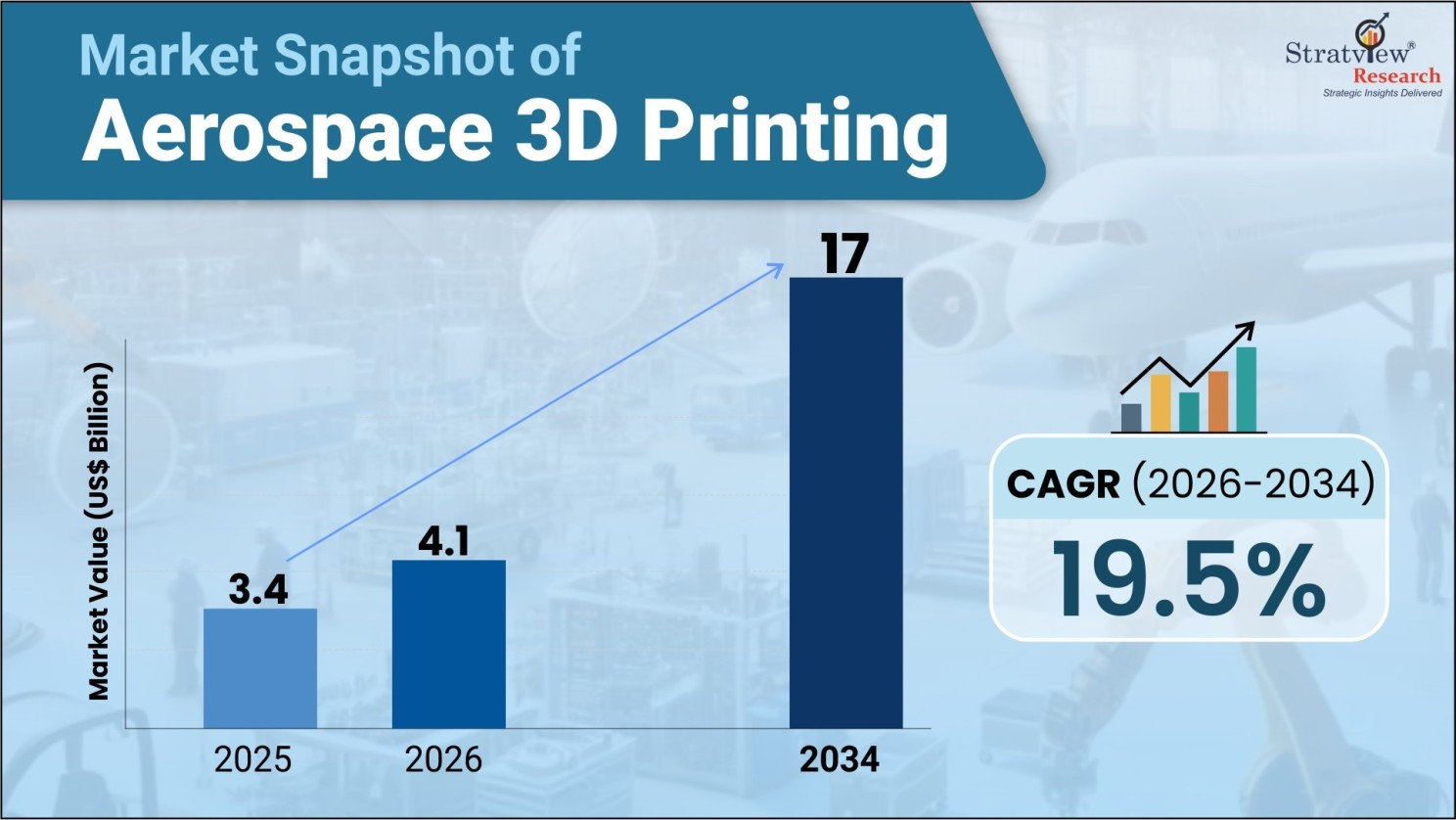
Image Courtesy of Stratview Research
The opportunity is also widening as new material and application pathways develop. Advancements in titanium 3D printing are opening opportunities for next-generation structural applications, while the growing adoption of additive manufacturing is driving demand for 3D-printed metal parts. Airbus, for instance, is advancing titanium wire-directed energy deposition for large structural components, with serial integration already underway on selected A350 parts.
As these applications progress toward qualified, repeatable manufacturing, they can create further avenues for additive manufacturing across aerospace programs.