Aerospace was never going to wait for 3D printing to mature before adopting it. The industry was among the first to use additive manufacturing commercially, starting in military aircraft shortly after its 1980s debut – and today holds the largest application share in the global 3D printing market at ~15–20%. It's a deliberate, decades-long bet that has largely paid off.
Today, the impact of that early adoption is visible across cost, performance, sustainability, and production efficiency.
The Economics of 3D Printing in Aerospace
The performance case for 3D printing in aerospace is well-documented by now: production timelines shrink from six months to a few weeks, material waste drops by up to 90%, and component weight falls by 40–50%. But the emissions story is equally compelling.
A study by Embry-Riddle Aeronautical University found that 3D-printed aerospace components deliver at least a ~40% reduction in both CO₂ emissions and energy consumption versus traditional manufacturing.
Protolabs Network adds another dimension: a single 3D-printed component can reduce an aircraft's lifetime fuel consumption by up to 5%. Multiply that across the 500+ 3D-printed parts found on wide-body aircraft like the B787, B777, and A350 family variants, and the cumulative impact becomes significant.
Those gains don't happen in a vacuum; they're the product of 3D printing's penetration into every major segment of aircraft production.
Where Aerospace Uses 3D Printing Most
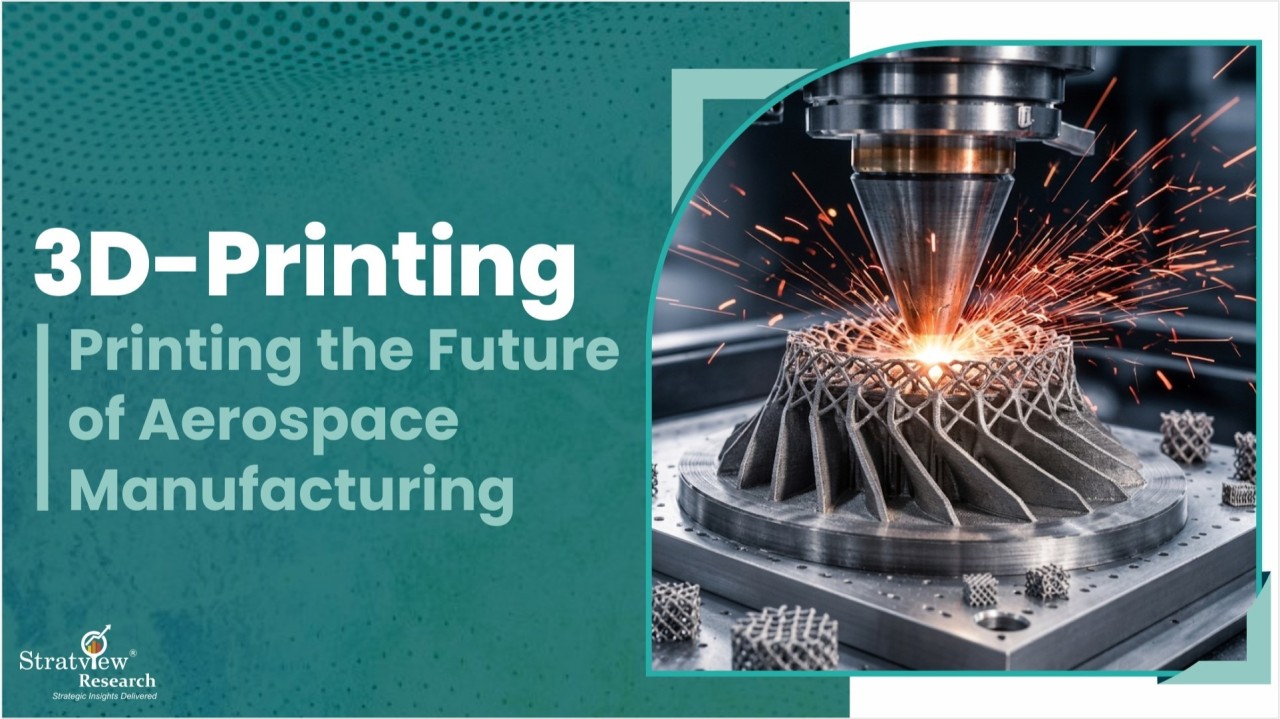
3D printing in aerospace has moved far beyond prototyping. Today, additive manufacturing is used across tooling, structural components, cabin interiors, and propulsion systems, producing parts such as ducts, support brackets, electrical housings, and lightweight structural assemblies.
Among all aerospace applications, engine components have emerged as one of the strongest use cases for additive manufacturing. The technology allows manufacturers to create highly complex geometries while reducing weight, material waste, and production steps. One of the most recognized examples is the GE9X engine, which incorporates ~300 3D-printed parts, including lightweight Titanium Aluminide engine blades, and was designed specifically for B777X jets.
The momentum extends across the broader aerospace value chain, including leading commercial aircraft makers (Airbus, Boeing, Bombardier, and Embraer) and engine suppliers (GE Aviation, Pratt & Whitney, Rolls-Royce, Safran).
North America Leads and Intends to Stay There
North America leads the aerospace 3D printing market, driven by the concentration of raw material suppliers and the dominance of major engine manufacturers such as GE Aerospace and Pratt & Whitney. The NA commercial fleet is projected to grow at 1.5% annually between 2023 and 2043, translating to roughly ~8,000 new aircraft deliveries, which is a part of a global addition of ~44,000 aircraft by 2043.
The region’s leadership is further reinforced by continued investments in advanced manufacturing infrastructure. In March 2026, GE Aerospace announced plans to invest more than €110 million across its European manufacturing sites to expand additive manufacturing, advanced machining, and engine testing capabilities supporting both commercial and defense engine programs, while also adding more than 1,000 new jobs.
In September 2025, GKN Aerospace expanded its Newington, Connecticut facility with a dedicated additive manufacturing production line for fan case mount rings used in Pratt & Whitney GTF engines powering the Airbus A220 and Embraer E195-E2, supported by a US$2.5 million state grant.
Market Outlook and What's Holding It Back
The aerospace 3D printing market reached approximately $3.5 billion in 2025 and is forecast to hit $17 billion by 2034, growing at a CAGR of ~20%.
That said, challenges still remain. Producing 3D-printed parts at a large scale can be expensive, and only a limited number of printable materials are currently approved for aircraft use by regulators like the FAA and EASA. As a result, fully 3D-printed aircraft are still far from reality. For now, the technology is proving most valuable where it performs best: manufacturing complex, lightweight, and high-performance aerospace components at production scale.