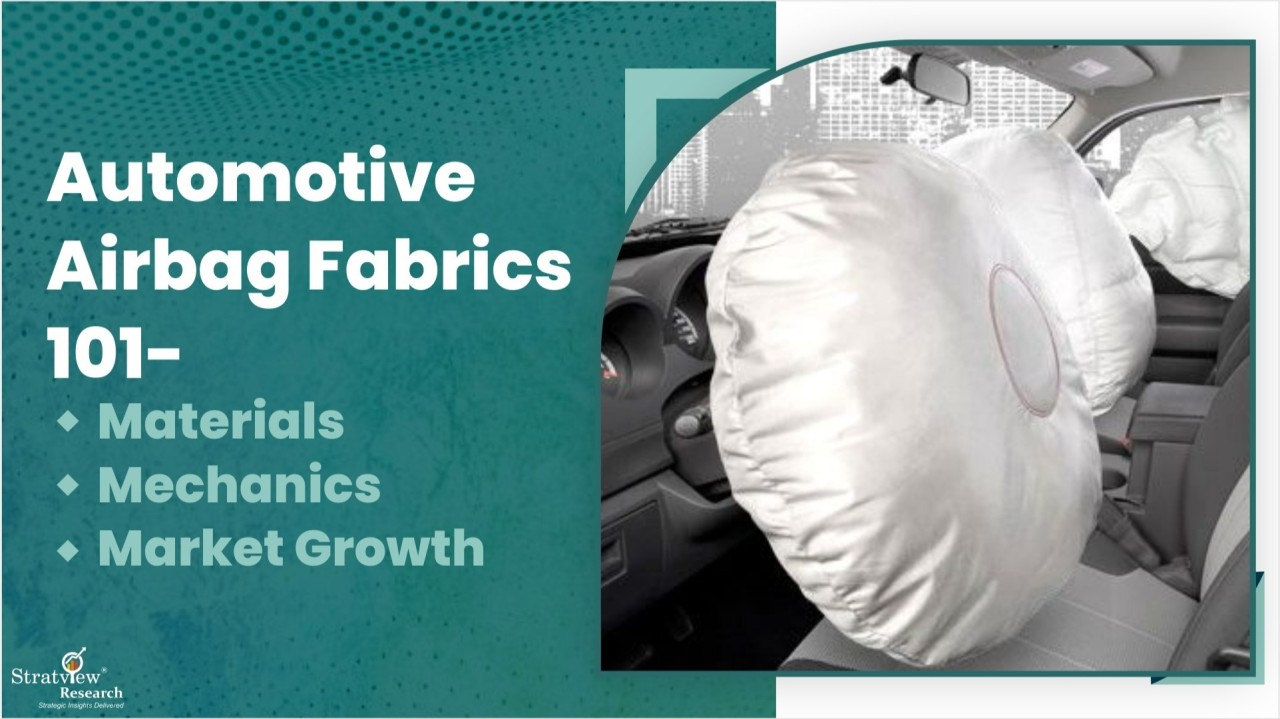
What Is Automotive Airbag Fabric?
Automotive airbag fabric is a high-performance safety material designed to keep vehicle occupants safe during a crash. Folded inside the airbag module, it deploys in milliseconds, absorbing impact and reducing injury.
To do this, the fabric must withstand intense mechanical loads, the heat generated during inflation, and years of being folded inside the vehicle, all while staying lightweight, compact, and dimensionally stable. Its performance directly affects how well a car’s restraint system protects passengers.
How Airbag Fabric Works:
Airbag deployment happens almost instantaneously, in under a second. The fabric plays a central role in every stage:
- Crash Detection – Sensors detect sudden deceleration and alert the airbag control unit. If the impact is severe enough, deployment begins.
- Inflator Activation – A small explosion in the inflator generates gas that inflates the airbag. The gas is filtered and cooled to protect the fabric. Inflation can reach speeds close to 200 mph.
- Rapid Expansion – Within 20–30 milliseconds, the folded airbag unfolds through the module cover. The fabric must handle both high pressure and heat without tearing.
- Cushioning the Occupant – Fully deployed, the airbag spreads the force of the crash across a wider area, lowering the risk of serious injury.
- Controlled Deflation – Gas escapes through vents in the fabric to prevent rebound and allow movement after the crash.
In just fractions of a second, the fabric determines whether the system performs perfectly or fails.
What’s it made of?
Airbag fabrics are carefully engineered using specific fibers, weaves, and coatings to meet safety, durability, and regulatory standards.
Common Fiber Materials
- Nylon 6,6 (Polyamide 66) – The most widely used fiber. Strong, heat-resistant, and durable, it handles repeated folding and high-speed deployment reliably.
- Polyester – Sometimes used for cost-sensitive applications or specific performance needs, but less common than Nylon 6,6.
Coated vs. Uncoated Fabrics
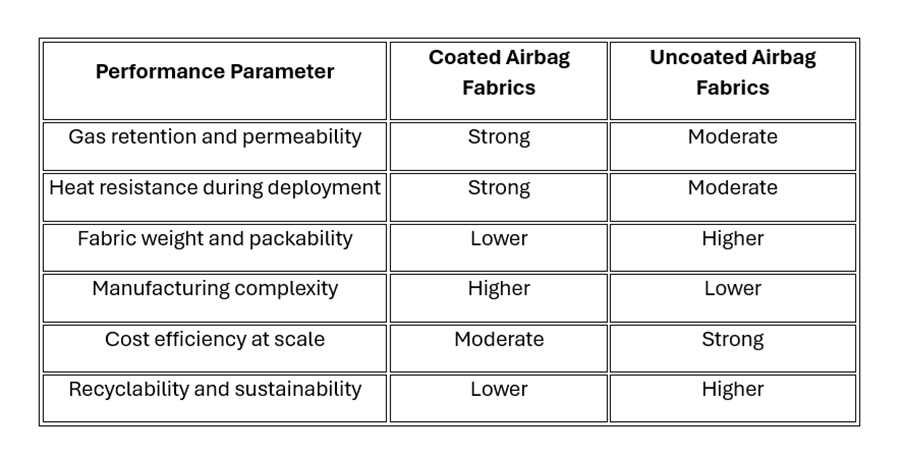
Source: Stratview Research
- Coated fabrics improve gas retention and resist heat, ideal for applications with high inflation pressure.
- Uncoated fabrics are lighter and increasingly used where weight and sustainability are priorities.
Where You Find Airbag Fabrics in a Vehicle
Airbag fabrics are used across a vehicle’s safety systems:
- Frontal airbags for driver and passenger
- Side airbags protecting the thorax
- Curtain airbags for head protection
- Knee airbags
- Center airbags between seats
As vehicles adopt more airbags, the demand for reliable fabrics continues to grow.
Why Airbag Fabric Matters
The fabric is critical because it delivers:
- High strength without adding unnecessary weight
- Stability under heat and pressure
- Consistent inflation and deflation behavior
- Durability during long-term folded storage
- Suitability for automated, high-volume production
A vehicle’s airbag system is only as good as the fabric it contains.
The Road Ahead
Airbag fabrics are evolving as cars get safer and regulations tighten. The automotive airbag fabric market, valued at USD 2.6 billion in 2024, is expected to reach USD 3.5 billion by 2031, driven by rising automotive production, innovations in fibers, weaves, and coatings.
Modern fabrics are not passive; they determine how well airbags protect passengers. As cars add more airbags and safety becomes more complex, the quality of the material itself will dictate how effectively crashes are managed.