Walk into any modern manufacturing facility and you'll find dashboards tracking machine utilization, production output, energy consumption, inventory movement, and workforce efficiency.
Every critical asset is monitored, measured, and optimized.
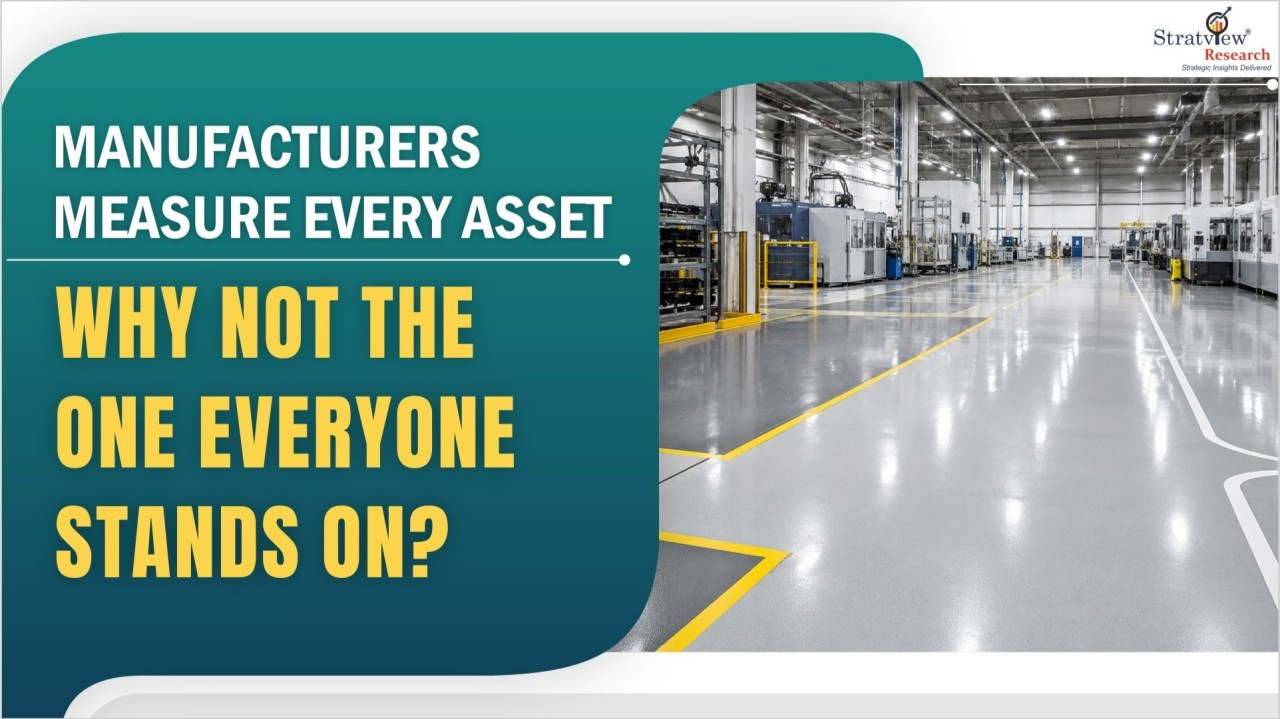
Yet one of the most heavily used assets in the facility often receives attention only when something goes wrong: the floor.
Despite supporting every aspect of daily operations, flooring has traditionally been treated as a maintenance item rather than a performance asset. That perception is changing.
The global industrial flooring market surpassed $5 billion in the year 2025 and is projected to exceed $6.8 billion by 2031. The growth is being driven by expanding manufacturing capacity, larger logistics networks, stricter safety requirements, and the rising cost of operational downtime.
Manufacturers are increasingly recognizing that flooring influences far more than the appearance of a facility. It plays a direct role in safety, uptime, and operational efficiency.
When the Floor Becomes a Business Problem
Most operational risks are easy to identify. A machine breakdown stops production. A supply chain disruption delays deliveries. A labor shortage impacts output.
Flooring failures are different. Unlike a machine breakdown that stops production immediately, their impact often appears as small inefficiencies that accumulate over time.
Damaged surfaces can create safety hazards, disrupt material flow, increase wear on equipment, and complicate maintenance activities. Studies continue to link faulty flooring to industrial slips and trips, among the most common workplace incidents across manufacturing environments.
This helps explain why industrial applications account for more than 75% of global performance flooring demand.
Unlike commercial buildings, industrial facilities expose flooring systems to continuous forklift traffic, heavy machinery loads, chemical exposure, abrasion, thermal cycling, and frequent cleaning procedures.
In these environments, flooring functions as part of the facility's operating infrastructure.
The Real Cost Isn't Installation. It's Interruption.
Historically, flooring selection was largely driven by durability and upfront cost. Today, operational continuity has become equally important. Epoxy remains the dominant material, accounting for more than 50% of the global industrial flooring market, thanks to its balance of strength, durability, and affordability. However, manufacturers are increasingly evaluating flooring systems based on how quickly operations can resume after installation or refurbishment.
A traditional epoxy system may require several days before reaching full operational readiness. For facilities operating continuously, that downtime can carry a significant cost.
This is one reason materials such as polyurethane cement, polyurethane resin, and MMA are gaining traction. MMA flooring systems, for example, can achieve full chemical and structural cure within hours, allowing facilities to return to service far more quickly.
As a result, flooring decisions are increasingly being evaluated through a business lens rather than a construction lens. In many facilities, the cost of a few days of lost production can easily outweigh the price difference between flooring systems.
Why the World's Fastest-Growing Facilities Are Investing Differently
The shift is especially visible in logistics, where operational efficiency depends on uninterrupted movement.
Large logistics operators, including Amazon and DHL, increasingly rely on facilities designed around seamless epoxy and polyurethane flooring systems that support continuous traffic and easier maintenance.
The same trend is spreading across aviation MRO facilities, food processing plants, healthcare environments, automotive manufacturing sites, and heavy industrial facilities.
While logistics is raising performance expectations, manufacturing expansion is creating the industry's largest volume opportunity. Industrial manufacturing continues to account for the largest share of flooring demand, driven by the intensity of machinery loads, impact requirements, and continuous operations.
That opportunity is most visible in Asia-Pacific, where more than 35% of global industrial flooring demand originates today.
Several factors are driving this leadership:
- China contributes roughly 30% of global manufacturing output
- APAC accounted for more than 60% of global vehicle production in 2025
- India continues to attract industrial investment as global supply chains diversify
Every new factory, warehouse, assembly line, and processing facility adds to demand for high-performance flooring systems. Not surprisingly, epoxy remains the dominant material across the region, accounting for more than 77% of industrial flooring usage in APAC due to its combination of performance and cost efficiency.
The Future: The Right Floor in the Right Place
Perhaps the most significant change underway is not the emergence of a breakthrough material. It is the move toward smarter flooring specification.
Manufacturers are increasingly adopting zone-specific flooring design, selecting materials based on the exact conditions of each area rather than applying a single system across the entire facility.
- Loading docks may require higher impact resistance
- Processing areas may require greater chemical resistance
- Healthcare environments may prioritize hygiene and ease of cleaning
- Warehouses may demand long-term durability under constant traffic
Flooring specifications are increasingly being tailored to the operating conditions of each area.
At the same time, sustainability is becoming a larger consideration. Low-VOC systems, antimicrobial surfaces, bio-based epoxy formulations, and easier-to-maintain flooring technologies are gaining traction as facilities seek to balance performance with environmental objectives.
For years, industrial flooring remained a background element of industrial facilities. That mindset is changing gradually.
Today, industrial flooring is increasingly being evaluated for what it actually influences: safety, productivity, uptime, and operational continuity. The companies recognizing that shift are no longer asking what a flooring system costs. They're asking what it protects.
TAGS: Core Material