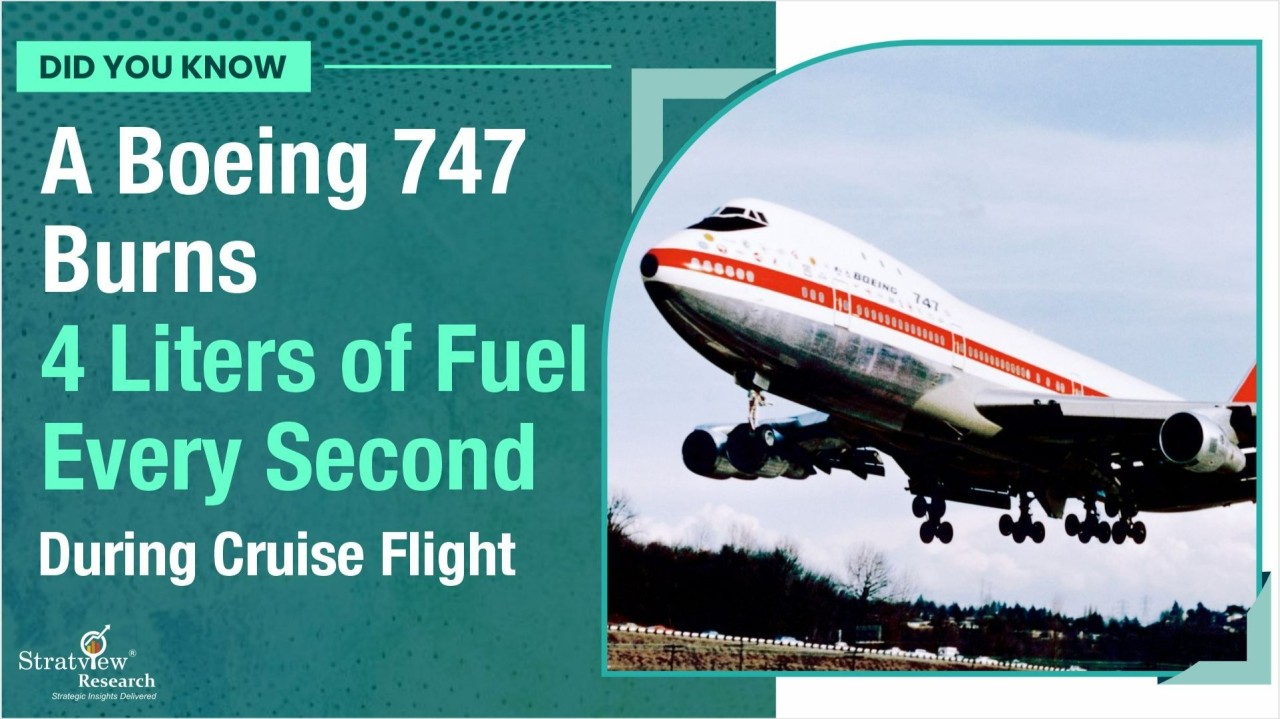
There is something remarkable about watching a Boeing 747 lift off the runway. Carrying hundreds of passengers and thousands of kilograms of cargo, the "Queen of the Skies" has crossed continents and oceans for decades with apparent ease. Behind that capability lies an extraordinary amount of energy.
During cruise flight, a classic Boeing 747-400 burns approximately 4 liters of jet fuel every single second. Not per minute - per second. Over a 10-hour long-haul flight, this translates to roughly 150,000 liters of fuel consumed from departure to arrival.
At first glance, that figure sounds staggering. But on its own, it tells only part of the story.
Scale Changes Everything
The Boeing 747 was designed to move large numbers of passengers efficiently over long distances. Depending on cabin layout, the aircraft can carry between 400 and 500 passengers. When you distribute that massive fuel burn across hundreds of travellers, the efficiency dynamic flips completely.
While a 747 burns roughly 5 gallons of fuel per mile, its capacity allows it to achieve approximately 100 passenger-miles per gallon. Viewed as a mass transportation system rather than a single machine, the aircraft's fuel economy is highly competitive with a standard commuter car.
Because fuel remains the single largest operating expense for airlines - directly influencing route economics and fleet planning, even fractional improvements in efficiency yield massive bottom-line savings over an aircraft's service life.
The 747's Legacy and Aviation's Evolution
When the Boeing 747 entered commercial service in 1970, the industry's priorities were different. Airlines were focused on increasing passenger capacity and extending route networks, while fuel efficiency was an afterthought compared to today's standards.
Over the decades, operational costs and modern carbon targets encouraged manufacturers to pursue more efficient aircraft architectures. Today, highly advanced widebodies like the Airbus A350 and the upcoming Boeing 777X perform the same long-haul missions once dominated by four-engine giants.
The Market Behind Aviation Fuel
The scale of aviation fuel consumption also explains why fuel has become a massive global industry in its own right.

According to our analysis, the global aviation fuel market was valued at approximately USD 201.4 billion in 2024 and is projected to reach USD 415.5 billion by 2032. Growth is being supported by rising passenger traffic, expanding air cargo activity, and increasing military aviation operations worldwide.
To meet tightening international climate mandates, the composition of this market is undergoing a structural shift:
- Sustainable Aviation Fuel (SAF): Produced from biomass, waste materials, and circular feedstocks, SAF is the fastest-growing market segment.
- Regulatory Compliance: Initiatives like ICAO’s CORSIA and the EU’s ReFuelEU program are legally mandating airlines to integrate lower-emission fuel blends into their fleets.
- The Scaling Challenge: While airlines and producers are signing major long-term supply agreements, SAF still accounts for less than 1% of global consumption. Scaling production remains the industry's largest infrastructure bottleneck.
While alternative concepts like hydrogen propulsion and hybrid-electric systems continue to advance, conventional jet fuel and SAF drops-ins will remain the dominant energy source for commercial aviation for the foreseeable future.
Four Liters Per Second - and a Much Bigger Story
The Boeing 747's fuel burn rate is a memorable statistic because it captures the sheer scale of commercial aviation in a single number.
While the passenger 747 is fading into retirement, its legacy lives on in the global cargo fleets keeping supply chains alive. More importantly, it highlights why fuel efficiency, alternative processing pathways, and next-generation propulsion have become top strategic priorities across the aerospace value chain.
TAGS: Aircraft Engine Aerospace & Defence
Subscribe to our newsletter
Related Blogs:
Aviation Growth Is Moving East into Lifecycle Services
Didn’t find what you were looking for?
Tell us about your requirements
(Our team usually responds within a few hours)