Often Overlooked, Yet Essential to Modern Vehicles
Whenever we step inside a vehicle, we instinctively notice the carefully designed interiors, carpets and flooring, seating systems, dashboard insulation, and headliners, etc., often without giving much thought to how it is achieved. What typically oes unnoticed are the nonwoven fabrics used in automotive applications that work behind these components.
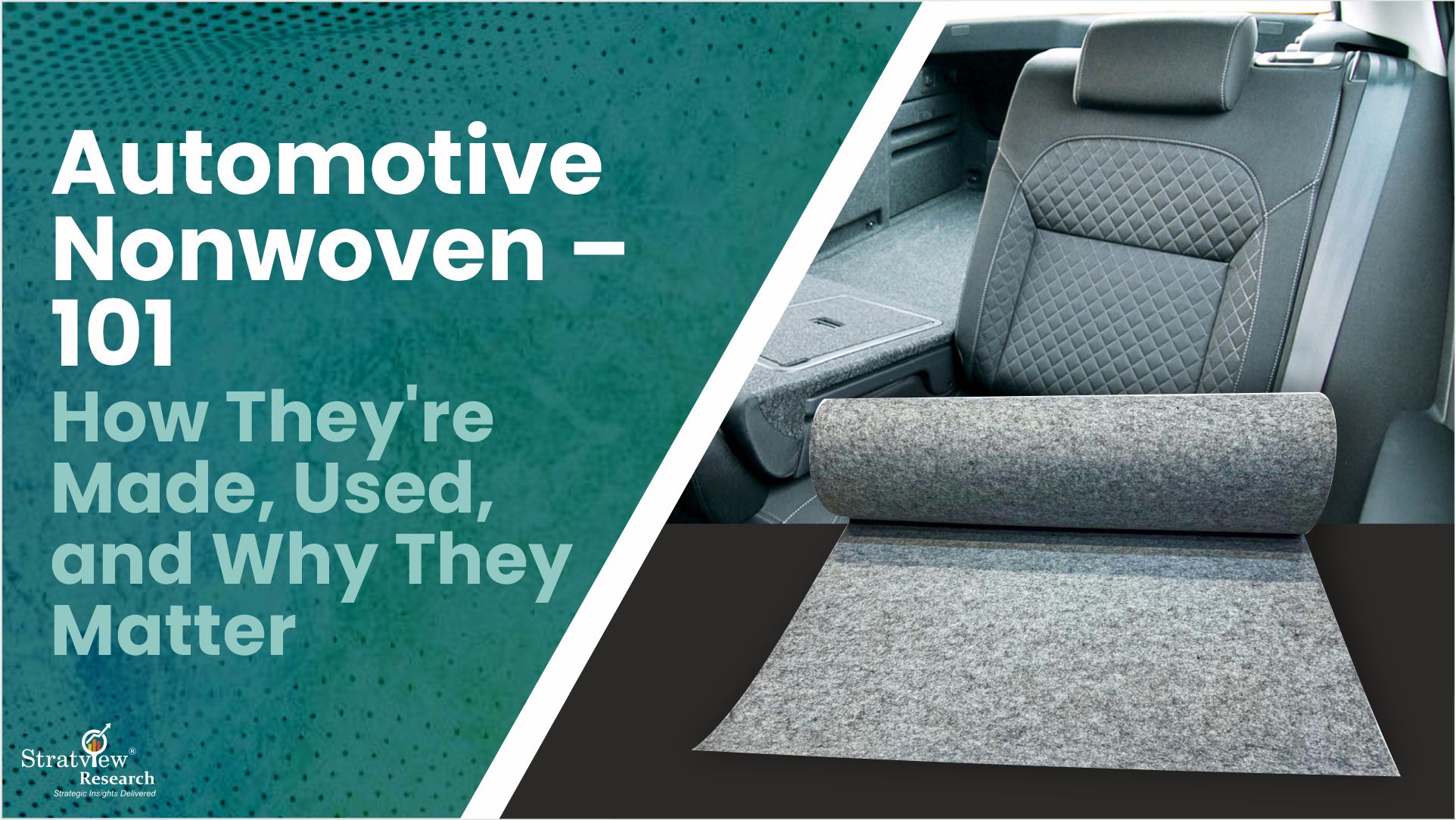
Automotive nonwoven fabrics refer to a category of engineered textiles made by bonding fibers together without weaving or knitting, specifically designed to meet automotive performance requirements. They are manufactured using processes such as spunlaid, meltblown, drylaid, airlaid, needlepunching, and hydroentangling, with each method shaping the material’s structure to suit different vehicle applications. This manufacturing flexibility allows nonwovens to deliver targeted performance while supporting modern vehicle design priorities.
Today, more than 40 automotive components, ranging from trunk liners and carpets to air and fuel filters, rely on nonwoven fabrics to deliver performance, comfort, and efficiency across the vehicle. This widespread adoption is driven by the inherent material advantages nonwovens bring to vehicle design.
Key Properties of Automotive Nonwovens
Lightweight is one of the defining properties of automotive nonwoven fabrics, supporting vehicle weight reduction and, in turn, improving fuel efficiency and extending electric vehicle range. In addition, their excellent acoustic absorption helps control noise, vibration, and harshness (NVH), delivering a quieter and more comfortable cabin. Their thermal insulation capabilities further support effective heat management across interior, underbody, and powertrain areas. In addition, nonwovens offer high design flexibility, enabling precise control over thickness, density, and stiffness. Their resistance to moisture, abrasion, and chemicals further ensures long-term durability in demanding automotive environments.
Common Applications of Nonwoven Fabrics Inside a Vehicle -

How Automotive Nonwovens Are Manufactured
1. Fiber Selection & Polymer Preparation - The process begins with selecting polymers such as polypropylene, polyester, or bio-based fibers based on required properties like strength, flexibility, heat resistance, and sustainability performance.
2. Fiber Formation (Extrusion) - The polymer is melted and extruded through spinnerets to form fibers. In spunbond processes, continuous filaments are drawn and cooled, while meltblown uses high-velocity hot air to create ultra-fine microfibers.
3. Web Formation & Laydown - The fibers are evenly deposited onto a moving conveyor or belt, forming a loose, uniform web. Controlled airflow and conveyor speed ensure consistent thickness and material distribution.
4. Bonding & Consolidation - The fiber web is bonded into a stable fabric using thermal bonding, needle-punching, or hydroentangling. This step defines the fabric’s strength, density, porosity, and functional performance.
5. Finishing & Functional Treatment - The bonded nonwoven may undergo coating, lamination, embossing, or treatment with fire retardants, water repellents, or acoustic enhancers to meet automotive standards.
6. Cutting & Automotive Integration - Finally, the finished nonwoven is slit, wound, cut, and molded into components such as headliners, trunk liners, insulation panels, carpets, and filtration media.
Road Ahead for Automotive Nonwoven
The push for improved fuel economy, driven by a combination of stricter government regulations and rising consumer expectations, is one of the key reasons for the adoption of lightweight materials in automotive manufacturing. As the automotive industry advances toward electric vehicles (EVs) and autonomous mobility, automotive nonwovens are expected to assume a more critical role in meeting evolving requirements for comfort, safety, thermal management, and sustainability.
Looking ahead, automotive nonwoven fabrics are increasingly shaped by trends toward lightweighting, sustainability, and enhanced multifunctionality. Our analysis forecasts that the global automotive nonwoven market – which was valued at ~USD 3.5 billion in 2024 is expected to cross USD 3.7 billion this year (2025), and USD 4.7 billion by 2031, reflecting steady demand driven by lightweighting initiatives, and increasing nonwoven penetration per vehicle.
TAGS: Composites