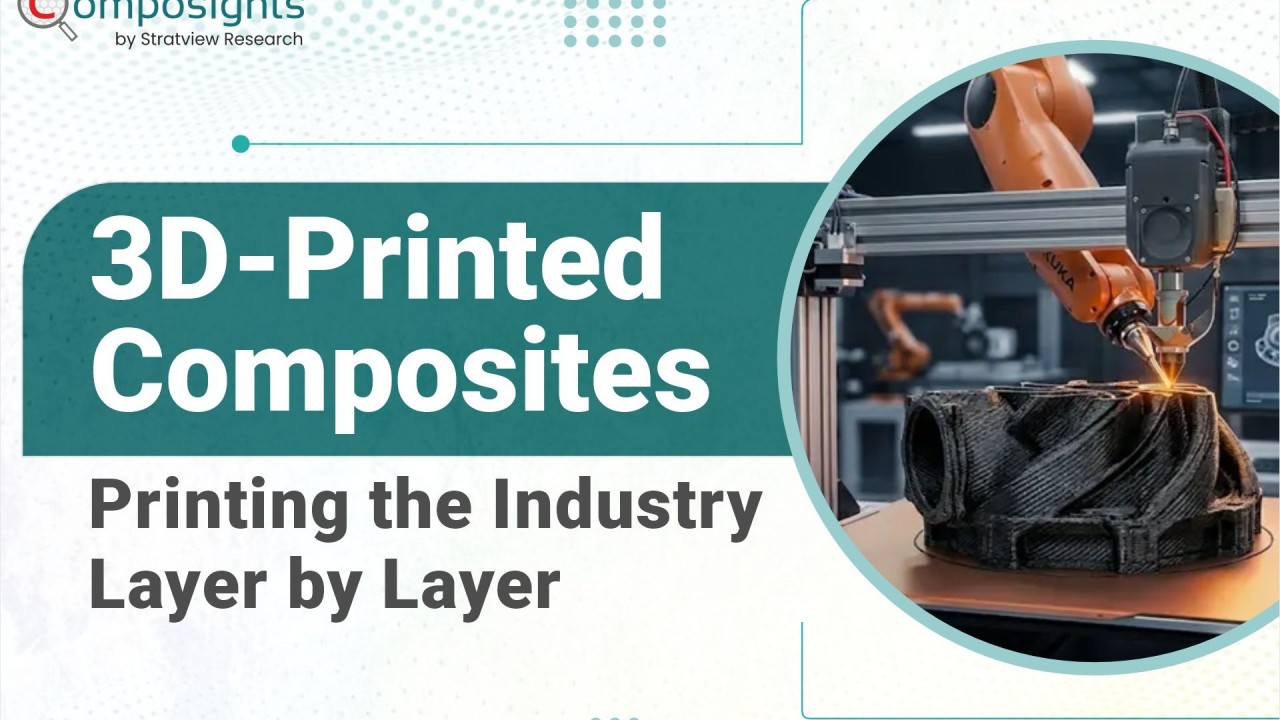
Labelled the world's first 3D-printed water taxi, the vessel showcases how far additive manufacturing has progressed beyond prototyping. Produced using large-scale additive manufacturing and glass-fiber-reinforced composite materials, the boat's two hulls were printed in just 5.5 days each using CEAD's Flexbot system, one of the world's largest robot-based additive manufacturing platforms. The vessel incorporates 67% recycled materials, including 30% fiberglass and UV stabilizers, highlighting the technology's potential to support more sustainable manufacturing.
Designed to accommodate 29 passengers, carry a payload of 6.4 tons, and operate using electric thrusters, the project demonstrates that composite 3D printing is increasingly being used to manufacture large-scale, structural, and commercially viable end-use products.
And this also reflects a broader shift as composite additive manufacturing moves from niche applications to mainstream production across aerospace, automotive, and other industries.
A Market Scaling at Near-Hypersonic Speed
The numbers here are hard to ignore. As per Stratview Research, the global 3D-printed composites market stood at USD >240 million in 2025 and is on track to hit USD >310 million in 2026.
What’s more surprising is that – by 2034, the market will reach USD ~2,380 million, roughly 7.5 times the 2026 figure.
Behind this growth are the three forces. First, lightweighting: composite 3D printing delivers superior strength-to-weight ratios where every gram matters. Second, economics: reduced tooling, lower waste, and part consolidation improve manufacturing efficiency. Third, design freedom: enabling lattice structures, internal channels, and optimized geometries that traditional manufacturing methods cannot easily achieve.
Recent Breakthroughs Highlight the Industry’s Direction
Globally, the demand for 3d printed composites has been growing. Recent developments highlight the growing industrial acceptance.
In 2025, Continuous Composites secured U.S. Air Force funding to advance its CF3D® continuous-fiber 3D-printing technology for high-temperature aerospace structures and flight-ready components.
In 2026, RUSAL launched RS-770K, an aluminium-ceramic metal-matrix composite for additive manufacturing, offering a tensile strength of 615 MPa, about 30% higher than the company's strongest aluminium powder alloy.
While these are just a few to count, there are a lot more developments in this way that reflect a broader shift toward combining composites with additive manufacturing to deliver lighter, stronger, and less waste-intensive products.
The Material Behind the Rapid Adoption
In 3D-printed composites, Carbon fiber, glass fiber, aramid fiber, and similar materials serve as reinforcements, providing the mechanical properties required for structural performance. These reinforcements can then be incorporated into different composite formats, the most common being continuous fiber composites and discontinuous (short-fiber) composites.
Continuous fiber composites are the most sought-after composite type, delivering 2–3 times higher tensile and flexural strength compared to short-fiber variants. That performance gap makes them the go-to choice for structural applications in aerospace and automotive.
While carbon fiber remains the reinforcement material of choice for high-performance 3D-printed composite applications. Roughly 30% lighter than glass fiber while delivering superior stiffness and fatigue resistance, it provides an attractive balance of weight savings and structural integrity. Glass fiber remains widely used where affordability and versatility are key priorities. For fabrication of these composites, extrusion is the most widely used process, prized for its scalability, accessibility, and natural compatibility with continuous fiber deposition systems.
A Market Led by Manufacturing Innovation
North America remains the largest and most mature market for 3D-printed composites, backed by a robust aerospace and defense sector, sustained investments in advanced manufacturing technologies, and the presence of leading additive manufacturing companies such as Stratasys, 3D Systems, Markforged, and Arevo.
However, the global growth in demand for 3D-printed composite materials is not hidden.
Across aerospace, automotive, defense, energy, industrial equipment, and other end-use industries, 3d printing is steadily evolving into a production-ready manufacturing approach.
As these end-use industries continue to expand and performance requirements become more demanding, composites are expected to remain at the center of material innovation. At the same time, 3D printing offers manufacturers a pathway to greater design freedom, shorter lead times, and more efficient material utilization. The result the entire world will see is a growing integration of the two – ‘3D-printed composites’.