




404
+1-313-307-4176

Cryogenic Insulation Market Growth Analysis | 2024-2030

Cryogenic Insulation Market Size, Share, Trends, Dynamics, Forecast, & Growth Analysis: 2024-2030
Cryogenic Insulation Market is segmented by Material Type (PU & PIR, Cellular Glass, Polystyrene Foam, Fiberglass, Perlite, and Others), by Form Type (Bulk-fill, Foam, and Multi-layer), by Cryogenic Equipment Type (Tanks, Valves, Vaporizers, Pumps, and Others), by End-Use Industry Type (Energy & Power, Chemicals, Metallurgical, Electronics, Shipping, and Others), and by Region (North America [The USA, Canada, and Mexico], Europe [Germany, France, The U.K., Russia, and Rest of Europe], Asia-Pacific [China, Japan, India, South Korea, and Rest of Asia-Pacific], and Rest of the World [Brazil, Saudi Arabia, Israel, and Others])
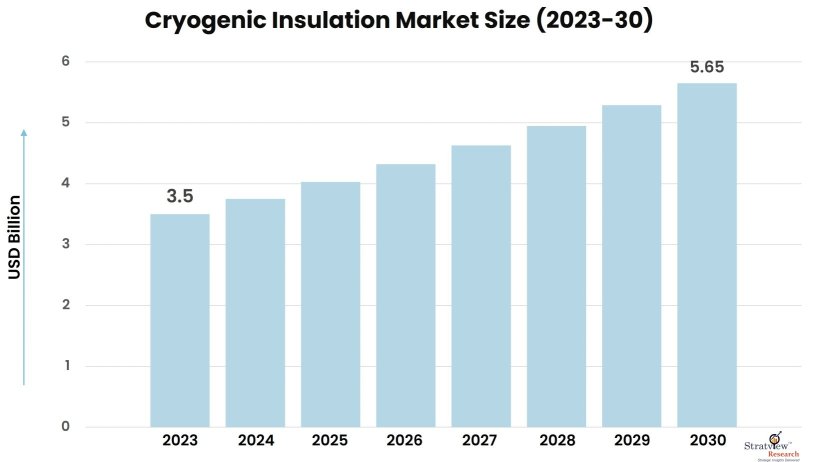
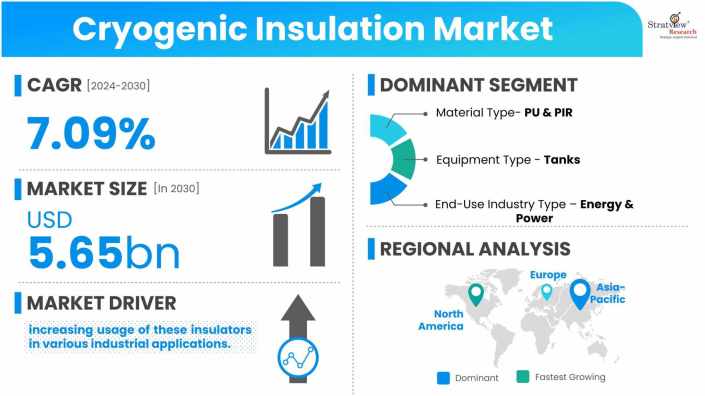
The cryogenic insulation market was estimated at USD 3.5 billion in 2023 and is likely to grow at a CAGR of 7.09% during 2024-2030 to reach USD 5.65 billion in 2030.
Wish to get a free sample? Register Here
Cryogenic insulation has a wide range of applications in the storage and transport sector of the energy & power industry. Liquefied natural gas (LNG) expands by 600 times when it is transformed from liquid to gaseous state. Volume is an important economic and technical aspect when transporting or storing this raw material. The gas will only maintain its liquid state at a temperature of less than -163 °C. Therefore, the high-quality and dependable insulation of pipelines, processing plants, transport, and storage vessels is, thus a vital part of the LNG business.
The major factors driving the growth of the cryogenic insulation market are:
Want to have a closer look at this market report? Click Here
The following are the key players in the Cryogenic Insulation Market (arranged alphabetically)
Note: The above list does not necessarily include all the top players in the market.
Are you the leading player in this market? We would love to include your name. Write to us at [email protected]
|
Segmentations |
List of Sub-Segments |
Segments with High Growth Opportunity |
|
Material Type Analysis |
PU & PIR, Cellular Glass, Polystyrene Foam, Fiberglass, Perlite, and Others |
The PU & PIR segment held the largest share of the market in 2023 and is expected to remain dominant during the forecast period. |
|
Cryogenic Equipment Type Analysis |
Tanks, Valves, Vaporizers, Pumps, and Others |
Tanks segment dominates the market during the forecast period. |
|
End-Use Industry Type Analysis |
Energy & Power, Chemicals, Metallurgical, Electronics, Shipping, and Others |
The energy and power industry is expected to grow as a result of the increasing demand for LNG as fuel. |
|
Regional Analysis |
North America, Europe, Asia-Pacific, and Rest of the World |
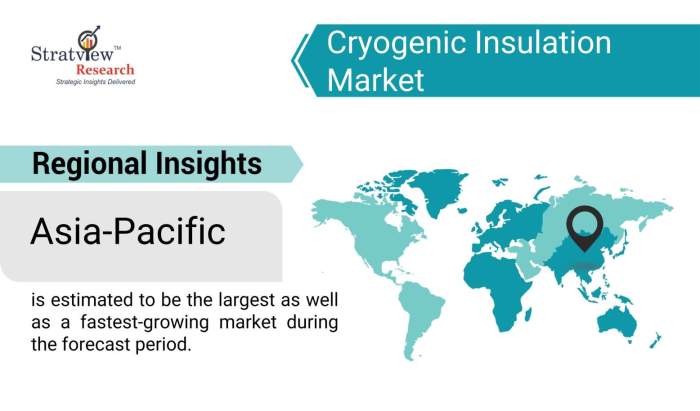
Asia-Pacific is estimated to be the largest as well as the fastest-growing market during the forecast period. |
"PU & PIR segment held the largest share of the market in 2023."
"Tanks segment dominates the market during the forecast period."
"The energy and power industry is expected to grow as a result of the increasing demand for LNG as fuel."
"Asia-Pacific is estimated to be the largest as well as the fastest-growing market during the forecast period."
Know the high-growth countries in this report, Register Here
This report provides market intelligence in the most comprehensive way. The report structure has been kept such that it offers maximum business value. It provides critical insights into market dynamics and will enable strategic decision-making for existing market players as well as those willing to enter the market. The following are the key features of the report:
Market Segmentation
This report studies the market, covering 12 years of trend and forecast. The report provides detailed insights into the market dynamics to enable informed business decision-making and growth strategy formulation based on the opportunities present in the market.
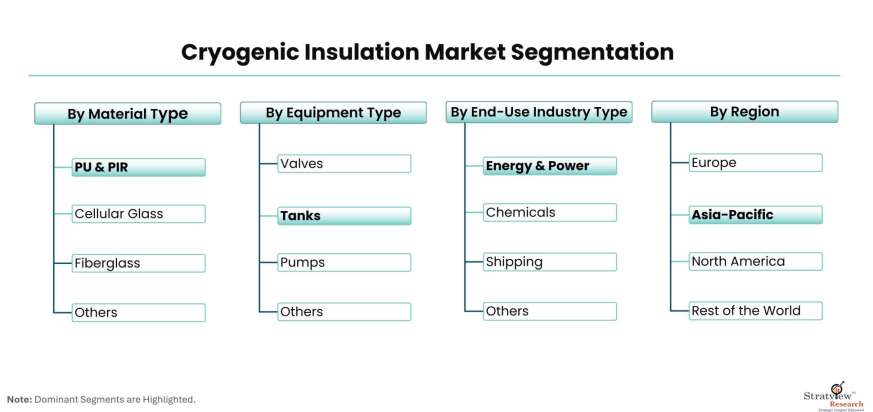
The cryogenic insulation market is segmented into the following categories:
By Material Type
By Form Type
By Cryogenic Equipment Type
By End-Use Industry Type
By Region
Want to know the most attractive market segments? Register Here
With this detailed report, Stratview Research offers one of the following free customization options to our respectable clients:
Company Profiling
Market Segmentation
Competitive Benchmarking
Custom Research: Stratview Research offers custom research services across sectors. In case of any custom research requirement related to market assessment, competitive benchmarking, sourcing and procurement, target screening, and others, please send your inquiry to [email protected].
The report is delivered digitally through our online portal. Buyers receive login credentials from our team to access the report and may update their credentials at any time after the initial login.
Delivery timelines depend on the status of the report:
For the most accurate delivery timeline, please contact us to confirm the current status of the report.
Yes. You may request a complimentary preview of the report through a video conference with our team.
Yes. The scope of the report can be fully customized to align with your specific research objectives and information requirements.
Please contact us at [email protected], and our team will be happy to discuss your requirements and propose a tailored solution.
Yes. Selected sections of the report can be purchased separately based on your requirements. Please contact us at [email protected] to discuss your needs.
Yes, AI can help gather publicly available information, but its outputs are only as reliable as the data it accesses. Stratview Research reports are built using validated data, extensive primary interviews with industry stakeholders, and the expertise of our experienced research team.
Additionally, many critical insights, including market dynamics, competitive intelligence, and industry-specific trends, are not publicly available and therefore cannot be captured through AI alone.
Cryogenic insulation has a wide range of applications in the storage and transport sector of the energy & power industry. Liquefied natural gas (LNG) expands by 600 times when it is transformed from liquid to gaseous state. Volume is an important economic and technical aspect when transporting or storing this raw material. The gas will only maintain its liquid state at a temperature of less than -163 °C. Therefore, the high-quality and dependable insulation of pipelines, processing plants, transport, and storage vessels is, thus a vital part of the LNG business.
The cryogenic insulation market was estimated at USD 3.5 billion in 2023.
The cryogenic insulation market is likely to reach USD 5.65 billion in 2030.
The cryogenic insulation market is likely to grow at a CAGR of 7.09% during 2024-2030.
Armacell International Holding GmbH, Lydall Inc., BASF SE, Cabot Corporation, Rochling Group, and Johns Manville Inc. are among the top players in the market.
Asia-Pacific is expected to remain the largest market during the next six years.
The PU & PIR segment is expected to remain the dominant material type in the market.
The major factor driving the cryogenic insulation market is increasing usage of these insulators in various industrial applications, such as LNG as fuel, rising demand for transportation and storage of liquefied gases.


WE ACCEPT