




404
+1-313-307-4176

Military 3D Printing Market Analysis | 2026-2034

Military 3D Printing Market Size, Share, Trend, Forecast, Competitive Landscape & Growth Opportunities: 2026-2034
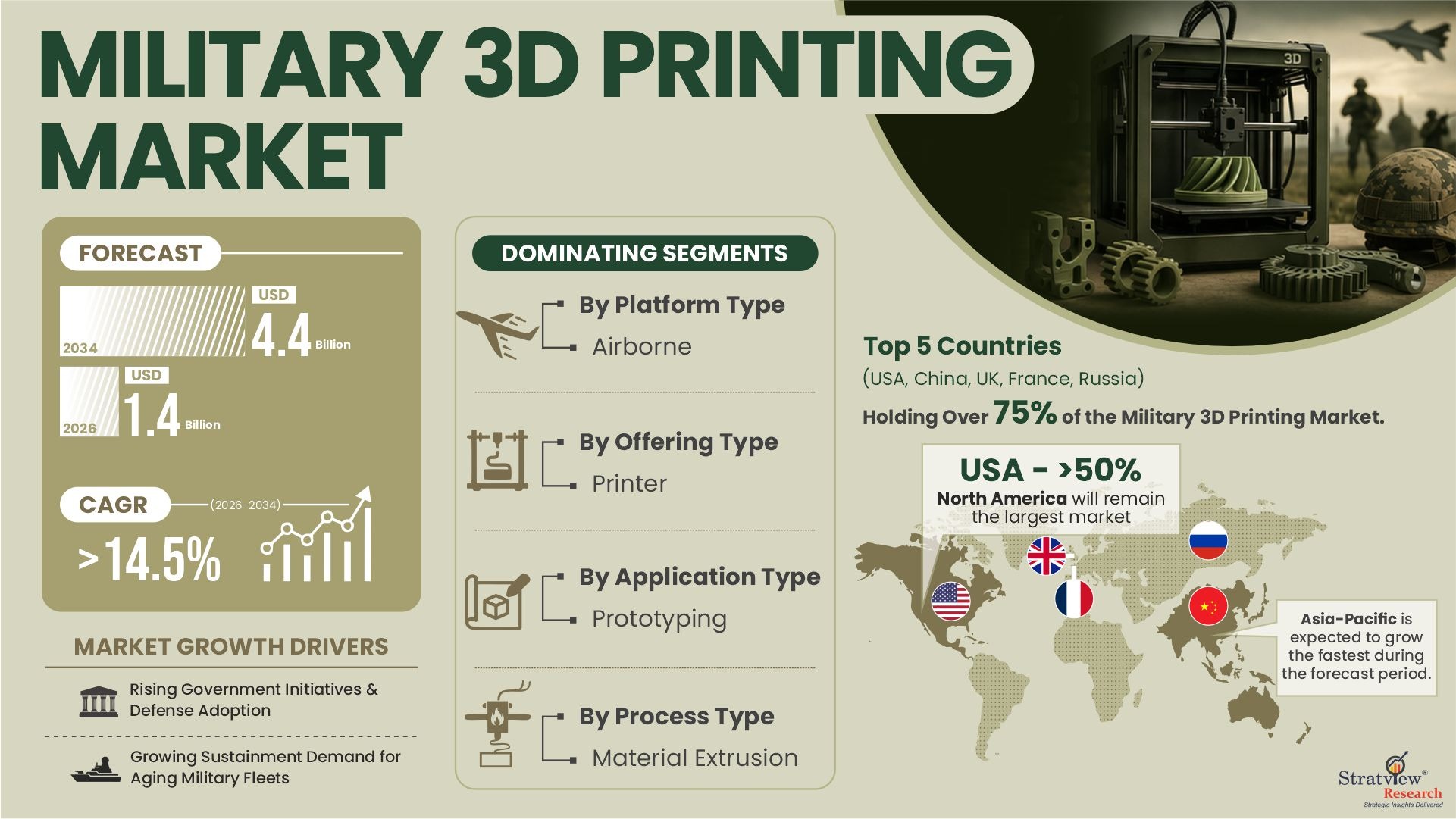
The annual demand for military 3D printing was USD 1.3 billion in 2025 and is expected to reach USD 1.4 billion in 2026, reflecting a year-over-year (YoY) growth of 15.3% compared with 2025.
During the forecast period (2026-2034), the military 3D printing market is expected to grow at a CAGR of 14.8%. The annual demand will reach USD 4.4 billion in 2034.
During 2026-2034, the military 3D printing industry is expected to generate a cumulative sales opportunity of USD 24.1 billion.
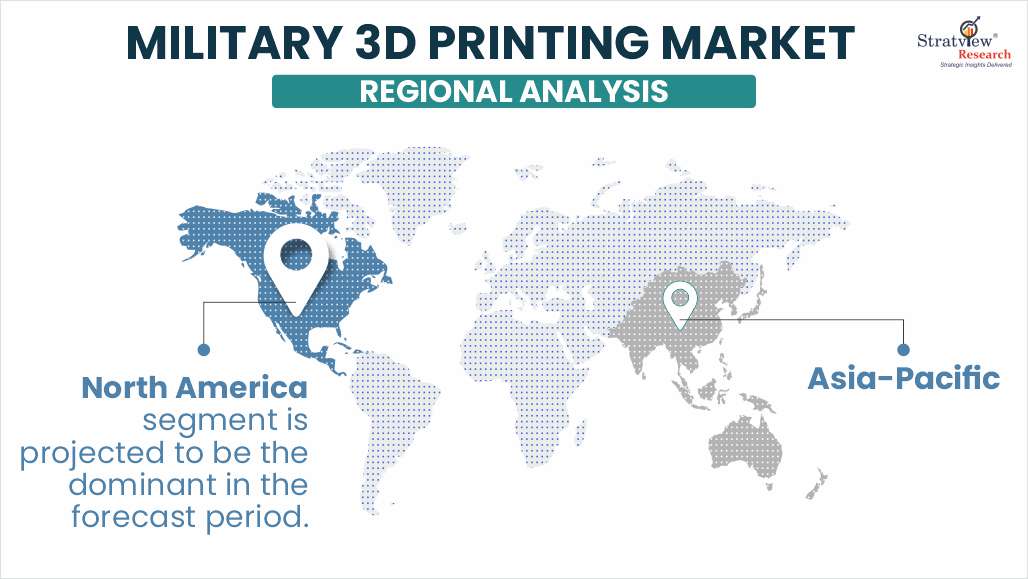
North America will remain the largest market, while the Asia-Pacific is expected to grow the fastest during the forecast period.
By platform type, airborne platform is the largest and the fastest-growing platform type in the market during the forecast period.
By offering type, printers are expected to remain the dominant offering type in the market during the forecast period.
By application type, prototyping applications will remain the largest application type in the market during the forecast period.
By process type, material extrusion will remain the most preferred process type in the market during the forecast period.
Want to get deeper insights? Click Here!
Have a look at the sales opportunities presented by the military 3D printing market in terms of growth and market forecast.
|
Military 3D Printing Market Data & Statistics |
||
|
Market Statistics |
Value (in USD Billion) |
Market Growth (%) |
|
Annual Market Size in 2024 |
USD 1.1 billion |
- |
|
Annual Market Size in 2025 |
USD 1.3 billion |
YoY Growth in 2025: 15.5% |
|
Annual Market Size in 2026 |
USD 1.4 billion |
YoY Growth in 2026: 15.3% |
|
Annual Market Size in 2034 |
USD 4.4 billion |
CAGR 2026-2034: 14.8% |
|
Cumulative Sales Opportunity during 2026-2034 |
USD 24.1 billion |
- |
|
Top 10 Countries’ Market Share in 2025 |
USD 1.0 billion+ |
> 80% |
|
Top 10 Companies’ Market Share in 2025 |
USD 0.6 billion - USD 0.9 billion |
50% - 70% |
Military 3D printing refers to the use of additive manufacturing technologies in defense applications to produce spare parts, tools, and mission-critical components directly from digital designs. Technologies such as material extrusion, powder bed fusion, and directed energy deposition enable layer-by-layer fabrication of complex geometries with high precision and minimal material waste.
Military 3D printing is increasingly used by defense organizations globally to support on-demand manufacturing, rapid prototyping, and battlefield logistics. Leading agencies such as the U.S. Department of Defense are actively deploying additive manufacturing capabilities, enabling production of components at forward bases, reducing supply chain dependency, and improving operational readiness.
Rising Government Initiatives and Global Defense Adoption of Military 3D Printing
The military 3D printing market is witnessing strong growth driven by increasing government-led adoption of additive manufacturing for defense logistics and sustainment operations. Defense forces globally are integrating 3D printing to enable on-demand production of spare parts, reduce logistics dependency, and enhance operational readiness across deployed environments.
For instance, the Indian Army’s participation in the National Additive Manufacturing Symposium 2026 highlights the growing focus on integrating 3D printing into military logistics and field-level manufacturing. Similarly, the U.S. Department of Defense continues to expand additive manufacturing capabilities, including deployable production units and digital inventory systems to support real-time part manufacturing.
In addition, defense collaboration under NATO is promoting the use of additive manufacturing for the standardization of spare parts and interoperability across allied forces, reinforcing the shift toward distributed and localized defense manufacturing systems. This growing global adoption is directly accelerating the demand for military 3D printing technologies.
Increasing Sustainment Demand for Aging Global Military Fleets
Aging defense platforms across military aircraft, armored vehicles, and naval vessels are significantly accelerating demand for military 3D printing for spare parts and MRO applications. The U.S. Department of Defense reported that the average age of U.S. Air Force aircraft exceeded 28 years, while similar aging trends are observed across NATO and allied fleets.
This has increased demand for on-demand manufacturing of obsolete and low-volume parts, where traditional supply chains face lead times of several weeks. Additive manufacturing enables rapid, tool-less production within 24–72 hours, improving fleet readiness, reducing inventory costs, and strengthening defense supply chain resilience.
Market Opportunities
Increasing Certification of Flight-Critical and End-Use Military Components
Advancements in metal additive manufacturing technologies and high-performance defense-grade materials are creating strong opportunities for the production of certified end-use and mission-critical components. Leading aerospace and defense OEMs such as Boeing have already deployed 70,000+ 3D-printed parts across commercial and defense platforms, indicating growing confidence in additive manufacturing for real-world applications.
As certification frameworks evolve for flight-critical, structural, and high-load components, military 3D printing is expected to transition from prototyping to serial production of qualified parts, unlocking high-value applications in aircraft, UAVs, and advanced defense systems.
Expansion of Digital Inventory and Point-of-Need Manufacturing Networks
The transition toward digital inventory systems and point-of-need manufacturing in defense logistics is expected to unlock significant growth opportunities for military 3D printing. Defense organizations, including the U.S. Department of Defense and NATO, are increasingly developing secure digital part libraries, where components are stored as certified design files rather than physical inventory.
This enables distributed additive manufacturing across forward bases, naval vessels, and maintenance hubs, reducing logistics costs and minimizing supply chain vulnerabilities. The shift toward “print-on-demand spare parts for military platforms” is expected to significantly expand adoption over the forecast period.
|
Segmentations |
List of Sub-segments |
Dominant/Fastest Growing Segment |
|
Platform Analysis |
Airborne, Naval, and Land. |
Airborne platforms are the largest and fastest-growing platform type in the market during the forecast period. |
|
Offering Analysis |
Printer, Material, Software, and Service |
Printers are expected to remain the dominant offering type in the market during the forecast period. |
|
Application Analysis |
Prototyping, Parts Manufacturing, and Tooling. |
Prototyping applications will remain the largest application type in the market during the forecast period. |
|
Process Analysis |
Material Extrusion, Powder Bed Fusion, Vat Photopolymerization, Binder Jetting, Directed Energy Deposition, and Others. |
Material extrusion will remain the most preferred process type in the market during the forecast period. |
|
Regional Analysis |
North America, Europe, Asia-Pacific, and the Rest of the World. |
North America will remain the largest market, while the Asia-Pacific is expected to grow the fastest during the forecast period. |
“Airborne Platform Leads Driven by Aircraft MRO and UAV Manufacturing Demand”
Based on platform, the military 3D printing market is segmented into airborne, naval, and land.
The airborne segment dominates, driven by rising use of military 3D printing for aircraft spare parts, UAV components, and lightweight aerospace structures. Additive manufacturing enables complex geometries and weight reduction, which are critical for aviation performance and fuel efficiency.
This enables faster aircraft maintenance, repair, and overhaul (MRO), reduced downtime, and improved fleet readiness, positioning airborne platforms as the primary demand center.
“Industrial and Field-Deployable Printers Drive Core Market Demand”
Based on offering, the market is segmented into printers, materials, software, and services.
Printers dominate due to increasing procurement of industrial-grade and field-deployable additive manufacturing systems across defense organizations. These systems enable secure, on-site production of military spare parts, reducing dependency on centralized supply chains.
This supports point-of-need manufacturing, faster logistics response, and enhanced defense supply chain resilience, driving sustained equipment demand.
By Application Type
“Rapid Prototyping Anchors Defense Innovation and Development Cycles”
Based on application, the market is segmented into prototyping, parts manufacturing, and tooling.
Prototyping remains the largest segment, driven by military 3D printing for rapid prototyping of mission-critical and high-performance components. Additive manufacturing enables real-time design iteration, validation, and functional testing, significantly reducing development timelines.
Rapid prototyping accelerates defense R&D efficiency, system innovation, and time-to-deployment, making it the most widely adopted use case.
“Material Extrusion Gains Preference for Low-Cost, Field-Level Manufacturing”
Based on process, the market is segmented into material extrusion, powder bed fusion, vat photopolymerization, binder jetting, directed energy deposition, and others.
Material extrusion dominates due to its cost efficiency, operational simplicity, and suitability for portable 3D printing systems. It is widely used for producing non-critical components, tools, and maintenance parts in military environments.
This enables expeditionary manufacturing and decentralized production, supporting on-site operations in remote and combat zones.
“North America Dominates While Asia-Pacific Accelerates with Defense Localization”
Based on region, the market is segmented into North America, Europe, Asia-Pacific, and the Rest of the World.
North America leads due to strong investments by the U.S. Department of Defense and early adoption of defense additive manufacturing technologies across major OEMs and military programs.
Asia-Pacific is the fastest-growing region, driven by defense modernization, rising military expenditure, and increasing focus on indigenous additive manufacturing capabilities.
Want to get more details about the segmentations? Register Here
Most of the major players compete in some of the factors, including price, service offerings, and regional presence, etc. The following are the key players in the military 3D printing market –
Stratasys Ltd.
3D Systems Corporation
EOS GmbH
Desktop Metal Inc.
Markforged Inc.
GE Additive
Materialise NV
Renishaw plc
SLM Solutions Group AG
Optomec Inc.
The ExOne Company
Note: The above list does not necessarily include all the top players in the market.
Are you a leading player in this market? We would love to include your name. Please write to us at [email protected]
February 2026 - Velo3D Becomes First Qualified AM Vendor for U.S. Army Ground Vehicles
Velo3D was selected as the first qualified additive manufacturing vendor to support the U.S. Army Ground Vehicle Systems Center’s initiative to accelerate qualified AM solutions across the Defense Industrial Base, marking a significant step in institutionalizing AM for ground combat platforms.
January 2026 - Velo3D Awarded $32.6 M U.S. Defense Contract Under Project FORGE
Velo3D secured a USD 32.6 million Other Transaction Agreement (OTA) with the U.S. Defense Innovation Unit (DIU) under Project FORGE to prototype and qualify additively manufactured defense components, directly addressing production bottlenecks in the national defense industrial base.
January 2026 - 3D Systems Accelerates Growth in Aerospace & Defense Segment
3D Systems announced a strategic expansion of its Aerospace & Defense business, projecting it to be the company’s largest industrial segment in 2026 with enhanced additive manufacturing capacity and facility investments, supported by National Defense Authorization Act (NDAA) provisions that prioritize secure domestic AM systems for defense programs.
August 2025 - 3D Systems Receives $7.65 M U.S. Air Force Contract for Advanced Metal Printing
3D Systems was awarded a USD 7.65 million contract by the U.S. Air Force for a Large Format Metal 3D Printer Advanced Technology Demonstrator (GEN IIDMP 1000), supporting development of large metal additive manufacturing capabilities suited for high-speed flight and defense structures.
June 2025 - Velo3D Enters CRADA with U.S. Navy to Advance Defense 3D Printing Capabilities
Velo3D entered into a four-year Cooperative Research and Development Agreement (CRADA) with the U.S. Naval Air Systems Command (NAVAIR) to advance metal additive manufacturing for defense aerospace applications, focusing on material characterization and qualification for complex flight systems.
This report provides market intelligence most comprehensively. The report structure has been kept so that it offers maximum business value. It provides critical insights into market dynamics and will enable strategic decision-making for existing market players as well as those willing to enter the market.
The following are the key features of the report:
Market structure: Overview, industry life cycle analysis, supply chain analysis.
Market environment analysis: Growth drivers and constraints, Porter’s five forces analysis, SWOT analysis.
Market trend and forecast analysis.
Market segment trend and forecast.
Competitive landscape and dynamics: Market share, Service portfolio, New Product Launches, etc.
COVID-19 impact and its recovery curve.
Attractive market segments and associated growth opportunities.
Emerging trends.
Strategic growth opportunities for the existing and new players.
Key success factors.
|
Market Study Period |
2019-2034 |
|
Base Year |
2025 |
|
Forecast Period |
2026-2034 |
|
Trend Period |
2019-2024 |
|
Number of Tables & Figures |
>100 |
|
Number of Segments Analysed |
5 (Platform Type, Offering Type, Application Type, Process Type, and Region) |
|
Number of Regions Analysed |
4 (North America, Europe, Asia-Pacific, Rest of the World) |
|
Countries Analysed |
15 (The USA, Canada, Mexico, Germany, France, Italy, The UK, China, Japan, India, Brazil, Saudi Arabia, Rest of Europe, Rest of APAC, and Rest of the World) |
|
Free Customization Offered |
10% |
|
After Sales Support |
Unlimited |
|
Report Presentation |
Complimentary |
|
Market Dataset |
Complimentary |
|
Further Deep Dive & Consulting Services |
10% Discount |
The report provides detailed insights into the market dynamics to enable informed business decision-making and growth strategy formulation based on the opportunities present in the market.
The military 3D printing market is segmented into the following categories:
By Platform Type
Airborne
Naval
Land
By Offering Type
Printer
Material
Software
Service
By Application Type
Prototyping
Parts Manufacturing
Tooling
By Process Type
Material Extrusion
Powder Bed Fusion
VAT Photopolymerization
Binder Jetting
Directed Energy Deposition
Others
By Region
North America (Country Analysis: the USA, Canada, and Mexico)
Europe (Country Analysis: Germany, France, the UK, Russia, Spain, and the Rest of Europe)
Asia-Pacific (Country Analysis: China, Japan, India, South Korea, and Rest of Asia-Pacific)
Rest of the World (Sub-Region Analysis: Latin America, the Middle East, and Others)
This strategic assessment report provides a comprehensive analysis that reflects today’s military 3D printing market realities and future market possibilities for the forecast period.
The report segments and analyzes the market in the most detailed manner to provide a panoramic view of the market.
This report offers high-quality insights and is the outcome of a detailed research methodology comprising extensive secondary research, rigorous primary interviews with industry stakeholders, and validation with internal databases and statistical tools.
More than 1,000 authenticated secondary sources, including company annual reports, industry publications, press releases, journals, and technical papers, were used to gather data.
Primary interviews were conducted with market participants across the value chain, including OEMs, suppliers, distributors, and industry experts to obtain both qualitative and quantitative insights.
With this detailed report, Stratview Research offers one of the following free customization options to our respectable clients:
Company Profiling
Competitive Benchmarking
Custom Research: Stratview Research offers custom research services across sectors. In case of any custom research requirement related to market assessment, competitive benchmarking, sourcing and procurement, target screening, and others, please send your inquiry to [email protected].
The military 3D printing market refers to the global industry using additive manufacturing technologies to produce mission-critical components, spare parts, and tooling for defense platforms. It includes printing for aircraft, naval vessels, armored vehicles, and UAVs, enabling rapid prototyping, on-demand production, and battlefield manufacturing with high precision and reduced lead times.
The global military 3D printing market was valued at approximately USD 1.3 billion in 2025, growing from USD 1.1 billion in 2024, reflecting a YoY growth of 15.5%.
The military 3D printing market is projected to reach approximately USD 4.4 billion by 2034, driven by rising adoption in aircraft, UAVs, naval vessels, and armored vehicles, along with increased demand for on-demand spare parts, digital inventory systems, and field-deployable additive manufacturing.
The market is expected to grow at a CAGR of 14.8% during 2026–2034, reflecting accelerated deployment of additive manufacturing in military operations, defense modernization programs, and localized production networks.
Key growth drivers include: • Deployment of additive manufacturing in active military operations for rapid on-demand parts production. • Increasing need for sustainment of aging military fleets with obsolete or low-volume components. • Expansion of digital inventory and point-of-need manufacturing networks across defense platforms. • Adoption of certified 3D-printed end-use components in aircraft, UAVs, and armored vehicles.
GE Aviation (GE Additive), 3D Systems Corporation, Stratasys Ltd., OC Oerlikon Management AG, Markforged Inc., The Exone Company (Now a part of Desktop Metal Inc.), Proadways Group, Optomec, Inc, and Wipro Infrastructure Engineering (Wipro 3D) are the leading players in the market.
North America leads in adoption due to strong U.S. Department of Defense investments and early integration of additive manufacturing in defense programs. Asia-Pacific is the fastest-growing region, supported by defense modernization, increasing military expenditure, and indigenous additive manufacturing initiatives in China, India, and Japan.
Major companies include: • Stratasys Ltd. • 3D Systems Corporation • EOS GmbH • Velo3D • Markforged Inc. • GE Additive • Materialise NV • Renishaw plc These players focus on advanced 3D printing solutions, defense collaborations, certification of end-use parts, and expansion of field-deployable additive manufacturing systems.


WE ACCEPT